search

Lorenzo Salgado Araujo: Murdered by ICE in Houston

Lorenzo Salgado Araujo: Murdered by ICE in Houston
Salgado’s family is calling for an independent probe into his killing. The demand has been backed by civil liberties and immigrants’ rights groups. So far, federal authorities have refused to consider the demand. Meanwhile, Houston’s Mayor John Whitmire has declined to seek a city-led investigation. On July 8, over a thousand protesters marched in Houston to protest the killing of Lorenzo Salgado and to demand justice. The march was organized by the civil rights group FIEL Houston and by the Party for Socialism and Liberation. It began at the Canal Street site of Salgado’s killing, where a memorial of flowers and candles had been set up. “This is the exact spot that Lorenzo took his final breath,” Cesar Espinosa, executive director of FIEL Houston, told the protesters. “And in the spirit of solidarity, I don’t know about you, but I say, if they come for one of us, they come for all of us.” Signs held by the demonstrators demanded “ICE out of Houston” and “Abolish ICE!”

Special Palestine

See more
The Future of Lebanon and the Stalemate in the Gulf.

The Future of Lebanon and the Stalemate in the Gulf.

Since March 2, the State of Israel has been carrying out devastating attacks against Lebanon, particularly against the southern region and southern Beirut. There are already more than 3,100 dead, over a million displaced, and many areas in ruins. How far will Israel go?
Lebanon
Ben-Gvir is no exception

Ben-Gvir is no exception

The Zionist “National Security” Minister Ben-Gvir has already visited other activists kidnapped from flotillas last year; this is not the first time, and he always displays a sadistic pleasure in humiliating them. Some dare to shout “Free Palestine,” which costs them further physical and psychological abuse. That is what was seen just now against an Irish woman, whom Ben-Gvir himself shoved to force her to kneel. The scenes are truly bizarre: 428 people forced to kneel, with their heads on the ground and plastic zip ties tightened around their hands. As part of the torture, they were forced to listen to the Zionist anthem. “Welcome to Israel!” Ben-Gvir sneered. He was mimicking another minister, Transport Minister Miri Regev, who also posted a video on her social media with the image of the hostages from the flotilla in the background. The attempt to reverse the diplomatic crisis and global condemnation—with several countries such as France, Italy, Canada, and the Netherlands announcing they would recall Israeli ambassadors, a gesture of reprimand and a sign of diplomatic discontent—was to present Ben-Gvir as an “extremist,” an exception. Nothing could be further from the truth.
Featured
The Release of Thiago Ávila and Saif Abukeshek

The Release of Thiago Ávila and Saif Abukeshek

After ten days of being held captive and subjected to torture and abuse at the hands of the genocidal state of Israel, the coordinators of the Global Sumud Flotilla (GSF), Thiago Ávila and Saif Abukeshek, were finally released this week and were able to return to Brazil and Spain, respectively. The crowd that greeted them highlighted the strength of the international mobilization and the relief felt, in Thiago’s words upon his arrival, at the “rectification of a violation.”
Featured
What Does Unconditional Support for the Palestinian Liberation Struggle Mean?

What Does Unconditional Support for the Palestinian Liberation Struggle Mean?

How can we defend unconditional support for the Palestinian liberation struggle—including the right to resistance—within the space of bourgeois democracy, especially when the government seeks precisely to suppress that support? The answer lies neither in adapting to the rules of the game nor in an abstract rejection of the legal arena. It is possible—and necessary—to use the very contradictions of bourgeois democracy against it. How can revolutionaries and those in solidarity with the Palestinian struggle use the formal freedoms of bourgeois democracy—freedom of speech, assembly, and the press; due process of law—to defend the right to self-determination, which includes, as the UN itself recognizes, “the struggle by all available means, including armed struggle”? This is the central contradiction we face. On the one hand, liberal democracies have been passing laws that equate anti-Zionism with anti-Semitism, criminalizing BDS, banning slogans like “from the river to the sea,” and persecuting activists. On the other hand, we know that abandoning the legal arena means abandoning the working class and the youth to repression without defense.
Europe

Bolivia: Revolution and Counterrevolution

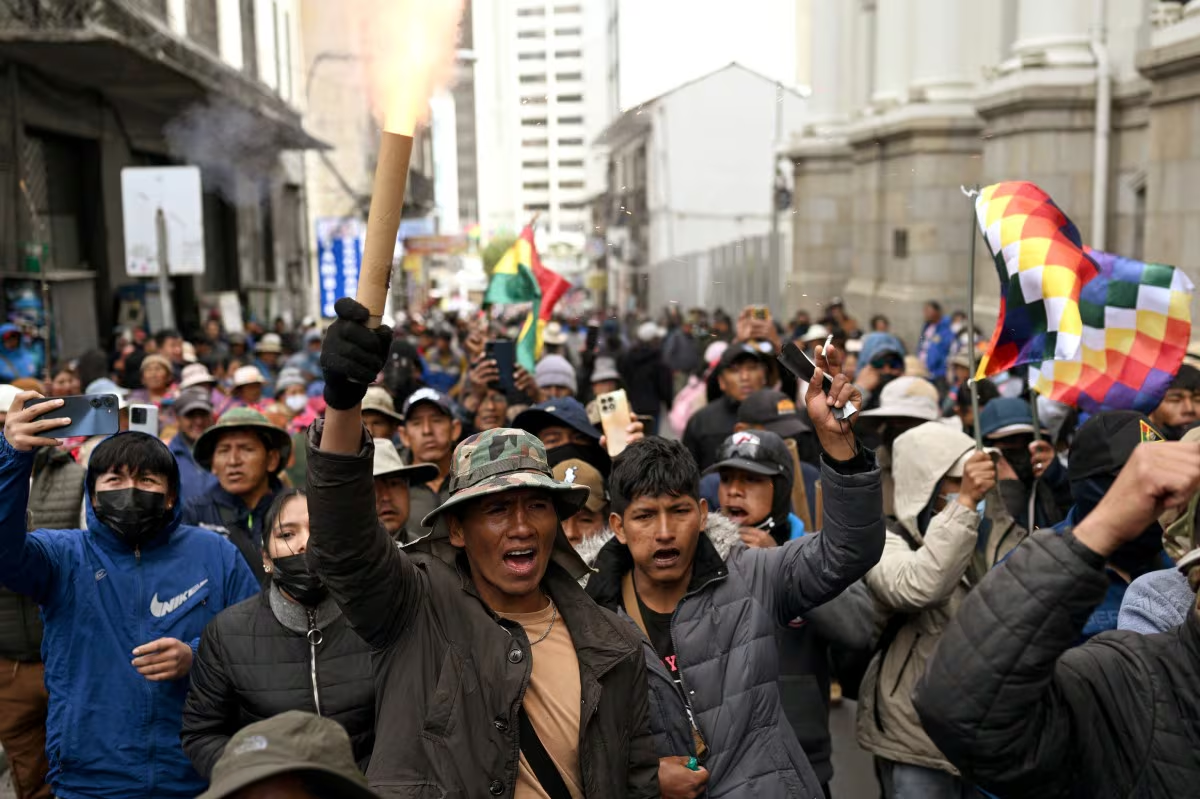
The mobilization succeeded in putting the government of Rodrigo Paz on the ropes. For several weeks, large regions of the country came under the effective control of the social organizations maintaining the blockades, particularly the Tupac Katari Peasants’ Federation (La Paz Department), sectors of the CSUTCB (Single Trade Union Confederation of Bolivian Peasant Workers), and other indigenous and peasant organizations in the Altiplano, such as the Bartolina Sisa Women’s Confederation and the Ponchos Rojos. In effect, a dual power structure has existed in Bolivia for over a month. It was these organizations that decided which goods, food, fuel, or vehicles could travel along the country’s main routes and which would be held up at the roadblocks. This situation led to growing supply difficulties, fuel and food shortages, as well as a sharp rise in prices, especially in the cities of La Paz and El Alto, where the economic and political impact of the roadblocks was most intense. While the government retained formal control of state institutions, the mobilized organizations demonstrated a significant ability to influence the movement of goods and the functioning of the economy. The slogan “Out with Paz!” became the unifying force of a movement that brought together miners, peasants, indigenous peoples, teachers, factory workers, neighborhood associations, and broad sectors of the populace. However, despite the enormous willingness to fight demonstrated by the masses, the movement failed to achieve its main political objective: the fall of the government. Understanding the reasons for this situation is essential for preparing for the battles ahead.
Bolivia

Vídeos

See more

Theory

See more
Is public ownership of AI enough?

Is public ownership of AI enough?

The national battle over “AI” is sparking a discussion on public ownership, a discussion that reveals the weakness of Democratic reformers and Republican leaders alike regarding the real needs of U.S. working people in the fight against the tech oiligarchs. On June 3, an hour-long meeting was held between Vermont Senator Bernie Sanders and OpenAI CEO Sam Altman to discuss the “idea” of transferring a portion of the company to public ownership. The only solution to society’s problems is 100% public ownership under the democratic control of working people. The capitalist class has no interest in “sharing” power with the people whom they intend to exploit or over the destiny of a planet they intend to exploit.
Economy
Our Promise to Akın Will Be Revolution!

Our Promise to Akın Will Be Revolution!

May 20th marks the 30th anniversary of the death of Akın Reçber; the Fourth Red Rose (Turkish: Dördüncü Kızıl Gülü) of May Day 1996, who died on May 20, 1996 as a result of the brutal torture he endured in police custody. Despite the brutal torture, Akın Reçber resisted to the end, and for thirty years his courage and determination have continued to live on in our struggle.
Featured

Partners