JBS meatpacking strike: A strong showing for future struggles
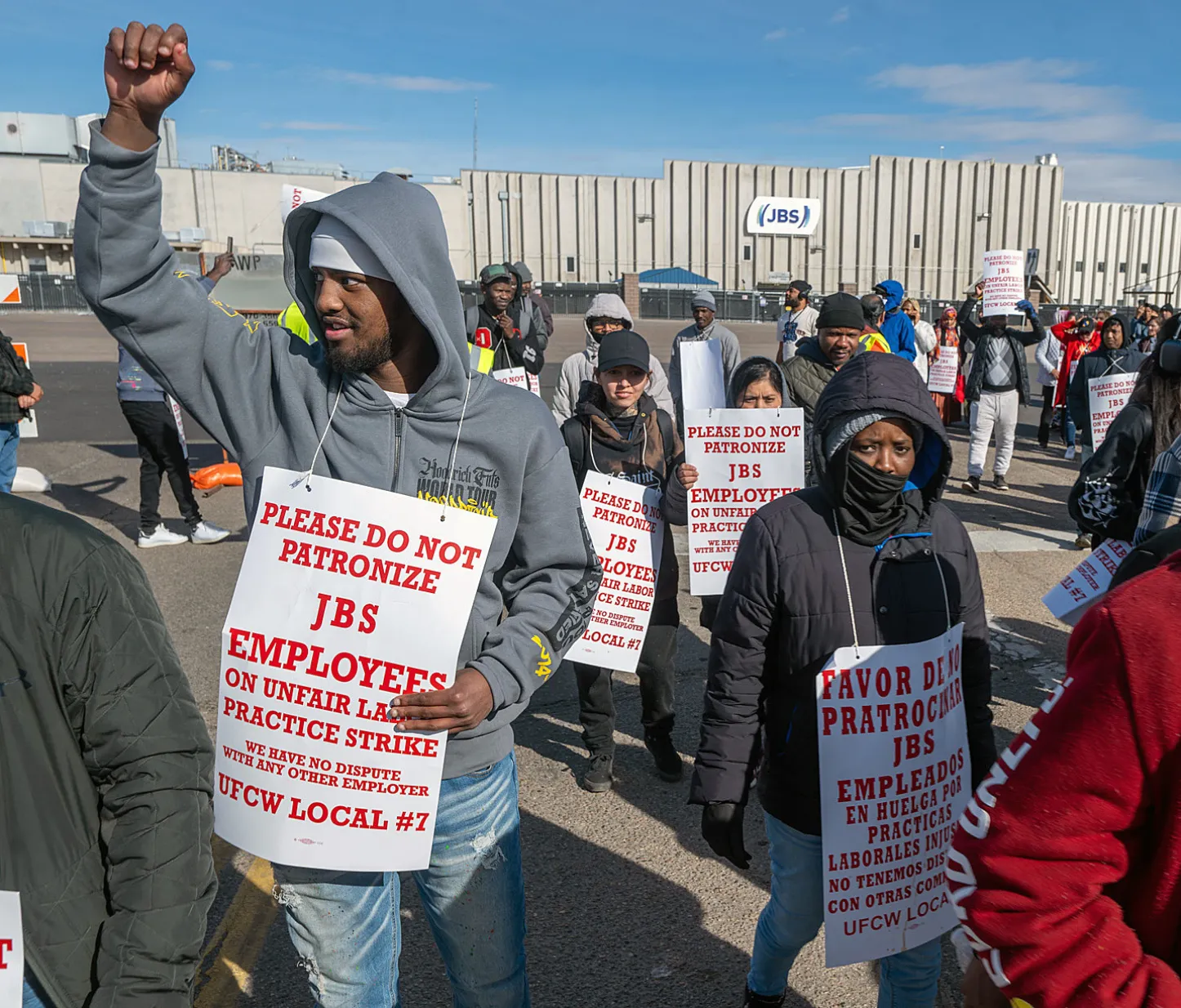
A three week strike in Greeley, Col. of some 3800 union meatpacking workers at the Swift Beef Co. plant owned by JBS USA was the first major strike in the industry since the 1985 year-long shutdown of Hormel in Austin, Minn. Despite threats and intimidation by the bosses of the Brazilian-based company, JBS workers voted by 99 percent on Feb. 4 to authorize a strike over unfair labor practices.
Kim Cordova, president of United Food and Commercial Workers Union Local 7, said, “This strike authorization is the direct result of JBS’s unlawful and bad-faith conduct. Over the course of bargaining for a new contract, the union has filed multiple Unfair Labor Practice charges against JBS. These range from regressive bargaining, to threats to withhold a proposed bonus and lump sum pension payment if workers exercise their democratic right to strike, to illegal intimidation and retaliation against workers and bargaining committee members.”
Between Monday, March 16, and Saturday, April 4, a predominately immigrant workforce shut down one of the largest beef processing plants in the country. Beyond the “bread and butter” issues of wages, healthcare and safety this strike had much larger political implications about the ability of immigrant workers to organize and fight back against employer and government attacks in the workplace and community. The strike certainly raised questions about the difficulties workers face in winning contracts that deliver big economic packages and make meaningful long term gains. But what the strike lacked in financial impact it made up for as an example of fearless union members coming together from dozens of different ethnic backgrounds to stand up and fight.
This article tries to look at what role a mobilized industrial immigrant workforce in meatpacking can play in building a broader fightback against the agenda of the bosses and Trump. We also want to look at some of the difficult questions on strategy and tactics that the entire labor movement faces and what lessons we can draw from the past to help us realize the full potential the power of organized today and in the future?
International solidarity, the bosses, and Trump
A major highlight of this strike is how an industrial union workforce, made up of dozens of different ethnicities, with varying degrees of immigration status, under a repressive Trump government stood up to the Batista brothers, who run JBS. The brothers are one of Trump’s major corporate donors and allies and in today’s political climate certainly represent an added danger to immigrant workers. JBS will revoke immigrant workers’ visas just like it did in Ottumwa, Iowa, in 2025, when 200 workers from Haiti, Cuba, Venezuela, and Nicaragua were asked to self-deport after Trump ended Temporary Legal Status (TPS) for over 500,000 refugees from those countries.
However, one antidote to Trump and ICE’s terror of immigrant communities is collectively walking off the job and hitting the picket line to stand up to the bosses and politicians. Immigrant workers in unions fighting for economic gains and protections on the job can give the immigrant community a powerful vehicle for waging a more potent political struggle against attacks on civil liberties. Any gains made in this strike also deal a blow to the narrative that the situation for immigrant workers is hopeless. Prior to the strike UFCW Local 7 partnered with the Colorado Immigrant Rights Coalition and other immigrant rights groups to address abuses of workers at JBS, following an influx of new members from Haiti and French-speaking African countries.
Strike solidarity!
Many of the videos put out by United Food and Commercial Workers Union Local 7R (UFCW Local 7) on social media were inspiring. Labor movement and left-wing circles buzzed with excitement about the first meatpacking strike since the P-9 workers shut down the Hormel meatpacking plant in Austin, Minn., in 1985 for a year. Solidarity poured in from UFCW members across the country, including United Latinos of UFCW. There were also statements from major politicians like Bernie Sanders, video greetings from the Teamsters Local 1150 Pride Caucus. Immigrant rights groups like Stamford Norwalk United With Immigrants (SNUI) posted video messages of support on social media, and the Brazilian union federation CSP Conlutas, who also organizes workers at JBS, made a solidarity video.
A statement from CSP Conlutas says, “The struggle of workers in the United States reflects a similar reality experienced by JBS workers in Brazil, where the company is also the target of complaints for imposing exhausting production rhythms, practices of moral harassment, underreporting of accidents and occupational diseases, in addition to maintaining low wages in meatpacking plants. This scenario reveals a global pattern of operation based on the pursuit of profits at the expense of super-exploitation and precarious working conditions. Therefore, the strike by American workers is part of a broader struggle by the working class against capitalist exploitation and greed. CSP-Conlutas reaffirms its full support for the JBS workers’ strike in Greeley and calls for international solidarity to denounce the company’s arbitrary and illegal stance and strengthen the workers’ struggle.”
After the dust settles, contract details are revealed
In a press release, UFCW Local 7 framed the two-year contract in this way: “This tentative agreement is a testament to the incredible resolve of our members at the JBS Greeley plant,” said Kim Cordova, President of UFCW Local 7. “These workers stood together on the picket line for three weeks, through extreme weather, because they knew their worth and refused to be disrespected. Today, that sacrifice has been rewarded. This is what union power looks like.”
The statement continued, “The new agreement secures JBS-leading wage increases, defends workers against increases in healthcare costs, and protects workers from having to pay for personal protective equipment that should be paid for by the company. By standing together, workers secured wage increases over the next 2 years some 33% higher in this tentative agreement than JBS had offered Greeley workers in its pre-strike final offer.”
The strike in Greeley, Col., also needs to be understood in the national context. The union in Greeley opted out of the national contract negotiated by the UFCW with JBS in 2025 that covered roughly 26,000 workers and established a national pension plan. UFCW Local 7 opting out allowed the union to fight for the company to subsidize better protective equipment in what is an extremely unsafe environment. However, the national agreement weakened the union’s struggle by allowing JBS to shift the slaughter of 6000 cattle daily to other plants, like the one in Cactus, Texas, that was noted in a March 16 article in The Wall Street Journal. This forced union members to essentially scab on the strike in Greeley.
We are learning some of the details of the contract after the members of UFCW Local 7 returned to work on April 4, prior to reading the agreement or voting. A week later, with very little time to process the terms of the tentative agreement and discuss it collectively, the workers voted. Despite 93 percent of the members voting in favor of the agreement, it seems like more could have been won from JBS, which has a robust market valuation of around $19 billion.
The final value of the agreement as noted by JBS is better but similar to their “last, final, and best offer.” The corporate media made it look as though the union traded away a pension in return for meager immediate wage gains. A statement from JBS says, “JBS USA strongly disagrees with Local 7 leadership’s decision to forgo the historic pension that was secured for workers at other major JBS facilities across the country. The pension was designed in partnership with UFCW International to strengthen long-term retirement security for the workforce. Instead, Local 7 chose to shift those dollars into short-term wage increases—an approach that appears to prioritize the Local 7 leadership’s immediate agenda over the long-term financial future of team members.”
Corporate media doesn’t miss an opportunity to promote a narrative that makes unions appear weak. Why did the union agree to a contract that wiped out the pension in exchange for what amounts to 10 cents more an hour and reimbursement for personal protective equipment (PPE)? The reality is that when UFCW Local 7 opted out of the national contract, it also rejected the pension. There never was a pension at the Greeley plant. Instead, the union chose to continue with the legacy 401K plan and put the money that would have gone to a pension toward PPE, wage increases, and a modest ratification bonus. It is also a reality that many workers have bought into the notion that 401Ks are better than pensions. Often younger workers don’t see the value in fighting for a pension and would rather the money go toward higher wages. Instead, through apps like Robinhood, they see a way to use the stock market to get a leg up. The real question for these workers is: Why can’t the working class have all of it—higher wages, a pension, a supplementary 401K, and safe working conditions? What type of struggle would it take to win all of the demands? We’ll try to answer this later on.
In terms of safe conditions, the fact that PPE is not already a given in an industry where speed-ups can cause severe injuries, including loss of fingers, is mind boggling. The PPE guarantees are perhaps one of the most significant wins in the deal and another example of what was at stake for workers in this strike. The memories of workers being maimed and killed on the shop floor is a recent reality.
On March 27, 2025, a union member was killed at the Swift facility in Greeley while dealing with dangerous chemicals. This was preceded by several other incidents that OSHA cited in an investigation of the company’s safety practices. The OSHA report states, “The fatality occurred after several other incidents at the same facility, including a JBS worker who suffered an arm amputation after being pulled into a conveyor belt; another worker who suffered laceration injuries while removing a hide; and a third worker who was exposed to a thermal burn hazard. As a result, OSHA cited the company for 11 serious violations, including failing to ensure proper machine guarding and not implementing safe process procedures.”
OSHA Area Director Amanda Kupper stated, “Injuries are all too common for workers in the meat processing industry, but most are preventable when required safety and health regulations are followed.”
It should come as no surprise then that JBS is one of the most corrupt companies in the industry. There have been many bribery scandals in recent years under the leadership of the Batista brothers. In a May 14, 2025, Forbes article, Chloe Sorvino writes that there are “more than three dozen incidents of bribery in Brazil, according to their 2017 cooperation agreements with the Brazilian government. The DOJ and SEC found evidence of some $150 million in kickbacks.”
JBS’s troubles with the SEC seemed to clear up following Trump’s reelection and a $5 million donation to his election campaign. In the United States, JBS has also been found guilty of child labor and price fixing. Kate Gibson writes in a November 11, 2022, article from CBS, “Children are working dangerous jobs at JBS meat processing plants in Minnesota and Nebraska, hired illegally for overnight shifts and tasks that left a 13-year-old with caustic chemical burns.”
The reality is that the meatpacking industry has always been dangerous and corrupt. The company doesn’t care if you are maimed or killed or arrested by ICE. They only want to squeeze every bit of profit from the workers. Contract negotiations are about power dynamics. This strike shows a working class that is growing increasingly ready for a real fight with the bosses that will win real gains. This is made evident by the number of workers around the U.S. who say they’d join a union if they could. A union strategy that negotiates a national contract without striking to win industry-setting standards for wages, health, and safety is not a winning strategy.
The workers in Colorado did the right thing by rejecting the national contract and fighting for more, but there is room for improvement. It was also smart to negotiate a two-year contract that expires near May 1, 2028. This could potentially line up the union to launch another strike at a time when UAW auto workers at the Big Three will potentially be on strike and other unions—following UAW President Shawn Fain’s strategy—set their contracts to expire and all strike together. UFCW will be able to re-enter negotiations from a stronger place whereas the national UFCW/JBS agreement would have locked them in until 2029. Ultimately, it would have been better for UFCW to strike the more than 14 plants now covered under the agreement reached in May 2025.
The strike in Greeley shows the potential of a mobilized working class. Strategies that don’t put into motion the full force of the workers in their shops, fail to build solidarity across industries, and rely on legislation as a crutch typically fall short of winning meaningful changes.
Organizing unions in the meatpacking industry has always been difficult and often takes years. In North Carolina it took workers at Smithfield meat processing 17 years to secure the union. In 1904 a militant strike of 50,000 meatcutters ended in defeat, just like the 1985 year-long P-9 strike mentioned earlier. With the odds stacked against meatpacking workers, what will it take to win lasting gains from the bosses?
1933: Workers take on Hormel and win
In Workers’ Voice, we often point to the Trotskyist-led 1934 Teamster strike in the Minneapolis coal yards as an example for workers to follow. At the same time, the Dunne brothers and Carl Skoglund were organizing in the Twin Cities, about an hour and 45 minutes up the road, workers led by former IWW militant Frank Ellis were organizing meatpackers at a Hormel plant in Austin, Minn. The two organizing efforts would join forces to win wage, safety, and benefit standards previously unheard of in these industries. The victories in this era gave a large immigrant workforce from predominantly Scandinavian countries a leg up in their fight against the bosses.
What was special about the struggle against Hormel in 1933?Workers in this period faced low wages, unsafe conditions, and abuses from the bosses. In order to change Hormel’s practices, Frank Ellis organized workers to take bold action. When the workers realized that people were scabbing and allowing the production to continue, hundreds stormed the plant and chased out the managers and either won over or evicted scabbing workers. This is widely seen as the first sit-down strike in the U.S., a tactic that would define the rise of industrial unionism under the Congress of Industrial Organizations and the pre-war and post-war strike waves.
The strike ended after a three-day siege of the plant. The result was the formation of the Independent Union of All Workers, organized on an industrial basis, and included significant economic gains for both the men and women working in the plant. Perhaps most important was the ability of the workers to shut down production for any reason. This precedent of workers’ power on the shop floor helped keep the abuses of the bosses in check. In “Organizing ‘Wall-to-Wall’” by Peter Rachleff, Frank Ellis is quoted as saying: “Most of our strikes were sit-down, sit-down right on the job and not do a damn bit of work until we got it settled. … We had strikes every day. Hell, if a fellow farted crooked we would strike about it.”
Hired in 1928 at the Hormel Plant as a foreman, Ellis was able to keep a low profile and help veteran socialists and trade unionists get hired. Rachleff again quotes Ellis: “I’d send out and get rebels that I knew from other towns to come in and go to work, and I’d work them during the rush season, see. Then, when it came to lay off time, instead of laying them off, I’d go to some other boss and say, ‘Here, I’ve got a good man. And I hate like hell to lay him off. Can you use him? And I’ll take him back as soon as business starts up.’ And I’d place him in the plant and scatter him out. Well, he was an old union man. He knew what to do. I didn’t have to tell him. He knew the idea was to get in there with the gang and to get them emotionally moved so they’d be ready to organize when the time came.”
The victories in meatpacking in the 1930s would undo the decades of abuse suffered under the Hormel family, who were known as “Benevolent Dictators.” The ability of rank-and-file workers to take ownership of the fight and beat the bosses was directly related on their ability to organize using an independent, militant, and democratic union model built from the shop floor. What does this mean for the struggle meatpacking and all union workers today?
Some brief concluding thoughts
The perspective of socialists and class-conscious labor militants going in to organize a shop and develop shop-floor militancy, trade-union democracy, and a politicization of the workforce is an essential part of developing the class struggle. This is what creates lasting and meaningful gains for the class. The fact that today so many socialists—from Workers’ Voice to the DSA—are developing perspectives for the labor movement and trying to put them into practice is important. All of these different efforts will be tested in the course of developing a class-struggle left-wing in organized labor, and the working class will begin to utilize the best examples that are effective and build massive strike picket lines that scabs are unable to cross.
What would be possible if union immigrant workers ready to strike linked up with the millions around the country mobilizing against Trump’s attacks on immigrants and civil liberties? The powerful combination of labor and the mass movement could deliver a blow to the MAGA/America First agenda and at the same time deliver meaningful wage, safety, and retirement benefits in the dangerous meatpacking industry.
A few words of caution. In order to make a lasting impact, such a movement cannot be hustled into the Democratic Party come election time. The Democrats have shown again and again that their party is pro-war, anti-immigrant, and anti-worker. To hustle the masses at election time for a vote for Democrats would lead our efforts to the graveyard of all social movements. We need to keep the movement independent and in the streets, and keep working through common struggle toward building a political party of the working class and for the working class.
First published here by Workers’ Voice
Photo: Jerilee Bennett / The Gazette / AP