
Who is Zé Maria?
Longtime industrial union leader and political activist faces 2 years' sentence for speech in defense of Palestinian liberation
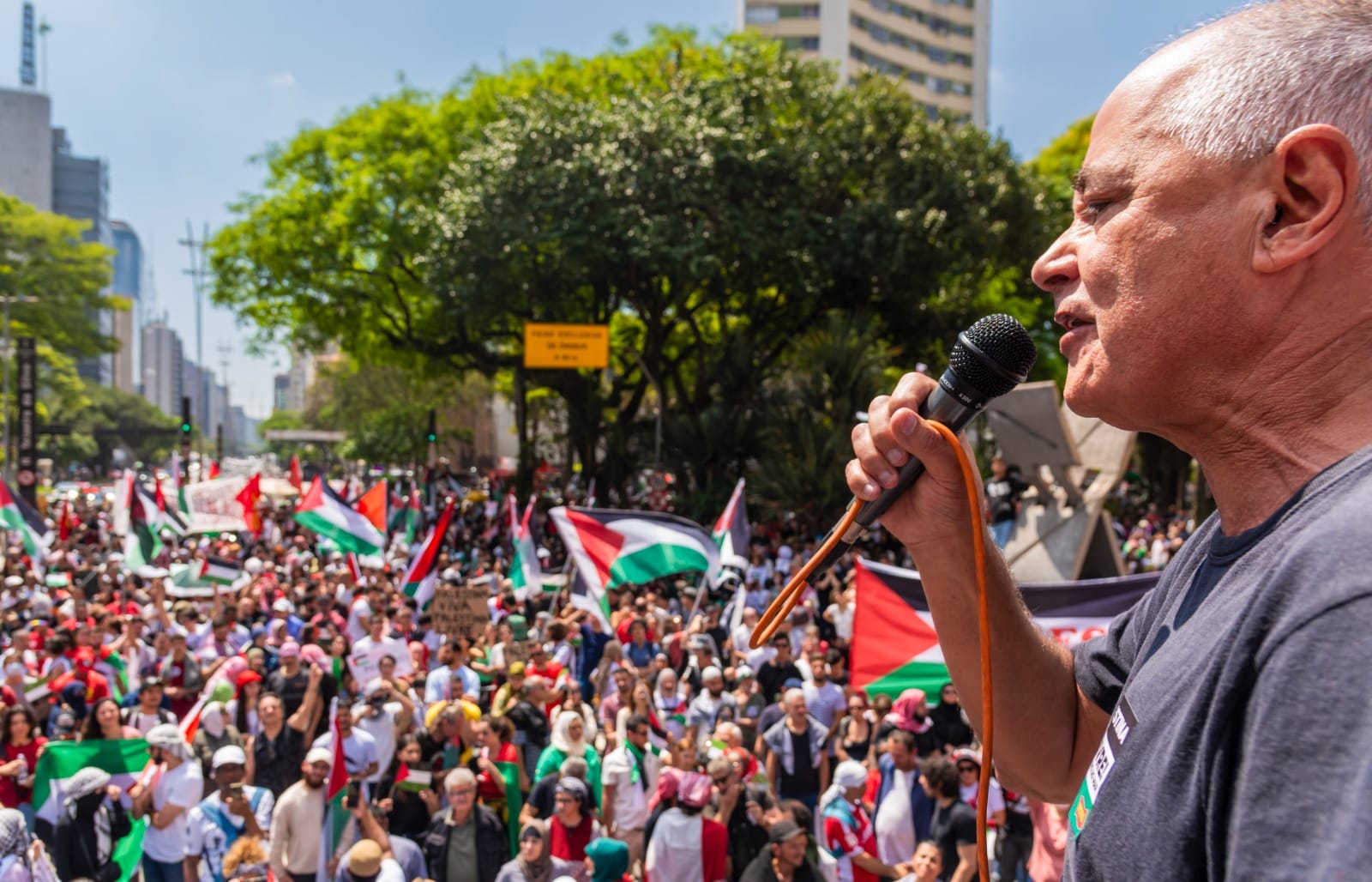
The trajectory of José Maria de Almeida, Zé Maria, is intertwined with the recent history of the Brazilian workers’ movement. Starting as a metalworker, he began his political activism during the military dictatorship. He participated in some of the main mobilizations that marked the pro-democracy movement, the process of trade union reorganization, and the political disputes of recent decades.
Born in 1957 in the interior of São Paulo, Zé Maria entered political activism as an industrial metalworker, already linked to the Trotskyist current Socialist Convergence, which opposed the military regime (1964–1985).
Repression was a constant reality. In 1977, he was arrested while distributing materials calling for May Day mobilizations and remained detained for about 30 days. The episode generated repercussions and mobilized student and pro-democratic sectors.
In 1980, during the historic ABC region metalworkers’ strike, he was again arrested, along with then-union leader Luiz Inácio Lula da Silva – now President Lula – and other leaders. The arrests occurred under the National Security Law and embodied the regime’s repression of strikes that brought together hundreds of thousands of workers.
Workers’ reorganization and Diretas Já
The late 1970s and 1980s were marked by an intense process of reorganization of the Brazilian workers’ movement after years of repression during the dictatorship. Large-scale strikes, massive assemblies, and new forms of collective organization challenged the state-controlled union model.
Inserted in this context, Zé Maria actively participated in mobilizations that combined economic demands (such as wage adjustments and better working conditions) with a growing political dimension of confronting the regime.
The ABC region strikes in the late 1970s and early 1980s paved the way for a new stage of organization for the country’s working class. This process expanded to other regions and categories, contributing to the formation of a new generation of union leaders.
In this scenario, Zé Maria was also present in the Diretas Já (Rights Now!) campaign, one of the largest popular mobilizations in Brazilian history. Millions of people took to the streets demanding the right to direct presidential elections, pressuring the military regime and accelerating the democracy movement.
Together with Socialist Convergence, Zé Maria advocated for connecting the struggle for democratic freedoms with the demands of the working class. For these sectors, political democratization needed to go hand in hand with the expansion of social rights and the strengthening of workers’ independent organizations.
The Lins Congress and the building of the PT and CUT
In the early 1980s, the advancement of workers’ struggles brought to the fore the need for the working class’s own political representation. Zé Maria directly participated in this debate, present at meetings and in articulations aimed at shaping this project.
Among these spaces, the so-called Lins Congress, held in Lins, stood out, bringing together union leaders, activists, and left-wing currents around the country’s political and union reorganization. The meeting was part of a broader process that questioned structures inherited from the dictatorship and advocated for workers’ political independence.
In this context, Zé Maria played an active role in defending the creation of a workers’ party that would directly express the interests of the working class and not be subordinated to bourgeois projects. He presented and defended the proposal to create a workers’ party. Once the proposal was approved, articulations began for the founding of the Workers’ Party (PT) in 1980, a milestone in the political reorganization of the Brazilian left.
In parallel, the construction process of the Central Única dos Trabalhadores (CUT – Unified Workers’ Center) developed, having been founded in 1983. Zé Maria was also involved in this initiative, which sought to reorganize the union movement on an independent basis.
The CUT emerged as an alternative to the state-bound unionism inherited from the authoritarian period, proposing a new form of organization based on autonomy, internal democracy, and direct worker mobilization.
Zé Maria’s participation in these processes evidences his involvement in two of the main institutional milestones of the contemporary Brazilian workers’ movement.
Role in the CUT and union leadership
Throughout the 1980s and 1990s, Zé Maria served on the national board of the Central Única dos Trabalhadores, participating in one of the most intense periods of organization and consolidation of post-dictatorship Brazilian unionism.
The CUT quickly became the country’s main union federation, bringing together strategic economic categories and playing a decisive role in struggles for labor rights, wage restoration, and expansion of social guarantees in a context marked by high inflation and economic instability.
As a part of this process, Zé Maria engaged in central debates about the center’s direction, including strategies to confront federal government economic policies and forms of strike organization, and advocated for grassroots organizing and workers’ democracy.
His work was linked to sectors that defended combative, independent unionism, with an emphasis on working-class autonomy from the state, governments, and business interests. This position placed him within the internal disputes that marked the CUT throughout its history, especially at moments of political inflection for the central.
During this period, he participated in national mobilizations, wage campaigns, and inter-union negotiations, contributing to the consolidation of an organizational model that sought to break with the corporatist unionism inherited from the dictatorship.
Zé Maria’s presence on the CUT’s national board for several years evidences his relevance within the Brazilian union movement, especially among sectors that defended a more combative and autonomous approach.
The Mannesmann strike
In the late 1980s, amid a period of severe economic instability, high inflation, and intensifying labor conflicts in the country, one of the most striking episodes in Zé Maria’s trajectory occurred: the strike by Mannesmann workers in Contagem, in the metropolitan region of Belo Horizonte.
Mannesmann, one of the country’s main metallurgical industries at the time, concentrated a large contingent of workers and played a strategic role in industrial production. The work environment was marked by demands related to wages, working conditions, and labor rights during a period when the economic crisis directly affected the working class.
The strike, which began in 1988, quickly gained political and labor-movement-wide dimensions. Zé Maria was the movement’s main leader, acting in organizing assemblies, articulating among workers, and defining mobilization strategies.
Unlike traditional work stoppages, the movement at Mannesmann took a radical turn. At a certain point, workers occupied the factory and exercised direct control over production, maintaining activities under workers’ management for several days.
The occupation represented a qualitative leap in the form of struggle, breaking with the usual limits of strikes and bringing the debate over workers’ control of production to the forefront. This type of action carried strong symbolic and political weight, directly questioning employer authority within the productive space.
The episode occurred in a national context of hardening labor disputes. In the same period, other mobilizations faced repression, such as the strike at the Companhia Siderúrgica Nacional (CSN, National Metal Company) in Volta Redonda, also in 1988, which ended with military intervention and the deaths of workers.
Taking place in Contagem, the Mannesmann strike stood out not only for its radicality but also for the level of worker organization. Massive assemblies with broad participation guided the movement’s direction, while grassroots commissions and internal structures ensured that the actions could proceed smoothly.
The experience had national repercussions and became a reference point for sectors of the union movement that advocated more combative strategies. At the same time, it intensified internal debate within the workers’ movement about the limits and possibilities of the forms of struggle adopted.
For Zé Maria, participation in this process consolidated his prominence as a combative union leader associated with sectors that defended greater confrontation with employers and political independence for the working class.
The Mannesmann strike remains an emblematic episode of workers’ struggles during the democratic transition period, expressing both the mobilizing potential of the working class and the tensions that marked union reorganization in Brazil.
Rupture with the PT and founding of the PSTU
In the 1990s, political disputes within the PT intensified, reflecting different conceptions about political strategy, alliances, and institutional participation.
The Socialist Convergence current, of which Zé Maria was a member, took a critical stance toward changes in the party’s orientation, especially regarding participation in governments, alliances with bourgeois sectors, and adaptation to the rules of the institutional political system.
One of the points of greatest tension occurred during the political crisis that led to the impeachment of then-President Fernando Collor de Mello. At that time, the slogan “Out with Collor” gained strength on the streets, driven by student, union, and grassroots mobilizations.
Zé Maria, together with Socialist Convergence, was at the forefront of defending the ouster of the government, publicly adopting the slogan “Out with Collor” and actively participating in organizing street protests. Within the PT, however, there were disagreements about the form and pace of this mobilization. Sectors of the party leadership prioritized the institutional path and the progress of formal investigations in the National Congress.
The internal conflicts intensified, highlighting strategic differences regarding the relationship between mass mobilization and institutional action. These divergences, along with other political clashes, culminated in 1992 in the expulsion of Zé Maria and all Socialist Convergence militants from the PT, a process marked by intense internal disputes and repercussions throughout the Brazilian left.
Following this rupture, Zé Maria and all militants of the current began building a new political organization, which resulted in the founding of the PSTU in 1994.
Zé Maria played a prominent role in this process, participating in the political and organizational articulation that gave rise to the new party. Since then, he has become one of its main national leaders.
The PSTU was constituted as a Trotskyist party, focusing its work on organizing the working class, intervening in social movements, and criticizing policies adopted by various governments.
The founding of the PSTU marked the continuation of a political tradition that sought to maintain class independence as the central axis of action, in contrast to paths taken by other institutional left forces in the period.
Rupture with the CUT and construction of CSP-Conlutas
In the early 2000s, the Brazilian political landscape underwent significant changes as Lula and the PT came to power. The election of a leader from the union movement posed new questions about the role of workers’ organizations in relation to the federal government.
In this context, sectors of the Central Única dos Trabalhadores (CUT) began adopting a more government-aligned posture, prompting internal criticism. Zé Maria, as a member of the central’s national executive, stood out in defending the central’s political independence from the Executive branch.
Divergences deepened especially during the debate over pension reform proposed at the beginning of Lula’s first term. For those opposing the reform, the reform represented an attack on historic workers’ rights.
This process led to the rupture with the CUT and the construction of a new union and grassroots movement formation: Conlutas (National Coordination of Struggles). The initiative sought to bring together unions, social movements, youth organizations, and land land rights’ movements around a proposal for independent action.
Over the years, Conlutas consolidated and gave rise to CSP-Conlutas, which began operating as a union and grassroots central with a presence in different regions of the country.
CSP-Conlutas seeks to strengthen union struggles with ties to broader social movements, taking up questions related to land, housing, youth, and struggles against oppression.
In 2026, the central held its 6th Congress in São Paulo, bringing together about 1,500 participants, including delegates and observers, to discuss the national situation, union organization, and mobilization strategies, also marking two decades in its journey.
Zé Maria’s participation in this process reaffirms his role in key moments of reorganization of the Brazilian union movement, both in building and in breaking away from and creating new structures.
Candidacies and the campaign against FTAA
Zé Maria was a candidate for President of the Republic in four elections — 1998, 2002, 2010, and 2014, representing the PSTU each time. His candidacies occurred in a context of strong political polarization and consolidation of major parties in the Brazilian electoral scenario.
Even with a small structure and limited airtime, the PSTU’s campaigns fulfilled the role of presenting a socialist program and giving visibility to the workers’ movement’s priorities, using the electoral process as a space for political intervention. The slogan ‘Against the bourgeoisie, vote 16’ is well known and associated with the party to this day.
Among the central themes of these campaigns were criticism of economic policies adopted by different governments, the defense of labor rights, denunciation of social inequalities, and opposition to measures considered harmful to the working class.
One of the most prominent moments of this period was the party’s role in the campaign against the Free Trade Area of the Americas (FTAA) in the early 2000s. The project, driven by the United States, envisioned creating a free trade zone covering the entire American continent.
The PSTU actively participated in mobilizations against the FTAA, organizing campaigns, debates, and actions together with unions, social movements, and youth sectors. For the party, the agreement would represent a deepening of Latin America’s economic dependence on central powers.
The rejection of the FTAA, which ultimately was not implemented, resulted from a combination of political factors and resistance from different social sectors on the continent, a context in which the PSTU’s work was situated.
Zé Maria’s candidacies helped inject issues related to the world of labor and socialism into the public debate and consolidate his presence as the party’s political spokesperson at the national level.
Political amnesty
The arrests and persecutions suffered by Zé Maria during the military dictatorship were later recognized in the political amnesty process in Brazil, as part of reparations measures. Like him, several militants linked to the former Socialist Convergence also had their status as political persecutees recognized by the Brazilian state, due to the harms they suffered for their role participating in workers’ and democratic struggles.
This process gained public visibility, especially with the so-called Amnesty Caravans, which brought trials and public hearings to various regions of the country, transforming institutional recognition into moments of historical recovery and affirmation of the memory of resistance to the dictatorship.
Parallel to this official process, militants and organizations linked to the political tradition of Socialist Convergence, whose tradition is today continued by the PSTU, also advanced their own initiatives for memory, denunciation, and appreciation of the histories of struggle against the military regime.
Amnesty is not just a legal act of individual reparation, but part of a permanent political struggle. Preserving the memory of the persecutions, arrests, and resistance is fundamental to understanding Brazil’s recent history and strengthening the political consciousness of new generations.
Therefore, the defense of memory, truth, and justice appears as a central element in Zé Maria’s militant work, which is part of a collective experience of militancy that spans the authoritarian period and projects into present political struggles.
Internationalist activism
Zé Maria also carries out internationalist work as part of the International Workers’ League – Fourth International (IWL-FI). This organization comprises socialist movements around the world and participates in political debates and organizing work alongside social and union movements on an international scale.
Throughout his career, he has taken positions on different conflicts and political processes in the world, defending, in line with the PSTU, support for struggles he considers linked to the resistance of workers and oppressed peoples.
In this field, notable positions include support for popular mobilizations in Latin America, such as social struggle processes in Argentina, Chile, and Venezuela; backing for workers’ movements and strikes throughout the world; and solidarity with popular uprisings in North Africa and the Middle East, especially during the cycle of mobilizations known as the Arab Spring.
Also included in this context is opposition to wars and military interventions by major powers, with criticism of actions by the United States and NATO in different regions.
Among these positions, his work in defense of the Palestinian cause stands out. Zé Maria is for the creation of a free, secular, and democratic Palestine as a solution to the conflict in the Middle East. In public statements, he has sided with the resistance of the Palestinian people and defended the dissolution of the State of Israel, a position aligned with the political line of the PSTU and IWL-FI.
It is precisely because of these positions that Zé Maria has been the target of political persecution, recently sentenced to 2 years’ confinement for statements made in defense of the Palestinian cause, on charges of antisemitism.
This accusation is unfounded and distorts his political positions. His work is based on anti-Zionism, understood as criticism of Zionism and the policies of the State of Israel, especially regarding the occupation and colonization of Palestinian territories.
The case has already had an international impact. Organizations, militants, and left-wing entities have been promoting an international campaign for support and solidarity with Zé Maria, denouncing the conviction and defending the right to express political positions in international debate freely.


