
Pakistan-administered Kashmir at a Turning Point
The Jammu Kashmir Joint Awami Action Committee (JAAC), the Ongoing Democratic Movement, and the Challenges of Building National and International Working-Class Solidarity. An Interview with Sajid Kasher of Mehnatkash Tehreek
What is the present situation in Pakistan-administered Kashmir?
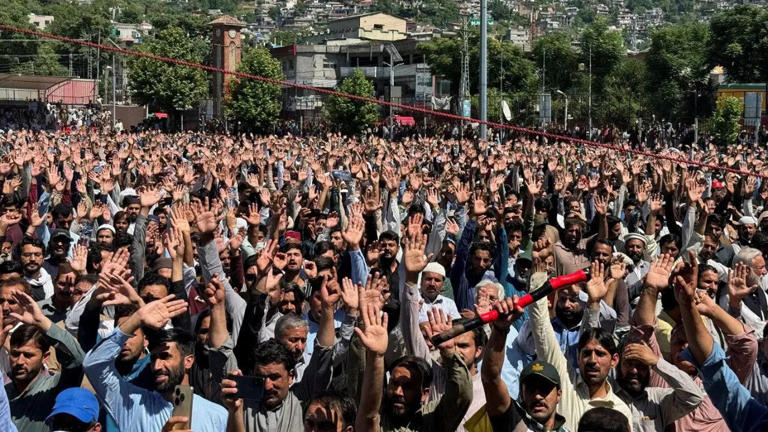
Pakistan-administered Kashmir is experiencing one of the most significant political and social crises in its recent history. What initially emerged as a mass movement against inflation, soaring electricity prices, excessive taxation, and the rising cost of essential commodities has gradually developed into a much broader struggle centred on democratic rights, political representation, and the relationship between the people of Jammu Kashmir and the Pakistani state.
The movement has spread across almost every district of Pakistan-administered Kashmir, including Muzaffarabad, Neelum, Jhelum Valley, Hattian Bala, Bagh, Rawalakot, Haveli, Sudhanoti, Kotli, Mirpur and Bhimber. Large demonstrations, public meetings, strikes, and sit-ins have taken place in towns as well as rural areas. One of the most remarkable features of the movement has been the broad participation of ordinary people. Workers, traders, transport workers, farmers, students, lawyers, professionals, women, young people, and entire families have participated actively, making the movement one of the broadest popular mobilisations witnessed in the region for many years.
Although the scale of demonstrations has fluctuated following the state’s crackdown, political mobilisation has continued. The movement’s demands have expanded beyond economic grievances to include the release of political prisoners, an end to arbitrary arrests and enforced disappearances, accountability for state violence, restoration of democratic freedoms, and the implementation of previous agreements reached between the government and the Jammu Kashmir Joint Awami Action Committee (JAAC).
The arrest of JAAC central leader Shaukat Nawaz Mir during the night of 30 June 2026 from Dirkot, District Bagh, marked another important turning point. Rather than weakening the movement, the arrest appears to have generated renewed mobilisation. According to movement organisers and local participants, spontaneous protests erupted in several towns immediately after the arrest, with demonstrators demanding his release and expressing continued support for JAAC.
Youth activists have continued organising campaigns through wall-writing, public slogans, social media, and cultural activities, including protest songs and rap music expressing support for the movement.
Despite sustained pressure from the authorities, reports from many districts indicate that significant sections of the trader community continue to observe strike calls. According to movement activists, authorities have repeatedly attempted to persuade or pressure traders into reopening their businesses and, in some cases, organising press conferences in support of government policies. However, these efforts have generally failed to produce lasting results, with many businesses closing again shortly afterwards.
One incident frequently cited by participants occurred in Muzaffarabad, where a trader reportedly reopened his shop under official pressure but later jumped into river after security personnel had left the area. Such incidents are presented by movement supporters as evidence of the determination of sections of the population to continue supporting the campaign despite considerable risks.
Workers in parts of the public and private sectors have also continued participating in protest activities despite disciplinary action, suspensions, dismissals, and legal proceedings against some employees. According to movement representatives, the combination of arrests, criminal cases, raids, surveillance, enforced disappearances, and the use of force has not succeeded in ending public participation.
JAAC has announced both national and international days of protest demanding the release of Shaukat Nawaz Mir and other detained activists. Organisers expect participation from the Kashmiri diaspora alongside trade unions, human rights organisations, students, lawyers, and solidarity groups in different countries.
At the same time, traditional parliamentary parties appear to have lost considerable public support in many areas. According to numerous local reports, candidates preparing for the scheduled 27 July 2026 elections have faced public opposition in several constituencies. In some areas, election candidates have reportedly been prevented from campaigning, while public meetings have been disrupted by angry residents. Whether the elections can proceed normally under these political conditions remains uncertain.
These developments suggest that the present movement has become much more than a campaign over economic grievances. It now represents a broader political challenge to the existing structures of governance in Pakistan-administered Kashmir.
What is the character of this movement?
The present movement cannot be understood through a single political framework. It combines three closely connected dimensions that reinforce one another.
First, it is fundamentally rooted in class issues. The movement emerged from the everyday economic problems faced by workers, transport workers, farmers, traders, students, unemployed youth, public employees, and the lower middle classes. Rising electricity prices, inflation, taxation, unemployment, declining purchasing power, and growing economic insecurity provided the initial basis for mass mobilisation.
Second, the movement has increasingly become a democratic struggle. As the authorities responded through arrests, restrictions on political activity, criminal prosecutions, and the use of force, demands expanded to include freedom of assembly, freedom of expression, the release of political prisoners, an end to enforced disappearances, and accountability for human rights violations.
Third, the movement increasingly reflects the national question. Many participants argue that the people of Jammu Kashmir should exercise greater control over their own political, economic, and social affairs rather than remaining subject to excessive intervention from Islamabad. Although participants hold differing political views regarding the future constitutional status of the region, there is broad agreement that the people themselves should play the decisive role in determining matters affecting their daily lives.
These three dimensions—economic, democratic, and national—should not be viewed separately. Rather, they have become increasingly interconnected throughout the development of the movement.
What is the Jammu Kashmir Joint Awami Action Committee (JAAC)?
The Jammu Kashmir Joint Awami Action Committee (JAAC) is not a conventional political party. Instead, it functions as a broad united-front platform bringing together diverse sections of society around a common programme of democratic and economic demands.
Its membership includes traders, transport workers, lawyers, students, teachers, youth organisations, civil society activists, professionals, community representatives, and individuals from different political traditions. This broad composition has enabled JAAC to become the principal coordinating body for the movement.
Rather than representing a single ideology, JAAC provides an organisational framework through which different social groups coordinate demonstrations, strikes, negotiations, public campaigns, and collective political decisions.
The movement is organised through local committees operating at village, town, tehsil, and district levels, while a central leadership coordinates region-wide activities. This relatively decentralised structure has allowed JAAC to maintain organisational continuity despite arrests and political pressure.
One of JAAC’s greatest strengths has been its ability to unite social forces that traditionally operated separately. By focusing on common democratic and economic demands, it has succeeded in building one of the broadest popular coalitions in the political history of Pakistan-administered Kashmir.
What role do the comrades of Mehnatkash Tehreek play within the movement?
Our comrades along with other progressive forces participate as one political current within the broader movement rather than exercising exclusive leadership over it.
In several districts particularly District Bagh our comrades have played an important role in organising demonstrations, coordinating solidarity campaigns, and strengthening links with workers’ organisations and international solidarity networks. Some our comrades have faced severe repression, including inclusion in the Fourth Schedule, restrictions on movement, the freezing of identity documents and bank accounts, and prosecution under anti-terrorism legislation.
Their political contribution has generally focused on strengthening the movement’s democratic character, encouraging working-class unity, opposing sectarian and communal divisions, and promoting solidarity between the struggle in Jammu Kashmir and broader workers’ movements in Pakistan and internationally.
Rather than attempting to substitute themselves for the wider movement, progressive comrades have generally sought to deepen its democratic, class-based, and internationalist orientation.
What happened after the June crackdown?
The events of June marked a decisive turning point in the movement. Security forces used extensive force against demonstrators, resulting in deaths, injuries, and numerous arrests. Following these events, the authorities intensified their campaign through criminal prosecutions, increased security deployments, surveillance, restrictions on political activities, and raids targeting movement organisers.
Although the level of direct street confrontation has declined compared with the peak of the June mobilisation, repression has not ended. Instead, its form has changed. Large-scale confrontations have increasingly been replaced by targeted arrests, legal proceedings, intelligence surveillance, blocking business,citizen ships documents and bank accounts, terminating from jobs, and sustained political pressure on organisers and participants.
According to local reports, security forces continue to maintain a visible presence around major protest sites, including the long-running sit-in at Rawalakot. Participants allege that security personnel periodically conduct patrols and, on some occasions, fire into the air before withdrawing. Whether intended as intimidation or crowd-control measures, these actions contribute to an atmosphere of continuing tension.
It would therefore be inaccurate to conclude that the state has withdrawn after the June events. Rather, the authorities appear to have shifted from direct confrontation towards a strategy combining selective repression, legal measures, and political pressure while maintaining the capacity to intervene more forcefully should the movement escalate again.
Are protests still taking place?
Yes. the movement is characterised on same level of continuous mass demonstrations witnessed during the peak of the uprising, it remains politically active throughout Pakistan-administered Kashmir. The authorities have been unable to restore political normality despite months of arrests, prosecutions, and security operations.
Protests, public meetings, symbolic demonstrations, strikes, and local campaigns continue across different districts. This time the most visible centre of resistance remains the Rawalakot sit-in, which has become both a political and symbolic gathering place for the movement. Every day, people from surrounding villages, towns and from districts travel to the sit-in with their families. Participants deliver speeches, sing revolutionary and cultural songs, raise political slogans, and discuss the future direction of the movement. The continued participation of entire families demonstrates that the movement has become deeply rooted within society rather than remaining limited to organised activists.
Since the events of 15 June 2026, women have played an increasingly prominent role throughout Pakistan-administered Kashmir. Women have participated not only in demonstrations but also in organising local protests, addressing public meetings, and defending the movement within their communities. According to movement organisers, in several districts women have also faced police action, with criminal cases reportedly being registered against ordinary women and housewives who participated in peaceful demonstrations. Rather than discouraging participation, these actions appear to have encouraged even broader public sympathy.
Young people continue to play an equally important role. Youth activists organise wall-writing campaigns, distribute leaflets, produce protest songs and rap music, circulate information through social media from pakistan areas, and participate in neighbourhood mobilisation. Their activities demonstrate that the movement has expanded beyond traditional political methods and increasingly incorporates cultural and creative forms of resistance.
Taken together, these developments suggest that the movement has entered a new phase. While mass confrontations occur frequently as during the initial uprising, political resistance has become more decentralised, socially embedded, and capable of sustaining itself over a longer period.
How has the rest of Pakistan responded?
The response throughout Pakistan has been uneven and reflects the country’s own political contradictions.
On the one hand, the authorities have sought to limit public discussion of the movement through extensive security measures, restrictions on public gatherings, and close monitoring of political activities. According to activists, restrictions under Section 144 have frequently been imposed in many areas, making public demonstrations more difficult. Journalists and media organisations have also faced significant constraints in reporting developments from Pakistan-administered Kashmir, while much of the mainstream media has largely reflected official narratives portraying the movement primarily as a security issue.
On the other hand, support has gradually developed among sections of Pakistan’s progressive political forces.
Trade union activists, left organisations, student groups, lawyers, journalists, human rights defenders, and democratic organisations have issued solidarity statements, organised meetings, and held discussions in cities including Islamabad, Lahore, Karachi, Peshawar, Faisalabad, and Quetta. Although these activities have generally remained smaller than the demonstrations inside Jammu Kashmir, they represent an important beginning in building wider solidarity.
At present, however, Pakistan has not witnessed a coordinated nationwide solidarity movement capable of matching the scale of mobilisation taking place inside Jammu Kashmir. The movement therefore continues to face a degree of political isolation despite growing sympathy among progressive circles.
One significant development has been the creation of the Workers’ Solidarity Caravan, an initiative bringing together trade union activists, progressive organisations, representatives of oppressed nationalities, and socialist groups from different parts of Pakistan.
The Caravan has already organised online coordination meetings aimed at developing practical solidarity with the people of Jammu Kashmir. Discussions have focused on sending delegations to the sit-ins, strengthening political education, building solidarity among workers, and countering misinformation surrounding the movement. Organisers have also begun visiting different regions of Pakistan to encourage broader participation among workers, students, oppressed nationalities, and democratic organisations.
Although still at an early stage, these efforts are helping to widen discussion of the movement beyond Kashmir itself and may provide the basis for stronger cooperation in the future.
Some parliamentary opposition leaders and independent journalists have also expressed support for democratic rights in Pakistan-administered Kashmir. According to movement participants, attempts by opposition politicians to visit Kashmir were reportedly prevented by the authorities, forcing them instead to address press conferences elsewhere. While these interventions remain limited, they indicate that debate surrounding the movement is gradually expanding beyond activist circles.
How have Pakistan’s provinces responded politically?
Political responses vary considerably from province to province and reflect each region’s own historical experiences, political traditions, and social struggles.
Punjab
Punjab remains Pakistan’s largest province and the political centre of the state. Among ordinary workers, students, lawyers, and progressive intellectuals there is growing sympathy for the movement, particularly where reliable information is available.
However, public understanding remains limited. Mainstream media coverage has generally been restricted or framed through official security narratives. As a result, many people remain unfamiliar with the movement’s democratic and economic demands.
Support therefore exists primarily among politically active circles rather than becoming a broader mass phenomenon.
Sindh
Among progressive organisations in Sindh there has generally been stronger political sympathy.
Sindh possesses a long history of democratic struggles, labour organisation, and campaigns concerning provincial autonomy and constitutional rights. Consequently, many Sindhi activists recognise similarities between their own experiences and the demands emerging from Jammu Kashmir.
Several left organisations, trade unionists, student groups, and democratic activists have publicly expressed solidarity with JAAC and condemned political repression.
Balochistan
Support among progressive Baloch organisations has been particularly significant.
Many Baloch activists identify parallels regarding enforced disappearances, centralisation of state power, militarisation, and restrictions upon democratic freedoms. While recognising that the political histories and objectives of the two movements differ, many organisations nevertheless view solidarity as an important democratic principle.
This solidarity has generally developed through political statements, discussions, and cooperation between progressive organisations rather than through large public demonstrations.
Khyber Pakhtunkhwa
Support in Khyber Pakhtunkhwa has primarily emerged from trade union activists, student organisations, lawyers, progressive political groups, and sections of movements advocating democratic rights.
Because many communities in the province have experienced similar debates concerning civil liberties, security policies, and constitutional rights, there exists considerable understanding of the democratic issues raised by the movement in Jammu Kashmir.
Nevertheless, as elsewhere in Pakistan, solidarity has remained concentrated among organised political activists rather than becoming a sustained mass mobilisation.
Why has wider solidarity remained limited?
From a materialist perspective, the principal reason lies in the fragmentation of struggles throughout Pakistan.
Workers in Punjab, Sindh, Balochistan, Khyber Pakhtunkhwa, Gilgit-Baltistan, and Jammu Kashmir frequently confront similar problems—rising living costs, unemployment, privatisation, democratic restrictions, and increasing centralisation of state power. Yet these struggles often remain separated geographically and organisationally.
Pakistan’s organised labour movement has become considerably weaker than in previous decades. Trade unions remain fragmented across industries and regions, making nationwide mobilisation difficult. Without a strong national labour movement capable of linking regional struggles together, democratic movements are often left to confront the state individually.
Media restrictions further reinforce this isolation. Much of the mainstream media has either underreported developments or framed the movement through official security perspectives. This has limited public understanding and enabled misinformation to circulate widely. In particular, movement organisers argue that official narratives have attempted to portray JAAC as anti-Pakistan or aligned with foreign interests, thereby diverting attention from its social, economic, and democratic demands.
Political organisations themselves also remain divided. Different provinces continue to prioritise their own immediate struggles, while cooperation between democratic movements remains limited.
Despite these obstacles, there are encouraging developments. The emergence of initiatives such as the Workers’ Solidarity Caravan, increasing cooperation among progressive organisations, and growing engagement from trade union activists indicate that broader solidarity is gradually developing. Although still modest in scale, these efforts may provide the foundation for a more coordinated working-class response in the future.
Ultimately, the fragmentation of democratic struggles weakens not only the movement in Jammu Kashmir but also workers’ and democratic movements throughout Pakistan. Overcoming this fragmentation remains one of the central strategic tasks facing progressive forces today.
What role can international solidarity play?
The movement in Pakistan-administered Kashmir has now reached a stage where international solidarity can make a meaningful political contribution. While expressions of support from trade unions, labour organisations, human rights groups, and solidarity networks have helped draw international attention to the situation, the next stage requires transforming solidarity statements into coordinated practical action.
Throughout history, international working-class solidarity has played an important role in supporting democratic struggles against repression. The movement in Jammu Kashmir should not be viewed as an isolated regional conflict but as part of the broader struggle for economic justice, democratic rights, workers’ rights, and human dignity.
Trade unions and democratic organisations can make a significant contribution by adopting practical solidarity initiatives. These include writing protest letters to Pakistani embassies and consulates in their respective countries, as well as to their own Ministries of Foreign Affairs, calling for an end to political repression, the release of detained activists, respect for democratic freedoms, and the implementation of agreements previously reached with the Jammu Kashmir Joint Awami Action Committee (JAAC).
Trade unions can also organise workplace meetings, educational seminars, public discussions, leaflet campaigns, and solidarity demonstrations to explain the democratic and socio-economic character of the movement to workers and local communities. Such activities not only increase international awareness but also strengthen links between workers facing similar challenges in different countries.
One of the most important tasks is to involve the Kashmiri diaspora, particularly in Europe and North America. Large numbers of Kashmiris are active in trade unions, migrant workers’ organisations, student movements, community associations, and democratic campaigns. Their participation can strengthen both the movement inside Jammu Kashmir and international working-class solidarity.
Joint campaigns involving Kashmiri diaspora organisations and local trade unions would provide an effective bridge between the movement inside Jammu Kashmir and broader labour struggles internationally. Such cooperation would also help challenge misinformation while giving migrant workers an active role in defending democratic rights in their homeland.
The International Labour Network of Solidarity and Struggle (ILNSS) is especially well placed to facilitate these connections. As an international network linking trade unions, workers’ organisations, and social movements across different countries, ILNSS can serve as an important bridge between the people of Jammu Kashmir and the wider international labour movement.
From discussions with comrades and friends participating in the Network, it is clear that ILNSS has developed into an important platform for coordinating international working-class solidarity. The movement in Jammu Kashmir would greatly benefit from stronger and more systematic cooperation with this Network.
We therefore encourage ILNSS and its affiliated organisations to continue expanding practical solidarity initiatives by:
- Encouraging affiliated organisations to write protest letters to Pakistani embassies and foreign ministries;
- Organising workplace meetings, conferences, public discussions, and educational events;
- Coordinating international days of solidarity and public demonstrations;
- Involving Kashmiri diaspora organisations alongside local trade unions;
- Strengthening cooperation between labour organisations and movements representing oppressed nationalities; and
- Developing direct organisational links with JAAC and democratic organisations in Jammu Kashmir.
The International Solidarity Campaign (ISC) and many progressive activists in Jammu Kashmir stand ready to participate actively in future campaigns, conferences, educational meetings, and solidarity initiatives organised through ILNSS and its affiliated organisations.
What are the principal strengths and weaknesses of the movement?
The greatest strength of the movement lies in its exceptionally broad social base.
Unlike many protest movements dominated by a single political party or social class, JAAC has succeeded in bringing together workers, traders, transport workers, farmers, lawyers, students, teachers, professionals, women, youth, and ordinary citizens around a common programme of economic justice and democratic rights.
Another important strength has been its capacity for mass self-organisation. Local committees have demonstrated considerable initiative in organising demonstrations, strikes, public meetings, and solidarity campaigns across different districts. Despite sustained political pressure, the movement has continued to regenerate itself through decentralised local leadership and widespread public participation.
The movement has also shown a remarkable degree of unity despite ideological differences among participants. Rather than allowing political disagreements to divide the campaign, JAAC has generally focused on common democratic and economic objectives.
However, the movement also faces significant weaknesses.
Its principal weakness remains political, they are unable to deliver a more advance political program which masses demanded and secondly political isolation. Although it enjoys considerable sympathy among progressive organisations in Pakistan and internationally, these expressions of support have not yet developed into sustained organisational cooperation capable of matching the scale of the movement itself.
Another limitation concerns organisational development. JAAC functions as a broad united front rather than a political organisation based on democratic centralism or a unified ideological programme. This flexibility has enabled it to unite diverse social forces, but it can also make long-term strategic coordination more difficult as the movement develops.
The movement also continues to operate under intense political and legal pressure. Arrests, criminal prosecutions, surveillance, restrictions on movement, and economic retaliation against activists create constant organisational difficulties.
Finally, stronger links with workers’ organisations throughout Pakistan remain an important strategic necessity. Without broader working-class solidarity, regional democratic movements remain more vulnerable to political isolation and repression.
What strategic lessons can be drawn from the present movement?
The experience of the movement demonstrates that economic struggles can rapidly develop into broader democratic movements when governments respond to legitimate social demands through repression rather than dialogue.
It also demonstrates that questions of class, democracy, and national rights cannot always be separated. In Pakistan-administered Kashmir these three dimensions have become increasingly interconnected, producing a movement that combines demands for lower living costs, democratic freedoms, accountability, and greater political participation.
At the same time, the movement illustrates both the possibilities and limitations of spontaneous mass mobilisation. While broad popular participation has created impressive political momentum, long-term success will depend upon developing stronger organisational links with workers’ movements, democratic organisations, student movements, women’s organisations, and international solidarity networks.
The movement also highlights the continuing importance of internationalism. In an increasingly interconnected world, democratic struggles cannot rely solely upon local support. Building practical solidarity across borders strengthens not only individual movements but also the international labour movement as a whole.
Conclusion
The movement in Pakistan-administered Kashmir has evolved far beyond its original economic demands. It has become one of the most significant democratic movements in the region, combining demands for social justice, democratic freedoms, political accountability, and greater participation in determining the future of the region.
Despite sustained repression, the movement has demonstrated remarkable resilience. Mass participation continues across different districts, new generations of young activists have entered political life, women have assumed an increasingly visible role, and local communities continue to sustain the campaign despite arrests, prosecutions, dismissals, and other forms of state pressure.
Nevertheless, the future of the movement cannot depend solely upon developments inside Jammu Kashmir. Its long-term success will also depend upon its ability to deepen cooperation with workers’ organisations, democratic movements, human rights organisations, student unions, migrant communities, and international solidarity networks.
Building stronger links between the people of Jammu Kashmir, the wider Pakistani working class, the Kashmiri diaspora, and the international labour movement represents perhaps the most important strategic task in the coming period.
For this reason, international solidarity should move beyond statements of support towards practical and sustained cooperation. The struggle for democratic rights in Jammu Kashmir is not an isolated issue. It forms part of the wider struggle for workers’ rights, social justice, democracy, and human dignity throughout the world.
As the international labour movement has long affirmed:
“An injury to one is an injury to all.”
The future strength of this movement will depend not only on the courage and determination of the people of Jammu Kashmir, but also on the willingness of workers and democratic movements across the world to stand with them in a spirit of genuine international solidarity.


