Unrest in Pakistan-Occupied Kashmir
The Promise That Was Buried
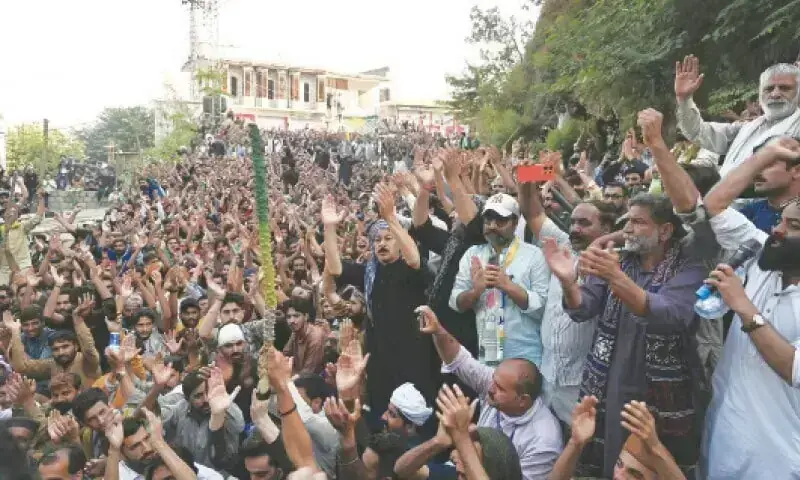
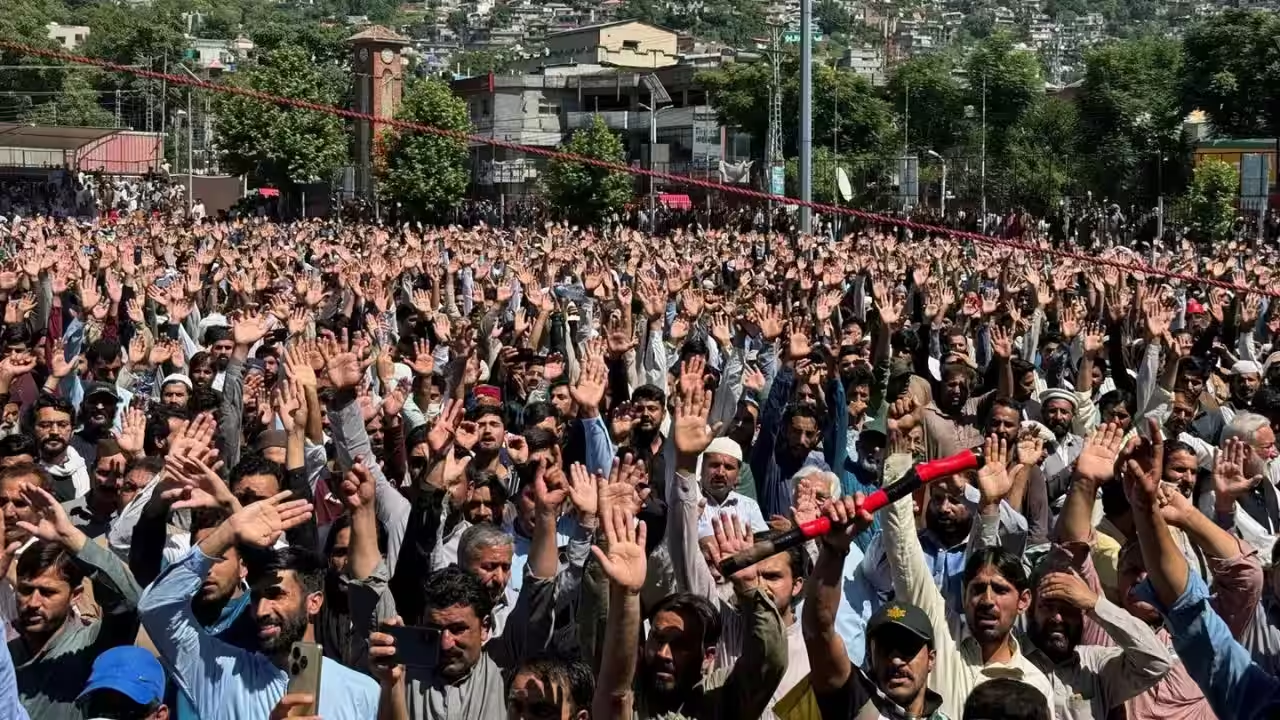
The reason for unrest in Pakistan-administered Kashmir began in October 2025, when after months of protests and mass mobilization, the government of Pakistani-administered Kashmir and Pakistan’s federal authorities signed an agreement with the Jammu Kashmir Joint Awami Action Committee (JAAC). The agreement, witnessed by Federal Ministers from Pakistan, was presented as a historic breakthrough that would address long-standing economic and political grievances. The charter of 38 demands included economic measures, subsidies, and questions of representation and governance. According to JAAC, the government had promised but never fulfilled these demands. Therefore, after 8 months of negligence and counter-measures by the state, the JAAC proclaimed a long march from District Bhimber to Muzaffarabad for the demands to be fulfilled.
Pakistan-administered Kashmir (PAK) has witnessed increasing unrest since the beginning of the month. The people have been protesting against the reservation of 12 seats along with 37 other demands. Police firing on the demonstrators resulted in the killing of 15 persons and the injuring of 200 others. The Joint Awami Action Committee (JAAC), which has been leading the protests, was banned by the government under anti-terrorism laws on June 5, claiming that the group “engaged in terrorism.” The popular demand touches the core issue of how Islamabad has governed the territory it calls “Azad” or “free” Kashmir.
Nearly a quarter of seats in the State legislature are reserved for people resident in Pakistan outside PAK. Pakistan raised a fuss over delimitation in J&K before the elections, claiming that this was intended to change the demographic composition of the state. In Pakistan, the arrangement is a permanent part of the PAK constitution, where people residing in Pakistan can not only vote in elections in PAK but also have a large chunk of seats reserved for them. The State of Pakistan-administered Kashmir, after 8 months of the agreement, brought the issue of seats to the Supreme Court when the next election of the legislative assembly was announced. The Supreme Court has sided with the government and declared that the reserved seats are part of the PAK Constitution, and the system cannot be altered through “administrative measures, political agreements or public pressure.” This closes the door for judicial redress of a popular grievance.
Elections in Pakistan-administered Kashmir invariably bring to power the party ruling in Islamabad. This is no coincidence. The State legislature has a total of 53 seats, out of which 12 are set for “Kashmiri” refugees, and 8 are reserved for women and technocrats. Direct elections are held only for 45 out of 53 seats. The refugee seats are essentially a free gift for the Federal government, since the “Kashmiri” refugees are not located in PAK, or a geographically delimited constituency, but are spread all over Pakistan—even though 90 percent do not know anything about the local legislative assembly elections, even as they intimately know the elections of the National Assembly of Pakistan. This allows for easy manipulation of election results by Islamabad and gives the Federal government control of nearly a quarter of the seats in the PAK legislature. This is used to change the balance within the assembly in favour of the local chapter of the ruling party in Islamabad, or a candidate preferred by the Army General Headquarters.
This arrangement has been used or misused by all the parties in Pakistan – PML (N), PPP, and PTI. Thus, when Nawaz Sharif was prime minister from 2013-17, PAK was ruled by the local chapter of PML (N). After his fall from grace, Imran Khan came to power in Islamabad in the 2018 elections. PAK Assembly elections in 2021 brought to power a PTI government headed by Abdul Qayyum Khan Niazi. Within a week of Imran Khan’s ouster, Niazi was booted out even though his party had a comfortable majority in the state legislature. He was followed in quick succession by Sardar Tanvir Ilyas and Chaudhary Anwar-ul-Haq. A vote of confidence against the latter brought to power Faisal Mumtaz Rathore, the fourth prime minister of PAK in five years. He belongs to PPP, while Islamabad has a Bonapartist government with PPP President and PML(N) Prime Minister, with the real power resting with the Army.
Overall, there are 4,64,000 refugees distributed over 12 seats. This includes 30,000 refugees from the “Kashmir” Valley, who are allotted 6 seats, while the remaining 4,34,000 refugees are from the Jammu Division, who are also allotted 6 seats. This has resulted in an imbalance. The refugees from the “Kashmir Valley” are given disproportionate representation, while their counterparts from Jammu are under-represented. The overall population of PAK is 3.3 million who have enfranchisement. The 30,000 ‘Kashmiris’ in Pakistan are less than 1% of PAK’s population, and 6.4% of the refugee population. This arrangement serves to keep alive the fiction that PAK or Pakistan represents the people of Kashmir and has a stake in the future of the Kashmir Valley on the Indian side of the LOC.
Eclipse of the Regional Parties
There is a complete eclipse of regional parties in PAK, which has been ruled by local chapters of Pakistan’s mainstream parties – PPP, PML (N), or PTI. In the last elections in 2021, out of 53 seats in the state legislature, only 1 seat was won by a representative of a regional party: Sardar Atiq Ahmad of All Jammu and Kashmir Muslim Conference. He is the son of Sardar Qaiyum Khan, who served as PAK’s President in the past—that is why his son received this award from Islamabad.
The absence of regional parties in the power structure of PAK is not a coincidence. Muslim League, which propagated the Two Nation theory, was against the idea of national or ethnic identities, which were described as “parochial tendencies.” The League feared that this would undermine the artificial idea of a homogeneous Muslim identity on which the demand for Pakistan was based. Rejection of “parochial tendencies” is built into PAK’s constitution, as well as Pakistan’s constitution. There is no place for ‘Kashmiriyat’ in PAK as like in Indian Occupied Kashmir.
In the current context in PAK, the protest movement against Islamabad’s dominance of PAK government is being led by local elements. They have no representation in the PAK legislature. Their ranks have swelled as Islamabad’s suppression has increased. The mainstream parties – PPP, PML(N), and PTI have stood aside.
PAK Constitution: Islamabad’s Wishes?
The establishment has conveniently stonewalled the protesters’ demands with the judiciary. The PAK Supreme Court’s judgment makes it clear that the agitation cannot bring about a change unless there is a constitutional amendment. This creates an impossible situation. Under Article 33 of PAK’s constitution, constitutional amendment requires not only a 2/3rd vote of the total membership but prior approval of the Government of Pakistan. Will Islamabad voluntarily give up the extraordinary privilege it enjoys in PAK? PAK Constitution reflected the wishes of Islamabad; Article 33 was devised to perpetuate Islamabad’s powers by giving it a veto over any change in the status quo that would affect its position.
Water and Electricity
The Mangla Dam in PAK, completed in 1967, supplies water and hydro-power to Pakistan. For the first 36 years of its existence, PAK received neither a hydropower royalty nor water usage charges. When the payment began in 2003, the territory was given 15 paisa per unit as water usage charges. PAK is not paid hydropower royalty for electricity produced by Mangla Dam. On the other hand, Pakistan’s provinces receive Rs 1.10 per unit as hydro-power royalty. This is 7 times higher than what is received by the people of PAK. The discrimination is explained in terms of Article 161 of Pakistan’s Constitution, which allows hydro-power royalty only to Pakistan’s provinces. Pakistan maintains that PAK is not its province. This raises many questions. Mangla Dam was constructed 6 years before Pakistan’s third, and present constitution came into existence. Why could Pakistan not include a provision to take care of PAK’s interests when Pakistan’s constitution was being finalized? If it was an oversight, this could have been corrected later. There have been 26 amendments to the Pakistani constitution. This provision was never touched.
The Joint Awami Action Committee (JAAC) had raised water and electricity issues during the protests in previous years, also. Prime Minister Shahbaz Sharif chaired a meeting to review the protesters’ demands. Pakistani officials explained that the people of PAK are charged higher rates since the electricity is “exported” from Pakistan to PAK. Electricity is generated from the Mangla Dam, which is located in PAK. However, since the Water and Power Development Authority (WAPDA) is located in Pakistan, the transaction is shown as “export” and charged higher rates. This perplexed even Shahbaz Sharif.
What is called PAK or “Azad Kashmir” is only 15% of the total area of J&K under Pakistan’s illegal control. The remaining 85% of the territory was part of the Northern Areas since renamed as Gilgit-Baltistan (G-B). The situation in G-B is even worse than in PAK. PAK at least has a constitution in name, though it reflects the wishes of Islamabad. Gilgit-Baltistan is run on the basis of the Gilgit-Baltistan Order of 2018. As the nomenclature indicates, this is an executive order issued by the Pakistan Federal Government. The G-B Order of 2018 and the 13th amendment of the PAK constitution have given Pakistan direct legislative and executive powers within Gilgit-Baltistan and PAK. Despite having elected assemblies, their situation is no different than a Federally Administered Area in Pakistan. Both changes were made a year before the deletion of Article 370 by India. Such major changes on the other side of the LOC brought about by Pakistan in the previous year went unnoticed to the people, even as they noticed how India tightened its grip on Indian-occupied Kashmir (IOK).
The issue of reserved seats will play a major role in the forthcoming elections in PAK in July 2026. Can the people of PAK expect fair play from Islamabad? Unlikely. Pakistan has devised institutions that act as its proxies. This includes the PAK constitution and the judiciary. The mainstream political parties of Pakistan reinforce this charade through their local chapters. Pakistan Army and the Ideology of Pakistan loom above the civilian institutions.
The Massacre of June 2026
The massacre of June 2026 will not be remembered merely as another episode of state repression. It will be remembered as a moment when ordinary people stood against injustice, refused to surrender their dignity, and paid the highest price for demanding their fundamental rights. The blood spilled in PAK is a stain on the conscience of those who ordered and justified violence against peaceful citizens.
History teaches us that no amount of repression can permanently silence a people determined to be free. The attempt to criminalize peaceful dissent, to brand protesters as terrorists, and to crush democratic movements of more than a million through force is not a sign of strength—it is a sign of fear. Governments may imprison activists, ban organizations, and impose blackouts, but they cannot extinguish the collective will of a people fighting for justice.
The struggle of the JAAC is not simply about economic demands or political reforms. It represents a broader struggle for democracy, accountability, and the right of people to determine their own future. Every arrest, every act of intimidation, and every bullet fired against peaceful protesters has only strengthened the resolve of those who refuse to accept oppression as normal.
Justice demands truth. Truth demands accountability. Accountability demands action. The families of those killed on June 7, June 9 in Kotli, and again June 13 in Rawalakot deserve answers. The wounded deserve justice. The detained deserve freedom. And the people of Pakistani-administered Kashmir deserve the democratic rights and representation that have been denied for far too long.
The caravans from Bhimber, Mirpur, Kotli, Sudhnoti, Bagh, Forward Kahota, and Rawalakot did not go home. They are starving. They have surrounded the city of Rawalakot. But they are not surrendering. Muzaffarabad is in lockdown today. But history remembers this blackout in the history of the capital—now the people of Muzaffarabad are sending messages to each other through their area leadership that they should be ready to come out when the two divisions are tired. Now Muzaffarabad is breaking these chains of complete occupation with complete blackout.
The state’s tactics to break the movement
The situation is such that on one side the state is using different tactics to engage the disappointed youth, to propagate more on national media of Pakistan, to free some of their puppets to directly engage with those progressive elements of Pakistan and the Kashmiri community living in Pakistan. The state announced elections and gave very short time for nomination papers, calling government servants along with candidates for nomination—under the guard of security forces—and after nomination, getting them to perform as actors to send video messages which spread across Pakistan the sense that everything is normal. They spread hate on social media and national media—that Kashmiris have become the enemy of Pakistanis, that is why they should not enter Kashmir. They attempt to disappear activists and the central leadership of the JAAC.
The state has announced a reward of Rs. 10 million on each head of four leaders belonging to JAAC. They have announced more than 150 leaders’ names in Schedule 4 of the Anti-Terrorism Act, closed their businesses and, in cases where there was no resistance, closed their houses as well, canceling their ID cards, bank accounts, and passports as well. They have imposed complete blackout of internet and phone service, and are not allowing any food and medication from Pakistan to Kashmir.
This blackmailing is pre-planned to obstruct the growth of agriculture and industry in Kashmir. On the other side, the state sends some white-collar individuals, ex-judges, Supreme Court lawyers, human rights activists, businessmen, and NGOs to offer the leadership of JAAC a compromise and end the sit-in to give face-saving to the state.
The strengths of the movement
The future belongs not to those who rule through fear, but to those who organize through hope. The voices rising from Kashmir, from every village and town, carry a simple message: dignity cannot be banned, and freedom cannot be buried.
During these aforementioned difficulties, as part of a sit-in lasting 13 days, people not only voluntarily closed markets, schools, and services, but are supporting the movement. Those who have a little extra food are getting it to reach the protesters. Women, along with their children are prepared and ready for protests when they are called. Doctors are helping the injured, facing repression by forces but they never stopping. Social media activists in Pakistan have had many police investigations lodged against them but they are rotating their participation and supporting the movement. Youth in villages and towns are connecting with people, telling them their presence is important in the movement and voluntarily encouraging them to help each other in food and other necessities.
Weaknesses of Leadership
The leadership of JAAC has been overconfident in its approach before. Due to the strength of hundreds of thousands, the leadership successfully accepted the demands with little damage, but they never learned from their mistakes. They are not forming mass committees with proper rank and file representation, with democratic centralism, with collective leadership that is elected and recalled. The committee has never given power to sub-committees. Before, the activists were sent as organizing members—they sat and never brought the method to re-elect themselves and new members. They formed very weak sub-committees, even some district leadership made advanced positions like constituent assembly and self-determination, etc. The leadership shouted and issued show-cause notices when there was criticism for people’s assembly and all power to sub-committees. The leadership turned to announce the demands on political and economical problems—it meant the leadership did not want to actually organize a very centralist leadership. This time they came forward and accepted and brought those on front who were bravely addressing the masses for an advanced programme.
Call for Solidarity
Now, as of press time, the JAAC leadership is announcing a one-day mobilization in districts and then starting a long march to Muzaffarabad to make demands from the state. For this, the people of Pakistan-administered Kashmir need the full support of every human rights activist. Because this time the state of Pakistan openly wants to kill the People of PAK for their movement in favor of basic rights. It is the duty of our international allies to come stand in solidarity with Kashmiris—as well as the diaspora of Kashmiris protesting in every country before the embassies—to be part of this movement to strengthen the international solidarities campaign for the international working class and Kashmir.
No to the starvation siege. Yes to the people’s caravan. An injury to one is an injury to all. Solidarity cannot be stopped.
References
- BBC, Urdu Service, 11th June, 2026, https://www.bbc.com/news/articles/cdxdyn5716xo
- BBC, Urdu Service, 11th June, 2026, https://www.bbc.com/news/articles/cdxdyn5716xo
- Express Tribune, 12 refugee seats become talking point in AJK polls, July 27, 2021
- The News, Ambassador of Kashmir has won: PTI celebrates after winning a simple majority in AJK Assembly, July 26, 2021
- Azad Jammu and Kashmir Interim Constitution, substituted by Interim Constitution (Thirteenth Amendment) as cited in Forgotten Kashmir: The Other Side of the Line of Control by Dinkar P. Srivastava