
Biodiversity loss: What it is and how to stop it
In 2026 the majority of people, 4.7 billion, live in cities, and 5.6 billion people (urban and rural) use the internet. A greater proportion of people now have lives that are very dependent on manufacturing and industrial processes that obscure our collective dependence on nature as a whole.
These very same manufacturing and industrial processes, organized for profit, have eaten away at nature. This means the shrinking of wild habitats such as forests and reefs, the extinction of species, and the narrowing of the available stock of life forms on Earth—in short, biodiversity loss. This process also involves the gradual erosion of human knowledge about the natural world, particularly the knowledge held historically by Indigenous peoples and small farmers.
For example, according to the most recent Global Assessment Report of the Intergovernmental Science-Policy Platform on Biodiversity and Ecosystem Services, based on the natural baseline, 47% of natural areas have declined or disappeared, 25% of all species are at risk of extinction, and 82% of wild land mammal biomass has disappeared, among other indicators [1]. Another ominous indicator of biodiversity loss is the decline of pollinators—bugs, birds, and bats that cross-pollinate flowering plants. One in five North American pollinating species, including butterflies and wild bees, are at risk of extinction. Marine life is under threat as well, with over 42,000 species—including, fish, mammals, and corals—near extinction.
Almost all of this is due to direct human activity such as agriculture, mining, or urban/suburban sprawl, and also indirectly due to chemical pollution and greenhouse gases that cause climate change. In fact, because world capitalism is addicted to fossil fuels, we will almost certainly see the global average temperature rise above 2.5°c, leading to multiple cascading climate effects that could make vast swaths of the Earth uninhabitable for many life forms.
It’s important to recognize that, although human economic activity is a direct driver of biodiversity loss, this is because capitalism as an economic system has failed to establish a healthy, regenerative exchange with nature—what is known as metabolic rift. This ultimately undermines human health, economic viability, and global farming capacity. This process must be halted and reversed to ensure human survival and a thriving, sustainable economy.
Biodiversity must be a mandatory part of the education of all people around the world and a central pillar of all economic policy. With that, we could have hope, as an agricultural revolution in our near future could halt and, eventually, reverse the worst outcomes of mass extinction.
Ecosystem diversity and ecosystem services
Our dependence on the natural world has its foundations in the billion-year evolution of complex (multi-cell) life on Earth, and even goes further back in time to the development of primitive microbes.
The popular and vulgar interpretation of evolution as survival and dominance of the “strongest”—a mis-reading of Charles Darwin’s famous dictum that evolution means survival of the fittest (i.e., the best adapted to their specific environment)—is shown by life to be untrue. In reality, millions of species have adapted to use many diverse strategies of survival. Many are confrontational, such as with predators and prey, or parasites, but many other strategies are often reciprocal and mutually reinforcing. The relationship between pollinators and flowering plants is one such example of mutualism. Another example is in every one of us, the probiotic bacteria that make it possible to digest our food. And there is the obvious fact that animal life, including humanity, is dependent on the primary production of biomatter from plant photosynthesis.
Life on Earth is interconnected in many ways, too numerous to list here. Researchers of biodiversity often refer to “ecosystem services,” functions that animals, insects, plants, fungi, and bacteria perform in the course of their survival that benefit the health of humans and of the environment as a whole. For humans, this entails interactive management practices such as pest control, air and water filtering, nutrient cycling, enhancing crop pollination, providing habitat for plants and wildlife, etc.
Nature can accomplish most of these tasks better than any current artificial alternatives. Food, clothes, medicines, dyes, oils, construction materials, and innumerable other products that we use require a minimum of genetic diversity that cannot be replaced by artificial means.
With regenerative agriculture, we can also improve the quality of our food. Further, clean air and drinking water—clean because humans evolved to live off of it—are a byproduct of a minimum of genetic diversity in ecosystems we share with other species. By undermining biodiversity, we inadvertently undermine the foundational basis for healthy human bodies.
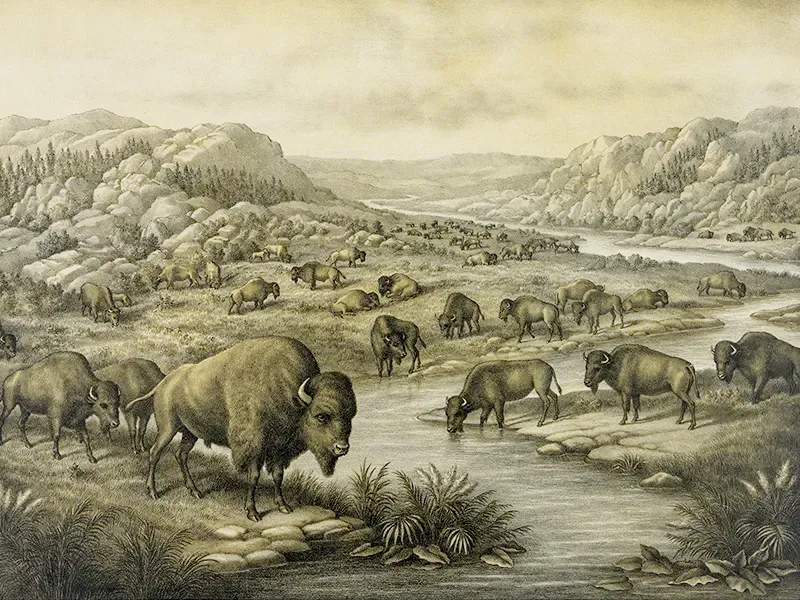
Although there are many examples on all continents, for the purposes of this article we can look at the ecology of the North American prairies and grasslands. Ruminants (large grass eating mammals), such as bison, used to number in the hundreds of millions on this continent. Their constant grazing, trampling the soil and providing their manure, was an essential means of regenerating the nutrition of the soil.
With the near-extinction of the bison and the extension of factory farming and urban sprawl, the North American continent has lost a million-years-old ecosystem that was an example of ecosystem services. This and other aspects of North American lands were generally understood by the original peoples (not over-hunting bison, performing controlled burns in the forests, etc.). It will be vital, during an ecological reconstruction, for human agriculture to mimic nature, as will be explained below.
Mining, urban sprawl, and deforestation
Urban and suburban areas are major sites of biodiversity loss and adaptation. Urban growth also expands car infrastructure and hence asphalt roads, parking, etc. This is the legacy of the auto manufacturers lobbying the U.S. government to eliminate trains and trolleys in favor of asphalt roads. Car infrastructure takes up much more space than humans actually require to live, and takes it away from plant and animal species. One of the challenges to ecological reconstruction is making cities more ecological and undoing much of the waste of urban sprawl. Asphalt also absorbs more heat and less carbon than healthy soil.
Mining is a major source of deforestation. Open-pit mines require hundreds of thousands of acres of land worldwide and are used for anything from gold to lithium. These mines are notoriously dangerous to the environment, to forests, and to miners’ health and safety. In the immediate term, open-pit mines require the destruction of large habitats and deforestation. In the medium to-long term, open pits frequently become standing toxic pits where metals and leftover industrial waste mix with rainwater and are a severe hazard to humans and other animals.
Rival powers, like the United States and China, are thinking about how to obtain so-called “critical minerals,” required for AI, war munitions, electric vehicles, etc. In light of this, we should expect a greater drive toward mining, especially in the neo-colonial countries that these big powers exploit, and note the inherent hostility of “our” governments to biodiversity.
Factory farming, monoculture, and disappearing ecologies
Capitalist methods of farming result in mono-culture, in which a limited number of plant species are cultivated due to their profitability and/or their use-value to the production process or as consumer goods (think corn, cotton, rice, sugar, flax, soybeans, etc). In the United States, the government has incentivized the production of corn through various subsidies. By its very nature, corn production benefits larger farmers (big business) at the expense of small farmers. Corn is a crop that tends, overtime, to deplete the soil of nutrients, nutrients that must be replaced by chemical fertilizers. Under capitalist agriculture, nature cannot use its methods to regenerate the soil, although such methods are available to humans if we re-organize agriculture in a non-capitalist way.
Capitalist methods of farming also demand the use of pesticides that kill not just “pests” but also many important pollinators, like species of bees or flies. This further harms biodiversity.
Deforestation is a huge problem with farming, particularly in Brazil, as capitalist farmers require large tracks of land to mass produce soybeans and provide pasture for cattle. Mono-culture also destroys other environments, such as the U.S. plains and prairies, which for millions of years supported ample nutrient-dense soil. The near extinction of bison (long destroyed by the settlers’ over-hunting), was an excellent example of both nature’s mutualism and ecosystem services.
Often, this farming serves to feed factory-bred animals. Capitalism’s preferred method of breeding cows (or other animals) for their meat or other products uses concentrated animal-feeding operations (CAFOs). CAFOs are cruel to the animals, pollute the land, and have high emissions. Working conditions at these facilities are often terrible and non-unionized, and CAFOs even produce lower quality beef [2]!
These animals (cows, chickens, pigs, etc) also represent a tiny portion of the animal species that evolved on Earth and which have been pushed out by human activity. With holistic management methods, these animals can perform ecosystem services (free-roaming chickens, for example, peck and scratch for seeds and will eat pests, etc.).
In total, capitalist methods of agriculture, which are organized to maximize profits, fundamentally undermine the natural health of the soil, deplete the available stock of life forms on Earth, and release plenty of carbon emissions as well. Later on, we’ll suggest some solutions.
Capitalism Offers No Hope for the Planet
Capitalism as a social system and economy has rapidly increased human productive and destructive powers, allowing the human species to profoundly alter the ecosystem. But capitalism by its very nature cannot control this process intelligently. It will continue to endlessly consume nature unless stopped.
Generally, the hunt for profits—capitalism’s reason for existence—requires the production of an ever larger body of both saleable products and avenues for speculation (stock market, big data, etc). This in turn requires, historically and generally, an ever expanding body of people who both work productively with raw materials and also consume these products of labor. It is in this sense alone that capitalism is “self-sustaining.” This global engine of production for profit, for competitive sale on the market, conflicts with the limits of planet Earth. Put simply, endless growth is unsustainable in the long run.
At the forefront of this unsustainable production is the use of fossil fuels, which are releasing greenhouse gases to warm the environment. Everything from transportaion to agriculture is infected from top to bottom with this addiction. Despite widespread knowledge of the danger, capitalism will not change course, as most developed nations [3] continue to exploit fossil fuels, and the fossil fuels magnates continue to dictate climate policies.
At the same time, existing capital reaches its limits nationally, and must expand. This is the chief and general cause of the economic and military competition between and within nations today. Virtually all modern wars are the product of capitalism. The competition between imperialist powers will only accelerate the anti-ecological tendencies of capitalism as exhibited in each country, in addition to the increased consumption of fossil fuels for war.
A revolution by workers, farmers, and Indigenous peoples will be necessary to deliver us from capitalism. We must expropriate the property of the rich and organize all major industries democratically. Energy, transport, the banks, the land, manufacturing and Big Tech would all have to be publicly owned. Only in this way will the destructive tendencies of capitalism be stopped and a new, planned economy based on fulfilling human needs be established.
What could a workers’ government do?
There are many things that a government of the working people could do to safeguard—and eventually regenerate—biodiversity, thereby dramatically improving human life.
First and foremost, wasteful and polluting production, including the production and use of fossil fuels and plastics, has to be reduced to the absolute minimum. A rapid and radical change to non-polluting sources of energy, such as solar, must take place. If we have a planned economy, we can reorganize labor so as to eliminate jobs that are polluting while guaranteeing employment to all, which will also allow us to dramatically reduce working hours. Reducing working hours without a reduction in pay is a vital part of socialist environmentalism and quality of life.
Another thing a workers’ government could do is reorganize our cities. Part of this involves undoing urban sprawl and car infrastructure, providing a robust mass transit system, including rail as an option, especially to people in rural areas. As will be explained in a moment, a complete transformation of the way we do agriculture must take place, including more local food sources, which can happen simultaneously with a greening of the cities.
Areas destroyed by industrial waste, deforestation, and mining need to be re-wilded. Current wildlife refuges and national parks must be protected and expanded. This means undoing all of the fossil-fuel-friendly legislation and executive orders of both Trump administrations (which have attacked the national parks), restoring to the land its sacredness.
A workers’ government can accomplish this because such a government will uphold and protect socialized ownership of the means of production, including the land. Capitalist governments cannot because they worship the private expropriation of social labor by a small number of people (the millionaires, billionaires, trillionaires).
Regenerative agriculture is key
All of the foregoing, however, is impossible so long as our farms and livestock continue to operate by capitalist methods. It will be necessary to replace CAFOs with methods that make use of ecosystem services. One such way is adaptive multi-paddock grazing. AMP (also called mob-grazing or rotational grazing) allows cows to freely graze within a controlled set of enclosures, periodically moving the cattle to new pastures every few days. This mimics the prairies of the bygone bison. In addition to improving the health of the soil and the cattle, AMP directly sequesters carbon from the atmosphere into the grass and soil.
The harms of capitalist mono-culture—which depends on chemical fertilizers and pesticides—can be addressed by several means, including restorative agriculture that makes use of ecosystem services in a variety of ways, including allowing more animal species to free roam (taking advantage of their ecosystem services) as well as no-till cropping and holistic management practices. Mono-crops themselves can be phased out to promote a variety of crops to complete our diets and grow locally (reducing transport costs and pollution).
This will require an end to the production of unhealthy, but profitable, products such as high-fructose corn syrup, and an increase in the production of unprocessed foods—like eggs, vegetables, grains, nuts and fruits—that are better for human bodies. AMP and similar regenerative practices will improve the quality of pork, poultry, and beef as well.
In the beginning, the workers’ government would promote small farmers growing a variety of crops, and would also protect and expand the land rights of original peoples, including a right to return for displaced peoples. Gradually, as our cities and transportation improves, and as we adapt our technology to holistic agriculture, collective management will replace small farms. Likewise, such a government would end wasteful subsidies to big business conglomerates on the competitive and destructive capitalist model. In fact, these big conglomerates and their land, equipment, and patents would become publicly owned and reorganized to meet the needs of nutrition and sustainability.
The next agricultural revolution
It will be argued that CAFOs and mono-cropping are efficient and necessary to feed the world. This is very doubtful. U.S. grain production could feed much of the world by itself (in terms of raw calories, if not taste), were it not for its use in feeding livestock. Beef is, evolutionarily speaking, a luxury item, part of a larger omnivorous diet involving a mixture of roots, fruits and grains. Corn itself is wasted, creating corn-syrup and other non-food commodities. The reason is profit, not efficiency as such. Moreover, the capitalistic “efficiency” of CAFOs and mono-cropping is offset by the long-term systemic problems of pollution, CO2 emissions and disease. It is provided by the exploitation of workers and casual cruelty to animals.
A truly efficient system will feed people, restore biodiversity, and avoid these problems.
Grass-fed livestock raised in AMP operations, a greater diversity of local crops, as well as methods of holistic agriculture would certainly require more labor in the short term, just as the processes of re-wilding and cleaning pollution would require significant labor outlays. From the perspective of capital (the money-bags), this is not profitable. But it would be no more expensive than the trillions wasted on global imperialism, subsidies to Big Oil and Big Agriculture, or the luxuries of the rich. A workers’ government would ditch these wasteful enterprises and adopt correct priorities for the people and the planet, and could guarantee full employment to boot!
Such a revolution would require, in an ironic twist of history, a return to the land for many. But the revolution would be a primarily industrial one. Under a workers’ government, industry and science would turn to the task of regenerative agriculture and re-wilding. When workers control all industries, we will be able to decide what, how, and how much to build to provide for human needs, especially providing necessary machines, tools, fuels, fertilizers, and communications to the agricultural sector.
Mechanization, satellite data, flight, and even judicious use of genetically modified organisms, or AI, could help tremendously with holistic agriculture. We won’t drop people on farms in the wilderness and say goodbye. Rural farming areas and the wilderness would have to become more connected than ever!
Science and statistics about life on Earth can be further refined, arming us with the knowledge to save more organisms. Imagine if AI, instead of being used to combine mass surveillance and weapons, were instead used to track the movement and numbers of endangered species?
Industry, organized today on a capitalist basis, could be organized under socialism tomorrow. Under those conditions it will become possible to save most species from extinction and provide future generations with healthy food, clean air and water. It’s a necessity to establish a cooperative exchange with nature to make living on Earth worthwhile.
Notes
[1] Page 31 of IPBES report
[2] CAFO-produced meats have lower quality animal proteins. As it turns out, an animal’s stress impacts the way proteins form. CAFOs also feed animals corn, which they did not evolve to digest and so gives the animals digestive problems and increases the likelihood of disease. Free-range and grass-fed beef, typically from the AMP method, is of higher quality.
[3] China stands out as a massive solar producer, outputting the largest production of solar in history to date. While all should welcome this development, this solar is, unfortunately, still far below the level needed to get China, let alone humanity, off of fossil fuels. But this shows that under a fully planned model (as opposed to China’s capitalist model with state intervention), combined with international cooperation, our species could convert to full renewables very soon.
Illustration: “Buffaloes at Rest” recalls a time when bison were plentiful; perhaps 30 million roamed the plains in the early 19th century. When the print was created in 1911, only about 1350 remained. (Library of Congress Prints and Photographs Division)
First published here by Workers’ Voice


