
SOCIALIST WORKERS’ LEAGUE OF PERU
The SOCIALIST WORKERS’ LEAGUE is a Trotskyist political current aspiring to become the Peruvian section of the IWL-FI.
MANIFESTO FOR THE WORKING CLASS
A handful of men and women from various regions of the country are organizing, determined to build the liberation tool that the workers and oppressed of Peru and the world need to free ourselves from the capitalist-imperialist yoke. With this supreme objective, we are giving birth to a new internationalist national organization, rooted in the need to contribute to resolving the crisis of global revolutionary leadership faced by workers and revolutionaries in Peru and around the world.
We are facing a complex global situation marked by inter-imperialist conflict.
With the restoration of capitalism in the workers’ states, the world order changed. From then on, U.S. hegemony reigned, within the framework of an upward capitalist trajectory, with the subjugation of the new Chinese and Russian bourgeoisies and their integration into the new global division of labor (globalization).
The economic downturn was marked by the Great Recession of 2007–09; the entire evolution of capitalism since then has led to a struggle between hegemonic and decadent imperialism (the U.S.) and the emerging imperialism of China. The brutal attack by imperialism and the bourgeoisie on workers’ living conditions has been generating social and political polarization and is leading to growing global political instability, which tends to intensify the class struggle.
It is within this context that the Palestinian people’s resistance struggles against the Zionist state of Israel and the Ukrainian people’s struggle against the Russian imperialist invasion and the war initiated by the Israeli-U.S. alliance represent the highest points of the class struggle worldwide.
The war launched by U.S. imperialism against Iran brings to the forefront the Bonapartist nature of imperialism, which seeks to act as the “world’s policeman,” responding with wars and invasions against anyone who does not obey its colonial agenda—as evidenced by the kidnapping of Venezuelan President Nicolás Maduro and its current threats of invasion against Cuba.
We also understand that there is no such thing as “bad imperialism” and “good imperialism”; characterizing China as an imperialist country means recognizing that the dispute between the U.S. and China is a dispute between two forms of imperialism—one dominant and the other emerging. Since joining the WTO in 2001, China has been implementing an aggressive policy of capital export that stems from the exploitation of the Chinese working class and the new oligopolies created by China, which are entering countries in Africa, Asia, Latin America, and other parts of the world, with the aim of implementing a “Chinese-style” colonization policy, seizing vast territories, infrastructure, and natural resources in those countries without firing a single shot.
We categorically affirm that the working class has not been defeated, despite the precarious conditions faced by young people and oppressed peoples and sectors—women, Black people, and LGBTQIA+ individuals. They fight, they make sacrifices, they bring down governments, and they bring about qualitative social change—as we see today with the Bolivian people, who are fighting against a puppet government of U.S. imperialism, mobilizing and putting the question of who holds power on the agenda.
That is why we affirm that, even though the political program of the global working class was written more than a century and a half ago and begins with these wise words: “THE HISTORY OF HUMANITY IS THE HISTORY OF CLASS STRUGGLE,” this premise remains so relevant that since World War I and the greatest experience of social transformation humanity has ever known—the October Revolution—the period of crisis and mortal agony of capitalism has begun.
The proletarian revolution has not yet succeeded in putting an end to this agony. On the contrary, the suffering it inflicts on humanity as a whole—and in particular on its most valuable and creative segment, the workers—continues to grow. In its death throes, imperialist capitalism threatens to drag humanity down with it into the grave; proof of this is the war launched against Iran and the possibility of dragging humanity into the holocaust of a Third World War. Or, at best, to plunge the vast majority of humanity into a bottomless abyss of barbarism, misery, and degradation. However, this will only be possible if the world socialist revolution fails to reverse this process.
We experience this open confrontation between revolution and counterrevolution on a daily basis throughout the world; there has never been such a prolonged period of wars and revolutions in history,
However, this period marked by revolution and counterrevolution has been mediated by class-conciliationist leaderships within the working class, and in many cases these have become veritable counterrevolutionary barriers that have impeded the advance of revolutionary positions and, thereby, the path to new triumphant revolutions.
This observation leads us to consider the need to contribute modestly to this goal: building the general staff of the international socialist revolution that will triumphantly lead the new revolutions to free us from the capitalist-imperialist yoke.
That is to say, a global revolutionary leadership. From the Socialist Workers’ League of Peru, we will fight to build the revolutionary leadership that the workers and the oppressed people need in our country.
We are aware that no national organization has a future unless it grows in the heat of debate and under the guidance of an international leadership; for this reason, we are committed to building the International Workers’ League in our country.
Our principles are:
- Class independence: Breaking with class conciliation and achieving the political independence of the workers from the bourgeoisie and imperialism.
- Workers’ government: The establishment of a government of the workers and the people, as a preliminary step toward building socialism.
- Internationalism: The conviction that the socialist revolution is an international process, which drives the building of global organizations.
- Democratic centralism: Complete freedom of discussion and broad unity in action.
- The leading role of the masses: Militant support for popular uprisings, workers’ struggles, and social movements.
The National Political Situation
In line with these guidelines, we must address the national political situation, characterized by the inauguration of Keiko Fujimori’s government, which has come to power under the auspices of the big capital of the transnational corporations she represents and has placed her government at the service of this sector of the big bourgeoisie. We cannot be an island in the context of the international situation. The new government has emerged under the auspices of U.S. imperialism. Its main objective will be to contain aggressive Chinese investments in the country, with the aim of allowing U.S. dominance; to this end, it has announced a series of investments in the military and port sectors to counter Chinese investments, setting the stage for an open confrontation between these two imperialist countries. This is similar to the conflict sparked by investments in the Panama Canal.
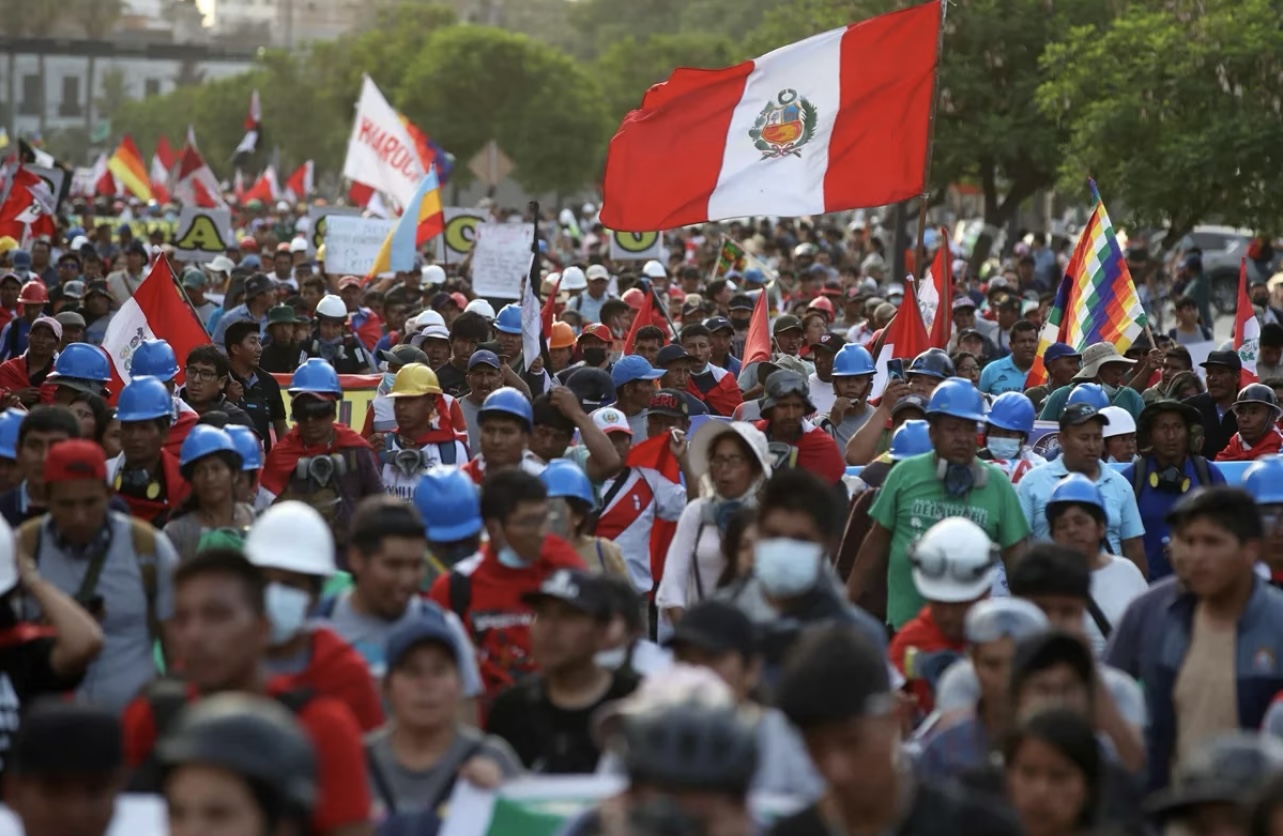
Implementing its government plan as currently formulated will require an austerity program targeting workers and the inland communities—who are justifiably demanding attention in the face of historic neglect, particularly the communities in the southern part of the country. This heavy-handed policy, proposed during the election campaign, will deepen the crisis and exacerbate social polarization between workers and the new government.
This deepening of the social crisis and political instability ushered in by the new government will be exacerbated by the high levels of crime and corruption rampant in the country and its institutions, which—along with organized crime (hitmen, extortion)— not to mention the greatest scourge of all—CORRUPTION—will continue to be a daily reality in national politics, contributing to the government’s rapid loss of credibility among workers and the people. Added to this are the demands that the people of the interior have been raising, seeking resolution of their long-standing grievances. We are convinced that the new government’s response to these problems will be a policy of repression; it has made this clear during the election campaign, by stating that the laws enacted by the current Congress regarding economic benefits for workers will be submitted for review by the Constitutional Court—which is entirely controlled by Fujimorism—so that this body can determine whether these hard-won gains for workers will be upheld and can be implemented by the Ministry of Economy. These factors will form the basis for greater mobilization and the erosion of the government’s standing over the next 100 days. Keiko enters office with a strong thirst for revenge, which she will need to act upon from the very first day of her administration. She cannot afford to wait any longer due to the risk of social upheaval that could arise from her attempt to implement her plan for ORDER AND CONTROL. These factors will serve as a driving force for the government and deserve to be taken into account. It is within this context that the request for legislative powers is made; she hopes Congress will approve it and, within 120 days, pass the laws that will facilitate the implementation of her neoliberal plan and her labor counter-reform, which were announced and outlined in that request to Congress. However, she does not control the Chamber of Deputies and will have to tread very carefully to secure a vote in favor of this plan.
This requires that our organization—born in the heat of this new political process—must mobilize its forces to contribute to the struggle against the plans of starvation and repression that we are certain Keiko Fujimori’s government, like any bourgeois government, will implement. We workers and the exploited people can have no hope or confidence that this new government will stand with the working class; on the contrary, it will be one of total submission to U.S. imperialism and to the native bourgeoisie, which acts as an agent of imperialist transnational corporations.
Among the vanguard, no one doubts that the new government will be submissive, pro-boss, and authoritarian; however, the same cannot be said of the working class and popular sectors that voted for it as if it were the “lesser evil.” Significant sectors harbor illusions that Keiko’s government might provide solutions to their countless subsistence problems, especially after the disappointing performance of the so-called “electoral left” and at the same time lost confidence in the power of the workers’ struggle due to the bureaucratic and conciliatory leaderships, which, for political expediency, prioritized the electoral campaign over the mobilization of the masses despite the Balcázar administration’s onslaught of laws targeting public and private sector workers.
We must clearly recognize that our main enemy is the government, and therefore we have an urgent need to formulate an alternative plan that will allow us, initially, to resist its plans and work toward its eventual defeat, uniting ourselves with the working class and the people of the interior—as the only way to stand with the masses in their disillusionment with the Fujimori government’s illusions. The only way out for workers is to defeat Keiko’s government; otherwise, it will end up defeating the working class and the people of the interior across the board. The other enemy, no less important, is the centrist and reformist currents operating within the working class, which we must combat with the same force with which we will confront the government. This requires us to uphold our class independence as the only guarantee of leading the masses in struggle toward victory.
To this end, we offer workers, youth, working women, peasants, and the impoverished sectors of the city and the countryside this new tool for political struggle to free us from the capitalist-imperialist yoke—so that they may make it their own and, together, embark on this long journey toward our second political, social, and economic independence for the working class and the poor.
Iquitos, August 2026
NATIONAL EXECUTIVE COMMITTEE
Republished from the original Spanish


