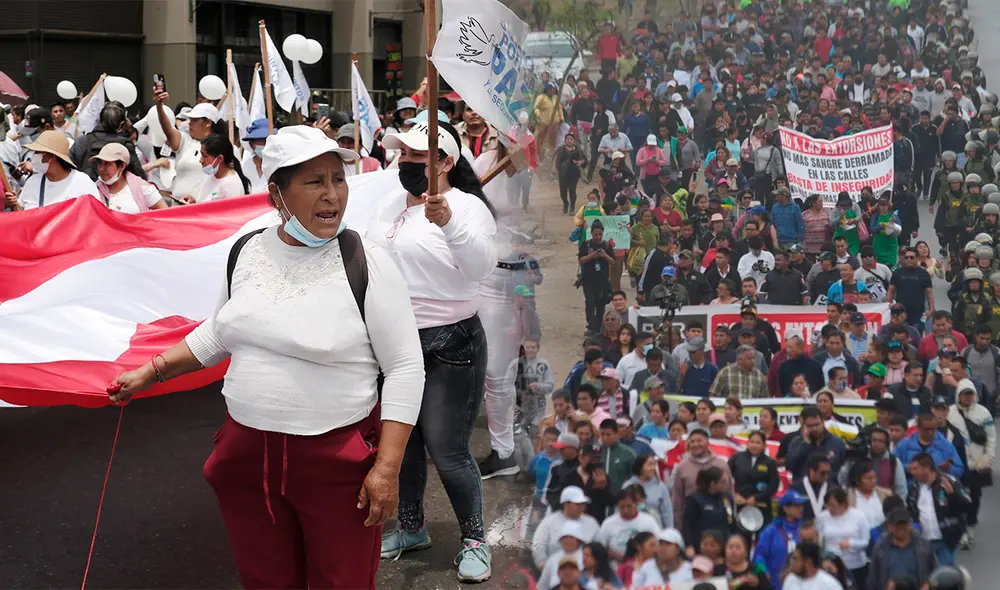
PERU: 72-HOUR GENERAL STRIKE IN IQUITOS
IN DEFENSE OF LIFE, LET’S SAVE THE NANAY RIVER NOW!
For Lower Fuel Prices!
An Immediate Solution to the Electricity Crisis!
Fight illegal mining head-on!
We reaffirm the decision of the CGTP’s (General Confederation of Peruvian Workers) grassroots assembly to call for a 72-hour strike [in Iquitos], and we emphasize that, in the context of the capitalist crisis, the current government will not resolve any of these three demands unless we escalate to a major confrontation—namely, an indefinite general strike.
JUAN CARLOS DEL AGUILA: PERSONA NON GRATA IN LORETO.
It was to be expected—as a staunch supporter of Keiko Fujimori—that Juan Carlos Del Aguila would call for people not to comply with the regional strike.
His role should be to stand with the people and demand a solution from the executive branch. However, he prefers to confront the people rather than his own government.
Aware of the magnitude of the problem we face, JUAN CARLOS DEL AGUILA must be declared PERSONA NON GRATA for failing to support the people’s decision to observe the regional strike; and if no solution is found, we must go on an indefinite regional strike.
Lower fuel prices—the oil is ours, so why is it so expensive?
The solution to high fuel prices lies in nationalizing, regulating, and independently exploiting crude oil, whose production cost (the cost of extracting it from the ground) is $20 USD per barrel, whereas Petroperú purchases it at international prices of $100 USD, a price that is reflected in fuel costs and, consequently, in higher prices for food and energy. For this reason, we propose that the state-owned enterprise assume full control of the oil fields to extract and process crude oil at production cost and eliminate fuel taxes to reduce fuel prices.
A Solution to the Energy Problem: Let’s Prevent an Energy Crisis
As background, Genrent do Brasil has been awarded the concession for the Iquitos (Loreto) Energy Supply Project. With an estimated investment of $100 million, this project would supply electricity to Iquitos, and, until the Moyobamba-Iquitos transmission line becomes operational, the supply will be provided as “cold reserve” within the National Interconnected Electric System (SEIN). In 2014, during the Ollanta Humala administration, the contract was signed for the Moyobamba-Iquitos transmission line and associated substations project; however, this project was not continued under PPK (Pedro Pablo Kuczynski), who, as a lobbyist, prioritized private interests over a project that could provide affordable energy to the population. Consequently, Genrent del Perú was granted a permit to generate electricity at the future Iquitos Thermal Power Plant with an installed capacity of 78.93 MW; at that time, Fernando Meléndez was governor.
Can the energy problem be solved? YES. Just as the armed forces did during Mr. Balcázar’s previous administration—they forced Balcázar to purchase scrap aircraft valued at $3 billion—so it appears that, in the coming years, the country will have a fleet of aircraft capable of confronting any neighboring country.
Similarly, through the contingency fund in the national budget, the government should have the necessary funds to purchase new equipment to replace the Skoda generators—among others—that have been in operation since the 1970s and were donated during the Velasco Alvarado administration to improve the city’s electricity supply. At that time, the population was barely 20,000 residents; now there are more than 500,000. Added to this is the consumption by a number of large industries and businesses—such as MALL ADVENTURA and Bodega 1, among others—which consume vast amounts of energy, exceeding the power generation capacity, which should be 100 MW. Is there a solution and a way out of this energy crisis? It’s only possible if we fight seriously, if we seriously confront the government, and do not allow ourselves to be deceived by central government commissions or dialogue committees that only serve to drag things out and will not bring any solution. We NEED a supreme decree authorizing the purchase of new generating equipment to replace and expand Electro Oriente’s power generation capacity until the interconnection with the SEIN is available; otherwise, we will face the following problem: the companies that were about to come here or those that are already established will close their doors and move elsewhere, plunging the city into even greater poverty because jobs will be lost—in other words, the problem isn’t just about energy for energy’s sake and the service itself, but is also linked to job creation and improving the living conditions of a segment of the population that finds secure employment.
Fight Against Illegal and Predatory Mining: Let’s Defend Our Lives
Mining activities carried out in river basins to extract alluvial gold (gold panning)—where the riverbed is dredged and substances such as mercury are used to separate the gold—are causing harmful health effects by leading to the deterioration, degradation, and alteration of the quality of drinking water. Therefore, it is important to ban all mining activities that harm the population’s water sources, as is the case with the Nanay River. It must be noted that officials currently in positions of power are linked to illegal mining—including former mayors, military personnel, and others—who have had investments in illegal mining since the 2000s. There has long been knowledge of the connection between dredging operations and generals and politicians, who, through other intermediaries, operated in the Napo River basin before being expelled. Today we know that gold panning takes place at the headwaters of the Napo River, extending into Ecuador. Added to this is the fact that during low-water periods, the Nanay River causes difficulties in supplying drinking water to the city, necessitating scheduled service restrictions. In other words, there is a need to consider the installation of a new water treatment plant that does not rely solely on water from the Nanay River; water from the Amazon River must also be treated because we have no other major water source. In the case of Lima, water is drawn from the Rímac River, which is murkier and more polluted than the Amazon, and yet it is made safe to drink. More resources are used to treat the water and make it safe to drink. Another treatment plant is needed to avoid the problems we face when there is a drought in the Nanay River.
Connectivity Issues: Better Internet
In Peru, the internet is very slow; in our city, it’s even worse. It doesn’t help our city connect with and become more integrated into the world. This issue should be part of the fight because Telefónica is the main monopoly in Peru, and its equipment is far too outdated in our city.
Other cities have modern equipment because they fought for it. Iquitos has radio-based internet—not satellite—so the satellite signal reaches Caballococha and then bounces back to Iquitos. That’s why the internet is slow: it’s radio-based. A few dark clouds are enough to interrupt the service, and then we have no internet.
These demands must unite the people in calling on Keiko Fujimori’s incompetent government to provide an immediate solution.
No more commissions—they’re just a sham.
We call on the representatives and senators to take the lead in this struggle—that’s why they were elected.
IF THE GOVERNMENT DOES NOT PROVIDE A SOLUTION, LET’S PREPARE FOR AN INDEFINITE GENERAL STRIKE.
Let’s organize neighborhood committees within each union and in every neighborhood to ensure soup kitchens and strike picket lines, and to guarantee the success of our struggle.
Merchants must contribute to the Central Strike Committee, and trade unions, peasant organizations, indigenous organizations, the Chamber of Commerce, political organizations, the “Vasos de Leche” (glasses of milk) committees, motorcycle taxi drivers’ associations, etc., must serve as the backbone of the strike.
We in the Liga Obrera Socialista stand ready to support the strike if the 72-hour regional strike fails to resolve the issue.
FOR THE SUCCESS OF THE REGIONAL STRIKE ON THE 16TH, 17TH, AND 18TH!!
Regional Executive Committee.