Uncertainty Over Negotiations Leaves the Strait of Hormuz Blocked
After ten weeks since the beginning of US-Israeli aggression towards Iran, there is still no clearly defined plan. There is a fragile ceasefire that has lasted one month, with three possible outcomes.
The main conclusion is that the US-Israeli plan of an overwhelming and quick victory, like in Venezuela, has failed. The Iranian strategy of asymmetrical war, with attacks with missiles and drones against countries with US and Israeli bases, and above all the selective blockade of the Strait of Hormuz, proved successful in creating a stalemate due to the worst international energy crisis, with important economic and political repercussions throughout the world as well as within the United States.
Given this situation, three possible scenarios emerge: a medium- or long-term agreement, renewed military actions, or a type of prolonged “cold war”, alternating between both military actions and sanctions and negotiations.
Renewed military actions, such as those that took place during the first 38 days of aggression, is not the most likely outcome. Facing pressure from most large corporations that want to avoid a global recession, and the unpopularity of the war demonstrated in surveys and the No Kings Day and May Day protests, Trump is looking for a way out where he can look like the winner.
At the beginning of the war, this meant the fall of the Iranian regime or the destruction of the country’s entire infrastructure. Now, Trump is simply calling for the end of the nuclear program focused on building atomic bombs and the unrestricted reopening of Hormuz as key points of the negotiation.
His goal is simply to secure, through diplomatic pressure, a better nuclear agreement than what President Obama signed in 2015. This is why he proposed suspending uranium enrichment for twelve years and the partial return of Iranian uranium reserves (Iran has around 11 tons of uranium, of which 400 kilos are 60% enriched, that Trump wants to remove from the country).
Another point: the opening of the country’s energy market to U.S. oil companies is in both parties’ interest. Trump would gain leverage over his main competitor, Chinese imperialism, the primary buyer of Iranian oil. And Iran could modernize their industry and sell their oil at international prices, without the discount imposed by China. This point comes up in the discussion about the end of sanctions against Iran.
The Iranian regime also doesn’t want resumed military aggression due to the destruction caused to the country, and it is pursuing strategic goals, both economic (an end to harsh sanctions, releasing Iranian funds abroad, war reparations, and tolls in the Strait of Hormuz) as well as geopolitical (control over Hormuz, maintaining the nuclear program for civilian purposes, and a permanent end to the war on all fronts–including Lebanon, but not Palestine–), which would demonstrate its success at surviving the joint aggression of the world’s greatest power and the region’s greatest power.
In their proposal for negotiations, the Iranian regime presented a three-phase peace agreement. In the first, there would be a ceasefire on all fronts (including Lebanon), and the reopening of the Strait of Hormuz, putting an end to the naval blockade against the country. The second phase would involve a trade-off between abandoning the military nuclear program and economic measures for the country’s reconstruction, primarily the lifting of economic sanctions and the release of Iranian funds held abroad. In the third, there would be a new Middle East preserving the role of Iran as an important regional power along with its allies, and eliminating the Israeli plan for a Middle East completely under its hegemony.
The halt of negotiations is leading the international economy towards a recession. The reopening of the Strait of Hormuz became key for Trump as well as Iran, and it might happen without a general agreement, leading to a type of “cold war” between both countries.
The only party interested in taking up the war again is the State of Israel. Its fragile internal stability depends on wars to impose new territorial conquests and gain complete regional hegemony (some call this project “Greater Israel,” others call it the “New Middle East”). But Israel is not even participating in the negotiations.
Israel lost the battle for the “hearts and minds” of the world due to the genocide in Gaza, and completely depends on U.S. imperialism to continue any war, both in economic, political, and military terms. But U.S. imperialism is in decline, although it maintains its hegemonic nature, and Israel’s popularity suffered a seismic blow in the country, especially amongst the youth, most of whom sympathize more with Palestinians than with Israel–including Jewish youth.
The genocide continues in Palestine!
This weakening of Israel is not reflected in the genocide taking place against Palestinians in Gaza, nor in the aggressive ethnic cleansing in the West Bank, nor the apartheid regime imposed on ’48 Palestinians (those who live in Palestinian territories that were conquered in 1948).
Israel maintains international support and complicity to continue the genocide in Gaza, which is under siege by land, sea, and air with the backing of the “Board of Peace” led by Trump, that simply repeats the Israeli demand of unconditional disarmament of the Palestinian resistance, while the Israeli forces advance on Palestinian territory and prevent sufficient humanitarian aid from entering.
On the other hand, the weakening of Israel, the continuing genocide, and the interception of the flotilla are driving stronger mobilizations of solidarity with Palestine, especially in Europe, some countries in Latin America, and Syria, although not at the same level seen before the cease fire. It is only through international solidarity that the Palestinians can continue their struggle against the genocidal state.
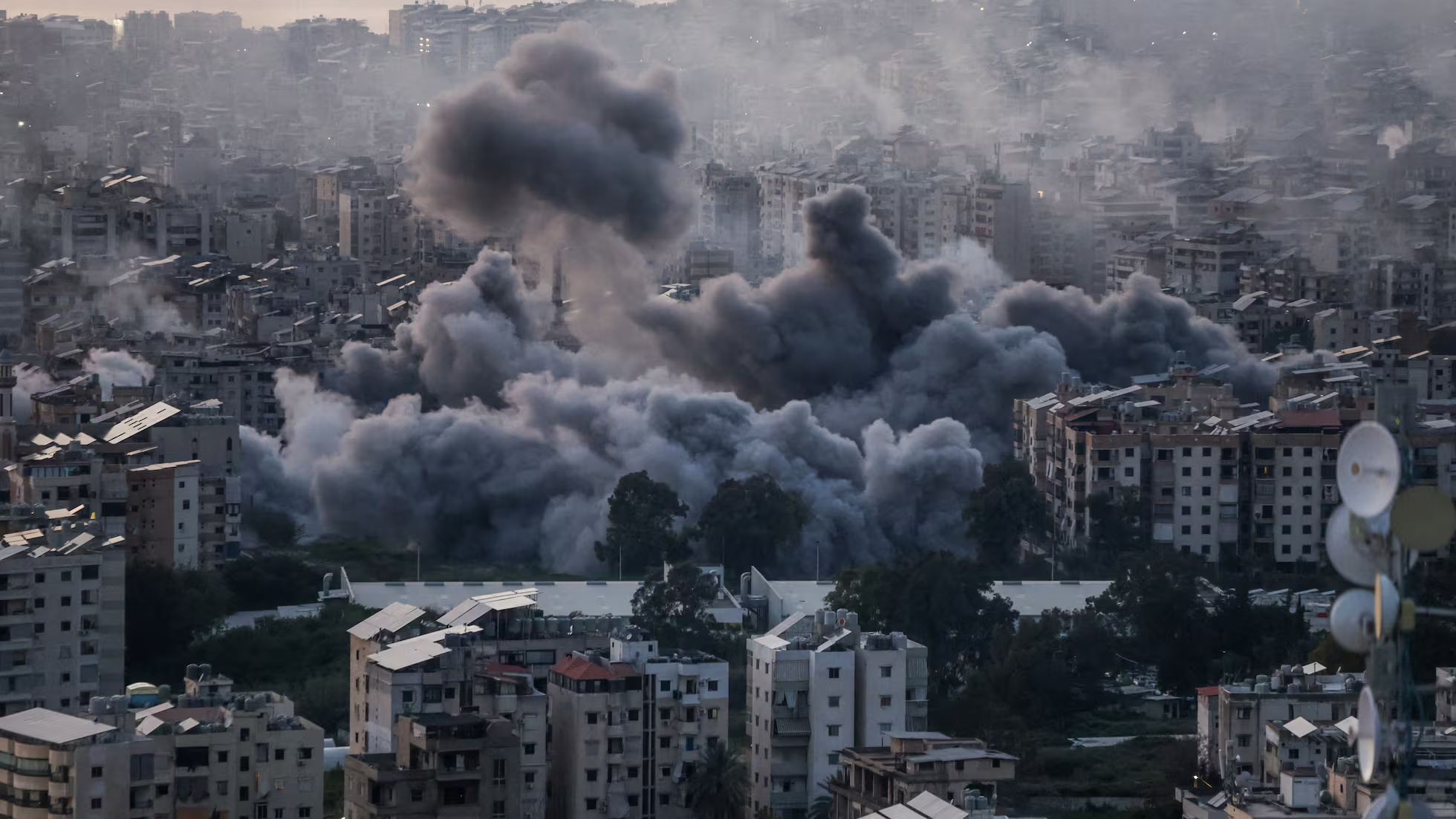
In Lebanon, Trump is working to normalize relations with Israel. But Israel demands disarming of Hezbollah manu militari, the control of a border region in southern Lebanon (from which it has no intention of withdrawing), as well as the right to militarily attack any target in the country. This type of agreement represents a complete capitulation, and the Lebanese government relies on the opposition of Saudi Arabia to secure a better deal. Meanwhile, Israel is not complying with the agreed cease fire and is carrying out a complete war in the south, attacking the capital, Beirut, yesterday. Also, Hezbollah remains active and incorporated cable-guided drones into their arsenal, which are cheap and difficult to intercept, and have made Israeli advances into the south more difficult.
The impact of the war within the U.S.
Unlike the aggression against Venezuela, Trump has not come out strengthened after 10 weeks of aggression towards Iran.
Within the United States, he faces low popularity, with questioning even within his own MAGA movement (Make America Great Again). The war and its damaging effects on the U.S. economy add to other sources of wear, such as the actions of ICE and his relationship with billionaire Epstein.
Most large corporations lose as the national and international economy slows down. Those that profit from military aggression, such as the military-industrial complex and Big Tech companies, no longer depend on the continued war to maintain their profits, which are guaranteed by the arms race and public investments. On the other hand, the oil industry, a major beneficiary of the closure of the Strait of Hormuz, could benefit from eventual access to Iranian reserves if sanctions are suspended.
The U.S. working class pays the price of the aggression, either through inflation caused by the increased price of oil, or through cuts to public spending on education, healthcare, and social services in order to increase the military budget. The Secretary of Defense, Pete Hegseth, confirmed that $25 billion have been spent on the aggression against Iran. But specialists believe that the amount is between $28 and $35 billion, or almost $1 billion per day.
In Iran: strengthening the regime and repression
The success of the Iranian military strategy led to the strengthening of the Revolutionary Guard within the regime, as well as a boost in morale of its base, which had been severely damaged by the massacres on January 8th and 9th against workers’ and popular protests.
The Monarchists and the MEK supported the imperialist aggression and are now facing widespread disapproval, just as the MEK experienced when it supported the invasion of Iran by the Iraqi regime, led by Saddam Hussein.
Most opposition groups were against the imperialist aggression, both because of the historical experience that has shown that no foreign invasion has benefited the country, as well as the destruction and death of more than three thousand Iranians, the vast majority of whom were civilians.
Despite the harsh imperialist attacks, the Iranian regime found ways to execute, since March 17th, at least 10 protestors who were secretly detained in January–without notifying their families or lawyers–based on charges obtained through torture.
In addition, the cutoff of internet and phone access impedes communication between families and friends, as well as making many economic activities unfeasible, which affects more than a million workers.
These repressive methods do nothing to aid the war effort against imperialist aggression. On the contrary, they divide the population and alienate dissidents. The goal of this brutal repression is to prevent the emergence of new protests against the cost of living and lack of democratic freedoms.
Necessary measures to defend the country against imperialist aggression, such as arming the general population, especially against the threat of a ground invasion, were not taken.
United Arab Emirates’ withdrawal from OPEC
Imperialist aggression accelerated the rift between the United Arab Emirates and Saudi Arabia. This division reflects differing economic interests and regional policies. On one hand, the United Arab Emirates pulled out of OPEC to avoid having to comply with oil and gas export quotas, and accepts Israeli hegemony to act in other countries that are in conflict with Saudi Arabia, such as Yemen and Sudan. During the imperialist aggression, Israel supplied them with anti-aircraft weapons which clearly failed to shoot down Iranian missiles and drones. Now they count on Israeli support to confront Iranian power.
On the other hand, Saudi Arabia does not accept the “New Middle East” under Israeli hegemony. Nor does it accept Iranian hegemony. On the contrary, it aspires to strengthen its regional influence. To that end, it is building an alliance with Pakistan, Egypt, and Türkiye, and it must diversify its relationships with imperialist countries.
The inter-imperialist dispute between the U.S. and Europe
The aggression against Iran has accelerated the crisis between the United States and Europe. The roots of this crisis lie in support for Russian imperialism at the expense of European imperialism in Ukraine, the dispute over Greenland, and the backing given to the European far right—particularly Germany’s AfD and Viktor Orbán—despite Trump’s record-low popularity among the European public.
On top of this, there is the demand for support for the aggression against Iran, after it became clear that Trump’s strategy for a quick victory had not materialized. Last week, Trump announced the withdrawal of five thousand soldiers from a NATO military base in Germany. Trump does not intend to destroy NATO, but rather to bring European imperialism more fully under his control.
China and Russia, beneficiaries of the war
In the short term, Russian imperialism benefited from oil revenue resulting from lifting U.S. sanctions that expire on May 16th. However, this was limited by Iranian attacks on targets in the Russian oil industry and the country’s ports. These attacks reduced oil production and exports by at least 20%.
Despite the additional revenue, military spending is taking up an increasing share of the national budget, in addition to more than one thousand deaths per day, 25% of which are casualties. It is estimated the Russia has already lost more than 1.2 million soldiers, a quarter of whom have been killed. This situation suggests that Russia is reaching its limit and is increasingly relying on Trump and Xi Jinping to seize a portion of Ukranian territory.
Meanwhile, Chinese imperialism benefits in the medium and long term from the United States’ loss of international political and military credibility due to the stalled aggression towards Iran, compounded by other measures such as the trade war. In addition, China was behind Pakistan’s efforts to reach a ceasefire. In recent days, the Chinese regime requested the unconditional reopening of the Strait of Hormuz, which has influenced Iran in the same direction.
For Iran’s military victory against imperialist aggression
The war is still not over, but its impact on the international economy and the dismantling of the world order that emerged from the end of World War II is already evident.
The defeat of U.S. and Israeli imperialism is not only in the interest of the Iranian, Lebanese, and Palestinian working classes, but also for all oppressed people that struggle for self-determination or freedom. If there is a confirmed defeat of U.S. imperialism in this war, although Trump will not admit it, this will have a significant impact worldwide, weakening the far-right imperialist government.
Unfortunately, the Iranian regime did not free their political prisoners nor arm the population, important measures to defend their country. We denounce the limits that the regime imposes on the country’s self-defense: it must provide arms to the population for national defense.
We defend the Iranian military victory–as this will constitute a step towards their liberation–without implying any political support for the regime. We support initiatives for self-organization of the working class, youth, women, and oppressed nationalities so that, by participating in defending Iran that is today led by a reactionary regime, they can build the revolutionary leadership that is lacking today and create the conditions to resume the path of the great workers’ revolution of 1979, which was interrupted by the ayatollahs.
First published here in Portuguese by the IWL-FI