
Youth at the Forefront in France: A Profound and Rapidly Growing Movement
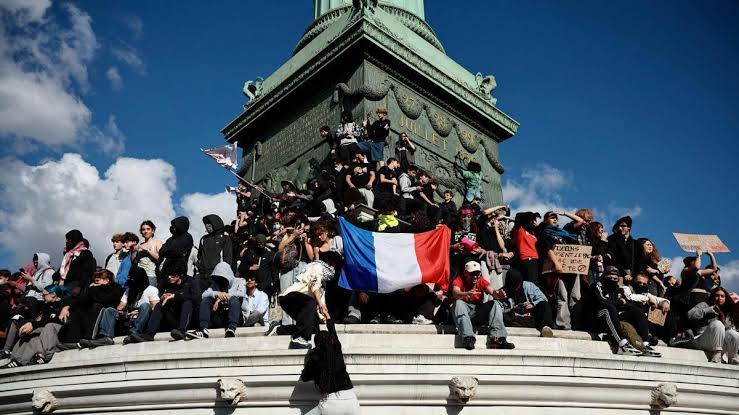
The Emergence, Growth, and Characteristics of a Large-Scale Mobilization
Just a few days before the start of the school year, there were teachers’ strikes and high school blockades, independent of the movement that emerged later: in Mayotte (Indian Ocean), in Rennes, in Villeneuve d’Ascq, and in Caen. But it was the Saint-Exupéry High School in Créteil (a suburb southeast of Paris) that lit the fuse: on Thursday, September 17, part of the teaching staff went on strike due to serious staffing issues.
Starting Point
The next day, September 18, some seniors decided to take up the teachers’ cause, blockading their school starting at 6:00 a.m. and demonstrating in front of it with signs. The same thing happened on Monday, September 21, at Saint-Exupéry, and this time two LFI members of the National Assembly from the area came to support them. The protest spread in the following days. The entire Paris region mobilized: first in Val-de-Marne, the department where Créteil is located; then, largely thanks to a video by a high school student that went viral, starting on the 24th and 25th, at high schools in Seine-Saint-Denis (France’s most disadvantaged department): Saint-Denis, Gonesse, Saint-Ouen, La Courneuve, etc. And also Sarcelles, in the Val-d’Oise. It is important to note that, in many of these schools, teachers are lending their support to high school students. The movement’s nationwide expansion began on September 28 (Marseille, Lille, and the southeastern departments: Rhône, Var, and Alpes-Maritimes). On September 29, the high school students’ mobilization joined the national public sector strike and, in some cases, was supported by staff from the Ministry of Education.
From Working-Class Neighborhoods to City Centers
In most cases, the mobilization first affects high schools in working-class neighborhoods[1] and gradually spreads to high schools in city centers, and even to elite schools[2].
According to figures from the Ministry of the Interior, the following trend can be observed (there are 3,700 high schools in France). At the movement’s peak to date, on October 6, 891 schools were reported to have been affected or disrupted by the high school students’ protests (figures from the Ministry of National Education). Both high school students and the GJ are acting in stages.
| Date | Number of schools affected | Total number of blockades |
| 9/28 | 180 | 27 |
| 9/29 | 338 | 45 |
| 10/1 | 900+ | |
| 10/2 | 1027 | 400 |
| 10/5 | 413 |
The prestigious Louis-le-Grand and Henri-IV high schools in Paris were affected by blockades and walkouts. High schools in the city center (in affluent neighborhoods) have, for the first time in their history, been blockaded by students: in Angers, for example, the David d’Angers high school. At these schools, the protesting students acknowledge that their learning conditions are much better, but they explain that they stand in solidarity with their peers in disadvantaged areas.
From High School Students to College Students
Little by little, universities have joined the high school students. Starting on October 1, some thirty university campuses(out of a total of 71) were subject to partial blockades during peak mobilization periods (particularly on October 1, October 6, and October 8, 2026), especially at universities in Paris and the Paris region (Panthéon-Assas, Panthéon-Sorbonne, Sorbonne Nouvelle, Paris Cité, Nanterre, Saint-Denis; as well as the Catholic Institute of Paris—a move unprecedented for this private institution, where dozens of students blocked the entrances at the beginning of the month); Lumière Lyon 2 University; the University of Aix-Marseille; Brest; Le Mans; Lille; Strasbourg; Rennes; Nantes; Bordeaux; Toulouse; Montpellier…
Recently, the high school student movement has expanded in Belgium, Italy, and Germany[3].
What are the demands?
This movement began with very specific demands. More specifically, at Saint-Exupéry, teachers fought against the shortage of teaching staff, and high school students joined this struggle at the local level.
In general, three main issues stand out:
- The lack of resources to study under good conditions.
- The lack of teaching staff leads to overcrowded classrooms (30, 35, or more students, since the government does not allocate enough funding per student). This also leads to excessively long school days (for example, from 8:00 a.m. to 6:00 p.m.)
- Other consequences: buildings that are often old and dilapidated; ill-equipped to handle extreme cold or heat; furniture that is also in poor condition; hygiene issues (sometimes there are rats)
- The lack of substitute teachers in the event of prolonged absences
- Access to higher education and the issue of Parcoursup, with demands to eliminate selection for admission to universities and master’s programs; demands to create 150,000 additional spots in higher education.
Let’s clarify this here.
High school and college students are demanding the repeal of “Parcoursup,” a selection process that aims to regulate high school students’ course preferences based on available spots in various higher education programs. However, the reduction in the number of spots offered in higher education—and even the closure of degree programs in public higher education—combined with the arbitrary nature of the procedure, is driving a significant number of students to choose private institutions that are not subject to this procedure, in order to gain admission to the degree program they desire… Despite the ongoing struggles against Parcoursup and the catastrophic results of this measure—in effect since 2018—successive Macronist governments have maintained it. For several years now, the governance of educational counter-reforms has been based on coercive imposition.
But today, the demands have gone beyond the purely academic and material framework mentioned above: other inequalities and other monstrosities are being denounced, ones that go much further—the condemnation of the genocide in Palestine; the condemnation of the law granting the police presumption of innocence (known as the “license to kill” law [4]), which will particularly affect working-class neighborhoods; the denunciation of the upcoming austerity budget…
Unlike the youth struggles of the past, this is not a struggle AGAINST a government project (which would have the clear objective of scrapping the project). NO, what is being highlighted is a set of demands IN FAVOR of a better future, of a better life for high school and college students.
In order to bring high school and college students together, on October 5 the Student Union launched a platform titled: “Youth Demands: Ten Emergency Measures.” Among the first signatories are: the Secondary School Students’ Union (USL), Solidaires étudiant·es, the National Union of Students of France (UNEF), and FAGE (coming soon); the platform details the following demands:
· An emergency plan to renovate schools and universities
· Mass hiring of educational, health, support, and guidance staff
· A rethinking of the pace of school and university life
· An end to selection through Parcoursup and Mon Master. Create 250,000 higher education spots
· Reform of democratic processes in high schools to allow for genuine student participation in decision-making
· Increase the value of scholarships and restore and increase the value of the APL for everyone
· Truly guarantee access to 1-euro meals for all students
· Repeal the “Bienvenue en France” plan, which establishes differentiated tuition fees for international students, and eliminate the CVEC
· Freeze CROUS rents[5], maintain rent control, and carry out a massive renovation and construction of CROUS housing
· Put an end to police repression and violence against the high school and college student movement
What actions are underway?
· At the entrances to high schools
At all levels, the preferred form of action is the blockade of educational institutions, the main goal of which is to allow undecided individuals to engage in dialogue with the mobilized youth.
At high schools in the city center or elite schools, or at other high schools where the balance of power is less favorable, the blockade gives way to “checkpoint barricades,” where students can go to class, but their striking peers urge them not to.
· More forceful actions
Another form of action seen in various locations and cities—one that borders on a “riot”—includes using a motorcycle as a battering ram to knock down a school’s gate or throwing fireworks at buildings… Several school entrances have been set on fire in recent weeks. The lobby of the Mandela High School in Nantes, for example, suffered a serious fire on October 1.
These more forceful actions are carried out mainly by young people from working-class neighborhoods, but they also resonate with other student groups. These forms of action, described as “violent” by the media and numerous political figures, are also a response to institutional violence: for several years now, high school and college students have been mobilizing, but successive governments have imposed their reforms by force, as demonstrated by the use of Article 49.3 [6] used to pass pension system reforms.
An Entire Generation
Judging by the slogans and forms of action, it is reasonable to conclude that an entire generation is mobilizing against a government and an economic and political system, with a level of engagement that transcends the traditional frameworks of social movements [7]. One indication of the depth of the mobilization is the number of individual banners, on which each person competes in creativity to highlight what they are demanding or seeking to denounce. During the Yellow Vests protests or those held against the pension reforms, we also observed this phenomenon.
At a recent demonstration, a sign was seen that parodied Macron’s speech to the armed forces on July 13, 2025: “To be free, one must be feared”… To which was added, “Oh, well, okay”… .
The “elites” versus the mobilized youth: the weight of the established order
What is alarmingly characteristic of this movement is its power, on the one hand, and police and judicial repression, on the other. But despite the violence of the state—a state that refuses to listen to its youth out of absolute loyalty to the harmful class it serves without fail—the youth movement continues and is growing. It is reaching a point where, without a doubt, it will have to seek new paths.
Laurent Nuñez and his police thugs
Nuñez is the name of our Minister of the Interior. A pure product of Macronism—cold, a liar, a hypocrite, cynical, inhuman! The head of the French police admits that he gives “no instruction not to use all the intermediate weapons at the disposal of the internal security forces” to his uniformed thugs. Intermediate weapons consist of semi-lethal weapons: LBDs, stun grenades, crowd-control grenades… not designed to kill, but only to seriously injure…
Then we witnessed a “good cop/bad cop”-style role-play between Nuñez and the Minister of National Education, Edouard Geffray. The former justified the total repression. He blatantly lies when he claims there is proportionality between the means employed and the gravity of the situation: “We are entering a situation of riots and urban violence. We are using all intermediate measures to put an end to it.” For high school students to take to the streets is “urban violence.” The latter takes a completely different stance, insisting on the entirely legitimate nature of the high school students’ demands and emphasizing that it is “essential to listen to and address the concerns of our youth”… This supposed willingness to listen is accompanied by a semblance of a response to the demands. One of the two ministers attacks, while the other pretends to listen to those who are being tear-gassed, injured, or maimed. Today, the head of the brutal police force seems to be in a bind, as Macron demands “empathy” and “education” in maintaining order in the face of the high school students’ anger. But some say that Nuñez doesn’t want to back down because he’s afraid of his own police! With more than 60% of police officers voting for the National Rally (RN) and their highly fascist police unions, it’s no wonder. What is surprising, however, is Macron’s willingness to show empathy! It’s so new that we can’t believe it! Rather, we must understand that the struggles of the youth frighten the bourgeoisie, because there are young people—especially in this case—in almost every family, and families easily show solidarity with the young people who are being repressed, injured (or worse).
Serious injuries, mutilations
Toll to date: 215 students injured to varying degrees, in addition to 85 Ministry of Education staff members; serious injuries and mutilations during clashes with police on the fringes of the blockades:
· In Tours (Loire Valley), a 16-year-old high school student who lost an eye;
· A 14-year-old boy with a fractured jaw in Saint-Ouen-l’Aumône (Paris region);
· In Lens (Nord), a high school student whose hand was torn off by a stun grenade; as a result, Laurent Nuñez announced the suspension of the use of stun grenades… To be continued.
· A high school student nearly drowned by a police officer in Belfort;
· A high school student nearly strangled by a police officer in Alençon (Normandy);
· Numerous fractures and facial injuries (many caused by LBD rounds)…
To date, the IGPN (“Police Internal Affairs”) has opened 24 investigations into these and other cases. Sébastien Roché, a sociologist and criminologist specializing in police violence, recently explained in Mediapart that law enforcement in France is by far the most violent in Europe in terms of injuries or deaths caused by the police: 12 times more than in Spain, the second country on the list.
However, this infamous list has raised awareness among various other segments of the population, starting with parents and members of the educational community.
In response, high school students often turn to humor on their protest signs. Examples: “1 teacher for every 35 students, 1 student for every 5 CRS officers”, “Young people aim for high school; the BAC aims for the head”, “I’d like to have more teachers and keep both my eyes and both my hands. Is that possible?”
Arrests and Detentions: Incredible Figures
The latest figures from the Ministry of Justice:
Since the start of the high school student movement, 6,877 people have been placed in pretrial detention, 86% of whom are minors, according to the Ministry of Justice. In total, “2,376 people are facing legal proceedings,” of whom 1,923 are minors, the ministry states. But only… 21 people have been imprisoned! Many are sent back home due to a lack of concrete evidence!
The number of pretrial detentions is similar to that experienced by the Yellow Vests. But in that latter case, it occurred over the course of a year. The high school student movement hasn’t even been around for three weeks yet!
Police, the justice system, the Ministry of Education, the media: all complicit in crushing the protest!
Principals and teachers, sometimes complicit
To a different extent, but with an undeniable impact, the “official” forces of repression also rely on the support of other branches of the state to suppress the movement. We immediately think of the Ministry of Justice’s administration, but perhaps less so of that of the Ministry of National Education, or even of certain teachers, who participate—more or less consciously—in containing a movement that nonetheless includes among its demands an improvement in civil servants’ working conditions…: letters to parents informing them of the penalties that would be imposed in the event of a school blockade, strictly organized video conference classes scheduled by teachers and communicated to the school administration, etc.
Fortunately, some union leaders are stepping up to their responsibilities and ensuring, for example, that school principals do not order technical staff to reopen the schools—a task that exceeds the authority of these staff members, who are thus exposed to confrontation with the protesters [8]. The Minister of National Education himself is complicit in this confusion regarding what a hierarchy has the right to demand of its officials, including school principals, who are also belittled and exposed on the front lines in various ways (suggestions to oppose the blockades, the Prime Minister’s request to begin consultations without mentioning any serious concessions regarding the movement’s demands…).
However, one unusual development is worth noting: on October 7, the main union of school principals formally urged the government to begin negotiations. School principals are denouncing the deterioration of working conditions and declaring their support for their students’ demands!
The Role of the Media
On the part of the media, the reaction tends to reduce the movement solely to actions that have a material impact, while saying much less about its demands or even silencing the reality of police violence—except when most of these media outlets believe they have found facts that would legitimize such violence[9].
Another attempt by the media to discredit the movement is to deny its profound and conscious nature, portraying it as an offshoot of La France Insoumise, the reformist party best positioned on the left for the upcoming presidential elections.
It remains to be seen, at this stage, whether La France Insoumise—which has been the target of multiple media demonization campaigns for several years—will ultimately benefit from the hatred of the media, whose moral and political corruption is now beyond question. But journalists are not alone on this front: judging by all this rabble, the mobilization of high school students is being reduced to an LFI operation. LFI to blame for the violence: the solution is easy to guess. Thus, we’ve had to listen to the former Minister of the Interior and LR presidential candidate, Bruno Retailleau, who advocates—quite logically…—for banning LFI!
Counterproductive repression?
Repression, in its various forms, weighs down the protests, but it also provides a springboard for the youth movement, the social movement in general, and labor and political organizations to develop their capabilities and demonstrate their value. One of the first effects of this repression, for example, has been to accelerate expressions of solidarity with the youth movement. Rarely in other youth movements have the participation and support of parents, staff, and union members become so quickly and obviously established.
The Challenges for the Movement Itself and for the Social Movement
Maturity and Ingenuity
For the youth movement itself, all activists supporting the mobilized youth are witnessing an impressive level of political and organizational maturity among young people. Many of them seem to have internalized much of what has been achieved by social movements and the political issues of recent years. While their lived experience undoubtedly remains a decisive factor, social media has also undeniably accelerated this awakening, contrary to certain arguments that claim social media primarily serves to dumb down young people.
Thanks to their ability to remain creative and demanding in the face of a system that suppresses their aspirations, they have an advantage in organizing against police repression, but they also have the tools to confront the more insidious repression of a system accustomed to neither stopping nor changing course.
Thus, for example, attempts to shut down educational institutions as in-person classes resume are sometimes thwarted by sabotage of video conferences [10].
Organization
As for the movement’s organization, inter-institutional general assemblies and local coordinating bodies have emerged in some cities. They have not yet been structured on a scale that allows them to counter media coverage, which at times distorts the representation of the youth movement. The mainstream media was caught red-handed overrepresenting a high school student participating in Gabriel Attal’s campaign, for example[11]. Even when it opts for “pluralistic” representation[12], it remains problematic that the question of whether or not to represent the movement is not decided by the movement itself… without forgetting to include, in one way or another, representation of youth from working-class neighborhoods.
In the coming weeks, establishing a national coordinating body could prove challenging. Ensuring a grassroots structure that prevents the “abuses of self-organization” practiced by numerous organizations or activist circles for several years will be one of the tasks at hand. In our observations, we have noted that, so far, the circles engaged in these practices have not been able to “impose” their representation on the movement.
What about other social movements? The labor movement?
For the social movement in general, one of the objectives is to come together to support this movement, but also to participate based on its own demands. It is regrettable to hear high school students calling for unity with the October 17th movement—which is a call to revive the Yellow Vests movement[13]—and to see the national labor coalition calling for an interprofessional strike… on November 5[14].
At the grassroots level of the unions, solidarity with the youth movement—and against repression—is pushing local leaderships and some national leaderships to adopt a schedule more in tune with the mobilizations. In the education sector, the federations called for a strike on Tuesday, October 13, though no strike strategy has yet been mentioned to ensure demands are met. This is rather weak support for a mobilized youth movement that insists it will only halt its protests once its demands are met!
For the organized social movement, one of the tasks is to call on union leaderships to align themselves with the social movement as it takes shape, should October 17 prove to be a success.
A political development as surprising as it is necessary and promising:
While the class struggle is traditionally channeled into the tunnel of the 2027 presidential election campaigns, the youth are pulling the social movement out of the quagmire and setting their own timeline and their own demands, without conforming to the government’s schedule of reforms and counter-reforms. The demonstration that it is possible to break free from the government’s counter-reform agenda and the electoral calendar is, in itself, already an achievement of the movement.
This phase could resonate with a movement that also shared these characteristics and that could be reignited in various ways on October 17. It should be noted that fuel prices—the issue that sparked the Yellow Vests movement—are at an all-time high, and that forecasts for gas, electricity, and food prices point to further increases… It is important to highlight that, by releasing fuel reserves to lower prices at gas stations, the government is revealing its fear of a widespread social upheaval in the coming weeks.
The movement could also join the “traditional” struggles against the “Lecornu budget,” which would be based on tax increases and the continued dismantling of public services—contrary to the demands of young people and a large part of the working class.
Union Leaderships: In Practice, on the Side of the Establishment
In this context, by setting November 5 as the deadline for the cross-sector mobilization, union leaderships are buying time—undoubtedly because most of their leaders are more focused on the electoral calendar and social dialogue than on an intense conflict with the government and capital.
This is an issue that arises as the class struggle unfolds against a backdrop of social polarization, with the rise of the far right—driven not only by the forces of repression but also by the very structure of the state itself.
However, we respond that we have no choice but to fight alongside the sector of the working class that is mobilizing; otherwise, the identity of social movement organizations will continue to be linked—often quite rightly—to a certain preservation of the established order.
The vast majority of social movement organizations, both labor and political, are undoubtedly still paying the price for their lack of commitment to the Yellow Vests, which allows the far right to deceive and pass itself off as “anti-system.”
The Case of LFI
In this struggle with an uncertain outcome, it remains to be seen whether the demonization of the only force offering a chance for the left to come to power, La France Insoumise, will ultimately lead to the strengthening of this force. In this context of LFI’s demonization, it seems prudent to stand alongside this party against the bourgeoisie and the media, even as we remain aware that this strategy allows the bourgeoisie to focus attention on an enemy that, after all, is not all that dangerous to the established order. We continue to defend the need for revolutionary organizations independent of reformist organizations. However, the weakness of revolutionary organizations within this movement currently prevents us from building an organized revolutionary force on a sufficient scale.
We must continue to strengthen ourselves by engaging with the movement and by offering an analysis of the situation that neither the reformist organizations nor many of the so-called revolutionary but parasyndicalist organizations provide. For example, political organizations go to great lengths to distinguish themselves from their political adversaries or enemies, but they struggle to offer a profound critique of the state. At this moment, young people should be particularly receptive to a sophisticated critique of the state and of both its “left hand” and its “right hand.” Educational institutions are currently revealing their oppressive nature and their commitment to perpetuating the social division of labor.
The emerging generation of activists seems ready to listen to these interpretations. This generation’s political maturity is also accompanied by a sensitivity to issues of oppression. Social movement organizations cannot afford to approach them in an authoritarian and paternalistic manner. It is by fighting and learning alongside them that we will forge the bonds necessary for the development of a revolutionary force.
References
[1]https://www.radiofrance.fr/franceinter/podcasts/le-grand-reportage-de-france-inter/le-grand-reportage-du-mercredi-30-septembre-2026-3748999
[2]https://ens-paris-saclay.fr/actualite/mobilisation-des-normaliennes-en-soutien-des-etudiantes-et-lyceennes
[3]https://www.courrierinternational.com/article/analyse-gilets-jeunes-la-mobilisation-des-lyceens-belges-est-elle-aussi-regardee-avec-mepris_276918
[4] https://www.amnesty.fr/reperes/loi-presomption-legitime-defense-de-la-police-ce-qu-il-faut-savoir/
[5] Crous = Regional Center for University and School Works: a French public institution under the Ministry of Higher Education and Research, whose primary mission is to improve the living and study conditions of nearly 2.8 million students in France.
[6]https://www.vie-publique.fr/fiches/19494-le-recours-larticle-493-de-la-constitution
[7]https://www.politis.fr/articles/2026/09/analyse-mobilisation-lycees-quartiers-populaires-avant-garde/
[8] https://www.bfmtv.com/societe/education/des-violences-inqualifiables-edouard-geffray-annonce-que-plus-de-100-personnels-educatifs-ont-ete-blesses-depuis-le-debut-de-la-mobilisation-lyceenne_AV-202610090384.html
[9]https://www.acrimed.org/Au-JT-de-France-2-poubelles-brulees-partout
[10]https://www.franceinfo.fr/societe/
[11]https://www.cafepedagogique.net/2026/10/06/renouveau-lyceen-le-spectre-d-avenir-lyceen-ressurgit/
[12]https://bonpote.com/mouvement-lyceen-comment-les-medias-invitent-des-intervenants-tout-sauf-neutres/
[13]https://17octobregiletjaune.net/
[14]https://www.franceinfo.fr/economie/syndicats/l-intersyndicale-appelle-a-faire-greve-et-manifester-le-5-novembre-pour-les-salaires-les-services-publics-l-emploi-et-l-industrie_8223574.html


