
Notes on the May Protests in Bolivia
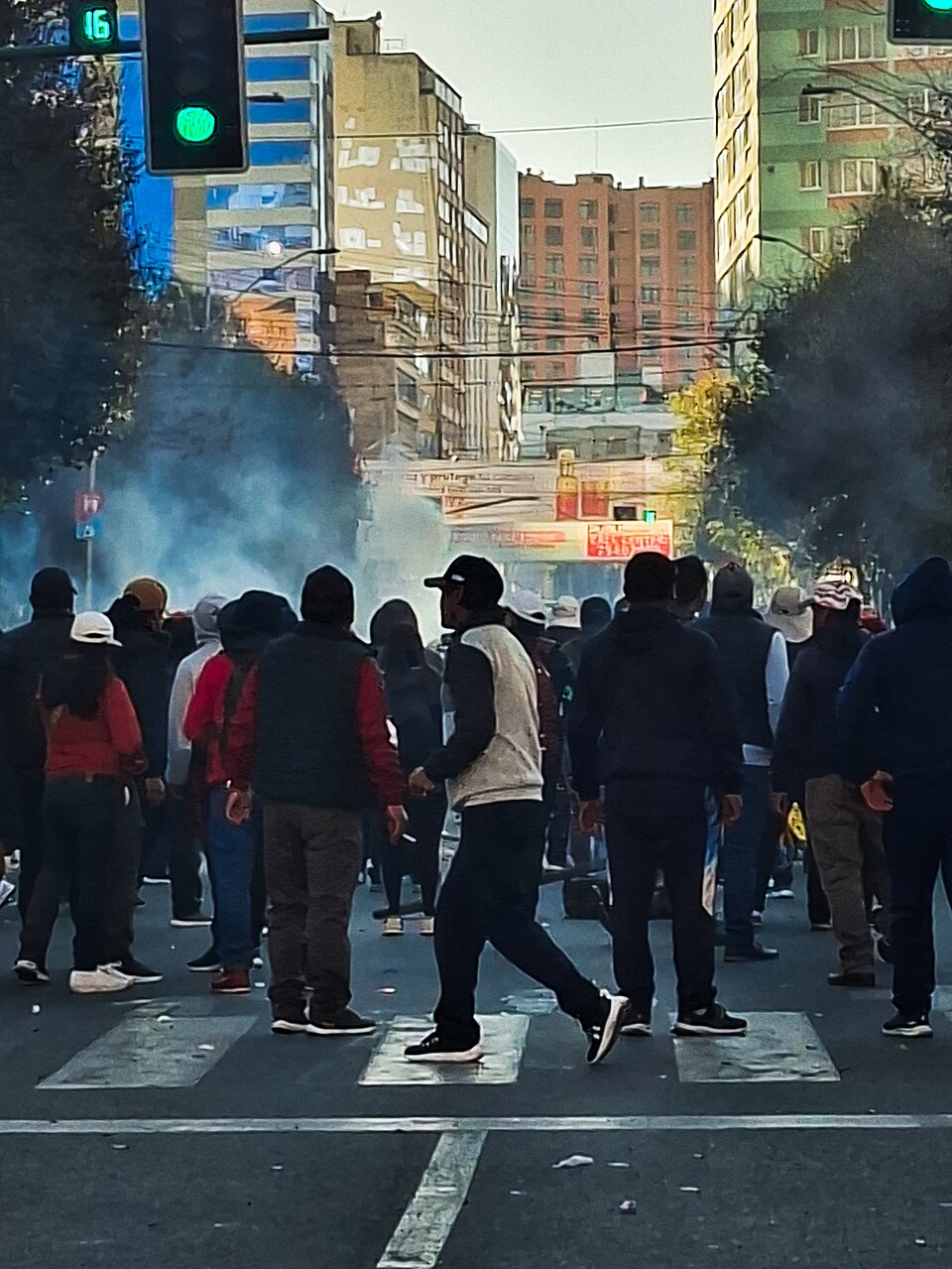
On May 18, 2026, crowds mobilized by the Bolivian Workers’ Confederation, the Tupak Katari Peasants’ Union Federation of La Paz, the Urban and Rural Teachers’ Federations of La Paz, the Federation of Factory Workers, and other sectors, as well as the “For Life to Save Bolivia” march organized by Evo Morales’s supporters, converged from the city of El Alto and other areas around Plaza Murillo, the seat of the Bolivian government and Congress, surrounding the plaza for about four hours amid clashes with the police, which brutally repressed the demonstration. The central slogan of the day was “Rodrigo Paz Pereira Must Resign!”
What unfolded that day is one of the consequences of a severe process of political erosion of the Rodrigo Paz government, six months after his electoral victory and inauguration on October 22, 2025.
The erosion of the Paz government
Since taking office, the government of Rodrigo Paz has been implementing austerity measures under the pretext of reversing the economic crisis, with a clear orientation toward favoring the agro-industrial sector of the Bolivian oligarchy and shifting the burden of the crisis onto workers and the impoverished population. It began by appointing a cabinet of ministers drawn directly from the agro-industrial sector, then repealing the tax on large fortunes, withdrawing the flour subsidy—causing a rise in the price of bread, a staple of the popular diet—and in December removing the fuel subsidy, leading to a widespread increase in the cost of living for the working population. But the worst part of the measure is that it failed to guarantee gasoline quality; since then, thousands of cars have been reported damaged by the bad gasoline mix, in particular affecting self-employed drivers who provide transportation services to the public. To top it off, on April 10, Paz enacted Law 1720 on the restructuring of agrarian property, opening the door to the dispossession of small landowners.
But, from the very beginning, it faced an organized response from the labor and popular movements.
In January, a powerful mobilization pushed back a series of anti-popular measures that had accompanied the fuel price hike; while it failed to reverse the price increase, it put a brake on the government’s other measures. Between March and April, several transportation strikes succeeded in compelling the government to compensate people for vehicle damage caused by poor-quality fuel. On the very day that Paz Pereira enacted the Law on the Restructuring of Small Agricultural Property, a march of Indigenous people from the east set out demanding its repeal; after a trek of nearly a month, the march reached La Paz and secured the law’s repeal.
On May 1, the Bolivian Workers’ Center (COB) convened a town hall meeting in the city of El Alto, demanding wage increases, the repeal of Law 1720, compensation for vehicle damage, and the defense of state-owned enterprises. The town hall declared an indefinite general strike until the demands were met or, failing that, the resignation of Rodrigo Paz if he was unable to resolve the demands.
The La Paz Peasants’ Federation also joined the call, declaring a road blockade in the department of La Paz and demanding the resignation of Paz Pereira.
Meanwhile, in the Cochabamba highlands, the coca growers’ federations led by Evo Morales called for the “March for Life to Save Bolivia,” walking nearly 300 km to the city of La Paz; the march arrived on May 18.
The current situation
It has been three weeks of mobilization, centered in the department of La Paz and particularly in the city of El Alto, with the central demand being the resignation of Paz Pereira. In an attempt to break up the movement, the government has been making partial agreements: it signed an agreement with urban and rural teachers’ leaders for an annual bonus instead of a salary increase; for Indigenous communities in the east, the repeal of Law 1720; for the El Alto Regional Workers’ Union, an agreement to provide internet access in El Alto schools; and for transport workers, agreements to compensate for damage to vehicles. At the same time, it has issued arrest warrants against the COB’s top executive, leaders from the city of El Alto, and peasant leaders, accusing them of terrorism, among other things, with the threat of prison sentences ranging from 3 to 5 years.
The country has become polarized; the mobilization is concentrated in La Paz and in some other departments through roadblocks organized by the peasant movement; however, due to a lack of preparation, the rest of the labor movement has not yet joined the strike; teachers, following an agreement by their leadership, have also stopped participating in several cities, with some exceptions such as La Paz and Oruro, where the rank-and-file have rejected the agreement and remain mobilized.
In general, the urban middle classes are demanding the declaration of a state of emergency and a crackdown on the protesters; in response, the government has issued arrest warrants for COB leaders.
The bourgeoisie as a whole has come out in support of the government; while they criticize its lack of competence, they collectively call for the defense of democracy and a crackdown on the protesters.
What’s next?
In the coming days, the course of the conflict may be decided. On one hand, the mobilization could intensify until Paz Pereira resigns; for this to happen, the entire labor and popular movement in other cities must join in, but that requires the leadership to take a more decisive role in organizing and strengthening the action—something that is not currently happening. One factor that does not facilitate progress toward this outcome is the question of who will govern after Paz? The immediate alternatives are: Vice President Lara? Early elections? In that context, a candidacy by Evo Morales? But for that to happen, the entire legal framework preventing his candidacy must be dismantled. This also opens the door to the risk of a far-right government. The lack of this clarity is a factor preventing greater involvement of the labor and popular movements.
Another possibility is an attempt to impose harsh repression to force the protesters to retreat, with the backing of the middle classes and the bourgeois parties, which would require the use of violent methods and result in many casualties. This alternative would also mean a further weakening of the government; for this reason, the government is not currently fully committing to this option, but it cannot be ruled out if its survival depends on it.
The third possibility is a negotiated settlement with the leaders, in exchange for certain concessions in legal proceedings and partial concessions on social gains. Currently, some sectors of the leadership have opened up to this alternative, but they have emerged weakened and disregarded by their rank-and-file.
The truth is that the government of Paz Pereira is becoming increasingly weakened, and this highlights the need to build a class-independent alternative.


