
Brazil: Amidst uncertain presidential elections, PSTU presents candidate and socialist platform
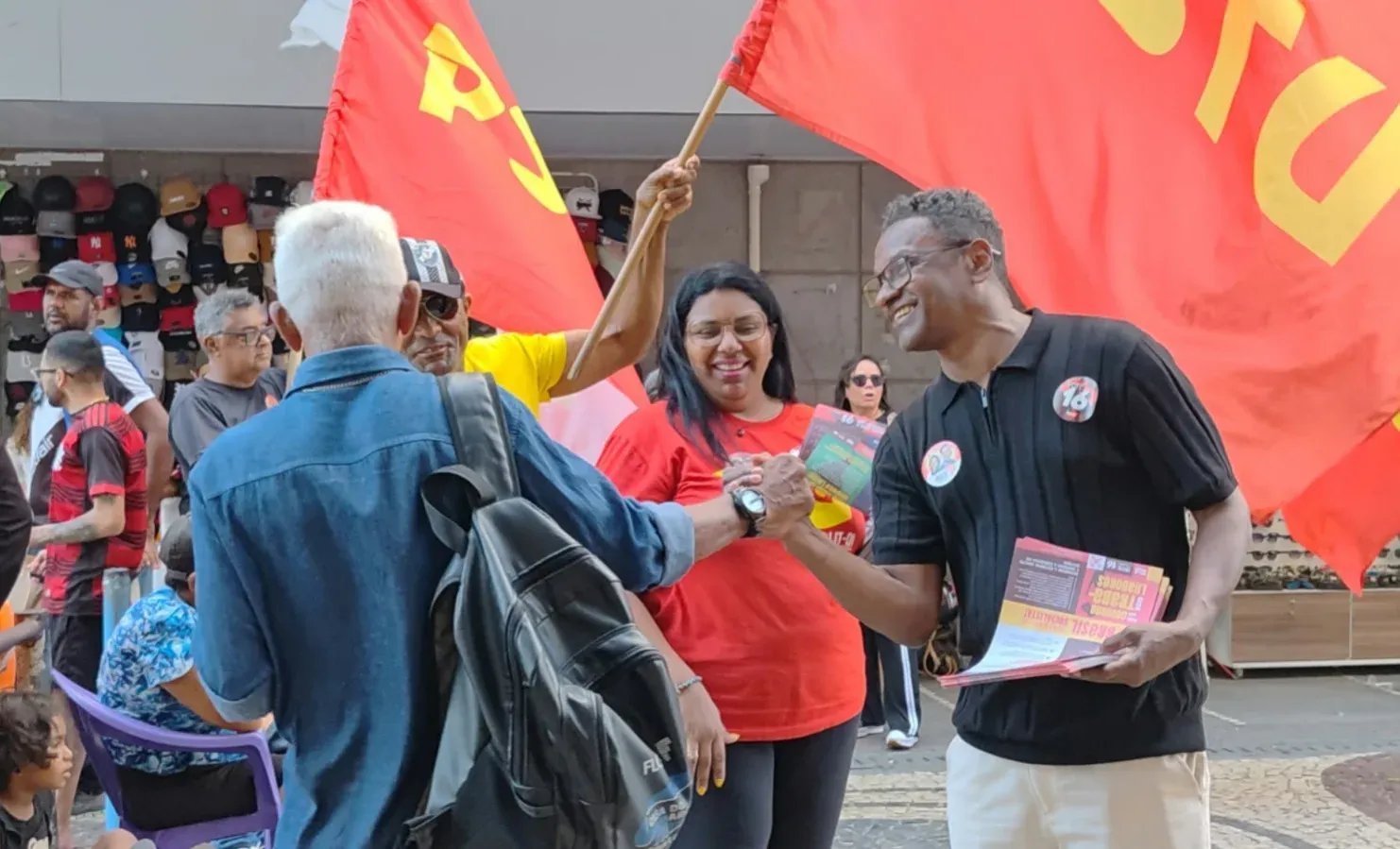
National elections will take place on October 4th. On the same day, elections for governors and state legislators will be held in 26 states, as well as in the capital, Brasília. There are eleven presidential candidates in a race highly polarized between two of them. Opinion polls show incumbent President Lula da Silva with a slight lead over far-right candidate Flávio Bolsonaro. The other candidates poll below 5%. If no candidate secures 50% of the vote, a runoff election between the top two contenders will be held on October 25th.
These elections are unfolding against a backdrop of over 30 years of economic and social decline and, more recently, a neocolonial offensive by Donald Trump across Latin America as well as the Banco Master financial scandal.
Economic and social decline
Over these 30 years of economic and social decline, Brazil’s role in the international division of labor has been reshaped and reduced to essentially that of a major supplier of primary commodities—specifically agribusiness products, minerals, and oil—as well as a key transit route for cocaine bound for Europe. Deindustrialization, privatization, and labor market deregulation have led to the impoverishment of the working class.
For part of this 30-year period (2003–2016 and 2023–2026), Brazil was governed by the Workers’ Party (PT) of incumbent President Lula da Silva. The PT administrations—always in alliance with key capitalist sectors (banking, agribusiness, and industry)—did not halt the reprimarization of the economy or deindustrialization (except in agribusiness-linked sectors, such as the food industry). To combat poverty, their administrations implemented compensatory social policies—most notably Bolsa Família, a kind of food stamps ranging from USD 110 to 220 for families living below the poverty line—and achieved gains such as raising the minimum wage (currently around USD 320). However, these measures did not bring about structural change, and Brazil remained one of the most socially unequal countries in the world.
This economic decline and its harsh impact on the lives of the working class explain, on the one hand, the difficulties Lula da Silva faces in winning the election by a wide margin and, on the other, the rise of the far-right and its racist, sexist, and LGBT-phobic ideologies—a movement consistently funded by sectors of major domestic and international capital.
Trump’s Neocolonial Intervention and the Financial Scandal
Compounding this economic and social decline are Donald Trump’s neocolonial policies. For Trump, Latin America is the United States’ “backyard”; consequently, all countries in the region must align with U.S. interests, and their wealth must serve U.S. imperialism. In the Brazilian election, far-right candidate Flávio Bolsonaro positioned himself as Trump’s representative in Brazil, whereas Lula advocated for Brazilian sovereignty—primarily regarding the interests of Brazilian capitalists, such as the agribusiness sector, in keeping export and investment channels open to China and other nations.
Finally, there is the crisis involving Banco Master and its owner, Daniel Vorcaro—a figure akin to a Brazilian “Jeffrey Epstein.” The bank developed sophisticated financial pyramid schemes and siphoned off funds from public-sector workers’ pension plans in collusion with state governors and mayors. To secure these shady deals, he developed a network involving multi-million-dollar bribes, implicating prominent figures such as far-right candidate Flávio Bolsonaro himself, and even Central Bank directors and justices of the Supreme Federal Court—the country’s highest court.
Although right-wing and far-right politicians are the primary figures involved, the list also includes a prominent PT senator from Bahia, the Zionist Jaques Wagner, and Supreme Court Justice Alexandre de Moraes, whom the public identifies as an ally of Lula da Silva.
Consequently, the election results remain uncertain. Lula holds a narrow lead heading into the first round, though it is insufficient for an outright victory. Thus, it is most likely that both campaigns will proceed to the runoff election scheduled for October 25.
Hertz Dias, the socialist candidate
The PSTU (Unified Socialist Workers’ Party)—the Brazilian section of the International Workers’ League (Fourth International)—has fielded candidates for the Presidency and in 15 states. For the election, the party developed a program for a socialist revolution in Brazil, published in a 76-page book. The bourgeois newspaper “Folha de S.Paulo” described this platform as the “most left-wing” of all the parties’ programs. From it emerge some of the party’s key proposals.
The first of these is the issue of national sovereignty. Unlike Flávio Bolsonaro, who seeks to fully subordinate Brazil to Trump’s interests, and unlike Lula—whose vision of sovereignty is limited to selling off Brazil’s natural wealth to the highest bidder (whether to Chinese or U.S. imperialism)—the PSTU advocates for sovereignty rooted in the interests of the working class. This entails developing domestic artificial intelligence capabilities and data centers—without which true sovereignty is impossible—and establishing a state-owned company, Terrabrás, to extract the country’s vast rare-earth reserves (accounting for about 20% of the world’s known deposits) using environmentally friendly technologies, alongside the necessary investment to develop the processing of these minerals. The PSTU advocates for the nationalization of key sectors of the Brazilian economy to fund not only these economic projects but also the essential investments in public education, healthcare, and social security needed to qualitatively improve the living standards of the Brazilian working class.
Another key element of the platform is a commitment to the self-organization of workers and oppressed groups around the demands most deeply felt by the working class and the general public, with the ultimate goal of establishing a workers’ and people’s government based on popular councils.
This platform—which opposes the far right while maintaining a left-wing stance against the Lula administration—has garnered significant support. This includes backing from the Revolutionary Brazilian Communist Party (PCBR), a left-wing splinter group from the old pro-Moscow PCB that is notably active within universities and among Brazilian youth. Two weeks ago, the PCBR announced its support for the PSTU’s candidacies, recognizing them as the only ones offering a left-wing opposition to both Bolsonarism and the Lula government.
The struggle for a free Palestine—from the river to the sea—is also a central part of the campaign. All 96 PSTU candidates across 15 states signed the letter of commitment expressing solidarity with Palestine. Furthermore, the candidates are promoting the campaign against the conviction of PSTU president Zé Maria, which stemmed from his stance against the genocide in Gaza and in support of the Palestinian right to resist the 78-year-long occupation.
Fourth International Tendencies
Several organizations linked to different currents claiming the legacy of the Fourth International are present in Brazil or have taken a position in these elections.
Some of them support the candidacy of Lula da Silva and/or candidates on the electoral slate he leads. Among these are organizations that operate as internal tendencies within the parties of the Lula-led coalition. This is the case for MES-PSOL—the official section of the Mandelist Fourth International and an internal tendency within PSOL—and for the “O Trabalho” tendency—a section of the Lambertist Fourth International that works within the Workers’ Party (PT). The Brazilian section of the RCI (Alan Woods) focuses its campaign on PSOL candidate Jones Manoel, a former leader of the Revolutionary Brazilian Communist Party and a prominent leftist influencer in Brazil that is currently supporting Lula da Silva.
Meanwhile, Hertz Dias (PSTU) has received support from the CST—the Brazilian section of the UIT-QI; the “Socialism or Barbarism” tendency (led by Roberto Sáenz in Argentina); “Voz Operária Socialista”—a section of the CORI-QI; the RCIT (a tendency led by Michael Pröbsting); the MRT—a section of the CRP; the LSR—a section of the ISA (supporting PSTU presidential and gubernatorial bids as well as PSOL legislative candidates, as they are members of that party); and the Partido Obrero of Argentina. The Socialist Revolution organization—a section of the LIS that works as a tendency within PSOL—has decided to call for votes for the three parties to the left of Lula: the PSTU, the PCB, and the UP (a Stalinist organization inspired by the ideas of Enver Hoxha).
Finally, there are organizations advocating for a null vote, such as the MPR (Brazilian section of the CIR) and the POR (section of the CERQI led by Bolivian POR).


