Bolivia: Revolution and Counterrevolution
The 2026 Uprising and the Limits of Its Leadership
The days of struggle that shook Bolivia between May and June 2026 constitute the most significant process of class struggle in the country since the 2003 Gas War, which toppled the government of Sánchez de Lozada and also led to the fall of Carlos Mesa in 2005.
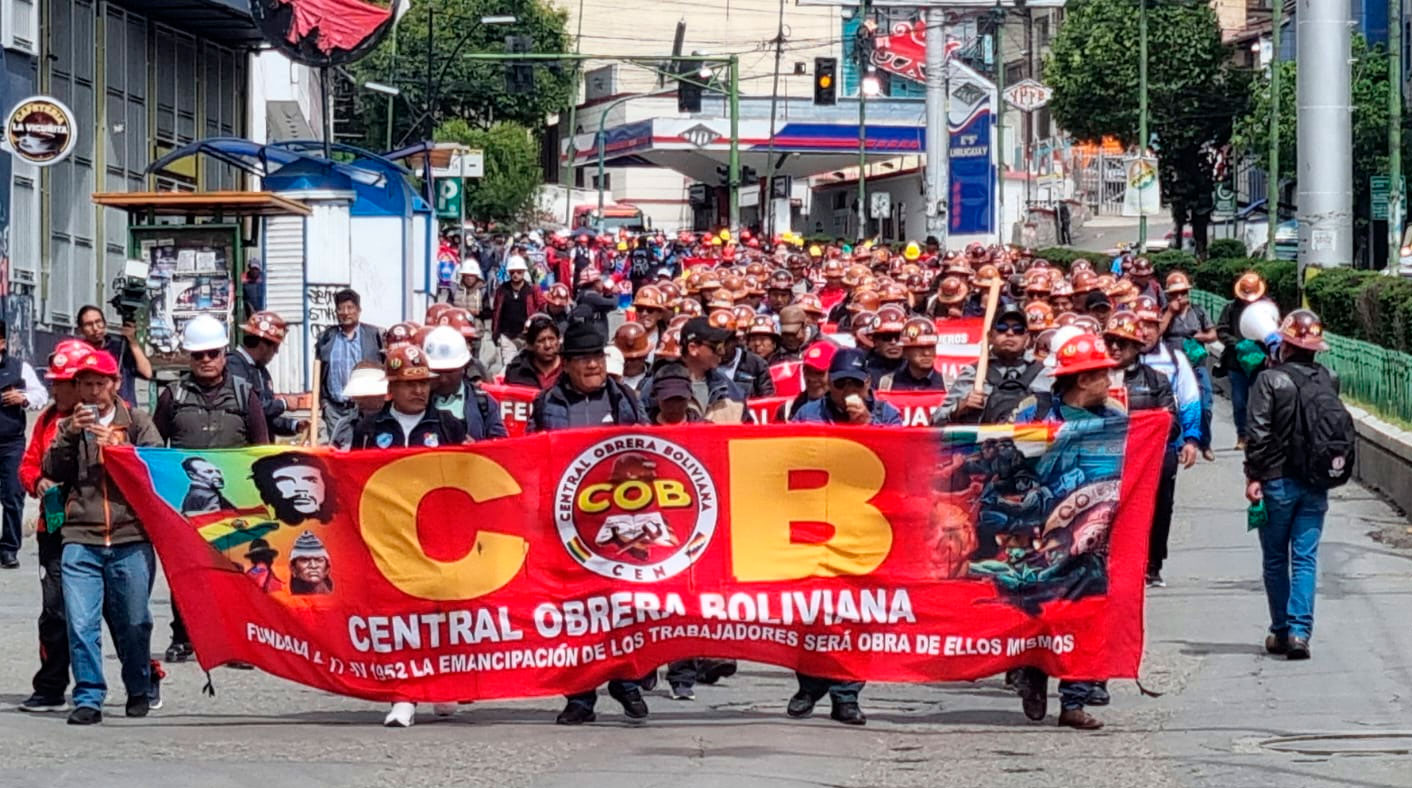
For nearly two months, a general strike was called; sectors of the workforce staged partial strikes, while peasant, indigenous, and neighborhood organizations maintained more than a hundred roadblocks in different regions of the country. Two major national mobilizations in the city of La Paz marked high points in the struggle: the march on May 18–19 and the one on June 10, both led by thousands of workers and residents of La Paz and the Alto, along with workers, peasants, and indigenous peoples who had traveled from different parts of the country.
On both occasions, clashes occurred with the state’s repressive forces. However, although the demonstrations showed an enormous willingness to fight, there was no political or organizational preparation aimed at effectively challenging the government’s hold on power. The absence of centralized leadership bodies for the struggle, combined with the vacillations of the national leaderships and growing government repression, allowed the demonstrations to be dispersed before they could develop into a decisive offensive against the regime.
The mobilization succeeded in putting the government of Rodrigo Paz on the ropes. For several weeks, large regions of the country came under the effective control of the social organizations maintaining the blockades, particularly the Tupac Katari Peasants’ Federation (La Paz Department), sectors of the CSUTCB (Single Trade Union Confederation of Bolivian Peasant Workers), and other indigenous and peasant organizations in the Altiplano, such as the Bartolina Sisa Women’s Confederation and the Ponchos Rojos.
In effect, a dual power structure has existed in Bolivia for over a month. It was these organizations that decided which goods, food, fuel, or vehicles could travel along the country’s main routes and which would be held up at the roadblocks. This situation led to growing supply difficulties, fuel and food shortages, as well as a sharp rise in prices, especially in the cities of La Paz and El Alto, where the economic and political impact of the roadblocks was most intense. While the government retained formal control of state institutions, the mobilized organizations demonstrated a significant ability to influence the movement of goods and the functioning of the economy. The slogan “Out with Paz!” became the unifying force of a movement that brought together miners, peasants, indigenous peoples, teachers, factory workers, neighborhood associations, and broad sectors of the populace. However, despite the enormous willingness to fight demonstrated by the masses, the movement failed to achieve its main political objective: the fall of the government. Understanding the reasons for this situation is essential for preparing for the battles ahead.
Rodrigo Paz, the MAS Crisis, and the Start of the Rebellion
Rodrigo Paz’s rise to power was made possible by the profound political erosion that had accumulated over nearly two decades of MAS governments. The economic crisis—marked by a shortage of dollars, rising costs of living, and the depletion of the natural gas cycle—along with the rift between Evistas and Arcistas [Evo Morales and Luis Arce’s respective supporters], eroded the social and political base that had sustained the MAS movement for years. Capitalizing on this discontent, Paz presented himself as an alternative capable of restoring economic stability and resolving the crisis. Many workers, peasants, and working-class sectors placed their hopes in his promises, not so much because they endorsed his platform, but because of the lack of a political alternative that appeared capable of addressing the crisis. However, as soon as the government’s first measures began to be implemented, numerous activists publicly acknowledged that they had trusted Paz and expressed their outrage at what they considered an electoral deception. The feeling of having been victims of false promises and a genuine political scam helped fuel the rapid growth of the mobilization.
The first months of his term were marked by a neoliberal offensive reminiscent of the austerity plans of the 1990s. Decree 5503 eliminated fuel subsidies and triggered immediate increases in the cost of living. The so-called Land Law opened up new possibilities for the commodification of communal lands. At the same time, the government pushed for economic liberalization, eliminated taxes on large fortunes, froze wages, and promoted new incentives for foreign investment in strategic sectors.
Paz’s agenda sought much more than simply implementing short-term economic measures. It aimed to alter the balance of power established after the 2003 and 2005 uprisings, strengthen the bourgeoisie, and deepen the subordination of Bolivia’s natural resources to the interests of international capital. Paz has proven to be a faithful implementer of Trump’s policies in Bolivia.
However, each of these measures was met with an immediate response in the streets. What began as protests against the rising cost of living and shortages quickly turned into a national uprising that challenged the government’s very legitimacy under the unifying slogan “Paz Out!”
The magnitude of the resistance forced the government to partially back down on several occasions. But these retreats never meant abandoning its strategic agenda. These were tactical maneuvers aimed at buying time, dividing the mobilized sectors, and gradually wearing down a movement that had managed to put the government on the ropes.
The Strength of the Uprising
One of the most important characteristics of the struggle was the breadth of the mobilized sectors.
The COB called for a general strike and brought the organized labor movement to the forefront. FEJUVE once again turned El Alto into the heart of popular resistance. The Tupac Katari Federation, the Ponchos Rojos, and the Bartolinas Sisa Confederation organized blockades that isolated La Paz for weeks. Sectors of the CSUTCB, Amazonian indigenous organizations, urban and rural teachers, factory workers, and transport workers actively participated in the mobilizations. This convergence was reminiscent, albeit only partially, of the great days of insurrection at the beginning of the 21st century.
The demand for Rodrigo Paz’s resignation served as a unifying force. Moving beyond sector-specific demands, millions of people began to question the very legitimacy of the government. For several weeks, a situation developed that was extremely favorable to the popular movement, with the movement on the offensive and the government on the defensive.
The protests and the dual power in Bolivia served as an important example for the Latin American masses. The bourgeois press around the world simply did not report on what was happening in Bolivia to prevent that example from becoming widely known.
The Government’s Strategy: Divide and Conquer
The government’s main strength lay in its rapid realization that it could not defeat the movement through a head-on confrontation. The government’s strategy consisted of negotiating separately with different sectors, offering partial concessions, and fostering specific agreements that would fragment the unity built from the ground up.
At the same time, it exploited the wear and tear caused by weeks of continuous mobilization. Fuel shortages, economic hardships, and accumulated fatigue began to take their toll on numerous sectors.
Meanwhile, the state apparatus intensified the criminalization of protest. Hundreds of activists were arrested, leaders were prosecuted, and communities were repressed. At the same time, the government waged an intense political and media campaign aimed at discrediting the movement, portraying it as an action driven by violent, seditious groups, or those linked to drug trafficking. This narrative was reinforced by high-ranking government officials and spokespeople for U.S. imperialism, who attempted to justify the repression by linking the protests to alleged criminal interests. However, this strategy did not achieve the expected success. On the one hand, the breadth of the movement—which involved workers, peasants, Indigenous peoples, neighborhood residents, and working-class sectors across the country—made it difficult to sustain such an accusation. On the other hand, various scandals related to drug trafficking and timber smuggling networks—the so-called “narcomadera” case—which implicated sectors linked to the state apparatus itself, undermined the credibility of the official narrative. Despite this, the criminalization campaign served as a complement to the police, judicial, and military repression deployed against the mobilized organizations. The passage of the new State of Emergency Law represented a qualitative leap in this policy. The government sought to create a legal framework to expand military intervention and restrict democratic rights with the explicit backing of U.S. imperialism.
The COB and the Problem of Leadership
The role of the COB leadership highlights the main contradiction of the process.
On the one hand, without the COB, the struggle would hardly have reached a national scale. Its call for a general strike and its participation in the main mobilizations in La Paz made it possible to transform social discontent into a political rebellion against the government of Rodrigo Paz.
On the other hand, its leadership showed enormous hesitation and ultimately betrayed the struggle. The COB’s main organized force—the mining proletariat, workers from Huanuni and Colquiri—participated in the pressure tactics through representatives of their organizations, but mining production was never brought to a complete standstill across the board. At various points, they expressed their willingness to march on La Paz and intensify the confrontation with the government. However, the COB leadership refused to call for a genuine general strike that would paralyze the country’s main productive sectors, nor did it move forward with the national centralization of the struggle.
At the same time, the COB also failed to take a firm stance to prevent the government’s policy of separate negotiations. From the outset of the conflict, the government sought to wear down and fragment the movement through partial agreements with different sectors. First, it targeted the mining cooperatives. Following a major mobilization and the clashes that took place in La Paz on May 14, the government managed to reach an agreement with their leaders (FENCOMIM) the next day, removing this sector from the pressure campaign; it subsequently negotiated on several occasions with transport workers and sectors of the teaching profession. Finally, it reached agreements with the COB’s main organized base—the miners of Huanuni and Colquiri—just a few days before the labor federation itself signed the agreement that ended the pressure tactics. Far from combating this divisive dynamic, the COB leadership went along with it, progressively weakening the unity built during the most intense weeks of the mobilization.
The lack of effective coordination and political centralization among miners, factory workers, teachers, peasants, indigenous peoples, and neighborhood councils prevented the accumulated strength from transforming into an offensive capable of effectively challenging for power.
Here lies a fundamental difference from the events of 2003. At that time, the convergence between the labor movement, peasant sectors, and popular organizations reached higher levels of coordination, radicalization, and political centralization, truly calling into question the regime’s survival.
At that time, the strength of the mobilizations—beginning with an effective general strike in which miners played a decisive role—succeeded in dividing the armed forces, leading to the government’s downfall. This had also occurred in 1952 and 1983–85.
A general strike paralyzes the country’s economy much more decisively, in addition to the highway blockades. The weight of the mobilized masses can split the armed forces.
This time, however, that did not happen; neither a true general strike nor a split in the armed forces materialized.
The massive June 10 march, with 40,000–50,000 workers advancing on the government palace, demonstrated the movement’s strength. But it also revealed its weakness. By the leadership’s directive, it was a “peaceful” march, which was not in a position to confront the armed forces defending the government. Not even the miners’ natural weapons—their dynamite—were present.
Thus, the mobilization was sustained solely by the strength of the roadblocks, which prevented a decisive blow to the government and led to the exhaustion of the masses.
Traditional Leaderships and Their Contradictions
The differences between FEJUVE, COB, Tupac Katari, Bartolinas, CSUTCB, and other sectors deepened as the conflict progressed. Some leaderships maintained the demand for Paz’s resignation. Others began to prioritize negotiations for their own demands. These differences reflect deeper political processes.
For years, numerous union and social leaders were incorporated into the state apparatus of the MAS governments. The administration of resources, public offices, and institutional spaces generated processes of bureaucratization that reduced the political independence of many organizations and promoted the co-optation and accommodation of many leaders.
When the struggle brought the possibility of a decisive confrontation with the state to the forefront, these contradictions emerged with full force, culminating in the betrayal by the COB leadership.
Evo Morales and the Strategic Crisis of Reformism
Evo Morales’s position during the conflict also revealed the historical limits of the reformist project built by the MAS. Evo participated at various stages of the process, particularly through the Federations of the Cochabamba Tropics and the so-called March to Save Bolivia. He also repeatedly denounced the attempts by the U.S.-backed government of Rodrigo Paz to arrest him and politically ban him, presenting these actions as part of a broader offensive against popular organizations.
However, despite his influence over important sectors of the peasantry and coca growers, Evo was unable to offer a political direction capable of unifying and leading the movement as a whole. Instead of promoting a strategy that would allow the mobilized forces to rally around a common goal, he ended up becoming part of the contradictions that ran through the movement itself.
These contradictions were even laid bare in Evo Morales’s final statements. At first, he spoke out against the betrayal by the COB leadership. Later, when the federations of the Trópico announced a temporary halt to their pressure tactics, Evo publicly stated that he had never called for Rodrigo Paz’s resignation, thereby distancing himself from one of the main slogans that had united broad sectors of the mobilized masses for weeks. The statement provoked criticism and ridicule among numerous activists and highlighted, once again, the political vacillation of a leadership incapable of offering a consistent solution to the crisis.
Criticism of the Leadership by the Grassroots
One of the most significant political phenomena to emerge from the struggle was the grassroots growing to question their own leadership. At expanded meetings, town hall gatherings, roadblocks, and union meetings, increasingly strong criticism emerged not only against the government of Rodrigo Paz but also against the movement leaders who steered the process. For broad sectors of mobilized workers, peasants, indigenous peoples, and residents, the various leaderships must be held accountable for the decisions made during the conflict and for their role in the outcome of the struggle.
However, the most profound criticism was directed at the COB leadership; the labor federation abandoned the demand for Rodrigo Paz’s resignation—which had been one of the main factors uniting the movement—to focus instead on a negotiating table with the government. For many activists, this shift meant abandoning the central political objective of the struggle precisely when the government was at its weakest.
The capitulation became even more evident when, after publicly declaring that the release of political detainees and those facing persecution was an indispensable condition for continuing negotiations, the COB leadership abandoned that demand in less than twenty-four hours and proceeded to sign an agreement with the government. That was a betrayal of the entire movement.
To this day, what is publicly known about that agreement is, fundamentally, the granting of a ninety-day period to discuss the demands put forward by the labor federation. In other words, the COB leadership suspended its pressure tactics without having secured the main demands that had mobilized thousands of workers and popular sectors for weeks.
For many activists, this decision represented an even more serious betrayal because it was immediately followed by the government’s declaration of a state of emergency. While the COB was calling off the mobilization, Rodrigo Paz used the truce to strengthen the state’s repressive mechanisms, restrict democratic rights, and prepare new offensives against the popular movement. In other words, the government shifted from the defensive to the offensive, taking advantage of the betrayal by the COB leadership.
Will this experience have profound political consequences in Bolivia? Hopefully, thousands of activists will draw conclusions about the limits of traditional leaderships and the need to build a leadership willing to carry the struggle through to the end, without subordinating it to negotiations that impose defeats.
The Prospects for the Struggle and the Imperialist Offensive Against Bolivia and Latin America
Although the movement has entered a period of retreat following the signing of the COB agreement and the decree declaring a state of emergency, the causes that sparked the rebellion remain intact. The government of Rodrigo Paz lacks the economic resources necessary to respond to the main demands raised by workers, peasants, indigenous peoples, and the popular sectors. The fiscal crisis continues, the shortage of dollars has not been resolved, and long lines for gasoline remain a part of daily life for the population. Nor have inflation, the rising cost of living, or the accumulated discontent with government policies disappeared.
For this reason, the current truce is unlikely to lead to a lasting stabilization of the regime. The movement has suffered a defeat due to the betrayal by the COB leadership, when it could have succeeded in bringing down the government.
However, this is not a strategic defeat. The economic and social contradictions that gave rise to the uprising remain present and could spark new outbreaks of struggle at an unforeseeable time.
At the same time, the Bolivian experience foreshadows processes that will likely unfold in other countries on the continent.
The Bolivian crisis is part of a broader international context. Lithium, strategic minerals, and other natural resources place Bolivia and Latin America at the center of the dispute between the United States and China. China seeks to consolidate the investments and contracts secured during the MAS governments.
Neither of these powers acts in the interests of Bolivian workers, peasants, and indigenous peoples.
Trump is fighting through Paz for Bolivian lithium, just as he has secured Venezuelan oil through his invasion of the country and the kidnapping of Maduro. U.S. imperialism relies on its puppet governments to drive out Chinese imperialism and recolonize the continent. Paz and Trump have achieved a victory.
Faced with the deepening global capitalist crisis, governments subordinate to imperialism seek to secure control over strategic natural resources through austerity measures, privatizations, attacks on democratic rights, and the strengthening of repressive apparatuses. The United States’ open intervention in support of Rodrigo Paz’s government demonstrates that the struggle for natural resources and political control over Latin America occupies an increasingly important place in imperialist strategy.
For this reason, international solidarity with the struggle of the Bolivian people is a fundamental task. The workers and peoples of Latin America must prepare to confront a continental offensive driven by governments that act as local administrators of imperialist interests. The defense of natural resources, democratic rights, and social gains can only be guaranteed through the unity of struggles across the continent and the building of revolutionary organizations capable of confronting both the national bourgeoisies and the various imperialist powers vying for control of Latin America.
Strategic Tasks
The main lesson from the events of 2026 is that the Bolivian masses retain their enormous capacity for struggle. The fundamental problem was not a lack of willingness to fight, nor was it a lack of social organization. What was missing was a leadership capable of carrying the struggle through to its ultimate conclusion.
Experience demonstrates once again that it is not enough to demand the fall of a government. It is necessary to build an alternative to power. The COB, along with peasant, indigenous, and neighborhood organizations, possesses enormous historical authority. But that authority must be placed at the service of a strategy independent of any bourgeois variant.
The perspective remains the building of democratic organizations of workers, peasants, indigenous peoples, popular sectors, and youth that can effectively challenge for political power and reorganize the economy on new social foundations. As long as power remains subordinate to the laws of capitalism and the interests of imperialism, crises will continue to recur.
That is why the main strategic task remains the building of a revolutionary leadership capable of transforming the enormous strength demonstrated by the Bolivian masses into a real alternative for a government of workers, peasants, and indigenous peoples. Only in this way can the unfinished tasks of the Bolivian revolutions of 1952, 2003, and 2026 be resolved.