
Paz Enacts State of Emergency and Intensifies Repression of Leaders of the Struggle
In the face of any attempt to impose an authoritarian solution to the Bolivian crisis, let us respond with more organization, more unity, and more solidarity.
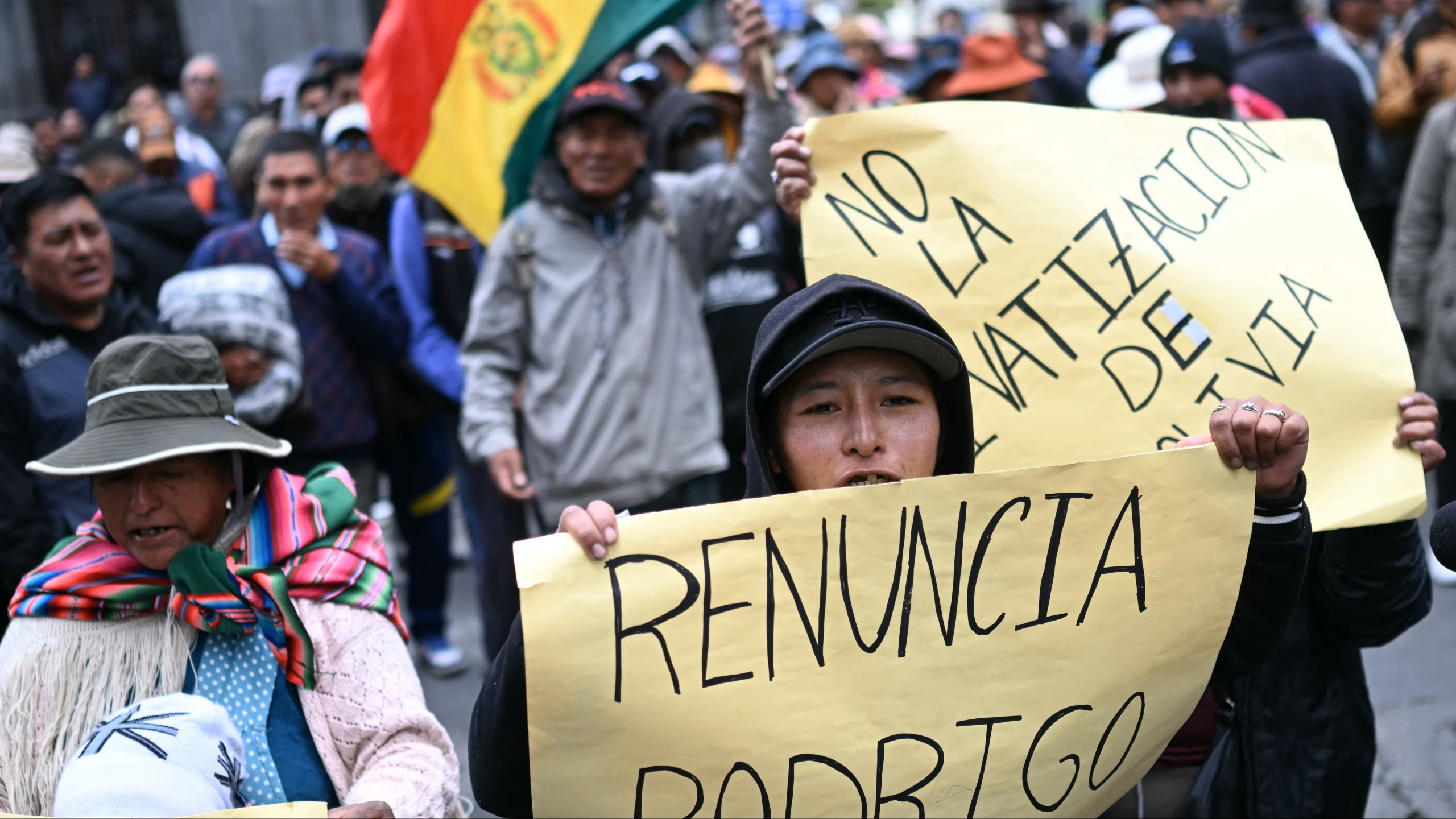
The passage of the new Law on the Regulation of States of Emergency by Rodrigo Paz’s administration marks an escalation of repression by the State amongst the political and social crisis that is taking place in Bolivia. Although the executive branch has not yet formally ordered the State of Emergency, the approval of a regulation that expands the authority of the Government and the repressive forces is happening amidst a scenario of increasing mass mobilizations, blockades, and protests. The law constitutes a warning/ regarding the direction the government intends to take towards the growing popular discontent. While the legal framework is being prepared for a potential harsher intervention of security forces, union, peasant, and Indigenous leaders are already facing severe persecution and arrests.
The State of Emergency Law: License to kill
Unions, grassroots organizations, Indigenous groups, and numerous defenders of democratic rights agree that the new law represents impunity for crackdowns against protests. The regulation expands the executive branch’s ability to intervene in internal conflicts and modifies the limits that previously regulated the actions of the armed forces and police.
One of the most noticeable differences between the new Law on the Regulation of States of Emergency and the previous Law 1341 is the expansion of powers of the executive branch and the increased safeguards granted to repressive State forces. While the previous law established that the armed forces could only intervene in a complementary role to the police when the latter had been essentially overrun and it maintained individual legal, civil, and administrative liability for its personnel, the new rules incorporate the concept of “sudden operational failure” to justify joint action of the military and police. In addition, Article 26 established that the actions of the armed forces and police during the state of emergency will be presumed to be lawful. Article 27 also guarantees state legal representation to service members that face charges for incidents that may occur during the operations.
For those who are protesting, the law constitutes a veritable “license to kill,” as it prioritizes the defense of order above democratic freedoms and the peoples’ right to protest.
Increased repression and arrest of several leaders
Although the state of emergency has still not been declared, reports regarding political persecution and repression continue to mount. The crackdown has escalated as the government lays the groundwork for an eventual declaration of the state of emergency. According to information released in recent days, at least 365 people were arrested during the more than five weeks of conflict gripping the country.
Among the most recent detentions are that of Justino Apaza, president of the Federación de Juntas Vecinales (FEJUVE, or Federation of Neighborhood Associations), who was kidnapped by hooded men in a vehicle without license plates and sent to pretrial prison based on accusations of terrorism, criminal conspiracy, and public incitement to commit a crime; there was also Bernabé Gutiérrez, leader of the Ponchos Rojos; and the arrest of five national leaders of the COB on June 7th. According to a complaint by the Central Obrera Boliviana (COB, Bolivian Workers’ Union), the leaders were driving on a public road in a private vehicle in the city of El Alto and were intercepted by hooded individuals wearing civilian clothing who were armed and did not identify themselves or show arrest warrants. During the operation, they threw tear gas into the vehicle to force them to get out, and the leaders were subsequently transported to FELCC facilities (the Bolivian National Police).
This policy seeks to create fear in the sectors that are protesting and to undermine mass mobilizing. Thus, the approval of a new state of emergency law is part of a strategy that has already begun to contain the social movement by force.
Paz follows the script of the Right and Trump
During the passage of the new State of Emergencies Law, President Rodrigo Paz has justified the crackdown with the familiar rhetoric of associating the protests and roadblocks with a network tied to “narco-terrorism.” This is not new rhetoric in Latin America. In the last few years, right-wing governments and the sectors aligned with the foreign policy of the United States have used labels such as “terrorists,” “subversives,” and “narco-terrorists” to discredit and criminalize the social struggles, justify intervention by repressive forces, and to restrict democratic freedoms. By presenting the mobilized/ sectors as a threat to national security, the government wants to de-legitimize the demands that originate from the economic crisis, the deteriorating quality of life, and popular discontent. The supposed fight against drug trafficking, terrorism, or organized crime is constantly used as an argument to increase political, diplomatic, and military interference of the United States in Latin America. In this context, Paz’s speech constitutes an attempt to prepare public opinion for a further escalation of repression, to legitimize the arrests of union leaders, peasants, and Indigenous people, and to convince the population of the need for imperialist interference in the country.
Thus, once again we condemn Lula’s position, who, under the pretext of “respect for democratic institutions and the rule of law,” has sided with the Paz government against the workers’ mobilization.
Freedom for those imprisoned for the struggle! We call for the broadest international solidarity
The struggle unfolding today in Bolivia transcends national borders. Its outcome will have consequences for all working people, campesinos, and indigenous peoples in Latin America, who face an increasingly aggressive offensive by right-wing governments, large transnational corporations, and imperialism against democratic rights, natural resources, and the living conditions of the poor and working people.
A victory for the popular mobilization in Bolivia would strengthen the struggles of the peoples throughout Latin America against austerity measures, repression, and the plundering of natural resources; while conversely, a defeat would pave the way for new offensives against social and democratic gains across the region.
International solidarity is not only an act to support the Bolivian people, but also a way to defend the common interests of Latin American peoples in the face of imperialist domination and policies that serve the economic elites.
That is why it is essential to build the broadest unity of action in defense of the Bolivian people’s struggle and the freedom for the detained and political persecuted.
We call for international solidarity from trade union federations, peasants’ organizations, indigenous movements, and democratic and human rights organizations throughout Latin America and the world. The defense of democratic freedoms in Bolivia is a cause that concerns all workers and all peoples that face austerity policies, persecution, and the criminalization of protests.
We must promote statements, publicity campaigns, public events, and solidarity actions at Bolivian embassies in different countries to demand the respect of democratic rights and the freedom of all those who have been detained.
History shows that when governments try to resolve social crises through repression, national and international solidarity becomes a fundamental weapon of the people. In the face of any attempt to impose an authoritarian solution to the Bolivian crisis, let us respond with more organization, more unity, and more solidarity.
Immediate release of all those detained for the struggle!
Down with criminalizing social protest!
Long live international solidarity with workers and the people!
All power to the COB!
First published here by the IWL


