LONG LIVE THE WORKERS OF IRAN ! ONWARD TO AN IRANIAN REVOLUTION !
Every uprising in Iran reminds us clearly, that the clerics are willing to bathe Iran in blood to stay in power.
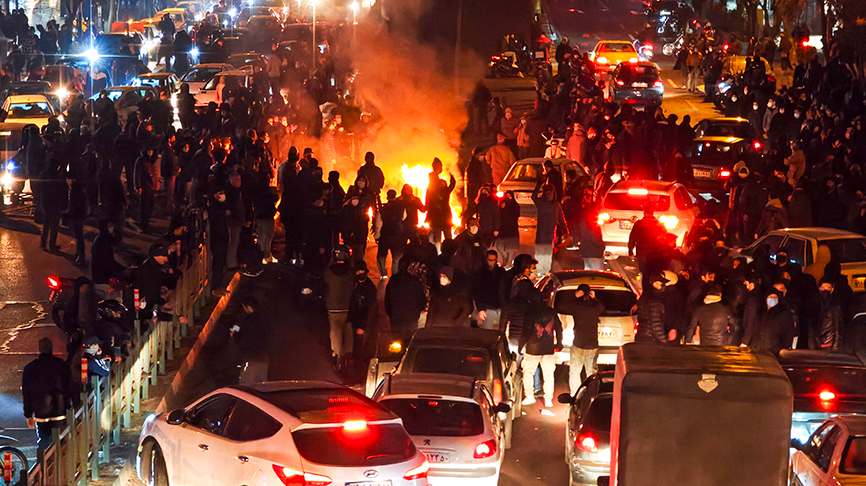
On the 28th of December, Iran’s Bazaaris (petty bourgeois shopkeepers, store owners) declared a general strike, amidst a falling economy and runaway inflation. This strike has now spiraled into a nation-wide uprising against the Islamic regime.
Every city in Iran has been gripped by mobilizations, from Tehran to Shiraz, to Isfahan and Yazd. The streets are scene to tens of thousands, perhaps hundreds of thousands of people in protest, numbers that are impossible to mobilize purely on the basis of the Bazaaris alone. It is only possible if the widest sections of the country’s youth and working class have joined into the mobilization.
The mobilization in Iran is unprecedented in its sweep and scale, far larger than the protests we have seen in the recent past. As such, this uprising represents perhaps the greatest threat to the power of the rule of the Mullahs, a power that has been ruling Iran almost unchecked for most of the last fifty years.
Iran is the latest in the string of pre-revolutionary uprisings in South Asia, beginning from Sri Lanka, with the latest being in Nepal. In two of these uprisings the protests have been able to overthrow the incumbent government, namely in Bangladesh and Nepal. It remains to be seen whether Iran will go this way or not, but the present protests show much promise of such an overthrow. It is no surprise therefore, that this has brought on unprecedented violence from the state.
Unofficial sources suggest that the death toll from Iran’s crackdown may already exceed three thousand deaths, with thousands more imprisoned and injured. There is at present, a total nationwide internet blackout making communication between Iran and the outside world nearly impossible.
It is impossible to ignore the context of these protests, nor can we ignore the machinations of imperialism operating from behind the scenes. The pre-revolutionary situation in Iran comes in the context of a severe crisis of capitalism that has gripped the world, and particularly that of West and South Asia. Iran is uniquely positioned as a bridge between West and South Asia, both in the geographic sense and historical sense. A successful revolutionary overthrow of capitalism in Iran will have its direct and immediate impact on the Levant, the Gulf States, Central Asia, and the countries West of South Asia (Afghanistan and Pakistan).
The destruction of Islamic fundamentalism in Iran would throw every regime of this kind into crisis, while giving imperialism a unique challenge. Rather than the conciliatory theocratic regime whose anti-imperialism is limited to useless rhetoric, US imperialism would have to deal with Iran of workers and youth, which would be genuine in its commitment to ending Zionism and the despotic monarchies of the Gulf.
It is not without reason, that the imperialists are scrambling their assets to make a vain attempt to take control of the protests, all the while the reactionary mullahs ramp up their repression of workers and youth. Between the national reactionaries on the one hand, and the forces of US imperialism on the other, the workers of Iran have two enemies to overcome to succeed in their revolution. Iran is a country which while not colonized, has been a historical victim of imperialism. The Iranian revolution will not succeed, unless it can bring about a social revolution, while also defending Iran from imperialist aggression.
Past protests
The present Islamic regime in Iran was born from betrayal, as a result of the defeat of a workers and youth revolution against imperialist domination in 1979. It was a victory made possible by the failure of the Tudeh party to fight the reactionaries and win over the masses of petty bourgeois and peasantry in Iran. The Islamic regime that emerged was not nearly as popular as they might now pretend to be, but by positioning themselves as defenders of Iran against imperialist aggression, the Ayatollah could rally wide sections of Iran’s population in support of itself. As such, every time the regime faces crisis, it pivots to nationalism, confirming Samuel Johnson that “Patriotism is the last refuge of the scoundrel”.
Crisis is not new to Iran, not long after the Ayatollah took power and established the Islamic Republic, Iran was plunged into a war with what was then a U.S.-aligned Iraq. The war took hundreds of thousands of lives, but cemented the regime of the Ayatollah. The crisis did not weaken the regime, but rather strengthened it and its anti-imperialist credentials. When recalling this legacy isn’t enough, it pretends at passing reforms. The present wave of protests should be seen in connection to the first wave of protests which erupted, shortly after the world financial crisis of 2009.
The 2009 protests
The 2009 protests erupted at a time when several countries saw large scale protests and mobilizations of workers and youth. Iran’s youth and workers were not ignorant of this wave. The trigger for the 2009 protests was the election victory of Mahmoud Ahmedinejad in the 2009 elections. The election was riddled with irregularities and widespread rigging to ensure a right wing loyalist of the Ayatollahs won. The protests was the first time in this century that Iran’s workers and youth erupted in open revolt against the Islamic regime. The regime responded with brutality against the protesters, hundreds were killed and thousands were arrested. The protests were spontaneous and not led by any organized political force, they eventually fizzled out in the face of repression. As an indirect outcome of the protests, the Islamic Republic had to pivot to reforms, and Ahmedinejad lost in the 2012 elections and a ‘moderate’ reformist leader, Hassan Rouhani became president.
All the while, the specter of US economic aggression loomed over Iran. Since the 1980s, the US has maintained an economic embargo on Iran in one form or another. Since 1995, sanctions directed against Iran’s nuclear programme were put in place, a programme which had its roots in the regime of the Shah. Iran was further attacked by economic sanctions during the presidencies of George Bush Sr and George W Bush through the 90s and early 2000s, over Iran’s support for Hezbollah and right wing sections of the Palestinian resistance. These sanctions forced Iran into adopting a highly militarized state capitalist system, maintaining a large paramilitary and armed forces.
The 2017-2019 uprisings
The system was always prone to crisis, sustained only on the strength of oil exports which Iran can only send to certain countries. Sanctions were progressively tightened following President Ahmedinejad’s policy of lifting the ban on uranium enrichment. Since then, Iran’s economy has gone from crisis to crisis, exacerbated by the crisis in world capitalism itself. Though buoyed by oil exports, the Iranian Islamic regime faced protests again some years later in 2017-2018, culminating in the 2019 general strikes and protests. The protests were against price increases of essentials, and became widespread when paramilitiaries opened fire on protesters in Mahshahr. The uprising was very similar to the current mobilization, the protests were nationwide, coupled with a general strike of workers throughout Iran. The regime once again reacted with harsh repression, causing the deaths of at least 1000 protesters, and the arrest of 20,000. The brutal pacification of the protests only brought about a temporary respite for the reactionary regime.
The COVID pandemic hit Iran as harshly as the rest of Asia, the Islamic Republic was soon confronted with systemic failures which caused the deaths of hundreds of thousands of Iranians. Much as the rest of the world, the pandemic upended the already strained economy of Iran, creating one of the most severe crises in the history of the Islamic Republic. The lockdowns and pandemic only temporarily stabilized the autocratic rule of the clerics, but soon the pent up anger of the population would erupt again.
The 2021 strike wave
In 2021, another wave of protests hit Iran, but this was quite unlike the 2009 protests, led largely by liberal minded students and youth, with limited if any participation from Iran’s working class. The 2021 wave of workers strikes were entirely led and consummated by the oil workers of Iran, causing the most severe disruption to the Islamic Regime’s economy, striking at the heart of the regime’s power. The basic demands of the workers were an increase in wages which had been stagnating for a decade, at a time when Iran was in the grips of an inflationary crisis. The workers demanded better conditions for work and affordable housing.
The strike was accompanied by a wave of unrest that gripped many parts of the country. People protested in Khuzestan which was suffering from a severe water shortage, metro workers in Tehran struck as well, while refinery workers at Qeshm and the Farad Bidkhoon power plant workers also struck work. The strike wave in Iran lasted from late June to late July, and ended in defeat as the Islamic regime once more responded with harsh repression. Police firing caused deaths in Khuzestan, while oil workers were summarily fired from their jobs and placed under arrest. While the strike did not have any immediate outcome, it shook the regime. The anger of the public did not lay suppressed for long, and would erupt again a few months later.
The Mahsa Amini protests
The Mahsa Amini protests broke out in September of 2022, over the execution of a Kurdish woman, Mahsa Amini, by Iran’s morality police, the so-called guidance patrol. The excessive use of violence to enforce an already unpopular hijab rule, triggered a population that had only recently struck work and protested over inflation. Protests broke out in Iranian Kurdistan, in the town of Saqqez which was Mahsa Amini’s hometown. Here too, the regime cracked down with violence, but this did not prevent the protests from spreading. In the city of Chahbahar protests erupted after reports emerged of a police chief raping a fifteen year old girl. The spark was lit once more to set a tinderbox ready to explode. This uprising was widespread, but was driven primarily by university students and youth activists. There was once again, no organized leadership. As was the case with earlier protests, this fizzled out over time in the face of harsh repression by the regime. By 2023 the protests had largely died down.
The peace might have lulled the Islamic regime for a time. Iran’s later intervention against the Israeli genocide on Palestinians brought it into conflict with US imperialism. Israel’s strikes on Iran did not weaken the regime, on the contrary it only strengthened it, even if momentarily. For a time, the Iranian regime could once more put on their anti-imperialist mask to show some legitimacy to their people. Threatened by US imperialism and its rabid proxy in Israel, the clerical rulers of Iran could mobilize some support on their side, appearing as defenders of Iran against an aggressive imperialism. That charade has now ended.
The current protests raise many of the same issues that were at the forefront in the 2017 protests, the 2019 protests and then in the 2021 general strike. At the same time, the protests put into question the legitimacy of the Islamic Republic, which is willing to pour money into enforcing a hijab rule, but has no money to stabilize price of essentials. The clergy and the failure of their supposed anti-imperialism was revealed when they failed to do anything of substance against Israel when it conducted its genocide of Gazans.
The ongoing protests in Iran are perhaps more intense than the protests in 2019, the government once again responds with repression, imposing an internet blackout and unrestricted violence on protesters. Various sources suggest a possible death toll far exceeding that of 2017 or 2019, and might run into thousands. History shows that tyranny can only secure power for some time, even the last ten years of Iranian history shows, that repression can only work to momentarily buy some time before protests erupt again.
Much like the scattered and ‘leaderless’ Quit India movement in 1942, leaderless, largely petty bourgeois movements fail in the face of organized repression at the hands of an undemocratic state. The period between repression and recovery may be short or long, in case of Iran, the periods of passivity are growing increasingly short, the fear of repression is slowly disappearing.
No to the mullahs! No to the US!
Far from the rhetoric, the Iranian clerics are nothing but the instrument of capitalist rule in Iran. Rather than brave defenders of Iran against imperialism, they are the ones who will be the first to cut a deal with imperialism, either as a partner of hegemonic US imperialism, or by aligning itself with Russian imperialism. Iran’s Islamist reactionaries are today hand in glove with Russia’s imperialist war on Ukraine. Their claim of fighting imperialism in West Asia rings hollow, when they openly and actively help Russia’s imperialist war on Ukraine. Not to mention, Iran itself oppresses several nationalities within its borders.
The killing of Mahsa Amini wasn’t just a case of extreme moral policing, it was also an incident of national oppression. The Kurdish and Baloch populations have their cultural and linguistic rights suppressed in Iran, all in the interest of maintaining the iron grip of the clergy. The military and religious bureaucracy have control over much of Iran’s economy, holding the people hostage with a bloated and privileged militarized elite holding up the clerical ruling clique.
The clergy would rather make a compromise with U.S. imperialism and freely export oil, rather than be locked into some kind of permanent war with the West. The only reason Iran’s economy hadn’t collapsed sooner is because China, Russia and India had helped it stay solvent with investments and trade. As U.S. imperialist pressure grows, and the capitalist world order is plunged into terminal crisis, the options for the Iranian regime to rule in peace grow slimmer.
Every uprising in Iran reminds us clearly, that the clerics are willing to bathe Iran in blood to stay in power. The current protests will be no different in this regard. The Iranian regime is already ramping up repression, and various reports suggest thousands of protesters being killed in massacres. Reports have also emerged of the regime’s police forces using chemical weapons on protesters.
Yet, the people of Iran, its workers and youth, have unfathomable bravery. They continued to defy the bullets and repression of the Islamic Republic to protest for better working conditions, against living costs, and dictatorial policing. In the midst of these protests, US backed puppets with an outsized media presence have been highlighted by mainstream western media as the solution to Iran’s problems.
Since the revolution of 1979 which ended the rule of the US aligned Shah, the forces of US and British imperialism have sought retaking control over Iran and its resources. Restoring western Imperialist dominance over this most strategic and powerful country of Asia has always been on the minds of policy makers in Washington and London. It is why they conducted the coup to overthrow Mossadegh in 1953, and stepped up economic aggression against Iran from the 1980s until today.
The people of Iran do not need to choose between two evils. The clerical regime is no defense against imperialism, it is at best the backdoor to other non-western imperialist interests, chiefly that of Russia, the largest foreign investor in Iran. It must be remembered, Russia too was one of the historical imperialistic hegemons over Iran, and the country that had done the most damage to its sovereignty over the course of the 19th century.
The protests represent a golden chance for the Iranian working class to break free from the shackles of reactionary dictatorship, and chart a new course for their country. The moribund capitalist dictatorship that the clerics offer, must be replaced by the democracy of the Iranian working class.
DOWN WITH THE MULLAHS !
LONG LIVE THE WORKING CLASS AND YOUTH OF IRAN!
ABOLISH THE IRGC ! ABOLISH THE BASIJIS !
FOR WORKER’S CONTROL OVER THE OIL INDUSTRY !