Trump’s environmental rollbacks hurt the Black community
”As a result, no longer will the federal government address racial discrimination in environmental policy considerations.”
Upon returning to power, Donald Trump wasted no time in resuming his environmental destruction. With a stroke of his felt-tip pen, Trump revoked Executive Order 12898, the “Federal Actions to Address Environmental Justice in Minority Populations and Low-Income Populations.
”As a result, no longer will the federal government address racial discrimination in environmental policy considerations.”
The Environmental Protection Agency closed the Office of Environmental Justice, as if to add another exclamation point to the administration’s racist polices. It allows corporations to continue to pollute in the Black community unchallenged. Even with significant evidence, Black communities rarely have received anything approximating justice, whether Trump was in the White House or not.
As was the case in his first term, Trump eliminated or weakened nearly a hundred environmental regulations, according to the Sierra Club. One of the more significant was the “endangerment finding” that provided the legal basis for the federal government to regulate greenhouse gas emissions. These emissions are the cause of the warming of the planet.
Regarding the “endangerment finding,” Samantha Gross and Ryan Beane write in a commentary for the Brookings institute: “They want to remove it root and branch in a way that will make it more difficult for future administrations to reverse.” The president and his administration argue that regulations hinder growth and place undue burdens on business.
EPA’s “endangerment finding” has its origins in the Supreme Court’s 2006-2007 case, Massachusetts v. EPA. The agency argued that the Clean Air Act did not mandate it to enforce regulations to address climate change, and that causal links between global heating and greenhouse gases had not been established. The agency lost that argument; the court affirmed that greenhouse gases, such as carbon dioxide, qualify as air pollutants.
Two years later, the EPA accepted the scientific belief that greenhouse gases were health hazards and contributing to the climate crisis. In January 2026, however, the EPA reversed that finding, removing the legal basis for regulating emissions from vehicles. Previously, in 2012, the majority of the Supreme Court ruled in West Virginia v. EPA that the agency does not have the authority under the Clean Air Act to broadly limit greenhouse gas emissions in a way that would change the country’s power system.
The EPA “has a deplorable record of responding to discrimination complaints” (Equal Justice Initiative: “Environmental Injustice in the Black Belt”). In 2018, it dismissed a complaint against Alabama’s Department of Environmental Management (ADEM) for failure to address the effect of toxic and radioactive materials on poor Black communities. When the ADEM rescinded its civil rights policy, this became the basis for the EPA to dismiss the complaint. ADEM’s abolition of its policy raises the question: what environment is it managing? The same could be asked of EPA.
The city of Uniontown, Ala., (predominantly Black) has multiple environmental hazards that include coal ash containing arsenic and radioactive material, and numerous sources of water contamination. That should be more than enough evidence to pursue the case.
Louisiana’s “Cancer Alley,” which encompasses the region between New Orleans and Baton Rouge, is so named for its high rates of cancer. In 2023, Jeff Landry who served as Attorney General (now governor of Louisiana) sued to stop EPA from investigating environmental racism. The agency dropped the case. Governor Landry is a key ally of the state’s oil and gas industry.
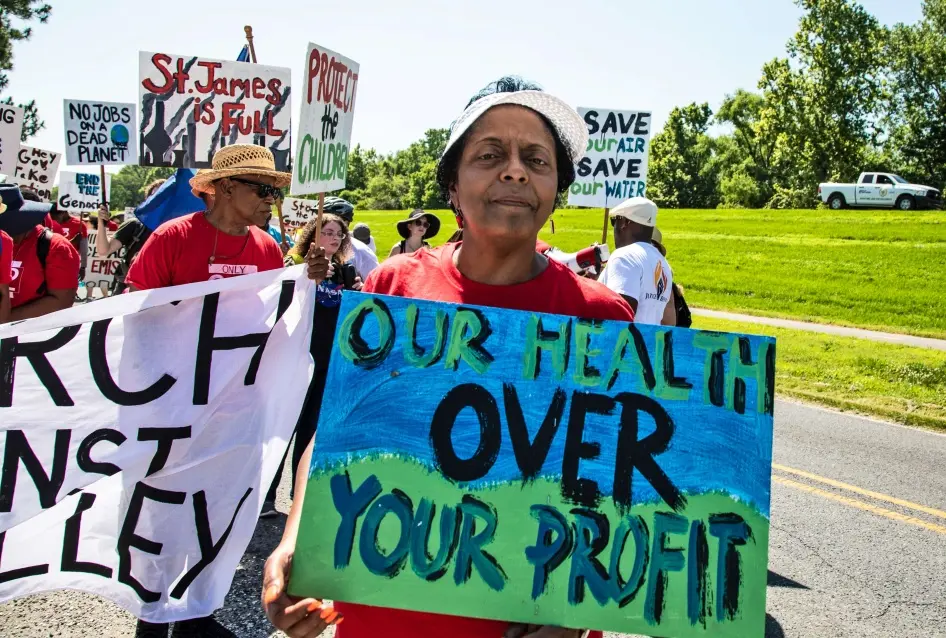
St John the Baptist Parish exemplifies the racial history of the U.S. “As the regional economy has shifted from chains and plantation slavery to smokestacks and petrochemical plants,” the descendants of the former slaves who founded the cities bear the brunt (capitalbnews.org, “The Court Ruling that Guaranteed a Future of Environmental Racism”). In August 2024 a Trump-appointed federal judge in the U.S. District Court for the Western District of Louisiana ruled that the Department of Justice could not enforce the disparate impact requirements under Title VI of the Civil Rights Act. The courts as an avenue to fight against environmental discrimination is becoming a much narrower street.
These communities must fight to survive. Scientific research established links between climate change and hazards to human health, as well as a correlation between the geographical proximity of predominantly Black communities near polluting industries and high rates of disease.
Exposure to particulate matter (PM2.5) is a significant contributor to a wide range of illnesses. PM2.5 are tiny particles, often emitted from oil and gasoline emissions, that enter the body through the respiratory system and into the bloodstream. Black communities are disproportionately affected by this exposure and are more likely to die than other racial and ethnic groups, according to a study conducted by Stanford Medicine. Proximity to polluting industries was the primary contributing factor to higher rates of disease. African Americans have historically been trapped in location populated by refineries, and other industrial polluters.
African American communities “suffer more from storms and flood events, extreme heat, infectious disease and disruptions to labor markets, all of which are occurring more frequently because of climate change” (clasp.org, “The Trump Administration, Earth Day and Environmental Racism”).
This is not a result of the neglect of one agency or even the malevolence of the government. It follows the logic of capitalist production. From primitive accumulation of capital, which snatched resources from native populations (and continues today), dispossession and displacement, forced labor, and the creations of ghettos and reservations all are features of capitalism. Affected communities are condemned to a slow death. They personify what is to come as the crisis becomes more acute. Trump is just the front man for this band of destroyers. He represents a system that extols the virtues of “creative destruction.” This is destruction for the sake of economic growth.
“Growth for the sake of growth is the ideology of the cancer cell,” wrote Edward Abby. To save the patient, radical medicine is necessary. Defeating environmental racism is a victory for the entire working class. We must demand an end to the system that like a metastatic cell dooms us and the planet.
First published here by Workers’ Voice
(Top photo) Julie Dermansky. (Below) James Jordan.