
The Struggle of the Bangladesh Garment Workers
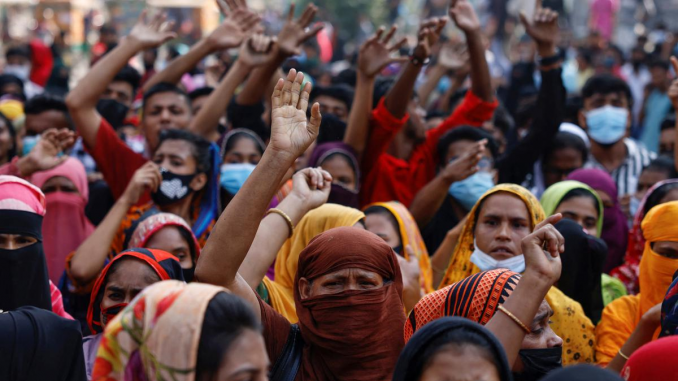
The first week of November saw the garment workers of Bangladesh once again on the path of struggle. On 1 November, workers blocked the Dhaka–Tangail Highway in Gazipur and a road at the Mirpur 10 intersection in Dhaka. Thousands continued protesting around Dhaka after the government’s wage board announcement. Police fired tear gas and sound grenades during clashes with protesters, the fight resulted in several workers being injured. According to The Daily Star, almost all RMG factories at the Mirpur area, and up to 50 factories in Ashulia and Gazipur were shut down by the protests.
The protests did not stop despite the deployment of thousands of police personnel and violence. Over the days the protests grew until up to 500 factories were temporarily shut. The protests continued to intensify, as did the policing. The matter came to a head when a worker named Toufiq Sheikh died from injuries following an attack by thugs hired by a factory management. This showed that the garment workers were willing to face the bullets and batons of the police and risk their lives, but for what ? The issue at the heart of these protests is the demand for the minimum monthly wage to be raised to Tk 30,000 ($241) from its present Tk 12,500 ($100).
Background
The garment industry accounts for 85% of Bangladesh’s exports, amounting to $55 billion. Most of the garment industry is focused on making clothes for fast fashion, cheap and expendable clothing which finds its way to garbage dumps and oceans after being worn out quickly.
Most of the money finds its way to the pockets of the factory bosses and owners, while the workers have to make do with an average wage of 12500 ($100 a month). The low costs of labour is one of the key factors that attracted global brands to source their supplies from Bangladesh, and turned it into a textile powerhouse, something Bengal was known for since the middle ages.
This progress was achieved on the backs of 4 million workers, most of whom are young women, and most of whom are the only breadwinners of their family. From sexual abuse and torture at the workplace to systematic exploitation with a starvation wage that is barely above the UN poverty line.
These conditions pushed the garment workers repeatedly on the path of struggle. Each strike, or protest, resulted in an incremental gain. The poverty line wage of Tk 8500 ($72) was increased to 12500 ($100). In 2012 and 2013, the garment workers staged one of the largest protests in its history, resulting in a 77% wage hike, but this only brought it to Tk 5300 ($68 at 2012 prices). This victory was achieved despite severe repression from the garment bosses and the police that served them.
The pattern becomes obvious, each wage hike in the industry from 2010 has been the result of workers mobilizations. The garment workers have braved repression from the bosses and the state forces, because a wage isn’t merely a question of a few dollars, it is a question of survival. Rising inflation eats into worker’s earnings, which are already near poverty rate. In 2013 they won a 77% wage hike following large scale strikes in the aftermath of the Rana Plaza disaster, then in 2018, another major wage hike followed 1,50,000 workers going on strike in a series of protests and strike actions across the industry. This raised the wage up to Tk 8500. Another wave of strikes occurred in the garment sector in 2022 and 2023, with half of all strikes reported that year coming from the garment industry. This was followed by another wage hike which brought the minimum wage to 12,500 ($100).
The exploitation of the garment workers and their fight against it was one of the fixtures of Bangladeshi politics during the Hasina era (2006 to 2024). During her tenure Sheik Hasina had created a state that was geared towards the enrichment of the garment bosses, people often linked with her own party, at the expense of the garment workers. She had effectively turned Bangladesh into a sweat shop where foreign capital can come and exploit its workers cheaply. Today, Sheik Hasina has gone, but the system she had put in place remains. Foreign capital is a major force in the garment sector with Indian capital alone controlling 25% of the garment factories. This hasn’t changed even with the so-called July revolution.
The material forces that led to the upsurge of youth protests have not gone. Chief among them was inflation caused by disruptive wars in West Asia and Ukraine. As always, the youth and workers of Bangladesh are the ones made to suffer the consequences of these shocks.
Bangladesh is a country that imports most of its oil and other essential raw materials and energy resources. Most crude oil that Bangladesh buys is imported from Saudi Arabia and the UAE, these two countries also control a major portion of Bangladesh’s remittance earnings, a major pillar of its foreign earnings. The US-Iran war hits at both these sources.
Many of the garment workers are also the sole support for their families. With factories closing down or work becoming more precarious due to a liberal hire and fire regime, the condition of the workers and their families has grown more miserable.
The protests
Protests for demanding fair minimum wage had been in place since August of this year with protests taking place across the country. These grew in pace and intensity over the months of September and October. On the 31st of October, it culminated in a strike action at the garment hub of Ashulia. The workers’ protests were met with factory lockouts across thirty units.
The protests intensified over the following days with key highways being blocked by the protesting workers. The announcement of the formation of a new wage board at Dhaka, did not dissuade the protesters, who continued to intensify their strike. The police were deployed, which led to clashes injuring dozens of workers.
As protests intensified, the paramilitary forces of the Bangladesh Border Guards were deployed. Over the 2nd and 4th of November, clashes came to a head and resulted in the death of a garment worker. The police responded with a crackdown charging 5000 ‘unidentified suspects’ with arson and vandalism. The state forces intentionally created an atmosphere of panic to deter the workers from continued protests as well as isolating them from wider solidarity.
The government finally relented on the 5th of November, with the wage board announcing that they had ‘in principle’ agreed to raise the minimum wage, but there was no clarity on how much. The garment workers union and the wage board met on the 9th of November. During this time intense localized protests continued with factory managers deploying hired thugs to intimidate workers.
The garment worker’s unions placed a proposal for a wage format with a minimum wage for entry level workers at 30,000 taka ($241) that scales up to Taka 48,000 ($385) for Grade 1 workers. In the midst of these negotiations, the government announced a multi-day holiday commemorating the 1975 coup that brought the current ruling party’s founder, General Ziaur Rahman, into power. At the same time, the garment bosses imposed a ‘no work, no pay’ rule. This initiated another round of strikes, with the workers now protesting the bosses’ arbitrary behaviour.
In several hubs such as Savar, factories declared a holiday to shut out the workers. When the workers protested the police intervened with firing tear gas and sound grenades. The stand offs continue with workers refusing to work after reporting. The Business Standard reported, that up to 140 factories suspended operations and owners may declare an ‘indefinite closure’.
The Wage Board has received the garment union’s wage proposal, but there has been no counter-proposal from the garment companies. The Wage board has stated that the new wage rate, which has yet to be decided, would come in force from December. Given the history of wage revisions it is unlikely that they would decide on the side of the workers. Even as negotiations go on, the factory bosses intimidate and attack the workers.
As of now, there seems to be no relenting on the strike actions. There is a degree of spontaneity in the protests, with workers in each factory conducting strike or protest actions in response to coercion by the management.
The government for its part has not shied away from using the most severe repressive measures to curb the garment worker’s strike, including filing anti-terror charges against the workers. Hundreds have already been arrested, and dozens lay injured. The BNP government has blamed the Awami League for the unrest, denying the actual conditions which give rise to the protests.
Towards a lasting solution
The central demand of the garment workers is a wage rate that can meet the challenge of inflation. The near poverty rate wage is one of the principal ways in which the garment companies exploit their workers. The other is the liberal hire and fire regime, and the third is the use of force either by the state forces of police and paramilitary, or with hired thugs. Fighting this requires political organization, unity and discipline.
Leftist parties, including the Communist Party of Bangladesh, and the Socialist Party of Bangladesh are among the few political parties who stand in support of the garment workers. The National Citizen Party (NCP) has also stated its support for the garment workers and its convenor has come out openly in support for raising the minimum wage in the garments industry.
By and large, the garment worker’s struggle is being waged by garment union bodies. They have come together to coordinate their struggle and present a unified face before the government of Bangladesh as they make their demands.
Over the last 20 years, garment workers have struck repeatedly against the conditions of work, especially against the pittance of a wage which keeps the workers near extreme poverty, while garment bosses make millions from export revenue to western countries. The garment companies had hitherto relied on the strong arm of the state represented through its police and armed forces to ensure the workers can be ‘kept in line’. The workers have shown incredible courage in repeatedly facing repression to make their demands.
A one time wage hike will bring relief to the workers, but this will only last until the next period of inflationary pressure. This is almost certain to happen as the world heads towards another generalized crisis of capitalism, not unlike 2008 and 2020. The main disruptive event today, is the US-Iran war, which shows signs that it might intensify and spill over into a wider regional war bringing a chunk of East Africa into its scope, as well as the rest of Western Asia from the Levant to Iraq.
The government and the garment factory owners cannot be trusted to care for the interest of the workers. The bosses have shown they would rather beat and kill the workers before giving up the exploitative system that benefits them. The right wing BNP government, cannot be trusted to stand on the side of the workers in this situation. The only solution is one of relentless struggle. The last 20 years has shown that the bosses and the government concede when faced with intensified struggle. The inescapable conclusion from this, must be to expand the demands as well.
TOWARDS A SLIDING SCALE OF WAGES!
Wages must be set to correspond to the inflation, and account for basic costs of living for the worker and their family. This must account for cost of groceries, rent, healthcare and transport. Each of these has been rising over the last 5 years owing to disruptions in West Asia, and crises like the COVID pandemic.
NATIONALIZATION OF THE MEANS OF PRODUCTION!
The garment sector provides 85% of Bangladesh’s export earnings. This vital industry is divided between foreign capital, and a clique of politically linked oligarchs whose interests are opposed to the interests of the working class. Bangladesh is vulnerable economically and politically. Nothing will change in Bangladesh, unless this class of capitalists are expropriated. If there was ever a case for nationalization, the garment industry is it!


