The new policy of US imperialism toward Latin America
Trump tries to project strength, but his posture towards Latin America covers a global retreat, and mounting contradictions at home
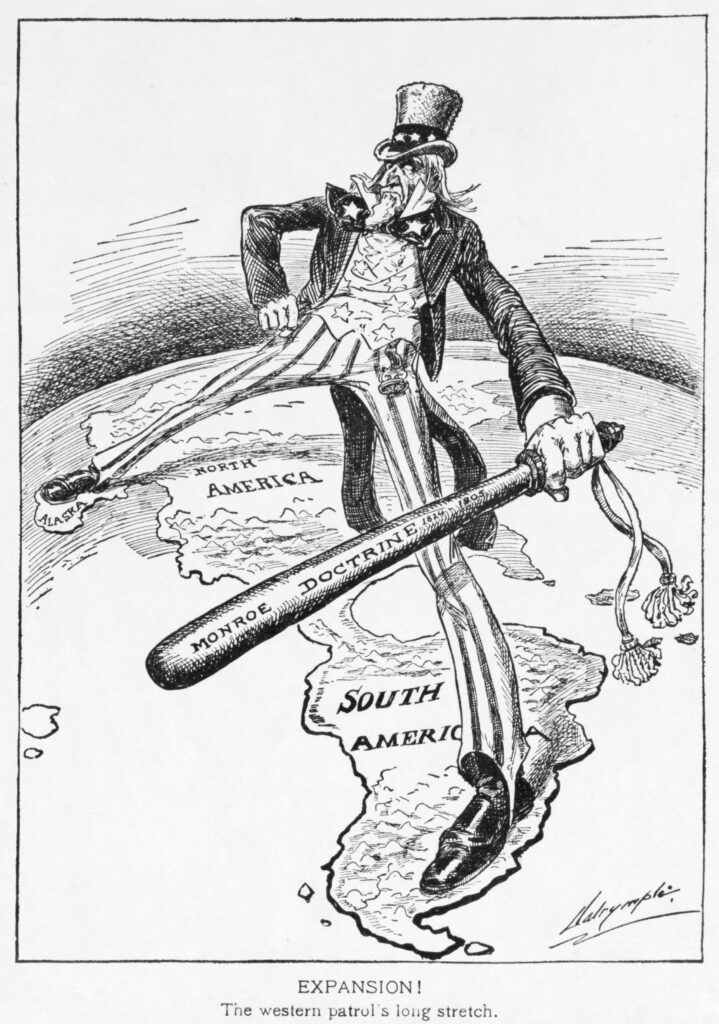
In November 2025, the Trump administration published the document “National Security Strategy,” in which it announced the new strategic foundations of imperialist action in this period to impose its hegemony in the “Western Hemisphere.” This plan comes as no surprise, since Trump, in his inauguration speech, announced that “The United States will once again consider itself a growing nation — one that increases our wealth, expands our territory, builds our cities, raises our expectations, and carries our flag into new and beautiful horizons.”
In this article, we want to focus on the consequences of this new policy for Latin America, which took the form of a brutal invasion and the kidnapping of Maduro in early January 2026. With this aggression, the U.S. government resumed the practice of direct military invasions in Latin America, which had not occurred for decades.
The document published by the White House details, with Trump’s typical shamelessness, the strategy of the far-right government that stands at the head of the still hegemonic but declining imperialist power, which seeks by all means to consolidate a regional base to compete with and confront China. This policy, in turn, further deepens the crisis of the imperialist world order and social, economic, and political polarization.
From the Monroe Doctrine to the “Trump Corollary”
The document explicitly vindicates the Monroe Doctrine and affirms a “Trump Corollary” to that doctrine. The Monroe Doctrine, announced by US President James Monroe in 1823, established the definition of “America for Americans.” At the time, it was a defensive expression against the intervention of hegemonic European countries in America, in a context of countries newly liberated from the domination of England, Spain, and Portugal.
Subsequently, this doctrine changed in character, reflecting the country’s transformation into an imperialist power with an offensive stance and military interventions in the late 19th and early 20th centuries. The Spanish-American War of 1898 marked this turn. The US not only seized the former Spanish colonies (Guam, the Philippines, Puerto Rico) and imposed a protectorate on Cuba, but also annexed Hawaii, began exploration of what would become the Panama Canal, and in the following months acquired more than 7,000 islands in the Pacific, more than 10,000 km away from California, establishing a military presence in the region of more than 100,000 troops.
In 1904, the “Roosevelt Corollary” (President Theodore Roosevelt) to the Monroe Doctrine blatantly advocated an aggressive imperialist policy, referred to as the “Big Stick.” This policy was expressed in successive military interventions to control the Panama Canal between 1903 and 1925, as well as in more than six interventions in Honduras between 1903 and 1925, and in military occupations in Nicaragua (1912-33), Haiti (1915-34) and the Dominican Republic (1916 and 1924). With this shift, the US began its ideological campaign to position itself as an “international police power,” with the moral and military authority to repress the ‘misconduct’ of other governments and defend the values of Christian “civilization” and liberal democracy..
The United States became hegemonic after World War I, which it entered near the end, in alliance with British imperialism (which had been hegemonic until then). The United States took advantage of its expansionist process and the fact that it had not suffered major losses in the war.
US imperialism consolidated its global hegemony after World War II. Crucial to this were the Yalta and Potsdam agreements, a counterrevolutionary pact between the US and Stalin’s Soviet bureaucracy that guaranteed US hegemony.
For more than five decades, the economic hegemony of the United States was based on its technological, financial, and military dominion. Its industrial oligopolies used ideologies such as “free trade” to expose the fragile industries of other countries to their dominance. The “American way of life,” spread by Hollywood and American bourgeois democracy, was the basis of political and ideological domination. International economic and financial institutions, such as the IMF and the WTO, operated internationally as an expression of US economic hegemony.
The Yalta and Potsdam agreements, together with the role of the Stalinist bureaucracy, ensured countless defeats in the great struggles of the postwar period. Even so, some revolutions were victorious and gave rise to new workers’ states, which soon became bureaucratized, such as Yugoslavia, China, Cuba, and Vietnam.
The combination of curbing progress and shifting revolutions toward bourgeois democracy was never a policy exclusive to imperialism. When this was not enough, imperialism resorted to coups and military invasions. In the 1960s and 1970s, the US government promoted countless coups in Latin America, such as those in Brazil, Argentina, Uruguay, Chile, and other countries.
In the 1980s and 1990s, globalization, neoliberal policies, and the restoration of capitalism in the former workers’ states made possible a new rise of capitalism. Neoliberal policies, the opening of countries’ economic borders, and the formation of international supply chains were then imposed.
After restoring capitalism, China and Russia integrated themselves in a subordinate manner into the upward curve of imperialism. But then, in this century, they became new emerging imperialist powers.
The US seeks to curb China’s expansion in the region
Since the beginning of the 21st century, US imperialism has shown increasing signs of decline. Although it remains the hegemonic imperialist power in the economic, financial, technological, and military spheres, its hegemony has been diminishing, losing important economic ground, particularly to China. Since 2010, China has surpassed the United States in industrial production and today accounts for 31.8% of global industrial GDP. In Fortune Global’s 2025 list of the world’s 500 largest companies, Chinese companies (147) extended their advantage over US companies (134) for the fifth consecutive year.
The National Security Strategy document responds to this reality. US imperialism remains hegemonic, but it is in decline and its hegemony is diminishing. Far from abandoning the struggle for world hegemony, the “Trump corollary” to the Monroe Doctrine is an aggressive expression, the “Big Stick” of decadent hegemonic imperialism to rebuild its global dominance in the face of rising Chinese imperialism.
Although Latin America is not the place where China accumulates most of its investments and disputes hegemony, as it does in Southwest Asia and Africa, China’s investment in the region that the US considers its backyard has taken a qualitative leap in the last two decades.
First, the region’s trade ties with the Asian giant have grown: “In 2000, the Chinese market accounted for less than 2% of Latin American exports, but China’s rapid growth and the resulting demand fueled the subsequent commodity boom in the region. Over the next eight years, commerce grew at an annual rate of 31%. In 2021, trade exceeded $450,000 million, a figure that, according to Chinese state media, grew to a record $518,000 million in 2024, with some economists predicting that it could exceed $700,000 million by 2035.
Obviously, this is a highly unequal trade that benefits Asian imperialism: while Latin America exports soybeans and other vegetable products, meat products, copper, oil, lithium, and other minerals that are key to Chinese development, the region imports high value-added manufactured goods, thus providing a market for Chinese industry and ruining domestic industry in the region. Within this framework, Beijing has already managed to impose free trade agreements with five countries: Chile, Costa Rica, Ecuador, Nicaragua, and Peru. In the case of some countries, such as Chile, trade dependence on China is very significant, as in 2023, 38% of its total exports went to that country.
Beyond unequal trade, China has increased its direct investment ($8.5 million in 2024) in the more than 20 Latin American countries that it has incorporated into the Silk Road (BRI). This investment focuses on strategic sectors, such as energy resources, or on “dual-use” (commercial and military) infrastructure, which is of increasing concern to Washington. China’s strategic investment in the Lithium Triangle (Chile, Bolivia, Argentina) is well known, as the region is home to between 60% and 70% of the world’s lithium reserves, which are essential for electric batteries. Between 2018 and 2024, Chinese mining multinationals have invested more than $16 billion in its exploitation. In Argentina, China owns or is a partner in six of the sixteen active lithium projects, including four of the most advanced ones. In 2023, a Chinese consortium (CATL, BRUNP, CMOC) signed a $1,000 million deal to build lithium carbonate plants in the Uyuni and Coipasa salt flats in Bolivia, the first foreign-led commercial lithium project in the country. Chinese companies are estimated to control nearly 40% of global lithium production through their operations in South America.
China currently has investments and total or partial control of more than 40 ports in the region, some in key strategic sectors, such as the port of Abaco in the Bahamas (near Florida) and the Beagle Channel in Argentina, in the Antarctic. Added to this are a dozen Chinese satellite facilities and the fact that China provides military equipment to several countries. This is the case in Venezuela, for example, which has been under a US arms embargo since 2006, but also in Argentina, Bolivia, Ecuador, and Cuba.
In addition, since 2005, Chinese banking monopolies have lent more than $120,000 million to Latin American countries. Of particular note are the loans requested by Venezuela, China’s main creditor in the region, which has received almost $60,000 million in loans, more than double that of Brazil, the second largest creditor. Also noteworthy is the latest $5,000 million SWAP loan that Milei, in Argentina, contracted with China in April 2025, despite his allegiance to Trump.
Trump seeks to impose puppet governments in the region
The document explains the strategy of imposing puppet governments in the Western Hemisphere to achieve its economic and military objectives:
“We want to ensure that the Western Hemisphere remains reasonably stable and well-governed enough to prevent and discourage mass migration to the United States; we want a Hemisphere whose governments cooperate with us against narco-terrorists, cartels, and other transnational criminal organizations; we want a Hemisphere that remains free of hostile foreign incursion or ownership of key assets, and that supports critical supply chains; and we want to ensure our continued access to key strategic locations. In other words, we will assert and enforce a “Trump Corollary” to the Monroe Doctrine;”
At this moment, Venezuela is the central focus of this policy. Contrary to what Stalinist propaganda claims, Maduro’s government has been devoted to US imperialism. Chevron remained fully involved in the exploitation of Venezuelan oil. In fact, in October 2025, Maduro, according to a New York Times report, offered to “open up all existing and future oil and gold projects to American companies, give preferential contracts to American businesses, reverse the flow of Venezuelan oil exports from China to the United States, and slash his country’s energy and mining contracts with Chinese, Iranian and Russian firms.” in exchange for remaining in power.
But Trump did not accept because his goal is not only oil, but also to implement a more global national security strategy. The Maduro government, despite being pro-imperialist, was not a puppet government, but rather reflected the contradictory and opportunistic interests of the corrupt Bolivarian bourgeoisie built up around the state. Trump, on the contrary, wants a government completely subjugated to his interests in the region, which is why he invaded and kidnapped Maduro.
This invasion could open the door to its repetition in other countries, such as Colombia, Cuba, and others. And it poses a great threat to the new revolutionary processes in the region.
The meaning of “recruiting and engaging” allied governments is very precise: pro-imperialist bourgeois governments are not enough; far-right puppet governments are needed. As the document states:
“American policy should focus on enlisting regional champions that can help create tolerable stability in the region, even beyond those partners’ borders. These nations would help us stop illegal and destabilizing migration, neutralize cartels, nearshore manufacturing, and develop local private economies, among other things. We will reward and encourage the region’s governments, political parties, and movements broadly aligned with our principles and strategy. But we must not overlook governments with different outlooks with whom we nonetheless share interests and who want to work with us.”
To this end, Trump openly and cynically uses economic pressure, making loans conditional on the electoral victories of his allies, such as Milei in Argentina and Nasry Asfura (of the National Party in Honduras).
It is undeniable that Trump has achieved results with this policy. Taking advantage of the disasters committed by class-collaborationist governments, such as those of Xiomara (Honduras), Boric, Petros, and others, the far right is making significant advances in Latin America. It can already count on the governments of Milei (Argentina), Kast (Chile), Bukele (El Salvador), and Asfura (Honduras), as well as victory in the 2026 elections in Colombia.
The case of Lula in Brazil is different. It is a pro-imperialist government, with which Trump negotiates under pressure from his own US bourgeois base, rebelling against the negative consequences of the tariff war. Even so, Trump will help build a post-Bolsonaro right-wing alternative to try to defeat Lula in 2026.
Something similar is happening with Sheinbaum (Mexico), who has completely adapted to Trump’s pressure, as the Mexican economy is totally subordinate to its relationship with the US: around 80% of Mexico’s exports, 55% of its imports, and 41% of its foreign direct investment depend on the United States.
In this context, it is essential to fight in all Latin American countries against this new aggression by Trump, who seeks to annex the continent. To this end, it is important that all parties that truly fight for socialism raise a program for the Second Independence of Latin America that proposes to confront all imperialisms, both US and European, as well as Chinese imperialism, which presents itself as a “friend.” We must seek the broadest unity of action that can mobilize the working class and its allies, such as indigenous peoples, against military interventions, such as that in Venezuela, against extractivist or overexploitation projects, and against other attacks on national sovereignty, such as indebtedness and unequal trade agreements, whoever the imperialism that proposes and imposes them may be. Once again, we must show that only an independent solution for the working class can achieve true independence that guarantees the social and political rights of the working class and stops the destruction of the environment.
The “Trump corollary” in politics: Bonapartism, the far right, and xenophobia
Trump, in order to impose his plan on the United States in the world, needs Bonapartism: the stark politics of decadent imperialism. One of the main differences between the Monroe Doctrine of the early 20th century and Trump’s policy today is that it no longer disguises itself with the false “civilizing” discourse used by the colonial powers of the last century, which sought to defend universal morality and legality and promoted a narrative of prosperity, modernity, and progress. Today, Trump seeks to subjugate other countries with his “America First” rhetoric, bluntly assuming that he can put his own economic needs above those of other nations simply because he has the power to do so.
Trump is a Bonapartist government in the United States, in collision with the bourgeois democratic regime, which he wants to turn into an authoritarian Bonapartist regime. He is in constant conflict with the justice system. He sends troops to states governed by Democrats. He has greatly reinforced the Border Patrol (ICE) for the repression of immigrants.
On the world stage, Trump is following a similar path: he is setting aside the international institutions and agreements that previously expressed imperialist domination (UN, WTO, IMF) and resorting to force to impose his rule. The values of bourgeois democracy, the “American way of life,” have been left behind. Domination is exercised through military force, direct economic pressure, and Bonapartism.
The crisis of the imperialist world order is increasingly narrowing around two blocs: one directly subordinate to US imperialism and another forming around China.
At the same time, there is a growing trend toward Bonapartism in countries around the world, which deepens the crisis of bourgeois democracy. Not only that, but the document explicitly expresses direct support for the growth of the far right worldwide:
“Our goals for the Western Hemisphere can be summarized as “Enlist and Expand.” We will enlist established friends in the Hemisphere to control migration, stop drug flows, and strengthen stability and security on land and sea. We will expand by cultivating and strengthening new partners while bolstering our own nation’s appeal as the Hemisphere’s economic and security partner of choice.” To this end, Trump uses all the resources of the US state, including economic, political, and military pressure. But the ideological and political basis common to the entire far right should not be overlooked. This includes the fight against immigration, which is so important to the far right in imperialist countries:
“The Era of Mass Migration Is Over – Who a country admits into its borders—in what numbers and from where—will inevitably define the future of that nation.”
“ Any country that considers itself sovereign has the right and duty to define its future. Throughout history, sovereign nations prohibited uncontrolled migration and granted citizenship only rarely to foreigners, who also had to meet demanding criteria. The West’s experience over the past decades vindicates this enduring wisdom. In countries throughout the world, mass migration has strained domestic resources, increased violence and other crime, weakened social cohesion, distorted labor markets, and undermined national security. The era of mass migration must end.”
Similarly, it spreads ideologies, such as the “war on drugs,” which are linked to the electoral exploitation of urban violence by the far right, so well capitalized on by governments such as those of Bukele (El Salvador) and Noboa (Ecuador), and by the entire Latin American far right. In Brazil, the far right echoes Trump and promotes the classification of common criminals as “terrorists.”
The document defends another fundamental ideological point for the far right, both in imperialist countries and in semi-colonial countries (such as Latin American countries, for example), which is the defense of oppression against women, Black, and LGBTQ people.
This ideological combination could have fundamental political importance in unifying the international far right around Trump and weakening anti-imperialist consciousness, which is a product of the Trump administration’s actions against Latin American countries, for example. This is a hypothesis that may or may not be confirmed in the coming period.
It is important to note that the so-called “bourgeois class collaborationist governments,” also known as “progressive” governments, bear direct responsibility for the rise of the far right. The implementation of neoliberal policies against the masses by these governments causes wear down that the far right takes advantage of.
The case of the Chavista regime is a particular expression of that process, because it was not class collaboration, but a bourgeois dictatorship hated by the masses and originated by the “left.” The polls after the invasion show that most of the Latin American population, even in Venezuela, supports the overthrow of Maduro by US imperialism, which shows the decline of anti-imperialist consciousness.
It is essential that working-class organizations take up the demands for the rights of migrants and indigenous peoples to national sovereignty, actively combat racism and xenophobia, and fight to defend and expand the rights of women and the LGBT community. It is the task of revolutionary socialists to seek to combine the struggles for democratic rights with the struggle for socialism, and the need for our class to come to power.
The consequences of the aggression against Venezuela for Cuba
The crisis in the Cuban economy is worsening with each passing day, and after Maduro’s forced removal by the US, the island could descend into social chaos. According to government statistics, in the last five years, more than one million Cubans (10% of the population), mostly young people, have emigrated abroad in search of better living conditions. Since 2020, the country’s GDP has fallen by 11%, the energy network is disintegrating, and wages are very low. Outside Havana, where the foreign bourgeoisie and the national bourgeoisie embedded in the Cuban state apparatus live, power outages of up to 18 hours a day are common. It is obvious that the new sanctions imposed by Trump in 2019 have greatly contributed to suffocate the island, with severe restrictions on travel and remittances from Cuban immigrants in the US.
In this context, Trump’s new control over what remains of the Chavista regime, led by Delcy Rodríguez, could cause Cuba’s total economic collapse. Cuba needs 100,000 barrels of oil per day to ensure the minimum functioning of its economy, and it only manages to produce a quarter of that volume. While Venezuela sent the rest a decade ago, today it only sends 35,000 barrels per day, partly due to pressure from the US and partly due to the frustration of the Chavista regime, which was unable to receive payments on time. The same is true of Mexico, which used to send 22,000 barrels per day but reduced its shipments to 7,000 bpd at the end of 2025. Trump’s criminal policy is clear, as he wrote on January 11 on his social media account: “THERE WILL BE NO MORE OIL OR MONEY GOING TO CUBA – ZERO!”
In the face of Trump’s threats, it is fundamentally to strongly oppose any US intervention in Cuba and demand an immediate end to sanctions and the economic blockade against the island. Building the greatest possible unity of action within our class against the attack on Venezuela and a possible attack on Cuba does not imply giving any kind of political support to the governments of Rodríguez or Díaz-Canel. On the contrary, in Cuba, as in Venezuela, our political and material solidarity is with the people who are mobilizing for their rights, and our goal is to ensure that they organize independently of the government and any interference from foreign imperialists, in order to position themselves as an independent and democratic class alternative that can advance toward true socialism.
The contradictions of the “Donroe Doctrine”
While the Trump administration is determined to exercise firm despotic domination over the continent, this does not mean that the success of its policy is guaranteed. On the one hand, this new policy will encounter resistance from the masses; on the other, it will have to contend with inherent limitations, or what we might call the “hidden corollaries” of this imperialist doctrine.
First, it must be considered that oil exploitation in Venezuela is neither an easy nor an automatic task. Venezuela’s oil production is in decline: at the end of the 1990s, 3.5 million barrels per day were produced, compared to just 800,000 today. Analysts say that at least five years of massive investment are needed to recover equivalent production levels. The consulting firm Rystad Energy, for example, says that at least $53,000 million would be needed over the next 15 years to increase production to 1,1 bpd. To be profitable, the operation that Trump is now selling as easy and quick requires securing both economic investment and political control of the country for at least the next two decades. Many of the oil fields had already been granted to China through legal contracts, and these imperialist multinationals will demand that their rights be recognized or that they be compensated.
Nor is it enough to invest in oil and mining resources to drive China out of the region. In fact, as we have shown, China has managed to insert itself into the continent’s supply chains and into the energy and digital infrastructure sectors. To “reconquer” the continent, the US will need to invest much more than just in sectors that suit it and propose itself as an economic alternative in other sectors.
Second, the repetition of Monroe’s doctrine does not occur in a historical vacuum. On the contrary, the US already has experience of the difficulty of maintaining economic and military domination over other territories: once you meddle, you end up meddling, which means allocating resources to neocolonial domination. The first case that demonstrated the cost of such a policy was the Philippines, because although the McKinley administration thought that installing a puppet government in the country would guarantee its control, it soon realized that the US could not simply withdraw its troops and maintain a friendly government. In fact, the US had to remain there for decades, and the Philippines only achieved independence in 1946. The same situation was repeated recently with the wars in Iraq and Afghanistan, which resulted in similar disasters.
Third, there is a domestic “corollary”: most Americans do not support another drawn-out war. Polls conducted in January 2026 show that only 33% of Americans agree with military action designed to kidnap Maduro, while 72% fear that such intervention would lead to prolonged intervention in Venezuela. In fact, the Republican-controlled US Congress has taken steps to limit any further military intervention.
Another risk of the deepening of this aggressive US policy toward the American continent (and Europe) is that it could increase China’s popularity among the masses as a factor of balance and development. While we know that China is another imperialist and plundering power, the fact that it is in an emerging dynamic and has more capital to invest allows it to appear as the power that offers “economic development” to its semi-colonial allies, while the US only offers coercion and oppression.
The most important contradiction is that it will exacerbate social and political polarization in Latin America and the United States. The mass movement has not been defeated, and sooner or later, there will be large mobilizations and even revolutionary explosions. This points to a more convulsive period of class struggle.
Translated from the original Spanish