The February 12th General Strike in India
There has been a general strike almost every year since the year 2010, yet the Indian capitalist class has grown only bolder in its attacks on the working class. It is important to understand why this contradiction exists, and to understand the general strike in context.

The prior general strike led by the central trade unions in India took place in July of 2025, in protest against the Labour Codes. Despite the strike, the government pushed through the Labour Codes, without widespread opposition in parliament. This is important to remember, as it highlights the attitude of most of the oppositional parties in India today, most of which are bourgeois parties, whether regional bourgeois parties or the national bourgeois parties like the Indian National Congress.
Eleven large Central Trade unions called for the general strike on 12th February 2026, this call was supported by the Samyukt Kisan Morcha, the united front organization of farmers who were one of the main organizers of the historic farmer’s protest in 2024. This was another instance of workers and peasants uniting together in struggle: all together, the central trade unions, farmers bodies, would number about 300 million members.
Despite these enormous numbers, it did not translate as well to a show of strength on the streets. In the run up to the general strike, several trade unions declared they would not support the strike. Some of these unions are part of the oppositional alliance, the so-called INDIA alliance. In states where INDIA alliance parties hold power, there were scenes of repression, as hundreds of protesting workers were arrested. Karnataka saw the forcible arrest of peaceful protestors from the Karnataka IT union. In Tamil Nadu, where the Dravida Munnetra Kazhagam (DMK, “Dravidian Progressive Federation” in Tamil) holds power, their aligned unions acted as strike breakers, much like last time.
The general strike of 12th February follows a familiar pattern in place since the first nationwide general strike conducted by central trade unions in 2010, which saw up to 100 million joining the strike. Yet, the impact of such a large strike was comparatively mild. The strike did not resonate on the streets at such a scale: the largest protests gathered thousands of workers, not hundreds of thousands.
There has been a general strike almost every year since the year 2010, yet the Indian capitalist class has grown only bolder in its attacks on the working class. It is important to understand why this contradiction exists, and to understand the general strike in context.
The Labour Codes
The new Labour Codes came into effect on the 21st of November 2025. The new laws replace nearly 44 labour regulations which had previously governed labour relations in the workplace, mostly notably the Industrial Disputes Act 1947, the Wages Act, and the Factories Act.
The new codes will override these laws in favour of four new laws which purports to ‘streamline’ labour laws in India, favouring ‘flexibility’ over security. Such changes in labour laws have been a long-standing demand of the Indian bourgeoisie, who wish to turn back the gains of labour struggles of the last 100 years.
In the same manner as the farm laws, the four new labour codes were passed through parliament without any discussion or consultation with trade unions. The arbitrary voice vote and the speaker’s decision to pass the bill despite clear opposition and uncertainty of a majority show the undemocratic manner in which both this and the farm laws were passed.
Among the sweeping changes brought about by the new laws, the companies with up to 300 workers are exempted from standing orders, an increase from 100 workers in the current law. This would allow companies with up to 300 workers flexibility to hire and fire at will. This would make millions of workers who are employed in the small to medium scale sector in India (the mainstay of employment), vulnerable to mass layoffs and retrenchments. In the words of CITU general secretary Tapan Sen:
“These codes, now passed, will throw more than 74% of the industrial workers and 70% of industrial establishments into a ‘hire and fire regime’ at the will of the employers; even formation of a trade union will be extremely difficult; will impose a virtual ban on workers’ right to strike and even collectively agitate on their grievances and demands to mention a few,” he said.
Under the new wages code, allowances (compensation and benefits beyond the basic salary) are capped at 50 percent. This means half of the gross pay of an employee would be basic wages. Provident fund contribution (social security payment) is calculated as a percentage of the basic wage, which includes basic pay and dearness allowance (cost of living adjustment, typically reserved for government employees). Most employers have been splitting wages into numerous allowances to keep basic wages low to reduce provident funds and income tax expenses. The new wages code provides for provident fund contribution as a prescribed proportion of 50 per cent. The effect of this would be to reduce the amount of pay the worker can get in salaries and wages, the money they actually get to take home.
Since the new laws were passed, pro-government propagandists have been active, hyping up the new laws as pro-employee. They speak about the new laws guaranteeing higher wages for workers, while at the same time lamenting the increased costs to employers. In the run up to the strike and after it, news articles from the government’s lapdog media have been spreading the half truths of increased wages, ignoring the ground realities of how badly pro-labour legislation is enforced and the inequality between worker and capitalist when it comes to fighting in the courts of law.
It is not without reason that workers have come out in protest against the new codes, even before they were passed into law. The passage of the laws found immediate protest from the leading Stalinist parties, their trade unions and even the BMS (Bharatiya Mazdoor Sangh, Indian Workers’ Union) affiliated with the BJP. It is important to note, that this trade union, which is presently the largest in terms of membership, did not support the general strike.
The strike : Who supported? Who did not?
Though the leading leftist Central Trade Unions claim to have mobilized 300 million worker, if this number is to be true then most workers who would have participated in the general strike would be outside of union membership, because only 8% of the total workforce in India is unionized as of 2022. This number seems harder to believe if one considers that several central trade unions, particularly those aligned with the BJP, and certain regional parties like the DMK and AIDMK, did not participate in the strike. Notably, the trade union linked with the All India Forward Bloc was the only major leftist aligned trade union that did not take part in the general strike. The combined effect of these absences blunted the impact of the strike.
Scenes of repression were similar to the strike in July 2025, when mass arrests of protesting workers were conducted, most prominently in West Bengal, Tamil Nadu, and Karnataka. These states witnessed acts of repression in a similar pattern to last time, though there was more visible militancy in West Bengal, where bank workers forcibly shut down banks and ATM counters to enforce the strike. Workers blocking rail lines were arrested, while in Karnataka IT workers were arrested while protesting peacefully.
The bourgeois opposition led states showed that they were as willing as the right wing BJP to suppress workers protests. Peaceful protesters were arrested in Karnataka, Tamil Nadu, and punitive action was taken by government workers who struck work in West Bengal. The same parties that had mobilized against the special intensive revision of voter rolls, were silent on the Labour Codes. Only in Kerala where the Stalinist left front has power, did the strike have real impact in shutting down the economy. This follows a typical pattern of top down organization.
Gig workers did not come to strike, while ASHA workers continued their agitations or strike actions independent of the general strike. The impact on industrial zones is unclear. While the Samyukt Kisan Morcha supported the strike, this did not result in a large scale mobilization of agricultural workers, nor did this bring about a visible impact on the streets. The media coverage of the strike remained skewed against workers, highlighting disruptions and protests without highlighting the issues behind the strike.
The dialectical situation in India today
The limited impact of the one day general strike should not lead us to conclude that we are in a situation of complete peace. India’s workers have shown that they are capable of militant action, be it the Samsung workers strike, the mobilizations by the ASHA workers, the indefinite strike by ASHA workers of West Bengal, the tea plantation workers strike, and the gig workers strike at the beginning of the year.
These strikes show the militant potential of Indian workers, and show the objective conditions which push workers towards militant action. That the central trade unions failed to channelize this into a militant nationwide general strike speaks not to the failure of the workers, but the trade unions and political leadership.
The CPI(M) remains as one of the largest national parties in the country, boasting a million members across the country. The All India Trade Union Congress, and the Centre of Indian Trade Unions together account for nearly 20 million workers. The CPI(M) alone has resources to mobilize workers on a national basis, if it chooses to organize for that purpose. The party still fields enough energetic youth cadre to make a visible impact on a mobilization such as this. Yet, we did not even see a fraction of its power in the 12th February general strike.
The saga of one day strikes has been going on since 2010, yet today India’s workers are worse off than before. The burden of successive economic crises have been shifted to their burdens. India’s billionaire oligarchy has become one of the richest in the world, while India’s workers remain one of the poorest. The general strike alone would not be enough to change that reality, but it could have and should have become a flashpoint to begin a larger movement for change. The focal point of the agitation being the Labour Codes.
There was a historic opportunity to bring together industrial workers, farm workers, and poor peasantry under one banner of struggle, as the Samyukt Kisan Morcha had supported the general strike. Rather than build on this, the unity of Central trade unions and farmers organizations became reduced to mere tokenism.
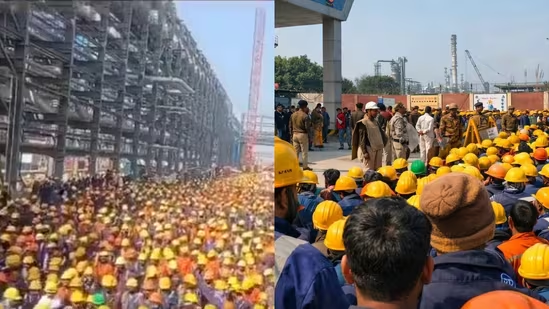
As of writing this article, a major protest is taking place in an oil refinery in Haryana by migrant workers from Bihar. Thousands of workers walked out, demanding an eight hour day and decent living wage. This is taking place a mere two weeks after the general strike. In West Bengal the ASHA workers continue their indefinite strike. These actions show the militant potential of a workers strike. Channelizing this into a unified nationwide action requires patient steady preparation, connected at the ground level with each and every worker. The unionized workers and political workers must be the vanguard of this action. Even if the strike action itself lasts a day, it requires sustained campaign over time to build up support for the strike.
The propaganda for the strike was limited, the efforts to organize was mainly limited to the trade unions rather than at the party level. This shows a disconnect between the union and the party, which had been present since the first unified general strike in 2010. The farmer’s agitation succeeded in forcing the Modi government in repealing the Farm laws through sustained agitation and enforcing a picket. There was nothing like this in the general strike.
Why we support
Despite its flaws and limitations, the general strike raised several important issues affecting the working class of India. The attacks on the rights to organize, the assaults on hard won rights such as the 8 hour day, must be resisted. Our criticisms of the union and political leadership is not a judgment on the striking workers, it is a criticism on the tactics and strategies deployed to enforce this strike.
The general strike is one of the strongest tools in the arsenal of the working class, it is not only a momentary disruption of the system but a means to unify the working class across sectors into one unified action against the system. The general strike can become an educational moment in workers solidarity. Done well, the general strike can bring the whole capitalist class to its heels. The fact that this is even possible in India shows that there is militant potential, but if it is not harnessed into kinetic action, the energy will dissipate, exhaustion will creep in, and resistance will die out.
This is already beginning to happen, there has been a general strike almost every year since 2010, yet today we are facing the worst crisis in the recent history of the working class. The danger posed by the BJP government in power requires action that is proportional. Unfortunately, the CPI(M) and its bureaucratized unions once again proves that it is incapable of giving this kind of response. The top down method showed itself in every general strike, and this was no different. The party and the trade union aren’t in coordination, nor is there an effort to educate the workers on the dangers of the new law.
The general strike of 12th February showed the problems facing the workers unions of India, but it also shows the need for such action. The Labour Codes will worsen the situation of workers especially in the small scale sectors, rights such as the right to strike will be narrowed, wages will be cut across the board, even as cost of living keeps going up. A one day general strike is a feeble response to such a sweeping attack.
References
https://labourbureau.gov.in/uploads/pdf/Report-of-Trade-Union–2022.pdf