
Revisiting SYRIZA: A Strategic Debate for Marxism Today
Introduction
The offensive launched by Javier Milei’s government is not limited to implementing austerity measures in the state budget. It is also—and perhaps above all—reshaping the political landscape of the Argentine left, putting its most deeply rooted strategic concepts to the test. Faced with an austerity program of a depth not seen since the 2001 crisis, and with the growing popularity of the FITU (Left and Workers’ Front—Unity), broad sectors are seeking to build a broader alternative capable of challenging the government. In this debate, a familiar proposal resurfaces: that this alternative would be achieved through the reunification of the entire “center-left” or “broad left” and the formation of a broad party or movement that prioritizes agreements among left-wing groups over programmatic distinctions. Those who defend this approach argue that only a force of this kind can break the left’s isolation and become a genuine alternative for power. But history has repeatedly shown that broad unity without a program is a refuge for the deluded.
The debate is not new. A little over a decade ago, millions of workers around the world placed similar hopes in SYRIZA, the left-wing coalition that came to power in Greece promising to end austerity without breaking with the euro—as if history, in its finest irony, could resolve its contradictions without walking the razor’s edge of rupture. Its rise and, above all, its capitulation to the Troika—the European Commission, the European Central Bank, and the International Monetary Fund, responsible for overseeing the eurozone’s adjustment and bailout programs—constitute one of the most important strategic experiences of the left in the 21st century. A broad international debate unfolded around SYRIZA regarding what kind of political organization the working class needed in the wake of the crisis of social democracy, in which proposals emerged to form “broad-based parties” and “new left-wing formations,” conceived as electoral coalitions that would bring together different political traditions under a deliberately open program. Revisiting that experience is not merely a matter of historical interest, since many of the fundamental discussions that took place then have been reignited today within the Argentine left.
The Greek crisis was not an isolated phenomenon. It was part of the general crisis of the eurozone that began in 2008, in which states socialized the losses of the financial system through bank bailouts financed by public debt and subsequent austerity programs. Greece represented the most acute expression of these contradictions.^1
The crisis also transformed the Greek political system. PASOK, the social democratic party that had governed the country for decades, saw its share of the vote plummet from 43.9% in 2009 to 13.2% in 2012. This collapse gave rise to the term pasokization, used to describe the electoral collapse of social democratic parties that implemented austerity policies. At the same time, between May 2010 and the end of 2015, there were twenty-eight general strikes—including four 48-hour strikes—along with hundreds of sectoral strikes, occupations, and demonstrations that turned Greece into the main epicenter of European resistance to austerity policies.^2
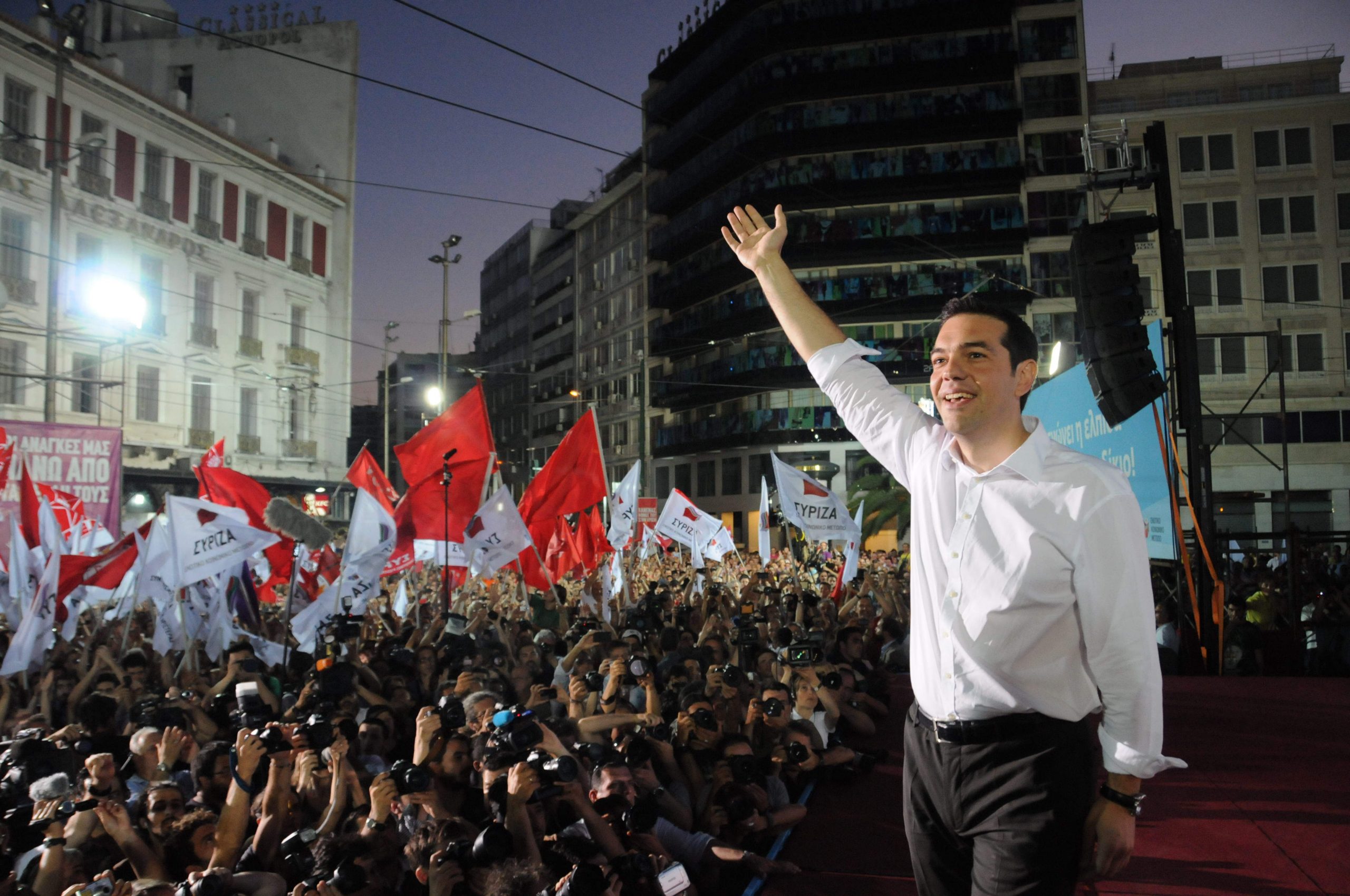
In this context, SYRIZA went from being a marginal force to becoming a viable alternative for government. It won 4.6% of the vote in 2009; 16.8% in May 2012; 26.9% in June of the same year; and finally 36.3% in January 2015.^3
Between 2012 and 2015, SYRIZA established itself as a leading force for broad sectors of the international left. For millions of workers and young people, it represented an alternative in the face of the economic crisis, austerity measures, and the discrediting of traditional parties. But for broad sectors of the population, the vote for the left-wing coalition was above all a way to punish the parties responsible for the austerity memoranda, rather than a full endorsement of a socialist project. As the IWL itself pointed out at the time, the vote fundamentally expressed popular rejection of the parties that had administered the Troika during the early years of the crisis.^4
Various revolutionary organizations interpreted SYRIZA’s growth and electoral victory in different ways. The MST (Socialist Workers’ Movement) presented SYRIZA as the model for a new, broad left capable of overcoming the “sectarianism” of the traditional revolutionary left. The Committee for a Workers’ International (CWI), through its Greek section Xekinima, viewed it as the most advanced expression of the “new left formations,” conceived as a step toward new mass workers’ parties. The United Secretariat considered it the most promising example of the “broad parties” that emerged in the wake of the crisis of European social democracy. Although their analyses differed, they agreed on one fundamental point: SYRIZA opened up a new path to contesting government and confronting austerity without initially breaking with existing institutional frameworks.^5
From the outset, the IWL criticized SYRIZA’s strategy because it was driven by a fundamental contradiction: it sought to end austerity without breaking with the institutions that imposed it. From that perspective, the problem was not merely Tsipras’s electoral program, but the strategy underpinning it. This article reconstructs that debate based on documents produced by the various currents between 2012 and 2015. Its purpose is not to offer a retrospective assessment, but to analyze how each faction interpreted SYRIZA’s experience as it unfolded and what strategic conclusions they drew from it.^6
What Was SYRIZA? The Thessaloniki Program and the Commitment to Negotiation
Following the capitulation of 2015, SYRIZA was portrayed by many as just another social democratic party. In government, it paid the debt, kept Greece in the eurozone, implemented a third memorandum with new austerity measures, and did not nationalize the banks. In practice, it ended up managing Greek capitalism in crisis, just as PASOK had done.^7
However, this characterization does not fully explain SYRIZA’s appeal between 2012 and 2015. Before taking office, it was not perceived as just another social democratic party, but rather as an alternative representing a new “radical left,” emerging from an alliance of diverse forces: Eurocommunists, Trotskyists, Maoists, eco-socialists, and independents.^8
This heterogeneity was presented as a virtue because it seemed to offer a way out of the fragmentation of the Marxist left. Various currents sought, using slightly different terminology, to adapt to this broad political spectrum: the unity of the “center-left,” the “new left-wing formations,” or the anti-capitalist “broad-based parties.” Although these categories were not exact equivalents, they did share a strategic premise: it was possible to build an organization capable of uniting diverse political traditions around a program that combined revolutionary ideals and radical reforms, and to aim for forms of government—either alone or in coalition—that did not entail an immediate break with the main institutions of capitalism. Within this framework, very different orientations could coexist, ranging from those who viewed these formations as a new variant of the reformist left offering a new path to socialism, to those who saw them as a stepping stone toward future mass workers’ parties.
SYRIZA’s strategic orientation found its most complete expression in the Thessaloniki Program, presented by Alexis Tsipras in September 2014. The program included ambitious social measures: the reinstatement of the Christmas bonus, free electricity for 300,000 households, and a minimum wage of 751 euros. All of this would cost 11.4 billion euros. But the question—which the program did not ask, as if it were impolite to do so—was: where would that money come from if neither the debt nor the euro were touched? The decisive factor was not the content of those measures but the mechanism proposed to make them viable. SYRIZA proposed convening a “European Conference on Debt,” establishing a grace period for debt repayment, exempting public investment from the restrictions of the Stability Pact, and easing the European Central Bank’s monetary policy. The political premise was clear: to end austerity through renegotiation with European institutions, while keeping Greece in the eurozone and the European Union. As Tsipras himself summarized, the alternative was “European negotiations with SYRIZA or acceptance of the creditors’ terms under Samaras.”^9
Tsipras sought to swim against the current, but without letting go of the euro’s helm. That contradiction—like so many in the history of the labor movement—was not the result of bad faith, but of the very logic of a wavering class position, straddling two worlds. However, a Marxist analysis is not fooled by the intentions of leaders. It focuses on the objective correlation of forces—on the ground, not in discourse; on structure, not on anecdote. The debt was in the hands of European creditors; the euro was administered by the European Central Bank, controlled by the continent’s major powers; and the liquidity of the Greek banking system depended on the Troika. The negotiations, therefore, did not take place between actors of equal weight, but within a profoundly asymmetrical power structure, under the subjugating logic of German and French capital.^10
In June 2012, Tsipras told the BBC: “No to the bankruptcy memorandum. Yes to the euro.” As if the euro and bankruptcy were rival siblings, rather than—as was actually the case—father and son of the same regime.
A few days later, he told Reuters that “the European Union is bluffing” and that Greece would remain in the single currency. Before the January 2015 elections, he summarized his vision by stating: “I am not going to be a leader of the far left. I am going to be the prime minister of all Greeks.” These statements were not short-term concessions, but rather the coherent expression of a political strategy: to end austerity by negotiating better terms within the eurozone, without breaking away from it.^11
SYRIZA as a Strategic Project and the Debate on the Left
SYRIZA’s rapid expansion transformed a national experiment into a model for the international left. The crisis of social democracy, the discrediting of traditional parties, and the emergence of new political forces seemed to herald a new era. In the years following the 2008 crisis, existing organizations such as the Bloco de Esquerda in Portugal (1999), the PSOL in Brazil (2004), and Die Linke in Germany (2007), while new movements emerged, such as Podemos in Spain (2014), the growth of the Democratic Socialists of America (DSA) around Bernie Sanders’ campaigns (since 2016), and La France insoumise in France (2016). Although their trajectories, platforms, and organizational structures differed, they all contributed to a shared discussion on ways to politically reorganize the left in the wake of the crisis that began in 2008. SYRIZA was the first of these movements to come to power. For that reason, the debate it sparked immediately took on an international dimension. What was at stake was not only the future of Greece, but the viability of a strategy that was beginning to influence much of the European, North American, and Latin American left .^12
The MST in Argentina was probably the Latin American organization that most clearly embraced this new experience. SYRIZA was not merely a successful electoral coalition, but the confirmation of a political orientation that the MST had been advocating for years: the need to build a “new broad left” capable of overcoming both the fragmentation of the left and the isolation of revolutionary organizations. SYRIZA’s broad-based nature was not considered a tactical concession, but rather a strategic virtue.
In January 2015, Alejandro Bodart traveled to Athens at the invitation of SYRIZA and declared: “Sectarians like Jorge Altamira should learn from SYRIZA. It is a broad left-wing coalition, made up of 13 forces, in which agreements take priority. We at the MST propose this model of unity so that the Argentine left can move beyond its token role and advance as a viable option for government.” Following the electoral victory, he reiterated this same orientation. In an article titled “SYRIZA Brings Winds of Change,” Bodart argued that “SYRIZA’s historic victory reaffirms our project to build a modern, broad, and non-sectarian New Left in Argentina.”^13
For the MST, SYRIZA and Podemos represented the same historical trend: the emergence of new organizations capable of filling the void left by the crisis of social democracy and challenging for government from the left. Bodart argued that, following the Greek example, “the next wave of contagion on the horizon is the possible triumph of another New Left, Podemos, in the May elections in Spain.” Even after Tsipras’s capitulation, the MST maintained that “the real debate is the need to promote broad, left-wing coalitions, while accepting their risks.”^14 The Greek experience altered the assessment of its leadership, but not the strategic orientation toward building broad organizations.
The IWL, for its part, shared the Greek people’s joy at the electoral defeat of the Troika parties, but carefully distinguished between understanding popular expectations and reinforcing them politically. As it stated a few days after the elections, “understanding the hopes placed in the new government does not require supporting those hopes themselves.” Its conclusion was that the only guarantee of real change remained “the struggle of the workers and the Greek people.”^15 From the outset, it maintained that the new government would face an inescapable dilemma: “to implement a bailout plan for the workers and the people or to pay the debt of the bankers and speculators. Either with the workers and the Greek people or with the Troika. That is the dilemma.”^16
The Committee for a Workers’ International (CWI) understood that the discussion opened by SYRIZA did not begin with Greece but with the historic crisis of the working class’s political representation. Since the 1990s, the organization had argued that the weakening of traditional social democracy would favor the emergence of “new workers’ parties”—that is, new mass organizations that would not necessarily replicate the structure or program of the old 20th-century workers’ parties. The “new left-wing formations” were to be understood as a transitional stage within this broader process of political recomposition.^17
This perspective led the CWI to take on a dual task: strengthening existing revolutionary organizations and actively intervening in the formation of these new mass workers’ parties. As Dobson summarized, the organization had to combine the building of the revolutionary organization with participation in the building of new workers’ parties.^18 The coexistence of both tasks rested on the idea that the reformist hegemony of these new formations would not ultimately condition their political development or turn them into an obstacle to the construction of a revolutionary project.
The CWI noted that the leadership headed by Tsipras based its policy on anti-austerity rhetoric but remained convinced that it was possible to negotiate a way out within the institutions of European capitalism. It argued that an electoral victory for the coalition would be a step forward because it would shift the balance of power between the classes and open a new cycle of struggles capable of pushing the government toward more advanced positions. As Andros Payiatsos explained, the main reason for supporting SYRIZA was that the working class hoped some of its demands would be met, and that a SYRIZA victory would have a liberating effect on society and could trigger a new period of class struggle. In the same vein, he asserted that, despite the leadership’s shift toward negotiations with the Troika, it was possible that they would be pushed to the left under pressure from the mass movement.^19
In this regard, the CWI’s position occupied an intermediate and ambiguous ground between the MST’s enthusiasm and the critique developed by the IWL. It shared the IWL’s concern about the growing moderation of SYRIZA’s leadership, but continued to believe that an electoral victory could trigger a process of mass radicalization capable of altering the balance of forces within the government itself.
The United Secretariat shared much of the CWI’s analysis, although it developed its own approach regarding “broad-based” or “anti-capitalist” parties, organizations broad enough to bring together different political traditions without requiring a complete programmatic demarcation as a precondition for intervening in the political struggle.^21 But that commitment to broad parties was not monolithic. Within the US itself, the Greek section OKDE-Spartakos openly questioned that policy and argued that SYRIZA remained firmly within the framework of capitalism and bourgeois democracy. The public exchange between the International Executive Bureau and its own Greek section showed that the debate was not external but internal to the United Secretariat itself. While the international leadership continued to call for electoral support for SYRIZA, OKDE-Spartakos responded that the party remained firmly within the framework of capitalism and bourgeois democracy, questioning both its strategy toward the euro and the general orientation of the International Bureau.^22
Years later, Kostas Skordoulis retrospectively summarized that critique with an even more direct formulation: they consciously decided to become the administrators of Greek capitalism. From his perspective, the 2015 capitulation was not the result of a tactical error but of a political decision consistent with the project undertaken by the Tsipras leadership.^23
The IWL reached a different conclusion because it started from a different problem. The discussion about SYRIZA was inseparable from the discussion about its leadership. But the fundamental question was not simply whether Alexis Tsipras would end up capitulating, but what political project that leadership embodied and what strategy it proposed to confront the Greek crisis. From the IWL’s perspective, the Thessaloniki Program did not represent a project for a radical break that was later thwarted by pressure from the Troika, but rather a strategy based on the possibility of defeating austerity through negotiation with the institutions responsible for imposing it. Preserving the euro, remaining in the European Union, and renegotiating the debt were not secondary aspects of the program, but its fundamental premises.
That conviction, held unwaveringly since 2012, led the IWL to conclude that the main demands put forward by SYRIZA—an end to austerity, the restoration of wages and pensions, refusal to pay the debt, and the expropriation of the banks—were incompatible with the preservation of the European Union’s institutional framework, the power of the big banks, and, ultimately, the capitalist system itself. Framed in this way, the problem was not simply the breadth of the coalition, but the strategy of class conciliation upon which that breadth rested.^24
In May 2015, the IWL deepened its characterization of the government. It no longer limited itself to questioning Tsipras’s negotiating strategy, but defined the SYRIZA-ANEL cabinet as an “atypical bourgeois government” or a popular front: a government led by organizations with roots in the labor movement that administered a capitalist state in alliance with sectors of the bourgeoisie. The discussion thus shifted from focusing on Tsipras’s subjective intentions to addressing the class character of the government and the state it administered.^25
After the Referendum: The Litmus Test
The moment arrived when words ceased to be mere words. On July 5, 2015, more than six million Greeks went to the polls. They were not voting for a government or a party: they were voting on a question—the most basic and at the same time the most radical one a people can ask itself in times of crisis: yes or no to austerity? That question, in its stark simplicity, was already a judgment on the existing order. 61.3% said no. That night, on the balcony of SYRIZA’s headquarters, Tsipras did not proclaim a break with the past. He announced negotiations. The litmus test had just begun.^26
The referendum did not come out of nowhere. It was the culmination of a cycle of mobilization that had begun years earlier through dozens of general strikes—many of them on a scale unprecedented since the restoration of democracy—as well as occupations and demonstrations against the memoranda imposed by the Troika. In 2015, the Greek working class was an erupting volcano. But SYRIZA did not want the lava; it wanted to negotiate with the crater. SYRIZA’s electoral rise was the main political expression of that process of social radicalization, but it did not cause it.^27
SYRIZA did not arrive at that decisive moment in a weakened state. On the contrary, it had just received the greatest political support in its entire history. Millions of workers had rejected the conditions imposed by the Troika and given the government an unequivocal mandate to confront them. The acceptance, just a few days later, of a third memorandum even harsher than the one rejected at the polls, turned that victory into a theoretical problem for the entire international left. The outcome placed the government in the most paradoxical situation a politician could imagine: it had just received a blank check from millions of workers, and it used it to buy the third memorandum. History, as Marx knew, repeats itself twice: the first time as tragedy, the second as farce. In Greece, the tragedy was that of the masses; the farce, that of their representatives.
The question was no longer whether SYRIZA could come to power. The question became more brutal: how to explain that a government strengthened by such a resounding political victory ended up accepting exactly what the majority of the population had just rejected?
That question took on a different meaning depending on the prior assessment that each faction had made of SYRIZA. Until that moment, the differences had remained partially hidden behind their shared support for rejecting the Troika’s policies. The referendum made it clear that these differences did not originate on July 5. They stemmed from a prior discussion about the nature of the Thessaloniki Program, the meaning of the European Union, and the strategy that a potential SYRIZA government should follow.
In that sense, the victory of the “NO” vote did not resolve the debate that had been ongoing since 2012; it shifted it to new ground: the relationship between the mandate expressed by millions of workers and the strategy the government was prepared to follow the very next day.
For the MST, the CWI, and the United Secretariat—albeit with significant differences among them—the “NO” victory substantially altered the balance of forces. The popular support garnered by the government seemed to open an unprecedented opportunity to take a tougher stance in negotiations with European institutions or to rely on social mobilization and push the process toward more advanced positions.
The IWL, on the other hand, considered that the referendum did not alter the fundamental contradiction it had been pointing out from the beginning. The decisive issue was not the magnitude of popular support or the government’s current strength, but rather the strategy upon which that government was based. As long as the SYRIZA leadership continued to attempt to simultaneously preserve the euro, the European Union, and negotiations with creditors, the mandate expressed at the polls would inevitably end up subordinated to those political limits. The referendum did not resolve the contradiction inherent in the Thessaloniki Program; it brought it to its peak of tension.
It was precisely this tension that began to manifest itself in the initial public reactions of the various factions immediately after the result was announced.
What did the victory of the “NO” vote mean?
The initial reactions agreed on one fundamental point: the referendum result represented a political defeat for the Troika and an extraordinary triumph for popular mobilization. But that initial consensus masked profound differences regarding the political actor capable of turning that electoral support into an effective break with austerity.
The MST interpreted the result as confirmation of the path taken by SYRIZA. Its statement hailed the victory, affirming: “Congratulations to the Greek people, congratulations to SYRIZA, and congratulations to Alexis Tsipras.”^28 The wording was no accident. The political subject that had defeated the Troika was presented as a unified whole: the people, SYRIZA, and the government. The enormous popular support received by Tsipras seemed to confirm that the strategy pursued since January retained full political legitimacy.
The CWI shared the enthusiasm for the result but introduced an important nuance. It also hailed the “NO” vote as a defeat for European imperialism. However, it insisted that this mandate could only be realized through a break with debt repayment, the nationalization of the banks, and the independent mobilization of workers, both within and outside SYRIZA.^29 The problem was no longer exclusively the government; it now depended on the capacity of popular mobilization to push SYRIZA beyond the limits that its own leadership seemed willing to accept.
The United Secretariat developed a similar assessment. In the days following the referendum, it continued to maintain that the government now enjoyed a more favorable balance of power to alter the course of the negotiations. The possibility that SYRIZA could rely on mass mobilization continued to occupy a central place in its analysis.^30
Although these three interpretations differed from one another, they shared a common premise. All understood that the “NO” vote had politically strengthened the government and that this strengthening could alter the outcome of the confrontation with European institutions.
The IWL framed the issue differently. It also called for a “NO” vote and actively participated in the campaign against the memorandum. But it considered that the referendum result did not alter the central contradiction identified since 2012.
The decisive issue was not the popular support the government had obtained but the political project that government continued to defend. As long as SYRIZA’s leadership continued to attempt to simultaneously preserve the euro, the European Union, and negotiations with creditors, the mandate expressed by millions of workers would ultimately be subordinated to that strategy.
For this reason, the IWL did not interpret the referendum as a validation of the path taken by the government, but rather as the ultimate expression of a contradiction on the verge of erupting. Popular support objectively strengthened the possibility of breaking with the Troika, but it did not alter the fact that the SYRIZA leadership was still attempting to resolve the conflict within the very same institutional framework whose preservation had constituted the core of the Thessaloniki Program.
In retrospect, this was the decisive difference. For the MST, the CWI, and the United Secretariat, the “NO” vote opened up a new political opportunity. For the IWL, the time had come to test whether the strategy of negotiating with European institutions could hold up in the face of the first major clash with them. The problem was no longer merely winning the referendum, but determining what the government would do with that victory.
That question was answered just a few days later, when Alexis Tsipras accepted a third memorandum even harsher than the one rejected at the polls.
The capitulation: what had really failed?
The acceptance of the third memorandum was not news. It was a verdict. In the language of history, these are called faits accomplis. But a verdict on what? On a treacherous leadership? On a naive strategy? On an impossible project?
The answers diverged precisely because each faction was addressing a different question. And that divergence pointed back to assessments made before the referendum even existed. The key lay in determining what had failed: political leadership, a negotiation strategy, or a broader political project.
Three factions essentially shared the same basic orientation: the problem was Tsipras. Bodart put it bluntly: “The only realistic way out for Greece is to implement an anti-capitalist plan, default on the debt, and even leave the euro.”^31 The MST, true to its approach, attributed the defeat to the leadership’s abandonment of the program. It was not the strategy of the “broad new left” that had failed, but rather those who had led it. The solution, then, was to find a leadership willing to see it through to the end. That is why Lafazanis’s split and the creation of Popular Unity were hailed as a second chance—with the same strategic premises, but with a different helmsman. As if, in the history of revolutions, changing the captain were enough to make the ship change course.
The CWI, more cautious, agreed on the essentials: Tsipras had abandoned the only policy compatible with the popular mandate. But its assessment did not stop at the leadership. The Greek crisis confirmed the need to combine the new mass organizations with a clearly socialist leadership, willing to break with the European Union, the euro, and finance capital. The experience called into question the course taken by SYRIZA as a specific case, not the general strategy of supporting intervention in the formation of new broad-based parties.
The SU reached a very similar conclusion. The defeat was historic, but it did not mean abandoning the perspective of anti-capitalist parties. The explanation once again focused on Tsipras’s decisions and his refusal to rely on popular mobilization.
Taken together, these three interpretations shared a common feature. Tsipras’s capitulation was seen as a temporary development, not as the logical consequence of his political project. It was explained by the decisions made by a specific leadership and by its refusal to fully rely on the open mobilization surrounding the referendum. None of them questioned the underlying strategic assumption: that it was possible to halt the offensive against the working class from within the institutions of the bourgeois state without breaking with the framework of the European Union and the capitalist economy. The defeat, in this reading, was reversible.
For the IWL, it was a mistake to focus the explanation on why Tsipras had capitulated, framing the issue in moral or psychological terms. It was not a matter of explaining an individual betrayal, but of establishing what class interests that government and the political project it represented expressed. The decisive question was not why a leader had failed, but which strategy had reached its historical limits.
From the IWL’s perspective, the acceptance of the third memorandum did not constitute an unexpected break with the government’s previous orientation, but rather its logical conclusion. SYRIZA’s strategy rested on a reconciliation between incompatible objectives: satisfying workers’ demands while simultaneously preserving the euro, the European Union, the Greek capitalist state, and the interests of finance capital as expressed in debt repayment. When that contradiction became unsustainable, it was not the institutional framework that gave way, but the social content of the program. For that reason, Correo Internacional, in its assessment of the Greek experience, posed a question different from the one predominant in other currents: “To which class interests has SYRIZA succumbed?”^32
This conclusion was supported by SYRIZA’s internal evolution. Within the coalition coexisted the Left Platform, which advocated breaking with the euro; the so-called Group of 53, which maintained a critical stance; and the pro-European leadership headed by the Tsipras-Pappas-Dragasakis triumvirate. ^33 The latter had already defined its orientation in November 2014, even before coming to power. Those primarily responsible for negotiating with the Troika—Varoufakis, Tsakalotos, Kotzias, Voutsis, and Stathakis—were accountable to that political leadership and not to the party’s rank and file. When the conflict with the European institutions reached its climax, the state apparatus, controlled by that faction, imposed its line, while SYRIZA’s left wing—lacking democratic control mechanisms and an independent organization capable of drawing on mass mobilization—was sidelined.^34
This experience thus confirmed the characterization that the IWL had formulated since 2012. The contradiction between popular demands and the preservation of the European institutional framework had not disappeared with the referendum; it had merely intensified until it became irresolvable. As the IWL later summarized: “Any government that does not break with the bourgeoisie and imperialism ends up (sooner rather than later) as an instrument of finance capital.”^35 What had been a strategic warning before the government took office was confirmed by experience after July 2015.
Strategic Lessons: Mobilization, Self-Organization, and a Transitional Program
Faced with a strategy that had led to defeat, the IWL proposed a class-based alternative with three pillars.
The first was the independent mobilization of the working class. Since July 2012, Correo Internacional had called for a general strike and the occupation of factories, warning that Tsipras’s strategy of seeking “social peace” was a dead end.^36 This was not an abstract slogan, but a concrete commitment: the only real counterweight to a leadership shifting to the right was the autonomous organization of workers in the workplaces and in the streets.
The second pillar was workers’ self-organization. The experience of the Left Platform had shown that, without grassroots control mechanisms, leaders could make decisions without consulting the party. That is why instruments such as the binding mandate, the recall of officials, grassroots committees, open assemblies, and the rotation of responsibilities.^37 These were not minor organizational details: they were the condition for a leadership to be accountable to the rank and file rather than to the state apparatus.
The third was to revive the method of the transitional program. It was not a matter of drawing up a “maximum program” (socialism) or a “minimum program” (reforms within capitalism). It was a program of rupture based on immediate needs: concrete measures that a truly anti-capitalist government would have to implement without delay. Refusal to pay the debt. Expropriation of the banks under workers’ control. A planned exit from the euro. A break with NATO. The transitional program is not a list of good intentions, but a bridge between the immediate needs of the workers and the strategic task of seizing power.^38
The Greek experience showed to what extent organizational breadth, when not accompanied by clear programmatic boundaries, becomes the grave of reformist illusions. History does not forgive ambiguity at decisive moments. Strategic clarity is not a sectarian luxury, but a condition for avoiding the fate of merely managing defeat.
Although the IWL called for supporting the “NO” vote in the referendum, it did so with an explicit political program: to expose the contradiction between the referendum’s terms and those of the Tsipras government. The aim was not to break off dialogue with the workers, but to acknowledge their legitimate expectations, intervene in the actual mobilizations, and let the masses gain their own experience.
That warning was not “sectarian”; it was the only way to build political trust based on real experiences and to promote independent, democratic, grassroots forms of organization capable of serving as a real counterweight to a government that was bound to betray them.^39
Conclusion
The SYRIZA experience was much more than an episode in Greek politics. It constituted the first major experiment in government to emerge from the cycle opened by the 2008 financial crisis and, for that reason, became an essential point of reference for the various strategies for reorganizing the international left. The interest it sparked among organizations as diverse as the MST, the CWI, the United Secretariat, and the IWL reflected a broader discussion on how to rebuild a political alternative for the working class in the wake of the crisis of social democracy.
The discussion regarding organizational breadth actually pointed to a deeper problem: the nature of the political project that these new organizations were meant to embody. While some currents considered it possible to usher in a new political cycle through organizations broad enough to bring together diverse traditions and programs, the IWL maintained from the outset that the decisive issue was not breadth in and of itself, but rather the strategy that made that breadth possible and the limits that strategy imposed once an organization came to power.
The debate over SYRIZA, viewed in perspective, was never solely a discussion about Alexis Tsipras. It was a discussion about the state, European imperialism, and what kind of government workers need. The Thessaloniki Program articulated a political project that sought to end austerity while preserving the euro, the European Union, and the Greek state integrated into the institutional architecture of European capitalism. The controversy among the various currents of the revolutionary left revolved precisely around the viability of that project.
The outcome in July 2015 was the defeat of a government, but even more so, a test of the various strategies developed by the international left in response to the crisis that began in 2008. That test was not passed by those who relied on organizational breadth as a substitute for programmatic clarity. Tsipras and his faction—representing a conservative, bourgeois tendency masquerading as radicalism—reached their limit due to the very same logic that today plagues other contemporary center-left projects —La France Insoumise, Podemos, the PSOL—which grew out of popular discontent but, at decisive moments, did not propose a break with the euro, the debt, or the banks; instead, they opted for conciliation by participating in governing coalitions. ^40 The Greek experience showed that the crisis of social democracy does not automatically lead to a policy of breaking with capitalism. It can also pave the way for new reformist formations capable of channeling popular discontent without breaking with the fundamental structures of the existing order.
The question SYRIZA raised remains as relevant as ever: what kind of political organization does the working class need to avoid ending up managing its own defeat? The answer, in light of Greece, points in one direction: programmatic clarity, class independence, and grassroots control. Everything else, as SYRIZA demonstrated, is an invitation to capitulation.
NOTES
^1 Costas Lapavitsas et al., Crisis in the Eurozone (London: Verso, 2012); Barry Eichengreen, Hall of Mirrors (Oxford: Oxford University Press, 2015).
^2 Greek Ministry of the Interior, 2009 and 2012 election results; LIT-CI, “No Truce for the Samaras Government!”, Correo Internacional, July 2012.
^3 Greek Ministry of the Interior, official results of the 2009 parliamentary elections, May 2012, June 2012, and January 2015.
^4 International Workers’ League—Fourth International, “Greece: Syriza Channels Massive Popular Rejection of the European Troika’s Attacks,” January 27, 2015.
^5 Alejandro Bodart, “Syriza Brings Winds of Change,” Socialist Workers’ Movement, January 2015; Andros Payiatsos, “Greece: Towards a Syriza Government?,” The Socialist, January 7, 2015; Fourth International, Executive Bureau, “The Future of the Workers of Europe Is Being Decided in Greece,” May 25, 2012.
^6 Stathis Kouvelakis, The Syriza Wave; Costas Douzinas, Syriza in Power: Reflections of an Accidental Politician (Cambridge: Polity, 2017); Alex Callinicos, Deciphering Capital (London: Bookmarks, 2014).
^7 Stathis Kouvelakis, The Syriza Wave, chaps. 8–10; Costas Lapavitsas, The Left Case Against the EU (Cambridge: Polity, 2019), chap. 5.
^8 Syriza, Founding Declaration (Athens, 2004); Kouvelakis, The Syriza Wave, chap. 1.
^9 Alexis Tsipras, “The Thessaloniki Program,” speech delivered at the Thessaloniki International Fair, September 13, 2014.
^10 Costas Lapavitsas, The Left Case Against the EU, chap. 4.
^11 BBC News, interview with Alexis Tsipras, June 2012; Reuters, interview with Alexis Tsipras, June 2012; Reuters, interview with Alexis Tsipras, January 2015.
^12 Matt Dobson, “New Left Formations: CWI School 2015—Report of Discussion on New Workers’ Parties, Left Populism, and the Ideas and Program of Podemos and Syriza,” Socialist Alternative, August 13, 2015.
^13 Alejandro Bodart, statements in Athens, January 2015; Socialist Workers’ Movement, “Syriza Brings Winds of Change,” January 2015; Alejandro Bodart, “Sectarians Should Learn from Syriza,” Socialist Workers’ Movement, January 2015.
^14 Alejandro Bodart, “Syriza’s Historic Victory Reaffirms Our Project to Build a Modern, Broad, and Non-Sectarian New Left,” Socialist Workers’ Movement, January 2015.
^15 International Workers’ League—Fourth International, “Greece: Syriza Channels Massive Popular Rejection of the European Troika’s Attacks,” January 27, 2015.
^16 International Workers’ League—Fourth International, “Greece: Syriza Channels Massive Popular Rejection of the European Troika’s Attacks,” January 27, 2015.
^17 Matt Dobson, “New Left Formations: CWI School 2015—Report of Discussion on New Workers’ Parties, Left Populism, and the Ideas and Program of Podemos and Syriza,” Socialist Alternative, August 13, 2015.
^18 Matt Dobson, “New Left Formations.” Original in English: “building the revolutionary organization while participating in the building of new workers’ parties”.
^19 Andros Payiatsos, “Greece: Towards a Syriza Government?,” The Socialist, January 7, 2015. Original in English: “The main reason we support Syriza… is that there is an expectation from the working class that some of their demands will be met… a Syriza victory will have a liberating effect on society… and can unleash a new period of working-class struggle.” / “it is possible that they will be pushed to the left under the pressure of the mass movement”.
^21 Fourth International, Executive Bureau, “The Future of the Workers of Europe Is Being Decided in Greece,” May 25, 2012.
^22 Fourth International Bureau and OKDE-Spartakos, “Exchange between the FI Bureau and OKDE-Spartakos (Greek Section),” June 9, 2012. Original in English: “definitively within the framework of capitalism and bourgeois democracy”.
^23 Josefina L. Martínez, “Interview: ‘Tsipras Is Saving Greek Capitalism,’” Left Voice, October 8, 2015 (interview with Kostas Skordoulis). Original in English: “They consciously decided to become the managers of Greek capitalism”.
^24 “A Way Station in the Crisis,” Correo Internacional, August 2012; Ricardo Ayala, “First Lessons from Greece,” Correo Internacional, no. 13 (São Paulo: Editora Lorca, August 2015).
^25 International Workers’ League—Fourth International, “The Syriza Government Is Taking Money from Hospitals to Pay the Debt,” May 11, 2015.
^26 Yanis Varoufakis, Adults in the Room: My Battle with Europe’s Deep Establishment (London: Bodley Head, 2017); Reuters, coverage of the negotiations between the Greek government and the Troika, June–July 2015.
^27 LIT-CI, “Not a Moment’s Respite for the Samaras Government!”, Correo Internacional, July 2012; Greek Ministry of the Interior, results of the July 5, 2015, referendum.
^28 Socialist Workers’ Movement, “Congratulations to the Greek people, congratulations to Syriza, and congratulations to Alexis Tsipras,” July 6, 2015.
^29 Committee for a Workers’ International, “Statement on the Greek Referendum,” July 6, 2015. Original in English: “inside and outside of Syriza”.
^30 Fourth International, Executive Bureau, statement on the Greek referendum, July 2015; International Workers’ League—Fourth International, “The Greek People Said NO… but Tsipras and the Syriza Government Said YES,” July 2015.
^31 Alejandro Bodart, “Tsipras Capitulated: Now the Only Way Out for Greece Is an Anti-Capitalist Plan, Defaulting on the Debt, and Even Leaving the Euro,” Socialist Workers’ Movement, July 2015.
^32 Ricardo Ayala, “First Lessons from Greece,” Correo Internacional, no. 13 (São Paulo: Editora Lorca, August 2015).
^33 The Times, June 18, 2015; Anadolu Ajansı, August 26, 2015; GreekReporter, August 26, 2015.
^34 Eric Toussaint, “Varoufakis’s Account: A Self-Condemnation,” Verso Books, 2017; Kouvelakis, “Popular Unity Is Born,” 2015; GreekReporter, August 26, 2015.
^35 International Workers’ League—Fourth International, “The Syriza Government Takes Money from Hospitals to Pay the Debt,” May 11, 2015.
^36 LIT-CI, “Not a Moment’s Respite for the Samaras Government!”, International Mail, July 2012; LIT-CI, Living Marxism, Nos. 6 and 7, 2015–2016.
^37 On grassroots control mechanisms: the tradition of Leninist Bolshevism and the model statutes of the LIT-CI.
^38 LIT-CI, Living Marxism, No. 6, December 2015; and Trotsky, The Transitional Program, 1938.
^39 LIT-CI, Living Marxism, No. 7, 2016.
^40 LIT-CI, Marxismo Vivo, No. 7 (2016); Correo Internacional (2015–2017, 2022–2024).


