
Iran: Imperialism’s Retreat
Despite intense repression and organized aggression, Iran has not only resisted but has consolidated its position in a decisive confrontation, continuing a long and historical struggle against imperial domination. Whatever follows, whether fragile ceasefires collapse or negotiations fail—a fundamental reality has already become clear: a regional state system, long subjected to sanctions, blockade, and continuous military pressure, has directly challenged and resisted the power of global imperialism and its regional allies. This situation is not limited to military outcomes; it reflects a deeper structural crisis within the global imperialist system, which is increasingly forced to rely on militarization, coercion, and fragmented proxy wars to maintain its economic and political dominance.
What is unfolding is not the emergence of a unified anti-imperialist bloc, but rather the destabilization of a historical system grounded in United States hegemony. The decline of a unipolar world order is generating further contradictions rather than stability. Imperialism never retreats peacefully; it reorganizes itself through intensified pressure, escalation, and conflict. The instability visible from West Asia to Europe and North America is not accidental, but the outcome of a structural crisis within global capitalism.
Structural Contradictions of Iran and Imperialist Domination
Iran’s resistance has not only affected strategic calculations but has also challenged the notion of absolute military superiority. It has contributed to the revival of anti-imperialist consciousness on a global scale. However, state-level resistance does not automatically translate into popular liberation. Within the framework of capitalism, neither state survival nor geopolitical resistance guarantees emancipation for working class.
The crisis of imperialism does not necessarily produce freedom for the working class. Instead, the weakening of a dominant system often gives rise to new structures of power and new hierarchies. Multipolarity, in itself, is not a project of liberation but a redistribution of global power among competing centers.
Fragmentation of Global Systems and Structural Dependency
As in other parts of the world, alliances in South and West Asia remain unstable and interest-driven. States continue to operate within the same global capitalist framework, even when they claim to oppose Western dominance. The so-called “Global South” is not a unified political force but a fragmented field shaped by class divisions, unequal development, and conflicting interests.
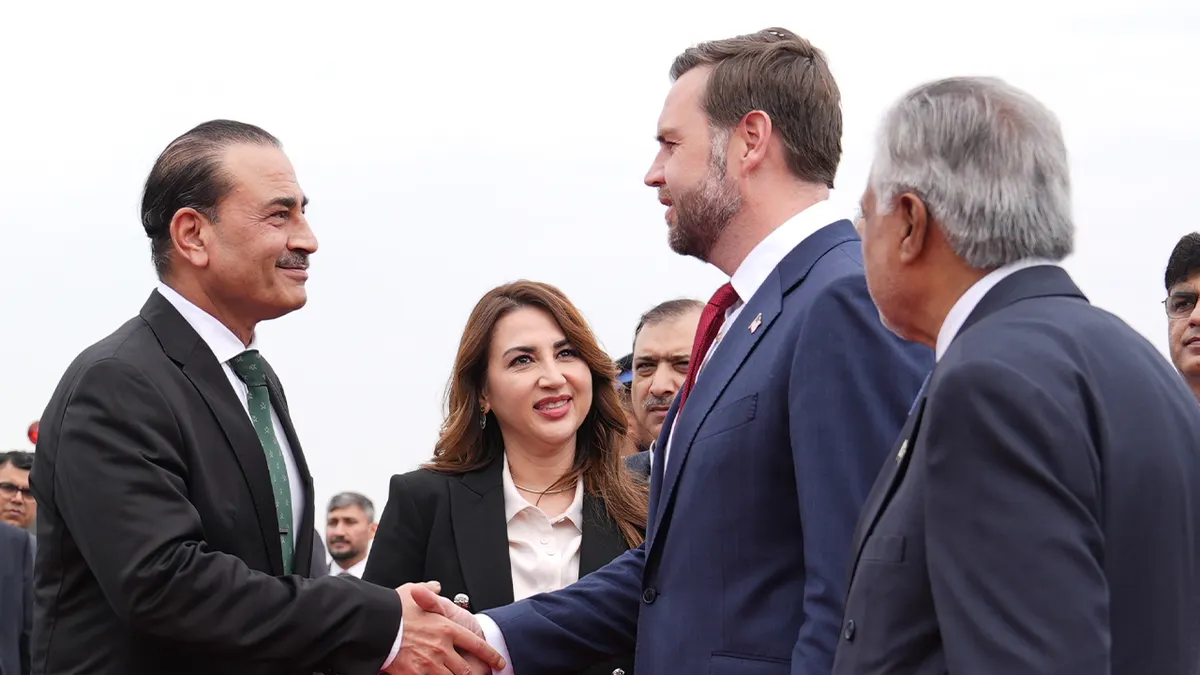
Within this framework, Pakistan emerges as a semi-dependent state embedded in global structures of economic and political reliance. Its ruling elites attempt to maintain their position through mediation between global powers rather than through fundamental transformation. Hosting negotiations and emphasizing geopolitical importance is not a form of independence, but an expression of limited space within the imperialist system.
Pakistan: Mediation as an Ideological Tool and Internal Stabilization
Pakistan’s role as an international mediator is not a sign of structural change, but a reconfiguration within the same system. The state uses its geographic position to enhance its relevance among competing global powers while managing internal instability.
This external role is transformed into an ideological narrative domestically. State media and official discourse present Pakistan as an emerging global actor and an indispensable force for peace. At a time when the population faces inflation, unemployment, and severe economic pressure alongside repression, this narrative functions as a substitute form of hope—that international recognition is improving and future conditions will become better.
From a Marxist perspective, this state function is a key instrument of class domination. Foreign policy and domestic governance operate as interconnected components of the same system. The concept of international prestige is used to delay class demands and stabilize the existing order.
Europe: Subordinate Imperialism and Internal Contradictions
Europe is caught in a contradiction that makes it both a subordinate component of the United States-led imperial system and a center of internal social crisis. Although European governments are formally aligned with the transatlantic alliance, their policies are constrained by economic dependency, energy crises, and internal political pressures.
Public protests in Europe against war, militarization, and economic austerity indicate a growing gap between ruling-class foreign policy and working-class interests. Europe’s imperial position is no longer stable or unified but increasingly fragmented and internally contested.
Israel: Internal Crisis of a Militarized State
Protests against Netanyahu’s government in Israel reflect an internal crisis within a highly militarized system. These protests are driven not only by external threats but also by judicial reforms, elite political conflict, war fatigue, and economic strain.
War initially produces temporary unity, but prolonged militarization creates deep internal fragmentation. Although the Israeli state is based on ideological cohesion, prolonged conflict is weakening that cohesion from within.
United States: Crisis of Imperialist Consensus
Growing opposition to wars in the United States signals that the imperial center itself is undergoing internal crisis. Students, workers, and broader social groups are protesting against war policies. Even within institutional circles, disagreement over military escalation is emerging.
This demonstrates that imperial power is not a unified structure but a complex system of class and institutional contradictions.
Central Global Contradiction
The primary contradiction of today is not between states, but between a global capitalist system engaged in continuous warfare and the increasing social unrest within its own core societies. Imperialism relies on external war and internal ideological control to sustain itself, but both mechanisms are weakening.
From Fragmented Resistance to Historical Possibility
Iran’s resistance, Pakistan’s diplomatic positioning, protests inside Israel, and rising dissent in the United States and Europe all indicate that the global system has entered a transitional phase.
The central question is whether these fragmented resistances can evolve into a unified, conscious, and international movement capable of transforming not only geopolitical relations but the entire structure of global capitalism.
If not, these resistances will remain temporary. If yes, the current crisis may mark not only the decline of an old order but the beginning of a new historical possibility.


