search

America

Paz Enacts State of Emergency and Intensifies Repression of Leaders of the Struggle

Paz Enacts State of Emergency and Intensifies Repression of Leaders of the Struggle

The passage of the new Law on the Regulation of States of Emergency by Rodrigo Paz's administration marks an escalation of repression by the State amongst the political and social crisis that is taking place in Bolivia. Although the executive branch has not yet formally ordered the State of Emergency, the approval of a regulation that expands the authority of the Government and the repressive forces is happening amidst a scenario of increasing mass mobilizations, blockades, and protests. The law constitutes a warning/ regarding the direction the government intends to take towards the growing popular discontent. While the legal framework is being prepared for a potential harsher intervention of security forces, union, peasant, and Indigenous leaders are already facing severe persecution and arrests.
America
On the U.S. indictment of Raúl Castro

On the U.S. indictment of Raúl Castro

This aggression is part of an effort to force regime change in Cuba or to coerce the regime into accepting U.S. hegemony. The U.S. seeks to recolonize Latin America to curb the growth of Chinese imperialism, which continues its economic and diplomatic intervention across the continent. This effort comes because other imperialist powers—primarily Russian and Chinese—have emerged, challenging U.S. hegemony in Eastern Europe, Central Asia, East Asia, and Latin America, a new global reality that is forcing the U.S. to refocus on its historic “backyard.” Trump is following the same pattern used in preparation for the fall of Nicolás Maduro in Venezuela. Legal charges, economic pressure, and military threats were used to isolate the regime and arrest Maduro with a special forces raid. With the abduction of Nicolás Maduro and the subjugation of the Venezuelan state under Delcy Rodríguez, Trump sent a message to all of Latin America—that the yanks had arrived to put things in order.
Cuba
2026 World Cup: Not even FIFA can cover for Trump

2026 World Cup: Not even FIFA can cover for Trump

FIFA, the body that governs soccer worldwide, is about to kick off its latest event, one which, without a doubt, is a cause for great excitement among large segments of the working class and the masses—particularly in the Americas and Europe. While for most people, soccer means passion, emotion, or a sense of belonging, to […]
America
Africa as dumping ground for migrants 

Africa as dumping ground for migrants 

In April the Democratic Republic of Congo began receiving third-country nationals deported from the United States. It is one of many African countries receiving these deportees. The Trump administration has forcibly removed migrants and asylum seekers without informing them of their destination. Mass deportation is attempted through repatriation, and when this is not an option because detainees refuse to be repatriated or their country of origin refuse to receive them, “Asylum Cooperative Agreements” or “third-country” agreements have become the administration’s welcome alternative. For Trump and his band of bigots, no effort can be spared in their accomplishing mass deportation.
Africa
Detained immigrants on strike at Delaney Hall: ‘Don’t give up!’

Detained immigrants on strike at Delaney Hall: ‘Don’t give up!’

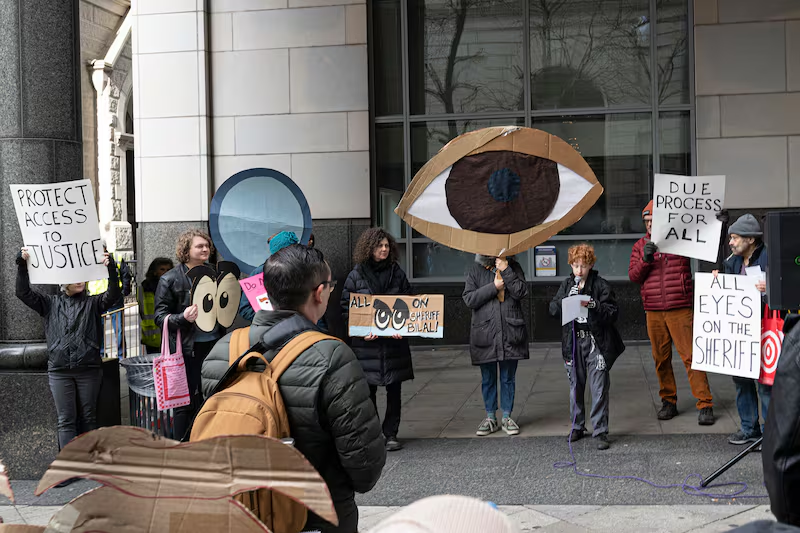
On May 22, about 300 immigrants detained at the Delaney Hall jail in Newark, N.J., began a labor and hunger strike. The bold action was organized to call attention to the inhumane conditions they are facing at the facility and to protest the lack of due process that led to their incarceration by ICE. They charge that immigration judges are ignoring their cases and that their bonds have been denied—tactics, they say, that are employed in order to force the migrants to self-deport.
Featured
Bolivia: Down with President Paz!

Bolivia: Down with President Paz!

The month-long general strike in Bolivia follows decades of both mass-resistance against neoliberal economic programs, as well as the failure of the reformist politics led by former presidents Morales and Arce. Understanding the dynamics behind the 2003 and 2005 uprisings, as well as the response to the 2019 coup and the MAS's fall from grace, is key to Bolivia's future
America
Mifepristone ruling means a huge fight ahead 

Mifepristone ruling means a huge fight ahead 

On May 14, the U.S. Supreme Court “kicked the can down the road” on medical abortion, saving some votes for Trump cronies in the mid-term elections but signaling to the rest of us that tele-health prescribing of mifepristone remains in danger. The Court decided that a lower-court decision from Louisiana that required patients, including those living in states with complete abortion bans, to visit a doctor’s office to get a mifepristone prescription would remain “paused.”  In the meantime, the issue would continue to be litigated in the lower courts and the part of the Republican base that remains pro-abortion would not be stirred up before voting. This maneuver has allowed the high court to expediently delay, but be ready use its powers to further erode the availability of reproductive health care when it is more politically convenient.
Featured
Notes on the May Protests in Bolivia

Notes on the May Protests in Bolivia

On May 18, 2026, crowds mobilized by the Bolivian Workers’ Confederation, the Tupak Katari Peasants’ Union Federation of La Paz, the Urban and Rural Teachers’ Federations of La Paz, the Federation of Factory Workers, and other sectors, as well as the “For Life to Save Bolivia” march organized by Evo Morales’s supporters, converged from the city of El Alto and other areas around Plaza Murillo, the seat of the Bolivian government and Congress, surrounding the plaza for about four hours amid clashes with the police, which brutally repressed the demonstration. The central slogan of the day was “Rodrigo Paz Pereira Must Resign!” 
America
On the Trump-Xi Jinping Summit

On the Trump-Xi Jinping Summit

The meeting underscores what a segment of the global left denies: the Trump-Xi Jinping summit is a meeting between the world’s two leading imperialist powers. And this is far more significant than Trump’s last visit, during his first term.
China
Bolivia takes to the streets! Out with Rodrigo Paz!

Bolivia takes to the streets! Out with Rodrigo Paz!

The uprising encompasses multiple social sectors united in the streets. What began as a list of economic demands has turned into a unanimous call for the resignation of President Rodrigo Paz: Bolivian Workers’ Confederation (COB): on indefinite general strike, demanding real wage increases in the face of devaluation. Peasant and Indigenous Unions: The ‘Túpac Katari’ Federation maintains a total blockade of roads in the Altiplano. Peasants from the Amazon marched on foot for 24 days toward the capital. The Red Ponchos: The historic Aymara indigenous movement from the province of Omasuyos has joined the mass mobilizations through indefinite road blockades, strategic encirclements, and fierce resistance in the Altiplano region and at the main access points to the cities of El Alto and La Paz. Miners and Teachers: Massive columns of miners marched through downtown La Paz, while teachers brought educational activities to a standstill, demanding budget improvements. Marches by social sectors toward the seat of government: Popular formations are walking from Oruro to besiege the capital.
America
Gutting of Voting Rights Act attempts to deny democracy to all working people

Gutting of Voting Rights Act attempts to deny democracy to all working people

Nearly 5000 protesters assembled in Montgomery, Ala., on Saturday, May 16, as part of the emergency mobilization dubbed All Roads Lead to the South.  The Montgomery rally followed the recreation of a segment of the first Selma to Montgomery march of 1965, when 600 protesters were attacked by state troopers on the Edmund Pettis Bridge in Selma, an event that has come to be known as “Bloody Sunday.”  Faith leaders, politicians, and activists joined figures like the “oldest living foot soldier” from that original crossing, 84-year-old Annie Mae Avery, and Sheyann Webb-Christburg, who was an eight-year-old participant and victim of the police assault. These mobilizations were a response to the Supreme Court’s April 29 ruling on the case of Louisiana v. Callais, which granted Louisiana the right to gerrymander voting districts to make Black representation to Congress nearly impossible. Within days of the verdict, other white Southern state governors and legislators rushed to use the ruling to squash the electoral voice of the Black community. This includes efforts in Alabama, Tennessee, and South Carolina.
Featured
Workers need a program of action that is independent of the Democrats

Workers need a program of action that is independent of the Democrats

For working-class people, the crisis of affordability has become more dire. Prices have been rising, rents are out of control, and many people work more than one job just to run in place. Many young workers are saddled with high debt from student loans. It’s not lost on them that the government, which is quick to bail out banks and corporations, has done nothing to help them. The Affordability Agenda highlights the basic bread and butter questions that form the affordability crisis, calling for affordable housing, good well-paying jobs and an end to wage stagnation, affordable universal needs such as “child care with fair provider wages, free school meals and expanded food assistance alongside anti-gouging measures.” The Agenda also calls for free higher education, comprehensive health care for all, free public transit, and publicly controlled utilities. While the planks in this program are both correct and supportable, there are limitations. If there is one lesson of the recent gutting of the Voting Rights Act, it is that no reform, no matter how hard won it might be, is permanent as long as capitalism continues to exist.
Featured
What Does Unconditional Support for the Palestinian Liberation Struggle Mean?

What Does Unconditional Support for the Palestinian Liberation Struggle Mean?

How can we defend unconditional support for the Palestinian liberation struggle—including the right to resistance—within the space of bourgeois democracy, especially when the government seeks precisely to suppress that support? The answer lies neither in adapting to the rules of the game nor in an abstract rejection of the legal arena. It is possible—and necessary—to use the very contradictions of bourgeois democracy against it. How can revolutionaries and those in solidarity with the Palestinian struggle use the formal freedoms of bourgeois democracy—freedom of speech, assembly, and the press; due process of law—to defend the right to self-determination, which includes, as the UN itself recognizes, “the struggle by all available means, including armed struggle”? This is the central contradiction we face. On the one hand, liberal democracies have been passing laws that equate anti-Zionism with anti-Semitism, criminalizing BDS, banning slogans like “from the river to the sea,” and persecuting activists. On the other hand, we know that abandoning the legal arena means abandoning the working class and the youth to repression without defense.
Europe
Who is Zé Maria?

Who is Zé Maria?

Longtime industrial union leader and political activist faces 2 years' sentence for speech in defense of Palestinian liberation. His life story is the story of the Brazilian working class and pro-democracy movements.
Brazil
Zé Maria responds to attacks in the Folha do S. Paulo

Zé Maria responds to attacks in the Folha do S. Paulo

Below, we publish an English translation of an attack against Zé Maria authored by Demétrio Magnoli in the major Brazilian newspaper, Folha do S. Paulo, followed by a response from Zé Maria published in the same paper. Original links to the Portuguese articles in the Folha are included. Freedom for antisemitic opinion By Demétrio Magnoli […]
Brazil