
All out support to the workers of the Indian Oil Corporation
The protests stands as one of the largest single action by workers anywhere in India.
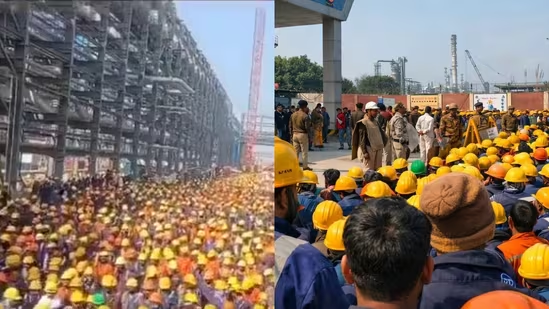
Since the 23rd February 2026, tens of thousands of contract workers at the Indian Oil Corporation (IOC) refinery in Panipat, the largest oil refinery of South Asia, have been protesting. These protests broke out after an accident killed two contract workers, highlighting the systematic exploitation of workers in the refinery.
The protests stands as one of the largest single action by workers anywhere in the country. These are contract workers, many of whom come from rural regions of Bihar and North India, they come for a better life to Haryana. Their labour built up one of India’s fastest growing industrial regions. Yet, for their sacrifices, they aren’t given the basic respect of a regular pay.
The contract workers of IOC have to work 12 hour shifts, seven days a week, getting only 2 holidays a month. Pay is irregular and when it happens, they receive a fraction of what regular workers get. Most workers at the IOC refinery at Panipat are contract workers, showing the bosses’ greed at play. Workers fought and died for eight hour days, and a weekend holiday over a hundred years ago, yet here in Panipat even these basic rights are denied to them! Basic sanitation facilities like toilets and lunch breaks are denied to the contract workers.
The workers have every right to mobilize against the company bosses, they have every right to fight back. Rather than try to listen to their grievances the IOC management in collusion with the administration, called in the police and the CISF. They resorted to repression!
The CISF fired warning shots to try and disperse the workers, but the workers remained firm. The authorities have filed FIRs against 2500 unnamed workers. At the same time, no proceedings have been initiated against the management or contractors, whose negligence caused the fatal accident to occur.
The strike action continues into its fourth day as of this writing. The management has only offered vague assurances of redressing the worker’s grievances. The only concrete offer from their side has been of repression at the hands of the police. Unions and workers organizations across Haryana and North India have offered solidarity with the IOC contract workers, strengthening their fight.
Not long after the protests broke out in Haryana, similar strike actions took place in the IOC refinery at Surat. That was followed up by workers of Larsen and Toubro striking work, again over conditions of work and pay.
What the strike reveals
Most of India’s 700 million workforce is young and exploited: most work in the unorganized sector where establishments employ less than 20 workers. Those who do find work in the organized sector often find themselves in small establishments with a few hundred workers. These smaller establishments are legally exempted labour right protections. The pre-existing protections under laws such as the Industrial Disputes Act, and Factories Act, have been further diluted under the new Labour Codes.
The Indian bourgeoisie found a novel way to bypass labour regulations even within organized work, this emerged in the form of contract labour. The system of contract labour shifts the burden of paying the worker to the contractor, making the employer unapproachable and unaccountable. In 1970 the Contract workers (Regulation and Abolition) Act was passed, with the aim of eventually abolishing this system. The law failed in its aim, today after more than fifty years, poor enforcement and oversight have ensured that most organized labour has become contract based.
The act lays down the provision of amenities for contract workers, such as restrooms and canteens. It is the duty of the contractor to provide for such facilities, but failing that it becomes the duty of the employer to ensure these are provided for. That no such facility was provided in IOC either by the contractor or employer shows the shoddy enforcement of the law. The most abused provisions come under section ten of the Act which prohibits employing contract work in work of a perennial nature. Yet, that is precisely what we have seen at IOC.
The situation in IOC is telling, the largest refinery in South Asia employing up to 50,000 workers is primarily composed of contract workers. That such abuse is taking place in a public sector company of the size and resources of IOC is doubly shocking, but it is not a problem that is unique to IOC. The same situation exists across the public sector, it was the same situation we saw at BSNL, where contract workers have been made to do work of a perennial nature, yet given pay and conditions not befitting their role.
The protests at Surat and Panipat reveal the deep hatred of the working class by India’s capitalist class. The contract workers have been treated like expendable resources, their dignity and humanity may be sacrificed for profits. Indian Oil Corporation recorded a 322% jump in its profits this quarter compared to the same last year. Yet this company, now valued at over $30 billion, can’t afford basic sanitation for its workers!
The protests have brought the spotlight on the systemic exploitation of contract labour in India, it has also revealed that this is as widespread in major public companies as it is in private companies. The government, which is supposed to be the source of stable good quality employment, has resorted to contract labour. The fight for its abolition isn’t just the fight of contract workers of one or two companies, but for the working class as a whole.
ABOLISH CONTRACT LABOUR ! PERMANENT WORK FOR ALL !
DROP THE CASES ! WORKER’S RIGHTS ARE HUMAN RIGHTS !
FOR THE 8 HOUR DAY !
HEALTHY WORK AND DECENT PAY FOR ALL !
First published here by New Wave (Bolshevik-Leninist)


