
Against US-led Imperialist War and For Iranian Self-Determination
Some ambiguous phrasing in this article could lead to a misinterpretation of how the tasks of national liberation against the imperialist offensive are combined with the democratic tasks in Iran. We explain this connection in the following article, “Crises Are Multiplying, but Trump Continues His Aggression.” In it, we write: “While the current war in Iran combines two tasks—national liberation and the struggle against the dictatorial bourgeois regime—we do not equate the two. We cannot oppose the U.S., Israel, and the Iranian regime in the same way, creating an imaginary camp consisting of the Iranian masses who would be outside the war. Today, the defense of Iran cannot be reduced to the defense of “the Iranian masses,” but rather takes the form of materially supporting the military front led by Khamenei’s reactionary regime in all its defensive actions.”
Fabio Bosco and Florence Oppen – March 26
7m
The U.S. and Israel Attack Iran
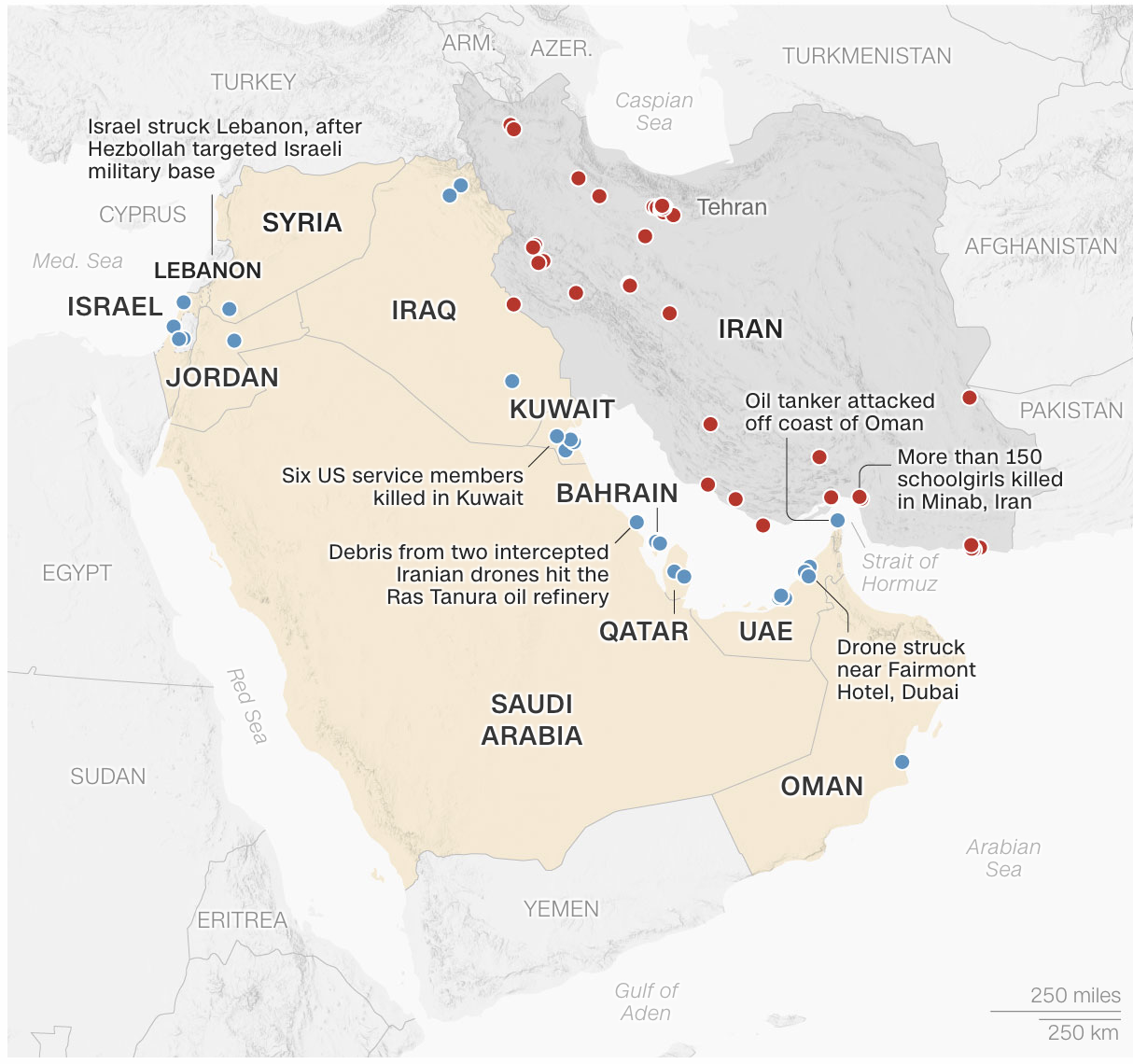
Over the weekend of February 28–March 1, 2026, the United States and Israel launched a coordinated military offensive against Iran, dramatically escalating long-standing tensions in the Middle East. The operation, described by the U.S. Pentagon as Operation Epic Fury and by Israeli officials as Lion’s Roar, involved air strikes and missile attacks on at least 14 Iranian cities and strategic sites, including Tehran, Isfahan, Qom, Karaj, and others.
U.S. and allied statements have put forward contradictory aims for the attack: to cripple Iran’s military infrastructure, missile systems, and nuclear-related facilities, and later to achieve “regime change” in Iran. These shifts echo earlier U.S. unfounded justifications for war, particularly the Bush administration’s case for invading Iraq in 2003. At the time, the White House framed military action as necessary to eliminate alleged “weapons of mass destruction,” a claim later shown to be a lie, and yet a new motive, “democracy promotion,” was used to continue the war in Iraq and justify prolonged occupation in Afghanistan. Defensive language—emphasizing imminent threats and regional stability—has been used by successive US administrations since 9/11 2001 to build public legitimacy and cover up the real economic and geopolitical goals of the US.
The current attack on Iran seems to follow a well-known path of manipulating and deceiving US workers to justify an ever-increasing military machine to reach military superiority over China, secure its threatened influence in the Middle East, and to cover up the failures of Trump’s domestic policy, from the reversal of tariffs to the growing embarrassment around the Epstein affair ahead of the Midterm elections. Recent polls, however, suggest that Trump has misjudged US sentiment, as 43% of Americans disapprove of this military aggression, and 29% are unsure.
On the surface, the US and Israel appear to have different goals. While the Trump administration struggles to keep a coherent and convincing narrative, Israel has never hidden that this attack was about destroying Iran and its people, labelled as an “existential threat”, and to continue its genocidal war for a “Greater Israel” against Palestinians and the rest of the people in the region. Yet, both countries are united in their strategy of domination, fighting against the self-determination of all peoples of the region, whether Palestinians, Iranians, Lebanese or anyone else who might stand in their way. The US, in particular, is interested in stopping Iran from developing as a potential future outpost for China and Russia in the region, or from pursuing any independent initiative of its own.
Iran Has a Right To Defend Itself
The US and Israel are not carrying out these attacks to defend themselves or to defend the democratic rights of Iranians. Quite the opposite, this is a war of aggression motivated by the US political and economic interests alien to the Iranian people. Regardless of the atrocities and repression committed by the Iranian regime against its people, the US and Israel’s imperialist aggression threatens the fundamental right of self-determination of Iran as a legitimate nation. The removal of the regime is the right that belongs to the Iranian people, and only to them. And in particular, given the nature of the Israeli and US offensive on Iran, consisting solely of widespread bombardments, the possibility for the Iranian working class to organize against the regime has thus far been severely diminished, not strengthened, by the disruption of public space and increased militarization of government forces.
Iran’s Supreme Leader Ayatollah Ali Khamenei was killed during the initial strikes, a fact confirmed by Iranian state media and acknowledged by U.S. and Israeli leaders. Khamenei had led the Islamic Republic since 1989, and his death marks a rare decapitation of a sitting head of state by foreign military action. The IDF and the Pentagon are reporting that they also killed 49 senior Iranian leaders.
More concerning is that, as usual, there are already reports of significant civilian losses considered as mere “collateral damage” by the US war machine. According to a preliminary report from the US-based Human Rights Activists News Agency (HRANA), the first day of the coordinated U.S.–Israeli strikes on Iran resulted in an estimated minimum of 333 civilian casualties (deaths and injuries combined) across at least 18 provinces — a figure that continues to evolve as more information emerges despite government censorship and communications blackouts. The Iranian Red Crescent reports figures so far higher: 555 deaths. Among those are the over 108 children killed at the girls’ elementary school in Minab, with many more injured. Western powers also bombed the Gandhi Hospital in Tehran.
The initial response from Iran, given that the official government was hit, came from its religious leaders: 99-year-old Grand Ayatollah, Makarem Shirazi, said Khamenei’s revenge is the “religious duty of all Muslims in the world to eradicate the evil of these criminals from the world,” according to state-affiliated Tasnim News Agency. Another leading cleric, Ayatollah Nouri Hamedani, issued a fatwa declaring an obligation for all Muslims to “avenge the blood” of Khamenei.
On Sunday, March 1st, one of the surviving top leaders of the regime, Iran’s Foreign Minister Abbas Araghchi, rejected US President Donald Trump’s warning not to retaliate against massive US and Israeli bombardment, claiming that the country will not respect any limit in its legitimate right of self-defense: “Nobody can tell us that you don’t have any right to defend yourselves. We are defending ourselves, whatever it takes, and we see no limit for ourselves to defend our people, to protect our people,” Araghchi told ABC News.
In this, and probably in this alone, the representative of the Iranian regime speaks a fundamental truth: the Iranian people have an unlimited right to defend themselves, by any means necessary, from this foreign aggression. The challenge is that this regime cannot “defend its people” while also continuing the brutal repression against them. In order to be able to truly oppose the US and Israeli aggression, the regime should stop all judicial proceedings against the protesters, stop the executions, free the political prisoners, and disband the forces responsible for the mass murders. A regime that kills and silences its own people cannot defend itself from foreign attacks.
A Growing Risk of a Regional War
Despite the delusional declarations of US War Secretary Hegseth asserting that “This is not Iraq. This is not endless,” the current dynamic of the war, as expected, is one of rapid escalation and regionalization. In less than 3 days, more than 14 countries are involved in a military conflict that could spiral out of control, and now we are set for “at least” 4 or 5 weeks of war.
Iran responded with retaliatory missile and drone attacks targeting U.S. and Israeli positions. Eight Arab countries have reported missile attacks: the United Arab Emirates, Bahrain, Kuwait, Saudi Arabia, Iraq, Jordan, Oman, and Qatar. In addition, the Revolutionary Guard also claims attacks on US and UK oil tankers, and the destruction of some US cruisers and destroyers.
Some of these attacks, however, have already caused military casualties. Four U.S. service members lost their lives in action, and several others have been seriously wounded. On March 2nd, Kuwait accidentally shot down three US warplanes, showing the chaos and confusion of a conflict with so many participants. Trump’s remarks on the question suggest that the U.S. military anticipates many more casualties among its soldiers.
In addition, some of the Iranian defensive actions can hit civilian locations and spark regional strife. In the UAE, which has so far endured 165 ballistic missiles from Iran, 3 people are reported dead, and 58 are injured. Bahrain’s Ministry of Interior confirmed that the Crowne Plaza Hotel in Manama had been damaged in an attack, with no casualties, which is an example that this conflict can get out of hand at any moment. There are also reports of a UK military base in Cyprus, an EU member, being hit by an Iranian missile.
Netanyahu Continues a Genocidal War Without Boundaries
Israeli leaders, especially Prime Minister Benjamin Netanyahu, have publicly and consistently urged the U.S. to take military action against Iran for years, framing Tehran as an existential threat due to its nuclear and long-range missile programs. This narrative was a central justification for the joint strike offered by Israeli officials, as part of the settler colonial expansion. U.S. officials have already indicated support for Israel to annex any territory it wants in the Middle East, and the U.S. provides the backbone and logistical infrastructure for all Israeli aerial military operations. It is hard to believe that Israel could carry out any military offensive of its own in the region that was not previously agreed upon with the US. While Israel’s attacks against Iran are not yet genocidal in themselves, they are made in the context of destroying any political force which makes even minimal efforts to stem its genocidal campaigns against Palestinians in Gaza, the West Bank, Lebanon and Syria, while the Israeli far right openly plots for a Greater Israel that could include Jordan, the Sinai, or more.
Iran’s retaliatory missile strikes hit central Tel Aviv, resulting in at least one civilian death—a woman in her 50s—and in addition, there are multiple people who were either seriously or lightly injured when the missile struck in the heart of the city, which triggered sirens, emergency response, and a state of emergency declaration. There are also reports that five people were killed in a direct missile hit on a residential building near Jerusalem, Israel police said in a statement on Sunday afternoon.
In response, the Israeli military announced on Sunday, March 1, 2026, that it is preparing to mobilize around 100,000 reservists as part of its campaign against Iran for a greater Israel. Hezbollah has fired rockets, and Israel has another round of bombings on Lebanon, which so far have killed 52 people.
Additional evidence that Israel’s attack on Iran is part of the same colonial offensive to exterminate Palestinians and expand the racist, zionist regime is the recent rapid increase of settlements. In the past three months, the Israeli government has formalized many of the largest settlement approvals, such as the December 2025 approval of 19 new settlements. These precedents set the stage for accelerated settlement activity and tighter Israeli governance over West Bank land, with the approval of the February 2026 land-registration, which authorizes authorities to classify land in the West Bank as “state property” for the first time since 1967. This is a historical step towards effectively expanding Israeli control and paving the way for the legalization of violent settlement activity and the dispossession of Palestinians. These new regulations are a de facto annexation strategy, transferring military-administered areas into civilian regulatory frameworks that favor settlement building and control.
Next to the violent colonizing efforts on the West Bank is the new attempt to strangle the Palestinian resistance in Gaza. Earlier in February 2026, after more than two years of near-total closure, Rafah reopened on a limited basis under ceasefire conditions. A small number of Palestinians — including patients seeking medical care — were able to cross into Egypt, though numbers were far below those in need due to strict controls and vetting procedures. Yet now, after the attacks, Israel closed the Rafah border crossing on March 1st again. Israel has once again shut its border with Egypt, sealing Gaza off from its only external border that doesn’t run through Israel. The Gaza health ministry had reported that at least 600 people have been killed since the ceasefire went into effect in October of last year.
The Conundrum for China and Russia
The current U.S.–Israeli assault on Iran cannot be understood without being also situated within sharpening inter-imperialist rivalries in a period of global capitalist crisis and sharp decay of US hegemony. Thus far, China and Russia, two rival imperialist powers to the US, have confined themselves to verbal denunciations of the attack against Iran. China’s foreign minister, Wang Yi, labeled the joint U.S.–Israeli strike “unacceptable” and condemned what he described as the killing of a sovereign head of state and moves toward regime change. Similarly, President Vladimir Putin called the assassination of Iran’s supreme leader a “cynical” act that violated “moral principles” and international law, according to TASS.
The policies of these two powers, however, cannot be analyzed by adhering to their empty rhetoric of peaceful internationalism. Their careful and complicated positioning in this conflict is not without contradictions, for they have invested in parallel economic relations with both Iran and Israel.
Over recent decades, Iran has been drawn more tightly into China’s orbit. A central framework for this cooperation is the 25-year Comprehensive Strategic Partnership signed in 2021, which outlines expanded collaboration in economic, political, regional, and security spheres, although many of its provisions remain undisclosed. What is sure is that China now accounts for roughly 30 percent of Iran’s total trade, largely through energy flows: Iranian oil and gas in exchange for Chinese manufactured goods. After Washington withdrew from the 2015 nuclear agreement and reimposed sanctions, Tehran’s dependence on Chinese markets deepened. Yet the relationship is asymmetrical: Beijing secures discounted energy and expanded geopolitical leverage, while Iran gains limited structural development. Chinese firms have helped sustain Iranian oil exports via the so-called “shadow fleet,” mitigating sanctions without fundamentally transforming Iran’s dependent position. Military ties — including joint drills within the Shanghai Cooperation Organization and exercises such as Sahand-2025 — remain cautious. Days before the attacks, China delivered minor “offensive” weapons as well as additional “defensive” arms to Iran, such as Kamikaze drones. There were also reports that Iran was reportedly nearing a deal to purchase Chinese-made CM-302 anti-ship cruise missiles with a range of about 290 kilometres, designed to evade shipborne defences by flying low and fast. The Islamic Republic is also in talks to acquire Chinese surface-to-air missile systems, so-called MANPADS, anti-ballistic weapons, and anti-satellite weapons. This missile purchase would be among the most advanced pieces of military hardware transferred to Iran by China and would violate a United Nations weapons embargo imposed on Iran in 2006.
Yet, if Beijing avoids direct military involvement on the side of Iran, preferring cautious, long-term strategic engagement, and is very unlikely to intervene militarily in this conflict, it is also because it is rapidly developing economic relations with Israel. China is Israel’s second-largest trading partner globally after the United States. According to China’s Ministry of Foreign Affairs, bilateral trade between China and Israel from January through October 2025 reached approximately $27.44 billion. This represents an increase compared with previous years and underscores continued growth in economic ties: in December 2025, China’s exports to Israel were about 29% higher than in December 2024, and Chinese imports from Israel were 98% higher than in December 2024. In addition, in 2021, the Shanghai International Port Group won a 25-year contract to operate part of the new Haifa Bayport terminal, a development that drew scrutiny from Washington because Haifa is a port visited by the U.S. Navy. Chinese firms have also been involved in rail and light-rail construction projects in Israel, as well as the HaDarom Port Project, Israel’s new main maritime gateway, located in Ashdod, southern Israel, and is the flagship Belt and Road Initiative (BRI) transportation project in the country. The tender for the project was awarded to China Harbour Engineering Company (CHEC) and the project works were executed by its Israeli subsidiary, Pan Mediterranean Engineering Company (PMEC).
A parallel dynamic shapes Iran–Russia relations. Following U.S. and EU sanctions tied to Russia’s 2022 invasion of Ukraine, Moscow and Tehran formalized their alignment through a Comprehensive Strategic Partnership Treaty signed in January 2025, projected to guide relations for about twenty years. The agreement provides a framework for expanding commercial exchange, coordinating positions in regional diplomacy, and reducing vulnerability to Western sanctions. Trade between the two countries has increased steadily; from January to October 2024, bilateral commerce rose by about 15.5 percent, reaching approximately $3.77 billion, reflecting intensified exchanges under shared economic pressure. Cooperation includes alternative payment systems, energy coordination, and defense collaboration, including a reported €500 million deal for thousands of advanced shoulder-fired rockets. Putin’s defense of Iranian “stability” during domestic protests further underscores that Moscow prioritizes regime continuity and bloc consolidation.
Despite the growing relations between China and Iran, the Iranian people cannot rely on China or Russia to fully support their struggle for national liberation against the US and Israel. It is clear that both countries, especially China, are more committed to their economic expansion in the region with all partners than to the rights of the Iranian people, and thus their guiding principle will be political stability at any cost, including the cost of Iranian lives, rather than a full-blown and expensive war that drags them in.
The Role of Saudi Arabia and Gulf States
The current offensive is unfolding within the framework created by the Abraham Accords and the consolidation of a regional counterrevolutionary bloc aligned with US imperialism. The normalization agreements signed between Israel and several Arab regimes—beginning in 2020 with the UAE and Bahrain, later extended to Morocco and Sudan, and deepened through informal security coordination with Saudi Arabia—were never about “peace.” They were about restructuring the regional balance of power in favor of US hegemony, integrating Israel openly into a US-led security architecture, and consolidating an alliance of authoritarian regimes against both Iran and their own working classes.
Today, this alignment bears direct responsibility for the escalation against Iran. Even where Gulf governments publicly call for restraint, their structural position is clear. Their airspace, bases, logistics corridors, and intelligence networks are deeply intertwined with US military operations. Decades of hosting American fleets and air commands—from Bahrain’s Fifth Fleet to Qatar’s al-Udeid base and facilities in the UAE and Kuwait—have transformed the Gulf into a forward operating platform for US war-making.
Reporting from The Washington Post and other outlets indicates that Saudi Crown Prince Mohammed bin Salman privately encouraged former U.S. President Donald Trump to consider military action against Iran. According to these accounts, the crown prince argued that failing to confront Tehran would allow it to expand its regional influence and increase the security risks facing Saudi Arabia and its neighbors. At the same time, however, Saudi Arabia’s public messaging continued to emphasize diplomacy and restraint, warning against a wider regional escalation.
This is a 180-degree turn from Ben Salman’s position in January, which initially opposed U.S. military action by refusing to allow the U.S. to use its airspace for an attack. Following the recent joint U.S.–Israeli strikes, Saudi Arabia privately backed, Riyadh publicly denounced Iran’s retaliatory missile attacks against Gulf countries and expressed support for coordinated defensive measures among Arab states. Notably, its official statements focused criticism on Tehran’s actions rather than openly endorsing the original U.S.–Israeli offensive.
The war against Iran reveals the true content of the Abraham Accords: a military alliance preparing for confrontation, not reconciliation. Against this counterrevolutionary bloc, the only progressive alternative is solidarity among the workers and oppressed of the entire region to first defeat the Western imperialist aggression, and then open the road for a more complete liberation of the region, which entails the recovery of the 1948 Palestinian territory for its people as well as the downfall of the many capitalist monarchies and clerical-military dictatorship that stifle working people, especially women, youth and national and religious minorities in the region. Only through independent working-class struggle can the reactionary architecture built by the Abraham Accords be dismantled and replaced with a federation of free peoples across the Middle East.
Mixed Reactions in Iran
Reactions among Iranian people appear deeply divided and intense, as this attack unfolds a month after the brutal repression of Iranian mass protests by the regime. The Western aggression occurred when the country was still mourning the bloodbath repression carried out by Khamenei and witnessing the slow death executions of at least 50 protesters.
The state’s response to the vast and widespread popular demonstrations for democratic rights in the country initiated three months ago has been met by extreme violence by the government. Security forces and military units reportedly fired directly on demonstrators, carried out mass arrests, and imposed widespread repression, including internet shutdowns and electricity cuts to suppress communication and coordination. The most brutal crackdown occurred on January 8 and 9, when massacres were carried out against protesters. According to the U.S.-based Human Rights Activists News Agency (HRANA), as of February 13th, there were 7,008 confirmed fatalities, with 11,730 deaths remaining under review as information slowly emerges despite government censorship, and 53,344 protesters had been detained. The scope of the crackdown is widely described as comparable in intensity to the repression that unfolded during the 1979 revolution.
This is key to understanding why there were reports of celebrations in some Iranian cities of the death of the very much hated Khamenei, including footage circulating of Iranians dancing and openly expressing support for the strikes against the clerical leadership — an extraordinary scene, given longstanding restrictions on public displays of such sentiment. Yet, most of these celebrations were also marked by deep grief and fear, and many of the protesters opposed to the regime have been vocally opposed to any US military intervention, as they know they will also be the likely casualties of US and Israeli bombs. Many Iranians interviewed have voiced staunch opposition to the attacks while also hoping for peace and an end to the suffering — especially amid reports of civilian deaths, such as schoolchildren killed in Minab.
The Islamic Revolutionary Guard Corps, Backbone of the Regime
The Islamic Revolutionary Guard Corps (IRGC), the Quds Force, and its affiliated networks constituted the backbone of Khamenei’s Islamic regime since 1979, after the Islamic Revolution. Removing a figurehead or even a leadership faction would not dismantle the broader system because it is a tightly interwoven institutional structure shaped over decades.
The IRGC started as an elite armed force and a constitutionally recognised component of the Iranian military. It operates alongside the country’s regular army but answers directly to the supreme leader. It is composed of ground, naval, and air forces troops and includes an internal security paramilitary militia known as Basij. It also has an external operations force called the Quds Force, which is focused on special operations outside Iranian territory. It plays a key role in Iran’s defense, foreign operations, and regional influence with its 190,000 or so active personnel and a total fighting force of 600,000 if reserves are included.
Yet, most importantly, the IRGC is not simply a military force, but a parallel political, economic, and security institution that reports directly to the Supreme Leader. At the military level, it dominates the most critical strategic sectors (missiles, asymmetrical warfare, and intelligence. The IRGC, however, is also deeply entrenched in Iran’s political and economic structures. Its economic role expanded during the 1980-88 Iran-Iraq war, as it handled engineering and logistics to sustain Iran’s war effort. Firms affiliated with the IRGC reportedly have contracts in key sectors, including Iran’s natural resources, transport, infrastructure, telecommunications, and mining. Iranian officials call this the “resistance economy”.
Two Opposed Paths for “Regime Change” and Self-Determination
Only a minority of Iranians backed the US offensive, and yet, only a minority of Iranians support the Islamic Republic regime. The majority of the population is trying to figure out a way out of the announced weeks of bombings, and out of the clutches of the bloody regime. This way out cannot entail a return to the US-backed monarchy or a renewed status quo with a new layer of the IRGC remaining in power.
Regime change in Iran can occur via two very different paths, with opposing outcomes. One possibility is for the independent elements of the democratic and grassroots movement that have been articulated since 2017 through successive waves of protest and repression to build a political alternative that takes up the fight against both the US and Israeli invasion, and the local regime, opening a new path forward in Iran.
Alternatively, it is possible that the US and Israel could carry out regime change via troops on the ground or via a covert CIA and Mossad operation, aligning themselves with the reactionary elements of the Iranian diaspora and the pro-Pahlavi monarchical sectors in Iran.
Of course, only the first path of regime change will guarantee real political and economic self-determination for Iranians. Any alliance with US-backed anti-regime sectors today will only lead to the further impoverishment and oppression of Iranians.
In the end, the only durable and reliable road to genuine liberation way out of this multi-faceted nightmare is the independent self-organization of the Iranian people—through workplace committees, strike councils, neighborhood assemblies, and democratic bodies of self-defense. And these were precisely the formidable forces from which the past wave of uprisings drew strength. Organized feminist collectives have continued to carry forward the legacy of Women, Life, Freedom and challenge state control over women’s bodies and everyday life. University students — from Tehran, Shahid Beheshti, Allameh Tabataba’i, and other major campuses — have played a dynamic role in mobilising demonstrations, producing statements, and sustaining networks of resistance. Crucially, sections of the organized working class have expressed solidarity, including the Retirees’ Union, the Council for Organizing Contract Oil Workers, the Coordinating Council of Nurses’ Protests, the Coordination Council for Teachers’ Unions, and the Bus Workers’ Syndicate. Intellectual and cultural figures, notably the long-persecuted Iranian Writers’ Association, have also voiced support, linking the struggle to longstanding fights against censorship. Ethnic and regional minority organisations — Kurdish, Baluch, Luri, and others — have mobilized or issued calls for democratization and equal rights, while shopkeepers and small economic actors have participated through closures and public demonstrations of support. In some sectors, especially among transport workers and bus drivers, the question of independent working-class leadership has emerged explicitly, with calls in cities such as Arak for workers’ and neighborhood councils, drawing on earlier traditions of grassroots self-organization in Iran.
Those who are inside or outside Iran and are backing the war, or a coup against the regime, are deeply mistaken. Imperialist war has never been a pathway to liberation. Every recent example—from Iraq to Libya to Afghanistan—demonstrates that US-led regime change brings devastation, sectarian fragmentation, and new forms of dictatorship. The bombing of Iran has already murdered civilians, destroyed infrastructure, and strengthened the most reactionary sectors of the regime. War consolidates repression. It allows the IRGC to tighten its grip, silence dissent, and present itself as the guardian of national survival. US–Israeli intervention is, therefore. not a shortcut to freedom, but a direct obstacle to the independent mobilization of workers, youth, women, and oppressed minorities who have repeatedly risen up against the Islamic Republic.
For the Defeat of Imperialist Aggression and for a Free, Workers’ Iran
The central dividing line in this war is clear. The United States and Israel have launched an imperialist assault on a sovereign country, openly demanding regime change and killing hundreds of civilians in the process. Whatever crimes the Islamic Republic has committed against its own people—and they are many—this does not grant Washington or Tel Aviv the right to bomb Iran, assassinate its leaders, or determine its political future. The right to remove the regime belongs to the Iranian people alone.
For that reason, the international working class must take a side. Not the side of the Islamic Republic, but the side of Iran against imperialist aggression. Workers in the United States, Europe, and across the region must refuse to be dragged behind their governments’ war machine.
A principled antiwar movement must be built as a broad united front rooted in the working class, a movement that puts at the center the immediate withdrawal of all US forces, and the dismantling of the vast network of American military bases that encircle the Middle East. It must demand the lifting of all sanctions. It must oppose any ground invasion, covert operations, or any other attempt to subordinate Iran to imperialist domination.
Trade unions, student organizations, feminist groups, socialist currents, Palestinian solidarity networks, migrant and immigrant communities, and anti-racist organizations must come together in mass demonstrations and coordinated actions against imperialist war and repression. Only through united, visible, and militant mobilizations—linking the struggle against war abroad with the fight against exploitation, racism, and austerity at home—can we create a force capable of challenging both imperialist aggression and the reactionary regimes it sustains around the globe.
At the same time, opposing imperialist aggression does not mean political support for the Iranian ruling class. The IRGC and the clerical–military apparatus are not truly anti-imperialist in any sense. Over decades, they have overseen neoliberal restructuring, privatization waves, and the consolidation of vast parastatal conglomerates for their own enrichment. Under the banner of a “resistance economy,” they have entrenched monopolies, suppressed labor organizations, crushed strikes, and deepened social inequality. They have eroded the material basis for genuine economic self-determination by fusing state-owned assets with semi-private empires shielded from democratic accountability and owned by a corrupt oligarchy. This regime is an obstacle, not only to democratic rights, but to real sovereignty rooted in popular control over resources.
For revolutionaries, the task is therefore twofold: military opposition to imperialism, full solidarity with the Iranian people’s right of self-defense, and political independence from the regime. We reject any US- or Israeli-backed “soft coup,” exile project, or right-wing diaspora scheme that would install a compliant government under foreign dominion. No to regime change imposed from above by bombs or by covert manipulation. No to monarchist restoration or neoliberal technocratic alternatives tied to Western capital. The future of Iran cannot be decided in Washington, Tel Aviv, Riyadh, or Beijing.
Internationally, the slogan must be clear: defeat imperialist aggression, defend Iran’s right to self-determination, and fight for a workers’ and popular alternative to the Islamic Republic. The struggle against war must be linked to the struggle against austerity, repression, and exploitation at home. Workers in the US and Europe cannot oppose war abroad while tolerating the same corporations and political elites that profit from militarism and crisis domestically.
Only the independent mobilization of the working class—against imperialism, against the clerical–military oligarchy, and against all forms of capitalist domination—can open the road to a free, democratic, and socialist Iran. The bombs of the Pentagon and the missiles of the IDF will not bring liberation. Nor will the entrenched apparatus of the IRGC deliver real sovereignty. The future belongs to the workers and oppressed of Iran, fighting on their own terrain, in solidarity with workers everywhere.


