
The Potential and Limits of This New Autumn of Struggles
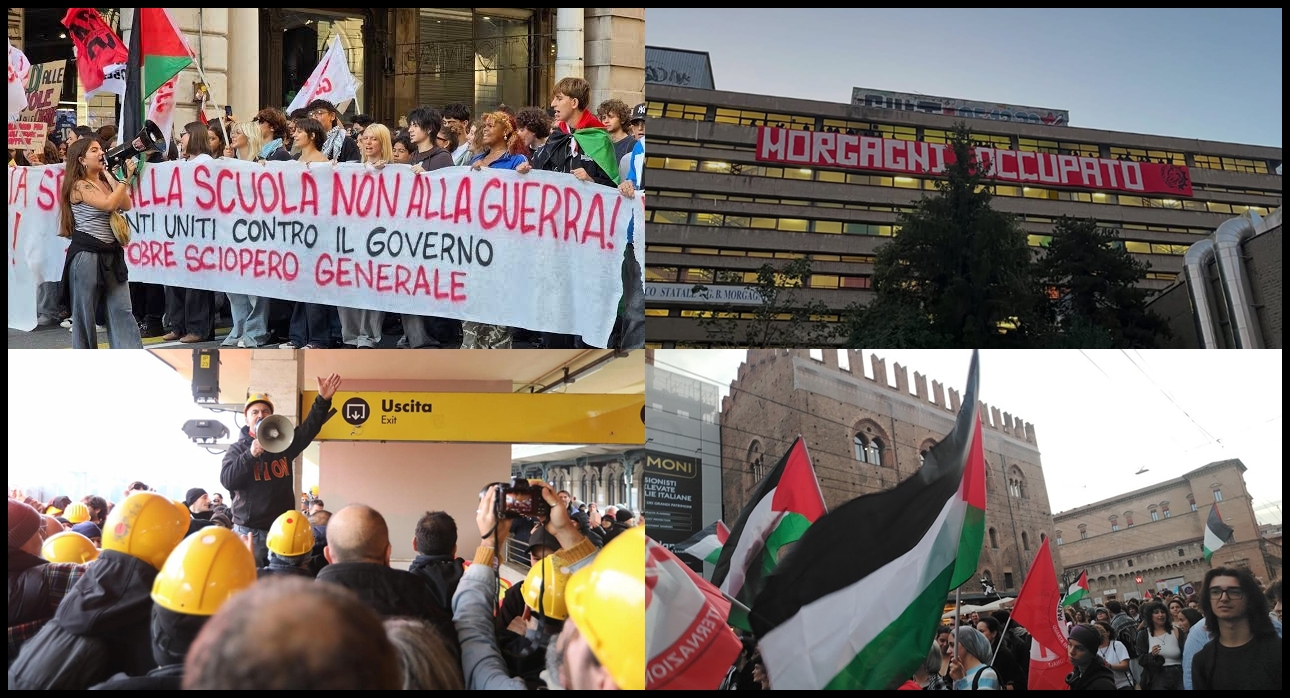
One year after the most intense fall Italy has experienced in the last 50 years—to the point that the masses in struggle rightfully earned the title of European vanguard in the struggle in solidarity with the Palestinian people and their heroic and exemplary resistance— today we are witnessing the massive demonstrations that are currently filling the major cities of France, Spain, and other European countries.
And in Italy? The situation is also intensifying. On Saturday, October 10, large marches filled the streets of Italy’s major cities in support of Palestine. On Friday, October 16, student strikes resumed their demonstrations, and dozens of educational institutions have already been occupied in various cities: as always, it is the young people of the Gaza generation who are showing us the way.
On October 16, young people also took to the streets to fight against the climate crisis. Workers at Ilva (the steel complex) are on strike and mobilizing in both Taranto and Genoa (as we write, the occupation of Genoa’s airport is underway). In the south of the country, supermarket shelves are empty because truck drivers and farmers are protesting.
The CGIL’s (Italian General Confederation of Labor) traditional fall demonstration in Rome brought tens of thousands of workers onto the city’s streets. What unites all these sectors is opposition to a system that makes survival impossible: the cost of living, inflation, the climate crisis, wars, and unemployment.
In recent days, we have also witnessed protests by young people that ended in clashes with the police and acts of expropriation at stores. These protests are organized through social media, without a specific political orientation (the government is taking advantage of this to intensify its repression).
We are still far from the large mass demonstrations in Europe or last fall’s mobilizations, but this shows us that, here too, there is the potential to achieve a massive general strike that could paralyze the country and, this time, bring down the Meloni government.
Where We Started Last Fall
“Let’s do as they did in Italy.” That was the slogan of our comrades on the other side of the Alps last fall, when marches of tens of thousands occupied highways, train stations, and ports in a series of demonstrations in solidarity with Palestine.
The formula that enabled such a surge in the class struggle was fueled by outrage over the infamous Zionist genocide in the Gaza Strip; the emotional momentum of the Global Sumud Flotilla, which sought to break the blockade imposed by the Israel Defense Forces (illegitimate even under bourgeois law) in international waters, with the aim of delivering humanitarian aid to the people of Gaza.
That momentum spread like a global contagion, as support for the heroic resistance of the Palestinian people filled public squares worldwide. But above all, the most important ingredient was unity of action, achieved by setting aside union and political leaders, who are generally bent on fragmenting and weakening the struggle.
This is what happened on September 22, 2025, when the CGIL bureaucracy’s failed boycott attempt—which had called for a ridiculous four-hour strike three days earlier—failed to weaken the united general strike of all grassroots unions, which brought the masses into the streets that day.
This is what happened on October 3, 2025, when pressure from numerous CGIL activists and members forced Italy’s largest union to join the grassroots unions in a general strike: the largest strike in the last 40 years, bringing the entire country to a standstill.
This is what happened on October 4, the day of the national demonstration for Palestine: a million people flooded the capital. Stunning images.
“Let’s do as they did in Italy,” cried the world, looking to our country, despite those who theorize about the Italian proletariat’s incapacity and ignore a glorious history of workers’ struggles.
This is not a good-faith error of analysis, but a false narrative—driven by clear interests—consciously perpetuated by those who wish to shift blame for failures by political and union leadership onto a supposed weakness and stagnation of the masses. An alibi for class betrayal, backed by a shameful lack of accountability.
Firefighters in Action
The strikes and mobilizations of the fall of 2025 put the forces of bourgeois order on the ropes; on several occasions, they proved powerless in the face of the overwhelming force of the masses. The bourgeoisie tasted the bitter medicine of losing control and its ability to contain society. The same applies to union leaderships, which have no interest in letting the social conflict reach its ultimate consequences. At most, they want to use it to negotiate privileges with the bourgeois state within the framework of capitalism. They loosen the chains on the proletariat’s ankles without breaking them.
It is no coincidence that, instead of capitalizing on the wave of that massive mobilization—which swept aside the anti-strike laws and put the repressive apparatus on the ropes—the fall of 2025 ended with the fragmentation and weakening of the struggles: two separate strikes, on November 28 and December 12.
Fast forward to this year: after the Meloni government’s resounding defeat in the referendum, neither the parties of the false bourgeois opposition nor the CGIL leadership lifted a finger to deliver a blow that would topple the government.
We had to wait until May (two months later!) for two separate “general” strikes to be called (on May 18 and 29), organized by different grassroots unions and which, in fact, were at odds with one another.
Fall 2026
This fall, instead of trying to unify the various sectors so that the ongoing mobilization can become a major struggle against the government, union leaders in Italy are doing everything they can to fragment and weaken the working class.
Workers are faced with the prospect of three so-called “general” strikes—but separate ones. We repeat: separate! If these were three unified strikes within a growing wave of struggle, we would be very pleased.
Thus, the schedule of mobilizations is as follows: on October 30, a strike called by the USI, with the support of the USB, in which dockworkers will also mobilize, as well as workers from various sectors affiliated with the CUB, including workers in the chemical, rubber, and plastics industries, as well as those in education, healthcare, universities, and the metalworking sector.
On November 20, the CGIL’s general strike will take place, featuring student mobilizations and local demonstrations (to avoid large gatherings that might irritate the government!).
Finally, on December 4, the pre-Christmas strike—called in September by the CUB, SGB, Si.Cobas, and other organizations—will take place. This late date accounts for neither the European mobilizations nor the student protests in Italy.
A discouraging picture: in the face of attacks by employers, governments, and imperialists, a fragmented and belated union response has emerged, leading the Front for the Struggle Against Austerity to immediately call for a large, unified general strike.
What is to be done?
The working class’s general interests demand that unions unify their struggles by organizing joint mobilizations to make the strikes more effective.
Let us remember that these strikes cost workers a portion of their already meager wages—unlike the opportunist bureaucrats who lead the unions.
Not to mention the hundreds, if not thousands, of workplaces where multiple unions call strikes on different dates. With whom should workers go on strike? How many (small and ineffective) strikes must they carry out?
Today, more than ever, within the labor movement, it is essential to do two important things:
- Organize the rank and file into committees, collectives, and coordinating bodies independent of the unions’ bureaucratic leaderships.
- Wage an internal struggle within the unions, demanding that active workers and the vanguard sectors lead them in line with their class interests, against any sectarian, self-referential impulse that becomes an end in itself.
But the union level is not enough: no gain under capitalism is guaranteed. The bosses will take everything back, with interest, as soon as they can.
We need revolutionary leadership that intervenes in the numerous struggles already underway: the resistance struggles of peoples under attack by imperialism; the student struggles; the struggles for the right to housing we are witnessing today in France and Spain; the ongoing student mobilizations in Italy; the peasant protests; etc.
That is why we are committed to building a revolutionary international, the IWL (Fourth International), which, by intervening in daily struggles, will lead them toward socialism and free humanity from the chains of profit.
Alternativa Comunista will stand with striking workers, regardless of the organization to which they belong, calling for the joint organization of general strikes, in unity of action with students and impoverished petty-bourgeois sectors (such as farmers).
We counter the bureaucratization of the unions with workers’ democracy, so that workers and students themselves mobilize and make decisions on the issues that affect them.
First published here by Partito di Alternative Communista


