
Marxist fighters in the Ukrainian resistance
Russian imperialism against Ukraine is an expression of a brutal attempt at colonial plunder. It lays bare the Kremlin’s objective: to violently eliminate a sovereign state, which it considers part of its former imperial sphere of influence. For five years now, the aggression of the Putin regime has clearly demonstrated its aim to completely destroy the Ukrainian people’s right to self-determination, based on the ideology of Russian supremacy over other peoples. This is the very same national oppression that Lenin and the Bolsheviks fought against and defeated with the October Revolution of 1917.
Today, more and more people with emancipatory aspirations have taken up arms to defend their people. For they clearly understand that the struggle for an international socialist revolution and for the collapse of imperialism is impossible without recognizing the right of nations to self-determination and without guaranteeing the well-being of their peoples, free from the yoke of any great power.
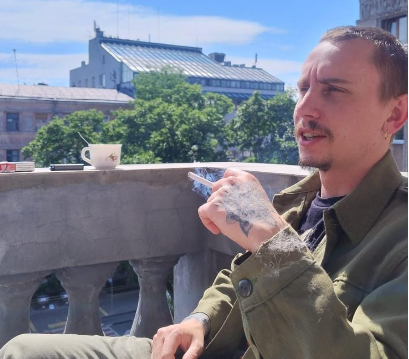
One of these heroes is Vladyslav “Iskra” Zhuravlev, a defender of Mariupol and a Marxist activist, who was taken prisoner by Russia in April 2022 and endured four years of hardship, torture, and harrowing abuse.
Vladyslav spoke with the editorial team of Krok do Peremohy (One Step Toward Victory) about his experiences in the student movement, in the marine infantry, and during his captivity in Russian prisons. He told us about the abuses and methods of inhuman humiliation employed by the imperialist aggressor.
And most importantly: “Iskra” emphasized the vital importance—even in the darkest moments—of continuing the resistance, defending human dignity, and maintaining faith in the power of international solidarity.
It is a great honor for us to publish this interview, translated from the Ukrainian publication “Krok do Peremohy.”
Interview with a recently released prisoner of war
— Tell me about yourself.
— My name is Vladyslav Zhuravlev; my nickname is “Iskra.” For a long time—since my youth, around age 15—I identified as an anarcho-communist, but I moved away from that anarchist worldview quite some time ago. Once I had acquired a solid theoretical foundation, I realized that, in reality, I had always viewed the world philosophically through the prism of Marxism. Today, I identify as a Marxist.
I initially enrolled in law school in Lviv (Ukraine), where I immediately became politically active. I became involved in social activism, participating in environmental initiatives, human rights campaigns, and social welfare projects.
Driven by the spirit of the times and the idealism typical of an eighteen-year-old, I feared the war [in Ukraine] would end without me, and that I would miss the chance to take part in this crucial historical process. So I enlisted in the Ukrainian Marine Corps, viewing it as a front of the utmost importance: a battlefield against Russian imperialism.
I turned 19, and in January 2018, I was deployed to the front lines for the first time, marking the beginning of my combat service. Earlier, during my time as an activist, I had met Denys Matsola, whom I later invited to join my unit. By then, I had already established contacts and built a good reputation, which allowed me to secure better service conditions for us. I invited Denys in 2021, and that same fall, he signed the contract and joined my unit. Russia was still waging a hybrid war, and even then, there was a strong sense that the likelihood of a military escalation was very high; this was evident to anyone who had visited the Donbas region during the “Anti-Terrorist Operation” (ATO) or the “Joint Forces Operation” (JFO).
— Was there a clear understanding that an escalation by Russia was inevitable?
— Yes. As early as September 2021, U.S. intelligence had information indicating that Russia was preparing a large-scale military aggression toward the end of winter 2022. Official Pentagon military analysts had made direct statements to that effect. But even before that—before any official announcement—anyone following developments on the front lines could see a growing number of Russian troops massing at the borders, ostensibly to conduct “military exercises.” These exercises were continuous: one followed another, but there was no actual rotation of troops. As a result, forces kept building up at the border, while the reasons the Russian Federation officially cited seemed implausible.
It was clear, then, that “the rifle hanging on the wall” would eventually be fired. If not right then, then the next time. Aware of the situation, Denis decided it was better to enlist before hostilities began; he wanted to gain experience rather than learn on the job in the heat of battle, especially since he had no prior military experience.
He enlisted, calmly completed his basic training—a six-month Marine Corps course—and arrived for his first rotation to the front lines, known as [Joint Forces Operation]; barely a couple of months later—or even less—the large-scale invasion by the Russian Federation began.
— When the great war began, had you already been in the military for quite some time?
— By February 2022, I’d been there for four and a half years, yes.
— What was it like facing the start of the invasion with that level of experience?
— Well, the large-scale invasion is officially considered to have begun on February 24—that is, the moment the first airstrikes hit our target areas: specifically, airports, airfields, and radar facilities. But for us, it all started earlier.
We were in the Joint Forces Operation zone, near the village of Shyrokyne on the coast of the Sea of Azov, holding the defensive line. On the afternoon of February 21, Russia officially recognized the so-called Donetsk and Luhansk People’s Republics as “independent states”—specifically during the night of February 21–22—and many more Russian troops and military equipment entered those so-called “republics.” Then, on the morning of February 22, intense mortar attacks began. This was on a scale we hadn’t seen in a long time. By then, the combat zone—which had been active since 2014—had stabilized into a defensive war, relatively passive on both sides. And then, suddenly, a type of combat broke out that hadn’t been seen since 2018 or early 2019.
Early in the morning of February 24, they launched their first assault against our positions, supported by tanks. Naturally, we confronted them from positions that had been prepared in advance and equipped for defense. The situation remained that way for a while, until we began to come under pressure from the direction of Crimea. And that remains a mystery: why did that happen? It was most likely an act of sabotage, but the exact details are unclear. In any case, we had to abandon the positions we held for just over a week and fall back toward the city of Mariupol. In fact, we were deployed along the Mariupol axis because it was easier to defend and had better logistical support.
We held our positions there from March 1 through April 4. Specifically, my unit, the 501st Independent Marine Infantry Battalion. Other defenders of Mariupol held out even longer; it all depended on the specific sector and exactly where the troops were deployed. And we ended up as prisoners… in a clumsy manner, to put it mildly.
We must begin with April 2. That day, a massive, prolonged assault hit our positions, backed by a significant armored force, artillery, rockets, and air support. We were surrounded in Mariupol; we lacked sufficient resources; the enemy controlled the skies, and we had to ration our ammunition very carefully, as no significant resupply was expected. That day, the Russian army—sparing no fire—essentially sent its men to the slaughter: wave after wave, directly against our positions. Finally, as evening fell—after an all-day assault—they managed to encircle us through sheer numerical superiority. We were forced to fall back and retreat.
The positions we occupied one block further back were, frankly, very precarious. To make matters worse, we couldn’t adequately fortify the defensive lines we’d established in Mariupol in early March. Constant mortar and artillery fire hindered our efforts to entrench ourselves. Many civilians in the city still had not been able to evacuate for various reasons. On the one hand, the Russians had organized a so-called “green corridor” for civilians. But it was only for those who had a vehicle. Those without transportation could not leave. Local authorities tried to organize buses, but simply getting to them was a tremendous challenge. In a city under constant fire from all directions, that proved extremely difficult. Furthermore, it was mandatory to carry identification documents, but due to the constant fires and the need to move from one hiding place to another —moving between different houses—many people lost their documents and, as a result, were unable to leave the city.
So, when we withdrew, there were civilians literally everywhere: in every house, in every basement. In other words, we couldn’t use the basements because civilians were taking refuge in them. To make matters worse, by April 2 we had practically exhausted all our reserves of anti-tank weapons. What little we had left was, for the most part, ineffective. We had only small-arms ammunition; we had nothing left of larger-caliber rounds, such as mortar rounds. The situation was critical.
It proved impossible to organize an adequate defense without simultaneously endangering the civilian population. So the command began to consider its options. There was talk of a possible meeting between Zelenskyy and Putin regarding Mariupol to decide how to hand over the city with minimal casualties and without bloodshed. There was even talk of an “honorable surrender”: marching out with our weapons, banners, and so on. But the situation only continued to worsen. Finally, our command decided to surrender on its own.
But the worst part was that it was done in a disorganized manner. Other units defending the city were not informed, nor were our own troops. We were told that an agreement had been reached for a “green corridor”, but only on the condition that we surrender our weapons and leave the city for territory controlled by Ukraine. In this way, the troops were deceived and led straight into captivity.
The person responsible for this—an officer from my battalion’s headquarters—is currently under investigation, albeit in absentia. In fact, formal charges have been filed against him in absentia. However, as far as I know, he is in the Russian Federation and is unlikely to return to Ukraine, where the case against him remains pending.
— In the Russian Federation? As a prisoner of war? Or did he flee there?
— At first, it seems, he was a prisoner of war. But now all sorts of rumors are circulating: that he lives in the city of Berdiansk—which is occupied by the “roughnecks” and where he’s originally from—or perhaps in Crimea. It’s hard to know for sure.
— Moving on to your captivity: when your captors discovered that you were a leftist and a Marxist, did they react in any way? Did that affect your time in captivity?
— Yes, unexpected things happened. First, regarding the interrogations. We went through a specific period of interrogations at the pretrial detention center: representatives from various agencies would come and ask more or less the same questions, although it was clear from their reactions that each group had its own objectives. Officials from the military prosecutor’s office, the FSB, and field operatives were present. I was interrogated by all of them, but the FSB officers showed a special interest in me; at first, they assumed I was a nationalist, so the interrogations were extremely harsh; they were conducted with “special intensity”, so to speak. Basically, they demanded that I admit to being a “nationalist.” And here’s a crucial point: for them, the very concept of nationalism is synonymous with “Nazism.”
— What do you mean when you say the interrogations were conducted with “special intensity”? Are you referring to torture?
— Well, there were severe beatings and the use of electric shocks. That’s what happened to me personally. They even put plastic bags over some people’s heads to cut off their oxygen. It was brutal. That’s how almost all the interrogations went, except for those conducted by the military prosecutor’s office. The military was the only group that didn’t lay a hand on me. Later, once they found out which organization I belonged to and what my actual activities were, they stopped demanding that I confess to being a “Nazi,” but the situation didn’t improve much. According to the investigator, they began preparing a case against me “for political extremism and participation in a political organization considered illegal in the Russian Federation”…
— Did they try to put you—a Ukrainian citizen—on trial for participating in an organization considered illegal in Russia?
— Well, I didn’t have the details. But they did interrogate me about that case in one way or another. I had never even seen the organization in question. My last interrogation on the matter was in October 2024. They discovered that I was part of activist circles on May 3, 2022. During that time, they tried to gather information and data, but the process wasn’t easy. First of all, I must point out that I wasn’t beaten for being an activist, but simply for being a prisoner of war. All prisoners of war went through that! There hasn’t been a single person released from captivity who hasn’t been beaten at least once.
But when they have additional reasons [to go after you], the situation gets even worse. Captured nationalist activists undoubtedly had it harder, because they were precisely the ones the captors were most interested in targeting to prove: “Look, we’re carrying out an anti-fascist mission in Ukraine. Look here at the real fascists.” Those cases interested them much more than, say, someone like me: a Marxist.
— What is life like in captivity? How does the day unfold?
— Actually, captivity varies enormously; first, depending on the prison, and second, depending on the length of time. I spent more than four years in captivity and was held in several prisons; my experience was different in each one. The situation for prisoners of war has improved slightly now, thanks to the ongoing solidarity campaigns for the prisoners, including those organized by your organization, IWL-FI. These campaigns influence the international community, which, in turn, puts pressure on Russia. That is my personal opinion.
And although international human rights organizations are not allowed direct access to prisoners, they do visit the prison facilities. You could always tell when the guards were preparing for their visits. When an inspection is being prepared, you can always tell by the unusual activity among the prison guards. You can sense their unease, and it seems to me that this, in and of itself, indicates that such inspections really do have an impact.
As for the worst period, it was in Mordovia—at Correctional Colony No. 10—where I was held from February 4, 2023, until the very day of the prisoner exchange. Before that, I spent some time in Taganrog and in the town of Riazhsk, in the Ryazan region.
— And how are transfers between prisons handled?
— By bus, in prisoner transport vehicles, and by plane. It all depends on the distance. I’ve been transported in prisoner transport vehicles more than once. You travel for hours in a cramped van with no stops; sometimes, with your hands tied and a sack over your head.
But back to my own experience: the worst period, as I already mentioned, was 2023 in Mordovia—specifically, the time I first spent there. The conditions were as follows: we had to stand at attention for 16 hours a day. We were forbidden to move; we could only walk when ordered, and those orders might come only two or three times a day. Breaking this routine on your own initiative gave them another excuse to beat you. In addition, there were the so-called morning inspections, during which beating prisoners of war was practically a daily ritual. Hardly a day went by without someone being beaten.
The food was terrible, and the portions were tiny. They poured the first and second courses into the same bowl. During my first year in Mordovia, there were no books. And, naturally, there was no entertainment.
Aside from the beatings, they subjected us to excessive physical exertion: we had to do 500 or even 1,000 squats. Sometimes it was 100 push-ups. If you didn’t do it, they’d simply beat you again. They also played the Russian national anthem from time to time. Sometimes this happened during meals; you had to put down your food—even though you already had very little time to eat—and sing the Russian anthem, fearing that if you didn’t, they’d beat you again with a baton. And, of course, nobody wanted that.
And most importantly: even if you managed to organize a personal protest, it affected your fellow prisoners, because collective punishment was the norm there. There was an incident where someone shouted “Glory to Ukraine” and 210 people were punished for it: they beat everyone in the cell block. Even those who hadn’t even seen the person who shouted.
— They say that in some prisons they played Russian pop music—like Kipelov’s—all day long. Did you experience anything like that?
— (Laughs) Actually, Kipelov wouldn’t have been so bad. We had a speaker, though it didn’t broadcast actual radio signals; the audio was looped from a central control room. Exactly the same daily program played over and over again. That was useful, in a way, because you could tell roughly what time it was based on the songs; it was like a musical clock, basically. But of course, the songs themselves were a nightmare. Things like “I Am Russian,” by Shaman.
— Weren’t there any normal clocks hanging anywhere?
— They’re forbidden, yes. It’s forbidden to keep track of time there. There aren’t any calendars either. But, actually, we always knew what day of the week it was and what the date was. We didn’t even have to try very hard. You spend the whole day doing nothing, and then the next day comes, bringing more of the same. You don’t have much to think about, so you just count the days. That’s why I remember so clearly which events happened on which days. In short, it’s like looking at a calendar all day, even if you don’t have one nearby. It’s a paradox.
— And why were they trying to prevent you from keeping track of time? To create an atmosphere of tension?
— Honestly, I don’t even know the answer to that question myself. To me, it just seems like a formal rule they follow. As for counting the days, I think it’s simply a formal deterrent, designed to make it harder for us to coordinate, organize a riot, or do anything like that. But I don’t know for sure; it’s a kind of internal protocol.
I mean, we were classified as a category of particularly dangerous prisoners. You could tell because movement from one place to another was only allowed in small groups and always in the presence of special forces. You couldn’t leave your cell on your own. You only went out with permission and accompanied by a whole group of people who monitored your movements. That’s how it worked every time they took us to the exercise yard or to the showers.
— It’s incredible how calmly you talk about this whole traumatic experience.
— (Laughs) Well, it’s easier for me to talk about it now. But, in reality, it’s the result of ongoing work with a therapist. Plus, I’ve given other interviews and told these stories more than once. That’s why they come more naturally to me now. If someone had asked me about this on the first day I returned, it would have been much harder. Enough time has passed, and I’ve had a chance to rest a bit.
To be fair, I should mention that I described the worst phase. But later on—as I said—the inspections began, and the situation started to improve little by little. For example, after each meal, they began letting us sit on our beds for a limited time: we sat down when ordered to and stood up when ordered to. At first, it was half an hour after each meal—that is, an hour and a half a day. Later, they extended that time to six hours: two hours after each meal. Starting in 2025, the food itself improved slightly: they stopped mixing the first and second courses. The beatings became less frequent. Today, they say, such incidents are not the norm. Although, of course, one certainly shouldn’t rule it out as a possibility. But now the focus there is more on psychological pressure. At least, that was the case when I left. Punishments involving excessive physical exercise were still being carried out, meaning that practice remained in effect even as of May 2026.
— Do you attribute this change to the fact that several international human rights organizations have begun visiting prisons more frequently to conduct inspections?
— Yes, exactly. They certainly wouldn’t have changed on their own initiative. It’s some kind of external influence. Personally, I saw representatives from human rights organizations only twice during that time: in late 2023 and in the summer of 2024. Before they arrived, a special forces officer warned us that if anyone said too much, “they’d leave, but we’d stay”. So there wasn’t much point in talking to them. Even so, we managed to see those human rights activists, even though in prison you’re not allowed to lift your head. Most of the time, you recognize people only by their voices and the shoes they’re wearing—I mean the Russian guards, the special forces, the investigators, and so on.
— Were you not allowed to lift your head?
— No, not at all. You could face physical violence for doing so. It was not worth the risk.
— You mentioned the showers. How much time did they give you? What were the shower stalls like? And while we’re on the subject, how much sleep did you get?
— In my last prison, specifically, there were no problems with sleep. The lights were turned off at 10 p.m., and we were woken up at 6 a.m.; that was the routine the whole time. But that was my experience. At the Donskoy prison in the Tula region, for example, the situation was worse for quite some time. As far as I know, that’s improved now, too. But there was a time there when they’d turn off the lights at 10, wake us up at midnight, then turn them off again at 1 a.m.—I think—and wake us up at 3 a.m. Something like that. I wasn’t there myself, so it’s hard to say for sure. But generally speaking, they’d wake us up several times a night, just to tell us “go back to sleep”. Naturally, you end up suffering from sleep deprivation. And then you still have to stand guard for another 16 hours. And this repeats day after day; you only manage to sleep about two hours straight, here and there.
You also have to understand what it’s like to sleep in prison. It’s a sleep where you’re constantly cold. Where there are often bedbugs in the bunk. Where the mattresses are usually hard as a rock: you can feel the metal frame underneath. So the sleep itself—even if the duration is acceptable—doesn’t provide any real rest. Not to mention that you don’t sleep in the dark. There’s daytime lighting—on for 16 hours—and then nighttime lighting. The nighttime light is dimmer, but it stays on for the entire eight hours of the night shift. So your eyes don’t really get any rest either.
As for showers: “officially” it’s once a week, but in reality it’s a matter of luck. In my experience, there were times when I could only take a shower once every two months. Although, to be fair, there were a few Russian guards who took the initiative to arrange an extra shower: one more per week. The schedule was also always vague. Once—just once!—a guard who was a good person showed up; he let us wash for ten minutes. That was an incredibly long time, considering that the usual allowance is two or three minutes. And even that’s considered a pretty good and common situation. Sometimes you get five minutes, but that’s very rare. Often, it’s even worse. Sometimes you’d rush into the shower and get wet —barely managing to grab the soap—before they rushed you out. That took less than a minute. And since this happened only once a week, everyone developed their own hygiene strategy. The priority was washing the parts of your body you couldn’t clean in the cell: areas you couldn’t reach at the sink.
— Was it common to wash up at the sink in the cell?
— Yes, absolutely; it was the only option. Of course, the cell had only cold water, and for quite some time—between 2023 and 2024—hygiene supplies were in serious short supply: toilet paper, soap, toothpaste… There were times when none of that was available for an entire month; a tiny bit of soap had to last for ten people (the cell was designed for ten). So we only used soap in extreme cases. As for washing properly with soap so we wouldn’t smell bad… well, that kind of comfort was completely out of the question.
— Would it be naive to ask about privacy in the shower? Doors, curtains…?
— (Smiles) Exactly. That was completely unthinkable. The shower was the least of our worries. After all, communal showers didn’t bother anyone in the military, let alone in prison. The “galera” situation was worse.
— Did they call the toilet the “galley”?
— No, sorry. That’s a naval term for the toilet. I’m from the Marine Corps, so I’m still used to saying it that way. But anyway… Throughout 2023 and the first half of 2024, the toilets had neither doors nor curtains. You were forced to relieve yourself in full view of nine other people who couldn’t look away or leave because everyone was lined up and waiting. Later, they hung a curtain. And that happened just before a second inspection, when we saw someone from outside on the prison grounds. The curtain improved things a little, but, of course, that was the situation in Mordovia—it’s not like that everywhere. It wasn’t the same in Ryazhsk or Taganrog; there, the stalls had doors.
In Mordovia, the toilet was a hole in the floor. In Ryazhsk and Taganrog, there were actual toilets. I could also add a bit more about the conditions, specifically regarding medical care. Overall, conditions varied by location. In Ryazhsk, where I was incarcerated, medical care was relatively decent. However, to see the doctor, the local guards devised a procedure whereby, while one person was being taken to see the medical staff, the others had to perform strenuous physical exercises. It was, in essence, a way of “paying the price” for the medical visit.
The situation in Mordovia was different: the doctor would come to the cell in person, so there was no need to go to the medical unit. However, the facility was run by a doctor nicknamed “Dr. Mal”; he carried a stun gun, and people were afraid to approach him. A documentary was later made about him that portrayed him as a criminal. I haven’t seen the documentary yet, but I know it exists. The film is, in fact, titled Dr. Mal. As far as I know, he was dismissed from his position in late summer 2024. He was replaced by another doctor who, in contrast, is very sensible and compassionate, and is always willing to help.
But the fundamental problem lies elsewhere. Very few funds are allocated for medical treatment, whether for prisoners of war or for the general prison population in Russian prisons. This applies to both prisoners of war and ordinary inmates. Sometimes, a doctor sincerely wants to help but is forced to be extremely frugal in allocating the scarce resources available. For example, there was an outbreak of scabies—caused by a subcutaneous mite—in our cell. We were unable to treat it for six months simply because there were no medications available. The doctor said he would love to help, but he simply had nothing with which to treat it.
— What was the situation with letters from loved ones?
— Now that I’m back, I’ve calculated that I should have received about 500 letters over those four years, but only three actually made it into my hands. One from my wife and two from my mother; that was all. Nothing came from my comrades, friends, or other relatives.
— How did you feel when you received those letters?
— In fact, I was the first person in my circle to receive a letter. It was June 8, 2024. The cell door opened, they called my name, and I stepped forward; I was afraid I’d done something wrong or that it was another interrogation… But then they told me: “Here, you have an hour to read this”, and handed me a piece of paper. I opened it, recognized my wife’s handwriting, and burst into tears. I hadn’t expected something like this to be possible; it was incredible. Her handwriting was unmistakable, even though the letter was written in Russian, despite the fact that my wife speaks Ukrainian.
Naturally, the letter didn’t contain any critical information, but it conveyed something and made a huge impression on me. At that moment, I was the only on, and, as I said, the first, to receive a letter. Everyone was very curious to know what was going on. After all, if letters were arriving, it meant that Ukraine still existed. It’s important to note that we had been completely cut off from information during that entire time and knew absolutely nothing about the outside world. For their part, the prison guards exerted constant psychological pressure: they claimed that “Ukraine no longer exists,” that “everything has been taken over,” that “such-and-such a city has disappeared,” that “everything was renamed long ago,” and that “you’d better forget about the Ukrainian language”…
And in that context, you receive a letter from Ukraine and read news—for example, that my sister is studying and that the universities are still open—which means that things aren’t going so badly. Later, I received another letter in 2025 and one more in 2026, shortly before my release. Those two were from my mother.
Then, other inmates also began receiving letters, though in limited numbers. Starting in 2026, they even let us keep a photograph in our cell if it came with a letter. Naturally, they let us read them, but then they took them back. I had hoped they would give them to me when I was sent to the prisoner exchange, but, unfortunately, that didn’t happen. I think they simply destroy them, or maybe they file them in the personal record; I don’t know.
— Were you only allowed to write letters in Russian?
— To be honest, no one ever specified anything about that. On one occasion, a fellow prisoner received a letter written in Ukrainian. The thing is, Ukrainian speakers often didn’t even try to write in that language. You never know: they punish you for the slightest oversight—and very harshly at that. No one gives you specific rules about what’s allowed and what isn’t; you just get a feel for it.
— And were you allowed to write replies?
— Yes. I was allowed to write 12 letters during my entire time in captivity, but only four reached their destination. In fact, one notable incident involved the letters. Take my first letter, back in 2022, for example: during the first few months of captivity, they asked us if we wanted to write to our families. Of course we did; we needed to let them know we were alive and all that. They handed out paper, pens, and a template we were supposed to follow. I read the template, and it said things like: “lay down your arms,” “we should be working, not fighting,” “now I realize that the Russians are our brothers”—that sort of thing.
I asked: “Can I choose not to write the letter?” They replied: “No, you asked for this, so now you have to write it”. Fortunately, however, that particular letter was never actually sent. Later on—in 2024, or rather, in late 2023, just before New Year’s—we were allowed to write letters again. These were still messages with a preset format, but without the political content: it was enough to say that everything was going well there, wish them a happy New Year, mention that I was celebrating it too, and say that I was doing great; we just had to hang in there—everything would turn out fine. And, once again, everything was copied word for word. But starting in 2024, we were allowed to write our own messages, though with one condition: we had to include an opening paragraph stating that conditions there were good.
— No one was actually celebrating anything, were they?
— (Smiles) I must remind you that, officially, we don’t know what date or day of the week it is.
— Getting back to the language issue: Was there pressure on prisoners who spoke Ukrainian?
— It all depended on the guards you had to deal with. Many, of course, showed great hostility toward Ukrainian. But there were times when they were curious and would ask: “How do you say this word?” or “How do you say that?”The opposite could also happen: as soon as they heard a word in Ukrainian, you’d get an extra blow with the baton.
There was one instance when I shared a cell with a man who spoke Ukrainian; we had to memorize the rules of conduct for inmates—we had to know them by heart, since we would later be tested on them. The rules were in Russian, and naturally, it was very difficult for him: he couldn’t read Russian and couldn’t learn them in time. We all received collective punishment because he didn’t understand. We tried to explain that it was simply harder for him than for the others because he didn’t know the language, but they wouldn’t even listen to us.
— At home, people often talk about the language issue in emotional terms… Sometimes with real fervor. But within the army—on the front lines—is it just as critical an issue?
— To be honest, it’s hard for me to say what the current situation is, since my information about the army only goes up to early 2022. But back then, there were no problems. Naturally, everything at the official level is conducted in the state language: Ukrainian. However, it didn’t matter what language personnel and commanders used to communicate; nobody cared. The situation has changed somewhat now because people have felt the impact of the war more intensely; the population has become more hostile toward Russia, and this is fueling strong resentment.
— How did you find out that, after four years, an exchange was finally going to take place?
— The thing is, when you’re in custody, they never tell you the details of your transfers: where they’re taking you, why, or how everything will unfold—you never know. They simply call your name, and everything gets set in motion. And most likely, it’s a transfer to another prison. Which is terrifying, because every new prison starts with the so-called “intake” process, in which they brutally beat you before taking you to your new cell. And, of course, no one wants to go through that process again.
So I didn’t know if this was just another transfer or if it really was the exchange. But things were unfolding differently from usual, so I still had some hope.
They took us in prisoner transport trucks, with bags covering our heads, to an airport or airfield and put us on an Ilyushin-76 plane. After landing, they let us take off the bags. We got off; I had health problems, so they separated me from the main group so the doctors could examine me. A medic accompanied me from the tarmac and said: “Relax, walk calmly; everything’s fine. Now I’ll give you first aid and see what kind of problems you have.” I was suffering from trophic ulcers on my legs, a common problem in Russian prisons.
Then he led me toward a row of vehicles: there were ambulances parked in a line, and I noticed that they all had Belarusian license plates. That’s when I realized the situation was very unusual. On the one hand, the way they spoke to me—kindly, treating me like a human being—was something I wasn’t used to. And on the other hand, why were there so many Belarusians there? And yet, right up until the very last moment, you can’t quite bring yourself to believe that it might actually be coming to an end.
And at that very moment, I asked him: “Are we in Belarus?” He said: “Yes, everything’s fine; we’re near Gomel. Don’t worry, everything’s in order—you’re going home.” That’s when I, too, started to cry.
They also gave us a package of humanitarian rations with decent food—there was even a small chocolate bar—; (Laughs) a celebratory meal, a “gift from the Belarusians.” Anyway, all of that was very comforting; I spent one more day in a separate camp on Belarusian territory. Then, a Belarusian ambulance transported me from there and handed me over to a Ukrainian ambulance at the border. While the others traveled by bus, you could say I had a private ambulance. I didn’t ride the buses like the rest of them.
— What was your physical condition when you returned to Ukraine?
— I’m not very tall, so I don’t weigh much to begin with; I didn’t lose a huge amount of weight—about 7 kilos—but for my build, that’s significant. I normally weigh 62 kilos, but I’d dropped to 55. That said, I should point out that the food situation had improved since 2025, so when I returned, I wasn’t in the worst physical condition I’ve ever been in.
— How did the reality of Ukraine strike you? Did it seem to you that things had changed?
— You could tell right away that the landscape had become militarized. We had just crossed the Belarusian border—where there’s a duty-free shop, and everything seems civilized and well-maintained—and entered Ukrainian territory. Suddenly, anti-tank obstacles, concrete bunkers, earthen and wooden fortifications, trenches, and people armed with protective gear appeared. It all looked like something out of a World War I movie. By the way, we traveled the same route that Russian tanks had followed in 2022: territory that had been under occupation. We were being taken toward Chernihiv (in northern Ukraine), and in every village along the way, people came out to greet us, waving Ukrainian flags, knowing that a convoy carrying freed prisoners was passing by. They shouted: “We’re so happy to see you back home!” It was truly moving.
Of course, many things have changed since then: some for the better and others for the worse. One striking change, for example, is that although I had fought in the war before 2022, the fighting always took place within the clearly defined boundaries of a combat zone. Now I’m in the capital, Kyiv, far from the Donbas, where the main fighting is taking place. However, attack drones and missiles frequently strike here, and civilians are losing their lives. It’s hard to take in: the fighting is far away, but the war is felt very intensely here as well.
— How was your recovery process?
— Actually, it’s a very long and slow process—one that’s still ongoing. I spent some time in a psychiatric unit, and right now I’m on leave for rehabilitation. After that, I’ll continue with treatment. So there are many physical and mental challenges.
It may seem as though certain problems have stopped bothering you. But then—as the body finally relaxes—everything begins to resurface over time. All that time, my body had been in a state of relative alert to endure the harsh conditions —holding firm—but the moment I relaxed, the full weight of existence, so to speak, came crashing down on me all at once.
— As a Ukrainian Marxist and a soldier who survived four years of Russian captivity, what would you say to people outside the Ukrainian context—to those who view the Russian-Ukrainian war simply as a “clash of two imperialisms” or who believe in the reality of Russian “denazification”? What is your main message for them?
— First and foremost, there’s nothing wrong with some people knowing little about Ukraine and not being immersed in its context. We understand our own context and the nature of our resistance perfectly well. But for some, Ukraine is a very distant country; after all, how many of our own people know anything about the Afghan provinces where fighting is also taking place?
Nevertheless, our task is to set the record straight. Yes, far-right elements really exist in Ukraine. There are even entire units influenced by the far right. But that’s not the issue right now. It’s true that the war may serve the geopolitical interests of both Russia and the United States. However, what matters most is what serves the interests of the Ukrainian people themselves.
The Ukrainians’ main goal is to free themselves from imperial influence once and for all and build their own independent state. There are plenty of reasons for this: a historic yearning for freedom, a unique culture that has faced centuries of attempts at suppression, the physical capacity to act, and, most importantly, the sincere desire of the people themselves.
This is ignored by the imperial aggressors of the current Russian Federation, who attempt to justify their actions through “denazification”. And this despite the fact that the Russian army itself includes many far-right members who view the situation differently and who, frankly, make no secret of their ultra-reactionary political views.
It’s simple: there is a people and their interests. And that people have their own sphere of action. Right now, any force that helps achieve the goals set by the oppressed people is welcome. The crucial question today is whether or not one supports Ukraine’s independence.
Thus, the Ukrainian masses have split into progressive and reactionary factions. The reactionary elements favor the old imperial order, while the progressives defend democratic values, development, independence, and sovereignty. The fundamental task now is to defend Ukraine’s independence; consequently, the country’s internal issues—as it simply needs to remain united—are secondary for now. The most urgent matter is that of the national liberation movement. Moreover, the issue of social liberation would be much more difficult to resolve under conditions of Russian occupation. Therefore, it is vital to preserve the conditions necessary to exercise these rights and freedoms.
— While you are adjusting to life in Ukraine, your friend and comrade Denys Matsola remains in Russian captivity. It is crucial for us to know what we can do on a global level to help secure his prompt release.
— I believe we must continue organizing support events, exposing the horrors of captivity, and spreading information. Inspections of Russian prisons would never have begun had it not been for the constant testimonies of numerous prisoners of war regarding the treatment they received from their captors. Consequently, the more this is discussed, the greater the pressure on the authorities to address and rectify the situation.
We must speak objectively about the reality of captivity in Russian prisons. Incidentally, Ukrainian civilians are also being held there under terrible conditions; I myself shared a cell with a civilian. In short, we must talk about what Russian captivity truly entails so that people do not forget it.
As for Denys and his situation: he was wounded while performing his duty in Mariupol, and his health—both physical and mental—is currently precarious. Medical care there is absolutely catastrophic. Furthermore, he had pre-existing nervous system issues that have likely been exacerbated by his captivity. We must not remain silent about this.
First published here by Krok do Peremohy


