On the Cockroach Janata Party
(The following article was written before the events of 20th July and the forcible removal of Sonam Wangchuk from the hunger strike site)
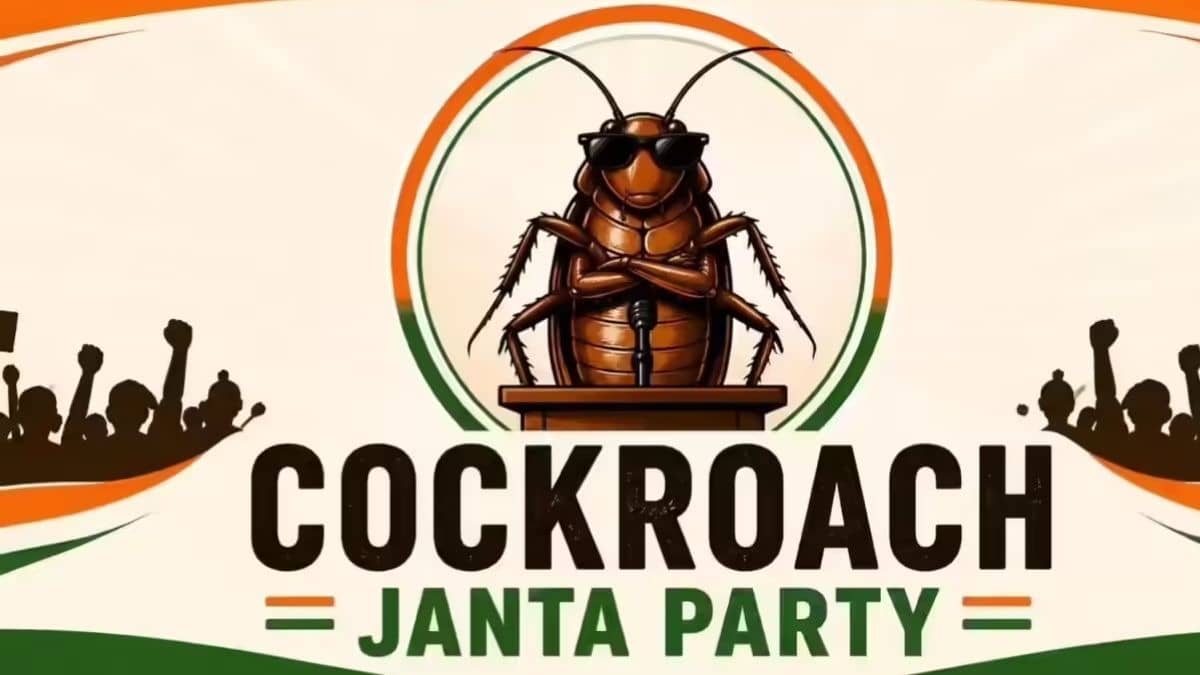
A peculiar movement arose in India, seemingly out of nowhere. The presiding Chief Justice of India, Surya Kant, commented that the youth of the country are ‘cockroaches’. Soon after, there was an outpouring of rage on social media, mostly among the youth. The ‘cockroach’ became an unlikely symbol of opposition for the enraged youth of India.
The symbol became the basis of what was primarily an online mobilization. The ‘Cockroach Janata Party’ (Cockroach people party) was formed online, and its following skyrocketed to over 20 million in a few days, outpacing the followers of the ruling BJP party. Such sudden viral popularity is cause for suspicion.
The party’s first real political agenda centred on the removal of the presiding Education Minister, Dharmendra Pradhan, who has been justifiably blamed for the fiasco around the NEET examination paper leak. The much touted protest by the CJP showed even more signs of suspicion, not only did the Delhi police uncharacteristically grant easy permission for the protest, officers arrived at the Delhi airport to greet the CJP leader, Abhijit Dipke, in person to grant him the permission.
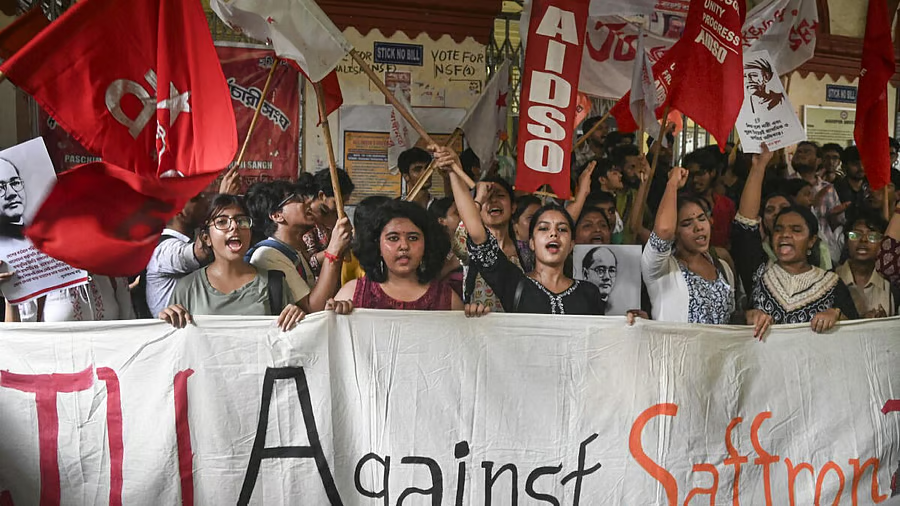
Reports on the ground suggest, that the gathering at Delhi had hardly met expectations, and the CJP had to call on leftist student organizations to add to the protest. The numbers have been reported to be in the ‘thousands’. The protest which called on the Education Minister to step down did not achieve its primary goal, and it appears that the ruling party does not feel very threatened by it. Even as the protest itself has ended, more protests have been planned out for later in the month, including a possible indefinite sit in at Delhi’s Jantar Mantar.
The youth’s anger is real, its issues are real, the question remains however, as to how real the CJP is.
The NEET paper leak
The National Entrance and Eligibility Test in India is a mandatory national entrance examination for admission to Undergraduate medical courses. It is conducted by the National test Agency, and counts as one of the largest examinations in the world, it remains India’s largest examination, accounting for over twenty million candidates appearing for the test.
The three hour test is seen as the most decisive moment in the lives of many students, the pressure of the exam leads many to routinely take their lives, especially if they fail the test. India has a youth unemployment of between 14 and 16% , with sub-employment in casual or gig work being much higher. Indian society puts immense pressure to succeed, the cost of failure comes with social humiliation, and the threat of becoming an outcast. These add to the importance of the exam, where success could mean access to better social standing and upward mobility, a guarantee of income and stability, and a dignified life.
This context must be kept in mind, when dealing with the consequences of large scale paper leaks which were caught for the 2026 NEET examination. Soon after the exam on 3rd May, allegations of paper leaks emerged. Such incidents are not new to the NEET examination, and incidents of question papers being leaked were caught in 2024 as well. A seventeen year old blogger, Sarthak Sidhant, had found many discrepancies in the conduct of the test and warned of the danger of leaks, especially with discrepancies in on-screen marking system. These warnings had gone unheeded then, the result is a large scale paper leak which led to this year’s examination being cancelled.
The efforts of millions of students were wasted because of the actions of a few dozen scammers, who exploited a half-baked system built to favour some candidates. The Education Minister Dharmendra Pradhan, callously asked the candidates to re-take the examination on the scheduled re-examination date of 21st June, not considering the pressures they had just undergone to give the test that had been cancelled. The insensitivity of this statement is especially stark, considering how a 17 year old candidate from Dehradun committed suicide after the cancellation was announced.
Much of the faults of the examination were on account of its conduct, the on-screen marking system, and the rushed nature of the common entrance test. Despite findings by a parliamentary panel, and recommendations for improving the security of the test, the Education Minister sat on it, curiously he rejected implementing measures to ensure more safety.
The NEET was but one exam, but the whole episode was symptomatic of the disregard for the youth by the ruling party and its ministers. This was the trigger that has fuelled much youth anger in India today.
The condition of the youth in India
When speaking of the ‘youth’ the media tends to focus on superficial analysis, either in terms of ‘generational’ perspectives, or focussing excessively on the upwardly mobile middle class youth of cities. This was blatantly obvious in the coverage of events such as the Bangladesh uprising and the Nepal uprising, where an essentially working class mobilization was cast as a ‘Gen Z rebellion’. When we speak of the youth, we speak for young students, and young workers. Those youth who must struggle to live, who account for the vast majority of young Indians.
To say that the youth of India live in misery would be an understatement. 121 million young Indians are neither employed nor seeking education, an unprecedented number. The highest number of suicides in India come from young Indians aged 18 to 35 years, among most of whom are daily wage earners. Youth unemployment in India stands at 12%, and a staggering 30% among graduates.
Thirty six years of neo-liberal growth have created conditions of jobless growth, big monopoly capital has only grown in this time, without substantially raising the standard of living of the masses of the country. The model of capitalist growth fuelled by relentless proletarianization has created an oversupply of workers, while Indian industry and services are yet unable to absorb new workers into the system.
The last twelve years of BJP rule has only intensified these processes, creating such massive inequality unseen since the days of the British raj. The worst affected are young workers, students and youth, for whom conditions of work have only worsened, opportunities for young students grow fewer, even as the capitalists continue to grow their wealth, expand industries without creating more stable paying jobs. At the same time unemployment rates among the youth doubled from 6% in 2011 to 12% today. The miserable condition of the youth is further reflected in 80 million young men and women who have returned to agricultural work in the villages.
The condition of work has worsened over the years, as unions have weakened, the public sector recedes, the scope for stable paying employment with permanent jobs grows scarcer. For the youth, even a good education is no guarantee for decent work. Costs continue to rise, but wages stagnate.
The worsening condition of work and lack of opportunities is mirrored in the continuing decline in the quality of education in India. An ideological offensive by the Hindutva movement has sought to transform education away from secular progressive values, towards right wing Hindutva propaganda, aimed less at empowering the youth with skills and more towards reinforcing brahiminical ideology.
A core part of the new educational system in India, is the increasing privatization of education, which leaves most of the youth who are poor, without access to quality education. Degree holding young workers are forced to survive on the bare minimum income provided by gig work, or informal labour. Many have to suffice with precarious labour as contract or casual work. Millions yet, return to the dead end of farm labour, often ending up as agricultural workers rather than property owning peasantry.
Youth unemployment in India is higher than the unemployment rate, yet even this masks the precarious nature of employment in India. The more moneyed layer of the youth, born into some privilege, owing either to their parent’s capital, social capital, or savings from stable government employment, are coaxed into the dead end of the startup economy. The myth of capitalist competition soon exposes itself, when the Indian bureaucracy, aligned as it is to the biggest monopoly capitalists, ensure that no competition emerges to threaten the dominance of the big monopolists of India.
The youth of India finds itself hemmed on all sides, its prospects growing bleaker, while the ruling class and its paid politicians sing praises of growth that never reaches them, selling fairy tales of India becoming a developed economy by 2047. The reality facing the youth is often reminded by incidents such as the NEET paper leak, where even a basic common entrance test is callously mishandled.
Youth anger against the government
Anger is boiling on many fronts, not simply among students. In 2024 and 2025, West Bengal saw the doctor’s uprising, where resident junior doctors, nurses and hospital workers led the fight against the TMC government in the aftermath of the rape and murder of a female doctor. In Bihar, students have regularly taken to the streets in protest against exam paper leaks. In Sriperumbudur, it was young industrial workers who led the charge at Samsung India’s plant. In the same vein, it was young workers in Noida who revolted against bad working conditions.
Now, a part of that rage is being channelized by a new party that appeared, seemingly out of nowhere, by weaponising an insult given by the Chief Justice of the Supreme Court. The Cockroach Janata Party, held protests in Delhi demanding the resignation of the education minister Dharmendra Pradhan. The first protests had a mediocre impact, but more protests are planned. Whether this grows into a larger movement or not remains to be seen, but one cannot deny the existence of anger against systematic exploitation.
Economic stagnation, inequality, and callous disregard at the hands of the ruling party fuel anger among the youth, but none of the parties have been able to channelize this anger in a concrete political direction. At the same time, the experience of decades of failures have made the vast majority of the youth cynical towards any political alternative. It is from this setting that the Cockroach Janata Party emerged.
It is worth noting, that in none of the large mobilization involving young workers, did any particular political party assume leadership. The Doctor’s movement was fought under the banner of an independent organization of the junior doctors, the wildcat strikes of oil refinery contract workers were fought without conscious planned action by any trade union, the revolt of young workers in Noida did not see any political leadership, nor did earlier students protests against NEET exam leaks in 2024.
The same tendencies that fuelled the rise of petty bourgeois liberal leaderships in Bangladesh, Nepal and Sri Lanka, are now at work in India, fuelling the rise of the Cockroach Janata Party.
Comparisons with AAP and the Anti-Corruption protests
In 2011 the anti-corruption movement took the country by storm. It was the largest spontaneous mobilization in India since the anti-emergency protests in 1977. The anti-corruption protests were fuelled by much of the same factors that are sparking public anger in India today. Unemployment, rising inflation, inequality, and corruption that seemed endemic. Anger against corruption became the focal point of widespread anger against the ruling Congress party.
The movement’s leader Arvind Kejriwal brought in leaders from disparate political tendencies, including RSS aligned individuals, or those with Hindutva leanings like Anna Hazare and Baba Ramdev. The latter would subsequently be charged with product tampering and corrupt practices of his own. The big tent tendency of the India-Against-Corruption mobilization allowed the more organized right wing to utilize it politically. The central agenda of passing a Lokpal bill and the creation of an empowered ombudsman who can act as a check on corruption. It was a problematic law with an equally problematic movement, with authoritarian tendencies.
The anti-corruption movement and the NGO at the centre of it would become the basis of the Aam Admi Party, which has now become one of the major bourgeois parties of India. The main objectives of the movement failed to answer the very question it raised, the challenge of ending systematic institutionalized corruption in India. The main legacy of the movement and its party, is that it cleared the way for the RSS to feel legitimate to a new generation of Indians, and the final destruction of the Congress’ hegemony over India paving the way for the rise of the BJP.
The Aam Admi Party finds itself against the very forces that it had aligned with during the mobilization of 2011. Far from solving corruption in the country, the BJP not only deepened and systematized it, but entrenched the already existing institutionalization of corruption. This is what has allowed BJP linked oligarchs like Gautam Adani to become one of the richest people in the world today, and virtually capture a chunk of India’s port and maritime infrastructure. It is what has allowed the Reliance group to nearly monopolize Indian telecommunications, while also taking over much of India’s private news media agencies.
The same corruption that allowed the old monopolists of Tatas and Birlas to exploit public infrastructure with political shelter, has now been expanded and deepened to benefit the new oligarchs of Adani and Reliance. In other words, the India-Against-Corruption organization, as well as the movement it spearheaded, failed completely. The Aam Admi Party itself, ran on a liberal petty bourgeois nationalist basis, with an orientation towards welfarist policies. This allowed the party to win in Delhi and Punjab, but it was hardly consistent in its character. While fixing Delhi’s public education and rolling out mass healthcare, it became a silent witness to anti-muslim pogroms, indirectly assisting the BJP in its agenda to persecute dissidents.
It is important to understand this history, because with the Cockroach Janata Party, we fear repeating it all over again, and this time with some of the same people involved in it.
Character of petty bourgeois leadership:
The petty bourgeois class is characterized by its middle position in capitalism. It is an exploited class, but it also exploits the working class. It finds itself constantly squeezed into a corner by the pressures of big capital, while also seeking to squeeze out the working class and every class below it, and when it cannot do so, it is compelled to exploit itself more desperately, simply to keep its position within the hierarchy of capitalism.
This strange middle position can make the class turn against capitalism, or turn ruthlessly in favour of capitalism. The contradiction comes from the fact that he petty bourgeois is a propertied class, but a small propertied class. It is a marginal exploiter of the working class, if at all. The urban petty bourgeois of India is largely invested in small scale trades, a class that has been at the receiving end of the worst policies of the BJP government, from the GST to demonetization, and the evictions.
A party like the Aam Admi Party represents the more progressive liberal wing of the Indian petty bourgeois, which otherwise is largely in support of the BJP, despite everything the BJP has done to it. Petty bourgeois leadership shows itself in their programme, just as was the case with the Anti-Corruption movement, there is never an attack on the capitalist system as such, just some aspects of the system.
The CJP (Cockroach Janata Party) is both a spiritual successor to India-Against-Corruption, and in many ways its organizational successor. Abhijeet Dipke, the founder leader, was a card carrying member and organizer of the Aam Admi Party, and has expressed in past statements, his commitment to the Aam Admi Party. The same person, has now decided to forge a new party and movement, modelled quite closely on the original India-Against-Corruption.
The anger of the youth has surely fuelled its rising popularity, but much of its online popularity is suspect, especially the quickness with which it outpaced the following of the BJP on social media platforms like Instagram. The CJP has made its central agenda, the resignation of the Education minister, but beyond this has scarcely shown any agenda or wider programme for change.
India’s youth has access to social media, world news and the internet. They are no strangers to the failures of the youth uprising in Bangladesh, the disappointing return to status quo in Sri Lanka, and the failures of the newly elected Balen Shah government in Nepal. Herein, we see the end result of petty bourgeois leadership. Without a programme for systematic change, even the most spirited uprisings fall flat on their face, the capitalist class only needs a window to return things to a status quo that benefits it.
Revolutionary movements require revolutionary leadership
The youth desire change that much is clear. India’s youth are growing in anger and frustration, and we are reminded of this every day. However, the CJP is not an answer to that challenge. The suffering of the Indian youth is the result of the capitalist system in India, whether they are being overworked or put out of work. The systematic oppression requires a challenge that aims at changing the system.
The answer to crisis of capitalism, is socialist revolution. A socialist revolution requires a socialist party rooted in the working class. Today, much of the youth of the country are working class, either in the cities or in the countryside, they must survive on selling their labour power, and have nothing else to sell, but their mental and physical faculties.
The CJP is riding the anger of the youth, but without a direction to systematic change, this movement will end the same way every petty bourgeois led movement everywhere has ended. The same way the anti-corruption movement ended, the same way the July movement in Bangladesh ended, the same way the mobilization in Sri Lanka ended, in failure!
For the working youth of India and the world, there is no alternative but Socialism.
First published here by New Wave