Bolivia takes to the streets! Out with Rodrigo Paz!
President Rodrigo Paz Pereira, who took office in Bolivia in November 2025, is facing the deepest political and social crisis of his administration. A massive wave of strikes and roadblocks has brought the country to a near-total standstill.
Rodrigo Paz’s government launched a package of neoliberal measures and capitulation to imperialism
Just six months into his term, Rodrigo Paz’s government has implemented a drastic political and economic shift in Bolivia. After ending nearly two decades of so-called “leftist” administrations, his cabinet justified these actions by claiming to have inherited a “broken state.” However, people mobilizing in the streets denounce that his economic agenda undermines national sovereignty, opening the door to extreme free-market policies, privatizations, and excessive alignment with international financial interests.
The Measures
Popular discontent erupted following the implementation and announcement of severe structural reforms:
- Elimination of fuel subsidies: This immediately sent diesel and gasoline prices skyrocketing.
- Importation of contaminated gasoline: Truckers have claimed that the low-quality fuel caused massive engine damage.
- Inflation crisis and foreign currency shortage: The lack of dollars drove year-over-year inflation to 14%, the highest figure in 40 years.
- The controversial Land Law (Law 1720): This allowed communal lands and small agricultural properties to be used as bank collateral, sparking fears of mass foreclosures benefiting landowners and bankers.
- Plans for Constitutional reform: Official announcement of amendments aimed at relaxing legislation and prioritizing foreign private investment.
The uprising is widespread and calls for the immediate resignation of President Rodrigo Paz
The uprising encompasses multiple social sectors united in the streets. What began as a list of economic demands has turned into a unanimous call for the resignation of President Rodrigo Paz:
- Bolivian Workers’ Confederation (COB): on indefinite general strike, demanding real wage increases in the face of devaluation.
- Peasant and Indigenous Unions: The ‘Túpac Katari’ Federation maintains a total blockade of roads in the Altiplano. Peasants from the Amazon marched on foot for 24 days toward the capital.
- The Red Ponchos: The historic Aymara indigenous movement from the province of Omasuyos has joined the mass mobilizations through indefinite road blockades, strategic encirclements, and fierce resistance in the Altiplano region and at the main access points to the cities of El Alto and La Paz.
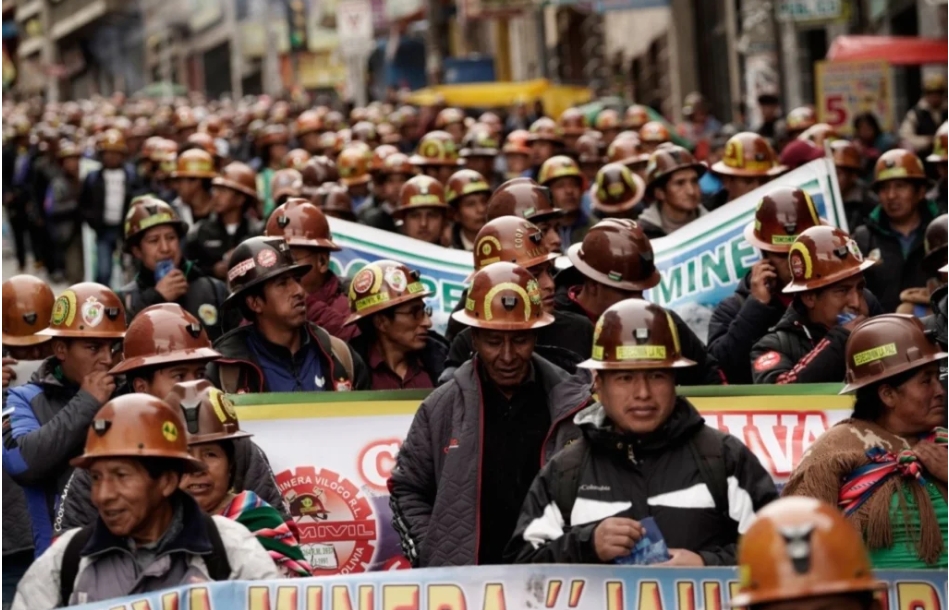
- Miners and Teachers: Massive columns of miners marched through downtown La Paz, while teachers brought educational activities to a standstill, demanding budget improvements.
- Marches by social sectors toward the seat of government: Popular formations are walking from Oruro to besiege the capital.
The government responds with repression and a media blackout
According to reports from community radio stations in the Altiplano and the alternative media platform La Raíz, state forces are operating under a logic of war against the popular sectors:
- Military deployment: More than 3,500 armed troops and riot police units were sent to break up the roadblocks.
- Use of chemical agents: Law enforcement used tear gas at critical points such as southern La Paz and Río Seco (El Alto).
- Criminalization and fatalities: Human rights organizations, the Ombudsman’s Office, and community correspondents on the front lines report at least 4 deaths and 57 civilians detained in recent interventions. Among those reported killed by grassroots groups is a Mallku (indigenous authority) from the Taraco region, allegedly shot during the operations to clear the blockades.
- Censorship and media blackout: Alternative media outlets denounce the existence of a media blackout by traditional television networks, which criminalize the protests, forcing communities to resort to community digital broadcasts to spread the harsh reality of the clashes.
- Legal persecution: The president publicly warned that protesters who block roads or destroy state property “will go to jail,” accusing the protests of being a criminal plot to destabilize democracy.
Current Situation
As of today, May 17, 2026, Bolivia is experiencing crucial hours of extreme tension:
- Humanitarian Corridor and Withdrawal: Following fierce clashes where protesters resisted with stones and homemade explosives, the government ordered a partial withdrawal of the military. Security forces are attempting to force open corridors to allow the entry of medical oxygen and food.
- Critical shortages: The cities of La Paz and El Alto are suffering from severe shortages of fuel, basic foodstuffs, and medical supplies due to roadblocks.
- Closure of land borders: Transportation access to the interior of the country, Peru, and Chile remains completely blocked.
- Call for conditional dialogue: Due to the crisis, the government signed the repeal of the controversial land law to appease the peasants and called for an emergency “productive dialogue” with the COB. However, the main union and indigenous movement bases maintain that pressure tactics will not be lifted until the underlying economic crisis is resolved or Rodrigo Paz is removed from the presidential palace.
References:
- Bolivia le declara la huelga general al presidente Rodrigo Paz – teleSUR
- El presidente de Bolivia anuncia una comisión para impulsar una reforma parcial a la Constitución | CNN
- Bolivia: Evo Morales denuncia plan de asesinato orquestado por EE.UU. – teleSUR
- Paz denuncia intentos de ‘desmontar’ la democracia y advierte cárcel para impulsores – La Razón
- «Para detenerme o matarme»: Evo Morales acusa que EEUU ordenó al Gobierno de Bolivia ejecutar una operación militar en su contra – El Ciudadano
- Crisis en Bolivia: las claves de los conflictos que amenazan la estabilidad del gobierno de Rodrigo Paz – Infobae
- Rodrigo Paz cede ante la marcha indígena y elimina la polémica ley de tierras en Bolivia ¿Qué pasa en Bolivia? Las claves de las protestas que exigen la renuncia del presidente Rodrigo Paz Reportes de represión en El Alto y Altiplano Boliviano – Plataforma de Comunicación Comunitaria La Raíz (Ecuador/América Latina)
- Live reporting from barricades – Red de Radios Comunitarias de Bolivia, and local correspondents
First published here in Spanish by the IWL