
Gutting of Voting Rights Act attempts to deny democracy to all working people
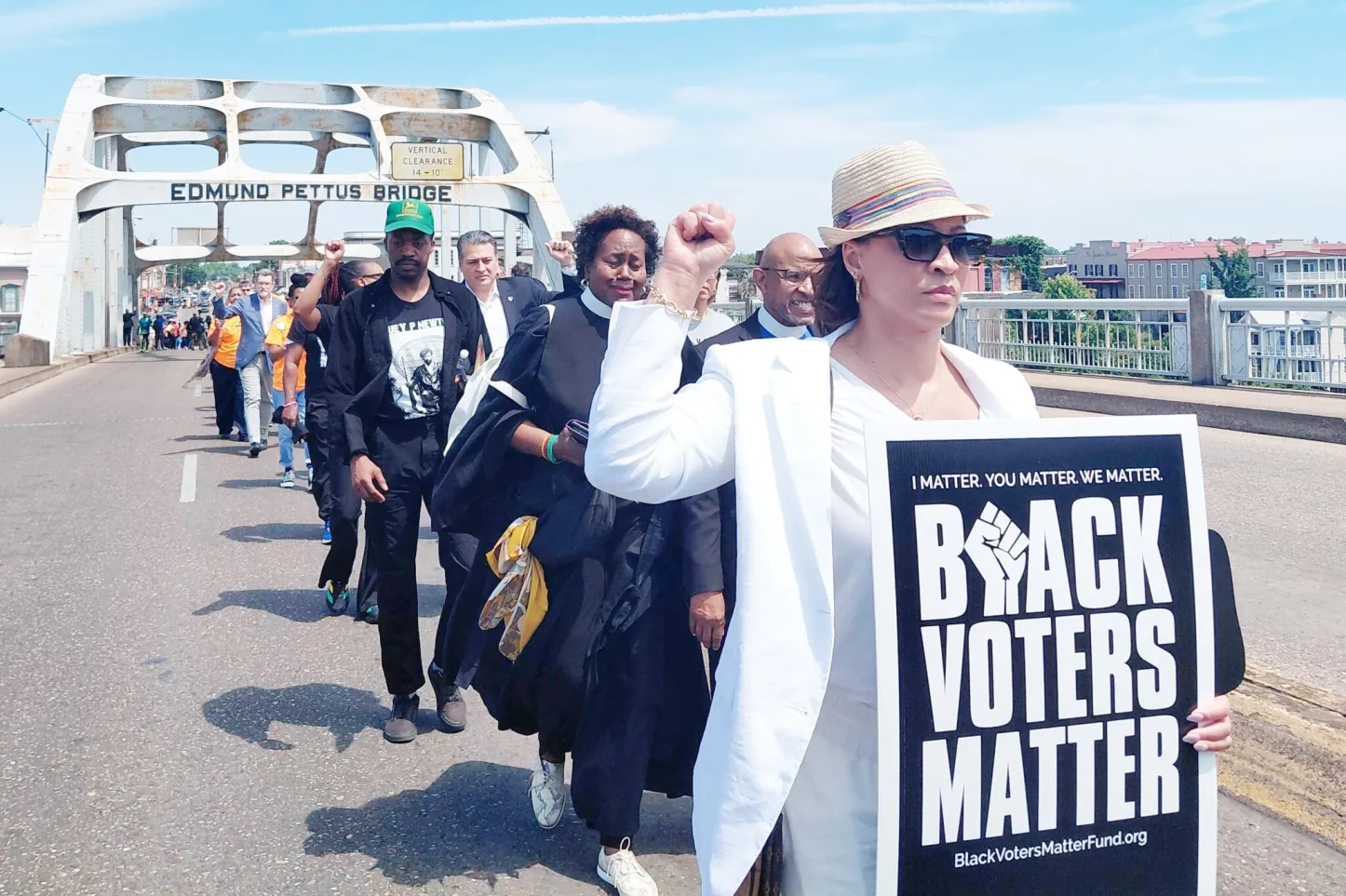
Nearly 5000 protesters assembled in Montgomery, Ala., on Saturday, May 16, as part of the emergency mobilization dubbed All Roads Lead to the South. The Montgomery rally followed the recreation of a segment of the first Selma to Montgomery march of 1965, when 600 protesters were attacked by state troopers on the Edmund Pettis Bridge in Selma, an event that has come to be known as “Bloody Sunday.” Faith leaders, politicians, and activists joined figures like the “oldest living foot soldier” from that original crossing, 84-year-old Annie Mae Avery, and Sheyann Webb-Christburg, who was an eight-year-old participant and victim of the police assault.
These mobilizations were a response to the Supreme Court’s April 29 ruling on the case of Louisiana v. Callais, which granted Louisiana the right to gerrymander voting districts to make Black representation to Congress nearly impossible. Within days of the verdict, other white Southern state governors and legislators rushed to use the ruling to squash the electoral voice of the Black community. This includes efforts in Alabama, Tennessee, and South Carolina.
These moves signaled that Section 2, a 1982 amendment to the 1965 Voting Rights Act that strengthened the act by requiring that the courts need not prove “intentional discrimination,” but only “the presence of discriminatory effects,” was dead. With this act and the resulting rush of a number of the former states of the Confederacy to dismantle Black voting districts, the Court and the Republican Party is attempting to render void one the great conquests of the U.S. Civil Rights movement and put the political rights of all working people in greater danger than any time in the recent past.
In the course of this rush to dismantle democratic norms, the Speaker of the Alabama House, Nathaniel Ledbetter, expressed his hope—undoubtedly nurtured in far-right think tanks—that the Supreme Court would next “overturn the 14th Amendment” to the U.S. Constitution. That is the one that includes birthright citizenship, but also says that no state should deny anyone in their jurisdiction the equal protection of the law. In addition, it states that no state shall deprive any person of life, liberty, or property, without due process of law.
The 14th amendment was ratified after the Civil War, and supporters of civil rights and Black self-determination have been trying to implement it ever since. The white supremacists given new momentum by the high court ruling are imagining being relieved of all restrictions to their attempt to turn back the clock and to gaining new legal support to limit political rights on a scale beyond what is afforded by diluting the Black vote.
In this dystopian, white supremacist scenario, the disenfranchisement of millions of Black, Chicano, and other oppressed populations will create the circumstances in which a growing pool of low-waged workers will have little capacity to make an electoral impact on government policy affecting wages, working conditions, and social support in the realm of education, health care, housing, and unionization.
Overturning the gains of the Civil Rights movement have been on the agenda of the U.S. far right since the day that the schools were first ordered desegregated. As Nancy McLean wrote in her 2017 “Democracy in Chains: The Deep History of the Radical Right’s Stealth Plan for America,” when the U.S. Supreme Court issued a second Brown v. Board of Education ruling in 1956, it immediately prompted right-wing intellectuals committed to the then current political economy of the South to set up an academic center at the University of Virginia under the leadership of Patrick M. Buchanan. These forces feared that future Supreme Court rulings might interfere with other state action said to be in violation of the 14th Amendment’s guarantee of equal protection under the law, a scheme that they saw as replacing “state’s rights” with “individual rights,” and they specifically worried about the potential for changes to labor law and their ability to manipulate elections.
This moment, McLean argues, stands as one of the ideological beginnings for the current drive of the billionaire-backed far right to undo the level of democratic governance won by working people to date. The Heritage Foundation’s “Project 2025,” while born directly from the global economic crises of the early 21st century, is also the intellectual product of nearly 70 years of planning to stop the increased democratization of the U.S. that began with the fight to desegregate the schools.
As Quinn Slobodian, author of “Hayek’s Bastards” (2025, puts it, right-wing economists believed that the Civil Rights movement begat the movements for feminism, affirmative action, and ecological consciousness, and these, in turn, resulted in millions demanding “redress of inequality” at the expense of profit. They saw these movements, which argued that inequality was systemic rather than genetic, the ideological right argued, which legitimized demands for government social spending, as posing an existential threat to the efficient workings of capitalism.
The parts of the capitalist class rooted in white supremacist ideology have always seen the Black movement for equality as opening the door to unwanted advances by labor, women, and environmentalists as well. The current efforts to dilute the Black vote are just the beginning of their efforts to retool the U.S. economy in interests of their flailing profit system and against the interests of all working people. Thus, the whole movement against the Trump regime must put everything into the fight to push back that attack on Black voting rights. The fight of the Black community must become the fight of the whole movement.
Photo: Some 400 protesters cross the Edmund Pettis Bridge in Selma, Ala., on May 16. (Ralph Chapoco / Alabama Reflector)
First published here by Workers’ Voice


