Struggles intensify against AI data centers

The explosion of artificial intelligence over the past couple of years has been breathtaking. Seemingly from nothing, it has now become the carrier not only of Big Tech’s most unhinged fantasies but also that of capital more generally. The claims of its most fervent believers—that it will replace most human labor and that it will initiate a new age of unlimited capitalist growth—will inevitably fall short of expectations. But even if we won’t see multibillion-dollar corporations run entirely by AI agents anytime in the near future, the future AI capital foresees for the rest of humanity reveals itself in its new “satanic mills,” the AI data centers popping up like weeds all over the United States. Marx once wrote that mechanization under class society provides new weapons by which the ruling class can dominate the working class.
AI’s increased role in U.S. and global capitalism
Companies like Apple, Meta, Alphabet, Microsoft, Nvidia, and Amazon, “all of which have staked their futures on the use of artificial intelligence,” now make up about 30 percent of the S&P 500. AI spending is not only a main driver of global profitability; it is propping up the real economy in both the U.S. and globally. Spending by tech companies on AI infrastructure was $375 billion globally in 2025 and is projected to rise to over $700 billion in 2026. Moreover, as The New York Times reported last summer, asset management firms estimate such spending to reach $7 trillion in the next decade.
The ancillary industries forecasting AI-data center related growth include infrastructure analytics and imaging, energy suppliers (for example, battery makers) and storage services, nuclear energy, construction and building materials, as well as electrician services, engineering, and heavy-equipment firms. All of this enthusiasm, however, has industry insiders already warning of an imminent bust.
Similar to other cycles of “irrational exuberance,” the AI boom rests on a house of cards: debt, speculation, and financial chicanery. In reality, the industry is groaning under hundreds of billions of dollars of debt. Tech giants are accruing this debt through the same “highly securitized” financial instruments that brought down the 2008 housing bubble. It’s an understatement to say that their profit expectations are highly optimistic and that a bust would devastate not only the aforementioned industries servicing it, but the wider real economy as well.
Opposition to data centers is spreading and intensifying
The top tech firms, or “hyperscalers” as they’re referred to in industry jargon, are expected to spend approximately $710 billion on data centers across North America in 2026. To outcompete their rivals, hyperscalers must construct data centers as quickly as possible. The computing power needed for this is gargantuan, putting enormous burdens on existing power grids and water sources. Alternatively, hyperscalers can opt to build their own onsite power generation facilities. But either way, they are usually required to go through local permitting application processes.
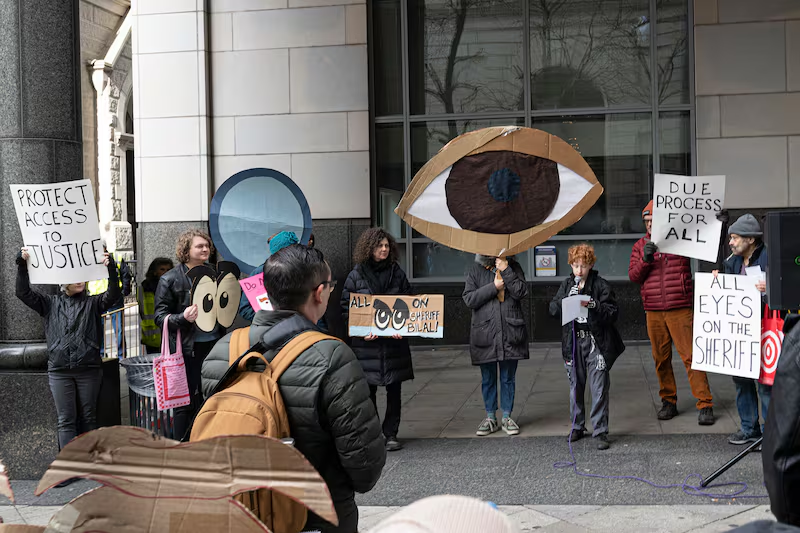
That’s where the resistance has come in places as diverse as the central valley of California, Georgia, Maine, Pennsylvania, Virginia, and Wisconsin—along with sovereign Indigenous lands. So far there are moratorium bills in over a dozen state legislatures, and the number is set to grow. A Pew Research poll recently found that Americans have more negative views of AI than people in any other country it has polled.
In 2025, local protests in the U.S. succeeded in blocking 48 projects worth over $150 billion. Grassroots local protests have stiffened the backs of local councils and legislative bodies, which have put up increasingly disruptive (from the perspective of corporate hyperscalers) legislative hurdles to new centers. One industry insider, Aniket Shah, a managing director at the investment bank Jefferies, expects even deeper resistance and mounting legislative pushback in the future.
The most sweeping legislation so far comes from Maine, where the Democratic Party-controlled legislature passed an 18-month statewide moratorium. The press has somewhat exaggeratedly called this the “first statewide ban,” but it is more accurately a moratorium and only on “large” centers, those using more than 20 megawatts of power. Nevertheless, the scope and the timeline of the moratorium are an indication of the resistance of Mainers. Localities all over the state have pushed back not only on the potential environmental impacts of proposed centers, but also on potential blackouts and lack of transparency and community participation. However, at the time of writing, Democratic governor Janet Mills has yet to say whether or not she will veto the bill and has made statements on the importance of the centers in bringing jobs to the state.
Virginia is another telling example. The commonwealth was one of the earliest places in the U.S. where data centers—servicing federal government cloud computing demands—were built. However, as the centers’ enormous demands on electricity and water along with their negative impacts, such as increased noise levels and poorer air quality, became clearer to local communities, they rose up in resistance, “some of the fiercest,” according to a recent New York Times article. One prominent slogan in the Virginia data center protests has focused on community control of local policy.
The many harms of data centers
It is not just their electricity demands that are raising these communities’ hackles, though these are eye-watering. One such center consumes as much energy as 100,000 households, the largest as many as 2 million. These energy “needs” indirectly promote other polluting and dangerous forms of energy, such as coal and nuclear. These centers run super hot and require oceans of water: by 2028, it is estimated that data centers will consume as much water as the indoor needs of 18.5 million U.S. households (a U.S. household, it should be remembered, is itself an enormously disproportionate contributor to the global carbon footprint). The residents of one Georgia county expect their water bills to rise over 33 percent over the next two years. A typical annual increase is 2 percent.
Air pollution, dumped by centers sited in working-class and racialized communities; the depletion of public funds owing to tax breaks by “business friendly” state legislatures; the e-waste and heavy metals that will likely be dumped onto semicolonial and Global South workers; the undermining and imminent devastation of working conditions—material and psychological—among white-collar workers. These are only some of the harms that data centers and the AI craze are already causing.
Environmental racism and colonialism
As a result of the aforementioned resistance, tech companies are increasingly targeting more vulnerable racialized, rural, and Indigenous communities as locations for new data centers.
In Mississippi and Tennessee, the NAACP is suing Elon Musk’s X, whose xAI data centers are dumping massive amounts of methane and other toxins in historically Black communities with long experience of environmental racism. The region’s “Colossus” and “Colossus II,” the xAI data centers running on makeshift power plants, are gargantuan facilities. Colossus II covers 1 million square feet in Southaven, Miss. The Guardian points out that Colossus I, in the industrial zone of Memphis, Tenn., is only a few miles from “residential neighborhoods that have long dealt with harmful pollution, including Boxtown, a neighborhood that was established by formerly enslaved people after emancipation in the 19th century.” The over two dozen gas turbines at Southhaven, “each one the size of a large bus” as noted in the Guardian report, together have capacity to emit 1700 tons per year of chemicals, including nitrogen oxides and formaldehyde. Community members and organizers have been mobilizing protests at both sites around slogans such as the right to clean air.
Hyperscalers also target Native American communities who have experienced centuries of colonial violence and environmental racism. These companies see Indigenous sovereignty practices and laws as opportunities to evade the legislative resistance mentioned above. While companies promise to bring new employment to such communities, in fact these centers threaten displacement and the undermining of Indigenous food and care systems. As reported in a recent article in Mother Jones, this has been the experience of the Muskogee (Creek) Nation in Oklahoma, whose Looped Square Ranch, “a 5,570-acre plot of land where the tribe runs its food sovereignty initiative” is currently under threat.
Activists with Honor the Earth, an Indigenous nonprofit, explain that there are currently “at least 106 proposed data center projects near or on Native lands.” Native activists see proposed data centers as a part of the long history of ongoing colonialism, of Indigenous dispossession, and the despoliation of Indigenous lands, a recent example being the Dakota Access Pipeline in 2016.
Similar to other parts of the United States, Indigenous communities have organized to fight what they rightly see as colonial invasions. Along with founding the Stop Data Colonialism coalition, Honor the Earth has helped organize local Indigenous resistance movements with some success: under pressure from the movement, the movement has won moratoriums or outright bans passed in both Tulsa and Coweta, Okla., and in the Seminole Nation in the northern part of the state.
Some General, Provisional Theses
Since 1980, we’ve seen a widening split between white-collar wage workers and blue collar wage workers. As the U.S imperial project began to decline in the 1970s, the latter grouping was hit particularly hard, seeing wage stagnation and even regression along with massive declines in unionization. The former, white-collar wage workers, actually benefited as a sector of the working class, partaking in the rise of financialization (debt) to power its credentialing in universities and its consumerism. However, since the 2008 financial crisis, white-collar wage earners too have started seeing their gains disappear under the neoliberal regime, with more and more members of this sector falling into unpayable debt and unemployment.
Now, with the emergence of AI as a mass consumer technology over the past two to three years, we see increasingly onerous disruptions of the work process and threats of imminent mass unemployment in the white-collar sector. Figures like OpenAI chief Sam Altman are becoming more open and vocal about their ultimate goal: corporations valued in the multibillions run entirely by AI agents.
White-collar workers now see a near future, if not a present, of deskilling, mass unemployment, and material and mental devastation. As this sector becomes proletarianized, it loses the privileged place it once had under neoliberalism and joins blue-collar workers already thrashed by decades of neoliberal deindustrialization. This opens the possibility for a truly powerful united movement of the two sectors, around slogans like “democratic” or “community” control of tech, democratic control of the economy, the centering of human needs over profits, universal socialized health care and other care work, etc.
Despite the splits that Trumpism has been causing between the two ruling-class parties and the real contradictions between the respective social bases of those parties, the U.S. capitalist class and the bourgeois parties are united in their promotion of artificial intelligence and the tech sector more broadly as weapons in the inter-imperialist conflict with China. We mean weapons in both the literal and metaphorical senses: AI is at the vanguard for development of military and surveillance technologies for use in current and future military confrontations and is also seen by the U.S. ruling class as an instrument for the maintenance of U.S. hegemony. Dystopian phenomena like AI-agents/cops and “predictive” warfare have surged beyond the borders of speculative fiction into contemporary reality for colonized and working-class people.
Marx argues in Capital, vol. 1, that it is possible to compose a “whole history” of innovations in machinery since the early days of the industrial revolution “for the sole purpose of providing capital with weapons against working-class revolt” (Capital vol. 1, p. 563, Penguin Classics). This insight resonates with the existential level of threat felt by the entire working class, regardless of credentials, in our own times. But more than this, data centers and the larger explosion of exuberance around AI are symptomatic of a more general crisis, a crisis expressed not only by the devaluing of work, but also in attacks on local communities and the environment along with attacks on Indigenous and racialized communities.
In Capital, Marx already saw the emerging “metabolic rift” caused by machinery and large-scale industry as the deepest contradiction of capitalism. This was expressed during Marx’s time, and to great extent also during our own, in the industrialization of agriculture and in the overproduction crises in the capitalist heartlands that, in turn, impel capitalist powers to engage in colonialism.
We can extrapolate directly from agricultural mechanization in the 19th century to robotics and AI in our own time. As Marx writes in Capital, “Capitalist production collects the population together in great centres, and causes the urban population to achieve an ever-growing preponderance. This has two results. On the one hand it concentrates the historical motive power of society; on the other hand, it disturbs the metabolic interaction between man and earth […] Capitalist production, therefore, only develops the techniques and the degree of combination of the social process of production by simultaneously undermining the original sources of all wealth—the soil and the worker” (vol. 1, pp. 637 – 638). Presciently, Marx saw that this dynamic, set loose by the capitalist mode of production, would inevitably lead to ever more devastating crises.
The inherent tendency of capitalism toward crises, along with the far more frequent and severe crises since the 1970s, relative to the post-World War II Keynesean trente glorieues, is well known.The dynamics we see today with AI not only echo the post-1970s era. Like seemingly everything else AI touches, it speeds these up: already, more sober economists and business strategists are warning of an imminent collapse. The madness of AI’s boosters and sobriety of its skeptics are nearly simultaneous. The attacks that AI visits on communities, the working class, and the planet—the deep disruptions so obviously benefitting only the wealth few—are so broad and widely felt that these have the potential to unite all sectors of the working class along with Indigenous and racialized communities across disparate national regions and international borders.
The task for revolutionaries is to clarify these connections and articulate these sentiments into a unified struggle. Only a unification of these struggles under a revolutionary program for the overthrow of capitalism and its replacement by a system that serves human needs and planetary health over the profits of a tiny minority can lead our class, and our planet, out of the crisis.
Photo: NBC News