Solidarity with the JBS meatpacking workers strike!
The meatpackers at Greeley, local and immigrant, speaking literally dozens of languages, are fighting as one against a multi-billion-dollar dragon.
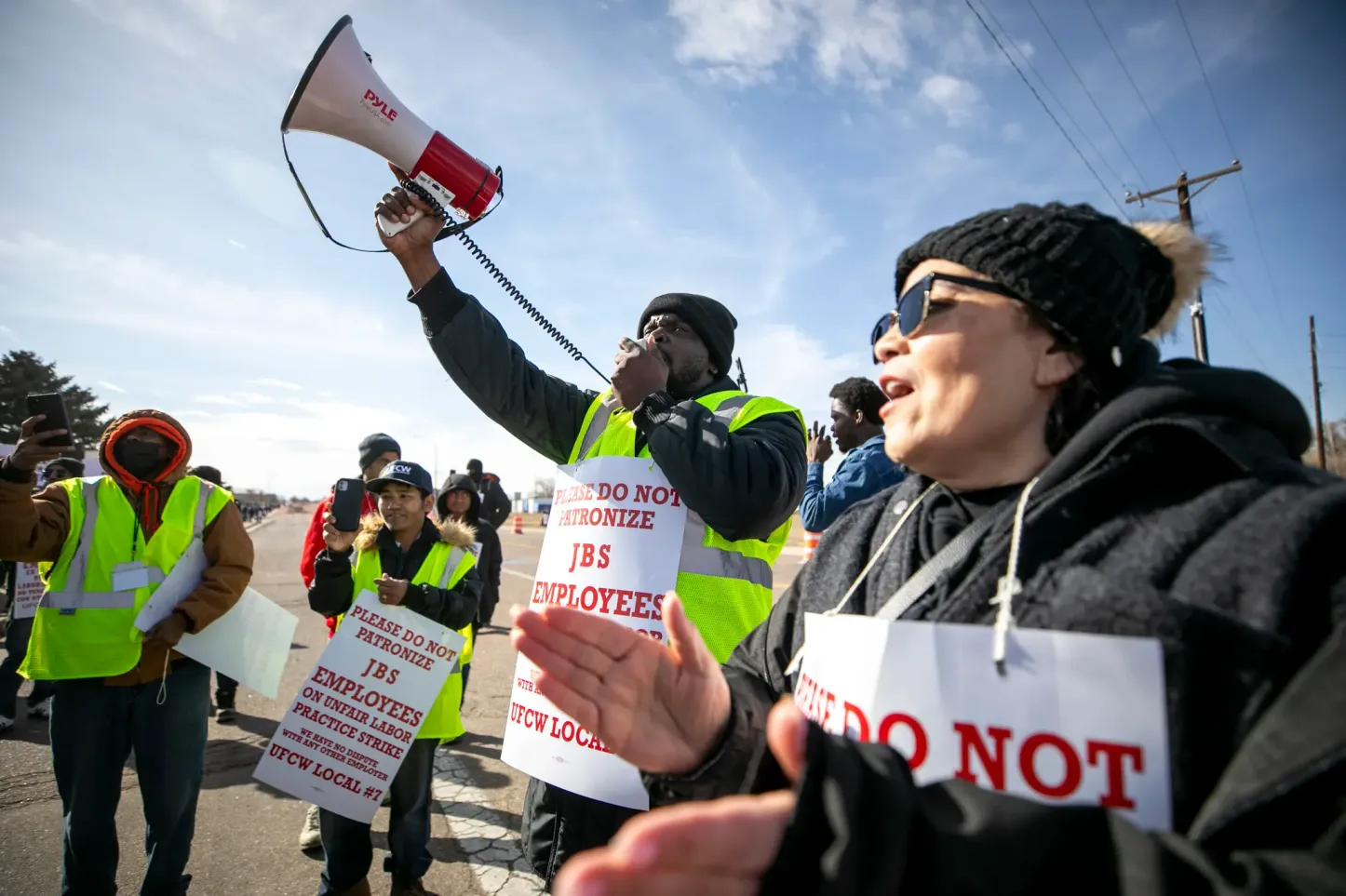
On Monday, March 16, some 3800 workers in Greeley, Col., went on strike. Represented by UFCW Local 7, they are up against the Brazilian multinational JBS, which often markets its products under the Swift Beef Co. brand. JBS is a huge multinational that netted $22.6 billion in sales in 2025; in fact it is the world’s largest beef processing corporation. Not since 1985—the historic Hormel strike—has a major strike taken place in the meatpacking industry.
“We want to be treated like human beings,” JBS employee Deborah Rodarte said in a statement from the union.
The strikers deserve all of our support; it would be hard to find a sector of the U.S. working class facing a worse boss. JBS already made a name for itself in the United States last year when it was found liable for utilizing child-labor through third parties.
There are a plethora of reasons for which the workers represented by UFCW Local 7 voted 99% in favor of going on strike. The company’s measly proposal of a 2% raise over the length of the contract was a slap to the face. It did not remotely keep up with inflation or help wages match cost of living. Reimbursement for equipment is also central. In some cases workers can expect to pay $1,100 out of their own pockets to acquire the equipment necessary to perform the work they are hired to do!
Conditions on the shop floor, such as speedup of the production line, have also caused significant discontent. Workers filed a complaint with the Equal Employment Opportunity Commission claiming that on the second shift—with more Haitian workers than on the first shift—the speed of the line went from around 250-300 heads of cattle an hour to 390-420! Speedup is the practice of intensifying the labor of workers in order to extract more value from their labor in the same amount of time. This level of speedup turns an already fast-paced, grueling, and dangerous job into an unbearable situation in which the worker is forced to risk life and limb for the sake of filling up the bosses’ coffers.
On the line, workers are forced to keep hold of meat hooks on one hand and knives on the other for hours on end, plunging and slicing repeatedly for the duration of the shift. This strenuous repetition leads to hand injuries, such as limitations of the range of motion and full use of their hands. Meatpacking plants are regularly classified as one of the most dangerous and deadly jobs in the United States due to poor working conditions, lackluster safety regulations, and profit-driven productivity increases.
In an attempt to break the strike, JBS carried out an anti-union campaign. UFCW Local 7 has denounced this campaign as full of unfair labor practices, such as the intimidation of workers in closed-door, captive audience meetings—where shop stewards and union representatives were excluded. Workers were threatened with termination of their jobs unless they resigned from the union and crossed the picket line. The company also lied to workers about their rights to strike by threatening reprisals. All of these are illegal attempts to intimidate the workers into submission. The 99% approval of the strike demonstrates the resounding failure of their anti-union campaign.
The struggle by JBS workers in Greeley extends beyond the shop floor. The issues of immigration and human trafficking also play a central role in understanding the relationship between the JBS workers and the managers and owners. Meatpacking workers are a highly immigrant sector of the class, and close to 50 languages are spoken on the floor of the plant. In Greeley, a significant number of the workers are Haitian immigrants, protected by Temporary Protective Status (TPS), a program that is now under attack by the Trump administration.
“¡Huelga,!” meaning “strike!” in Spanish, is often heard on the picket line. This international composition of the workforce condenses into a single shop floor the often-spoken phrase, “Workers of the world, unite!”
Human trafficking and inhumane housing conditions are also part of this story. Immigrant Haitian workers, lured to work at JBS under the pretenses of free housing and dignified work, soon found themselves crowded into completely undignified living quarters. “A group of those workers filed a class action lawsuit alleging that “they were promised free housing but, upon arrival, were charged ‘to live in overcrowded, uninhabitable ’ conditions at the Rainbow Motel nearby.”
With both living and working conditions reaching unbearable levels, a worker compared his situation to slavery. His story was told in Mother Jones, “Auguste told me he can’t shake the humiliation. Every day at work, he walked through the slaughter side of the plant, where each cow has its own little holding pen, but he was expected to share a tiny space with five of his co-workers. He found himself thinking the cows had it better. ‘I feel like,’ he said, ‘I was being treated as a slave.’”
These conditions led to righteous anger boiling over into active resistance before the current strike was voted on. Some workers began “coordinating short work stoppages, letting beef slide by on the conveyor belt uncut and untrimmed while banging their meat hooks on the sides of the metal work stations to alert supervisors that the chain conveyor system needed to be stopped.”
The strike at JBS needs support from the entire labor movement. Fundraising for the strike, solidarity statements from our union locals, campus organizations, and civil liberties coalitions will all serve to build necessary support for the strike.
Already, CSP-Conlutas, a 3.5 million-member union federation in Brazil, has come out in support of the strike. As a Brazilian company, JBS already has a history of corruption and super-exploitation in their country, bribing politicians and artificially lowering wages. After UFCW Local 7 had taken the vote to go on strike, “CSP-Conlutas put out a statement praising and supporting the workers. They wrote that “the work stoppage by American workers fits into a broader working-class struggle against exploitation and capitalist greed.”
This strike takes place on a truly international, immigrant shop floor. The workers are on strike against an incredibly predatory company, fighting back against all the traditional abuses of the bosses, while the workers are under threat of repression and deportation by the Trump administration, to whom the owners of JBS donated $5 million during the inauguration. Deportation of combative meatpacking workers is a tool that has already been infamously deployed by the capitalists and their state in the past; we must keep an eye out to prevent it from happening again.
The meatpackers at Greeley, local and immigrant, speaking dozens of languages, are fighting as one against a multi-billion-dollar dragon. The workers are setting an important example for the entire labor movement. Their determination and grit demonstrates the tremendous contribution that workers with experiences from around the globe can make to rebuilding and strengthening unions in the U.S. And their strike suggests, in embryo, that concerted labor action can be elevated as one of the main tools utilized to defend all immigrants victimized by the MAGA machine.
To support the striking workers of UFCW Local 7, visit their website to donate to the strike fund. Solidarity forever!
Photo: Kevin J. Beaty / Denverite