Remembering Walid Khalidi, historian of the Palestinian cause
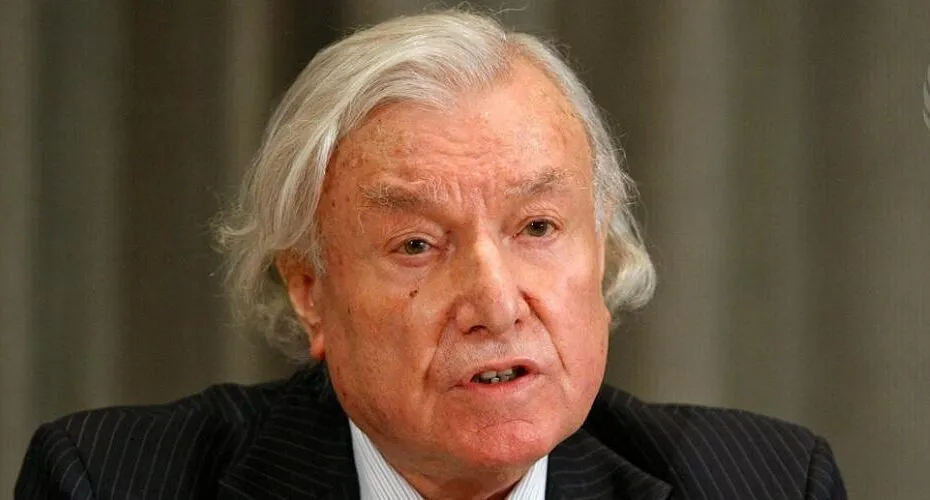
Walid Khalidi, a leading authority on the Nakba (the Palestinian catastrophe that began with the establishment of the racist and colonial State of Israel in 1948), passed away on 8 March at the age of 100. His legacy is essential for understanding the history and memory of Palestine.
His research is crucial for understanding the immense injustice that the Palestinian people have suffered for 78 years, and for combating the disinformation and dehumanization that sustain colonization, apartheid, ethnic cleansing and genocide.
Palestinians are confronted with anti-history on a daily basis in the form of false narratives that demonize their legitimate resistance, while they endure brutal national oppression. Understanding Palestinian history and memory is a vital step towards confronting this reality and achieving liberation.
Walid Khalidi, who was aptly called ‘the historian of the Palestinian cause’, provides us with his extraordinary research, particularly in two fundamental encyclopaedic works:
All That Remains: The Palestinian Villages Occupied and Depopulated by Israel in 1948 (1992) and Before Their Diaspora: A Photographic History of the Palestinians’ 1876-1948 (1984). The latter book contains a rich photographic record of Palestinian life and places prior to the Nakba, compiled from nearly 500 rare photographs.
In All That Remains, alongside a map of historic Palestine showing the locations of over 400 villages destroyed during the ethnic cleansing carried out by Zionist militias in 1948, there is detailed documentation of these villages before, during and after the Nakba.
One of those villages is that of my paternal family: Qaqun. Walid Khalidi is a key reference for many researchers and students, and his work formed the basis of my own research for the book Al Nakba: Um Estudo Sobre a Catástrofe Palestina (2017).
His work was instrumental in broadening my understanding of Qaqun, the village where my father, Abder Raouf, was born in 1935 and from which he was forcibly displaced at the age of 13. He referred to his village as a ‘paradise’ before the Nakba, and like millions of refugees, he described it lyrically. In this place of memory, he connected with his land, from which he had been torn away, and with the prospect of liberation and return.
Born in Jerusalem in July 1925, Walid Khalidi revealed the details of the Dalet Plan, which was drafted in the late 1940s and set out how the Zionist movement intended to carry out its final plan for ethnic cleansing. Plan Dalet sealed the fate of the Palestinians in the Nakba of 1948.
Although Walid Khalidi was a pioneer in researching and exposing the planned expulsion in order to establish the racist, colonial state of Israel, it was Ilan Pappé’s book The Ethnic Cleansing of Palestine that gained Plan Dalet greater academic recognition in Nakba studies.
However, in the introduction to his work, Ilan Pappé acknowledges that he drew from that source, and that Arab and Palestinian historians had already explored this path before him, explicitly mentioning the work of Walid Khalidi. But these voices had not been heard or considered credible.
Walid Khalidi, a professor at the universities of Oxford and the American University of Beirut, a researcher at Harvard, and the co-founder of the Institute of Palestinian Studies in 1963, may not have enjoyed the same international recognition, but he is widely respected by any serious researcher of the Palestinian question.
As is almost inevitable for Palestinians, Walid Khalidi combined academic knowledge with political commitment. For example, he resigned from the University of Oxford in 1956 following the French, British and Israeli invasion of the Suez Canal and joined the Palestinian nationalist movement.
In the political arena, he advocated for the so-called ‘two-state solution’ and went on to join the Jordanian-Palestinian joint delegation at the 1991 Madrid Conference. A few years earlier, he had served as a special advisor to the Arab League.
However, in a 1997 article marking the 50^(th) anniversary of the UN General Assembly’s recommendation to partition Palestine, Khalidi was unequivocal: “No, the 1947 UN partition was not the legally, morally, justly, balanced, pragmatic and viable ‘compromise’ formula that it is claimed to have been”.
Addressing the debate over whether the Palestinians should have accepted the partition, he questioned how a plan could be fair when more than half the territory was allocated to the creation of a Jewish state despite Jews representing less than a third of the population and owning only 7% of the land. Meanwhile, the Arab majority owned most of the land yet would be left with barely 45% of the territory.
In the same article, however, he refers to the negotiation process as a path, though he notes the ‘flaws’ of the Oslo Accords signed in 1993, stating:
‘No lasting reconciliation is possible if its ingredients are torn from their historical context and based on a misleading narrative of the past.’
Regardless of his seemingly defeatist view of what would be just, and his mistaken view of what would be possible — the ‘two-state solution’, which never aimed for anything more than a peace of graveyards — recognising the importance of Walid Khalidi means acknowledging his legacy, and valuing the history and memory recounted by the children of that land.
The legacy of Walid Khalidi will remain with us until Palestine is free, from the river to the sea.