
Will Erdoğan’s new ministers guarantee his reelection?
An exit from this quagmire is possible!
In Turkiye, the recent appointments made in the Ministries of Interior and Justice are undoubtedly the most critical agenda items of the week. The fundamental pillars of Erdoğan’s oppressive “palace regime” consist of the judiciary, the police, the military police (jandarma), and the intelligence services. Consequently, these moves are a clear declaration of the trajectory the regime intends to follow in the upcoming period.
It is possible to interpret these appointments on two primary levels: on one hand, as the preparation for a new wave of regime-led violence, and on the other, as an expression of the regime’s own anxiety and its fears for its own survival in the face of its inability to halt the opposition despite its use of all of its tools to suppress it. In this context, it is premature to produce reductive arguments such as “elections will no longer happen.” However, it should not be forgotten that a political climate where elections become completely dysfunctional—where opposition leaders are neutralized through models similar to Russia or Venezuela, or where assassination threats loom as in the Colombian example—is not an impossibility in today’s world.
Why Should We Be Concerned?
The new Minister of Justice, Akın Gürlek, was the strategic architect of operations against 15 CHP (Republican People’s Party, the main liberal opposition) mayors, including Ekrem İmamoğlu, during his tenure as the Istanbul Chief Public Prosecutor. Therefore, his involvement in the IBB (Istanbul Metropolitan Municipality) case immediately upon taking office cannot be considered a coincidence. Empowered by the mandate he received from the Palace, he holds the authority not only to shape judicial decisions but also to determine the future of 25,000 judges and prosecutors. It is evident that the regime will accelerate its policy of forcing the entire opposition into submission through the Ministry of Justice.
Nevertheless, we are still in a phase where a certain sensitivity toward the concept of “bourgeois justice”—even if merely symbolic—and the ballot box persists. The Minister’s initial “image-polishing” speeches should not mislead us; for there is neither a total domination of a dictatorship nor an encouraging atmosphere of a democratic spring. On the contrary, we are at a critical threshold where we must fight tooth and nail for democratic positions and electoral rights.
Mustafa Çiftçi, appointed to the Ministry of Interior, is a figure from an Islamist background who is known for his balancing act with the MHP (Nationalist Movement Party, a far-right party in coalition with the government) and nationalist factions within the bureaucracy. The police and federal forces are now under his command.
Both ministers will have a direct impact on the following critical processes:
- Possible negotiation processes between the state and Abdullah Öcalan regarding the Kurdish question,
- The struggle of the oppressed masses in a state of mobilization,
- The future of the country’s remaining fragments of democratic tradition.
It is a reality that these figures will not be bureaucrats who respect election law unconditionally. Their primary duty is to stifle the voices of poor workers and to act as a shield for the regime in a fierce class war.
Regional siege and attacks on organizations
The “terror-free Turkiye” and the “internal front” discourse of the last 1.5 years cannot be considered independently of regional geopolitical developments. While the Kurdish movement and the DEM (Peoples’ Equality and Democracy Party, an opposition party associated with the Kurdish movement) are being pushed into a serious silence, a risk of isolation and passivization is being imposed through developments in Rojava. While the Minister of Foreign Affairs openly states that after Rojava, the turn will come to destroy the Kurdish federal structure in Iraq, he simultaneously defends the survival of the mullah regime in Iran.
This wave of liquidation is not limited to the Kurdish political movement. Operations against the ESP (Socialist Party of the Oppressed, a Maoist group) and the arrest of nearly a hundred revolutionaries are part of this total assault strategy. The ESP has been specifically chosen as a target for the liquidation of both the socialist presence in Rojava and the revolutionary dynamics in Turkey. The fact that the party is targeted despite its legal status—along with its unions, media outlets, and cultural centers—is a warning to all social forces that demonstrate a commitment to struggle.
Intervention in the social sphere and the entrapment of youth
While the regime attacks the institutional opposition and socialists, it continues to impose a conservative/Islamist lifestyle on society. The gains of jihadist groups in Syria pose a serious threat to all secular and democratic values in our region. The youth watch this process with deep concern; daily attacks on secular life, expanding cult networks, banned concerts, and threats against artists have become the primary tools of the Palace’s war for cultural hegemony.
The Blockade is Broken Through United Struggle!
Despite all its steps toward authoritarianism, the regime fails to gain the consent of the masses. The labor-capital contradiction creating an undeniable crisis, and corruption is erupting in every field. Every new attack on universities further sharpens the anger of the youth against the regime.
There is no room for pessimism! Even in the harshest periods of oppression, news of victory continues to arrive from the working class The strikes of Smart Solar, Migros Depot, and Okmeydanı Private Hospital workers have concluded in victory. A mobilization that began in the last quarter of 2025 has yielded results by early 2026. Melting wages in the face of inflation and poor working conditions spurred workers into action across many sectors. Public support also empowered these strikes.
Smart Solar Strike: After 114 days of resistance, the strike ended with the workers’ victory and the employer’s retreat. At the Smart Solar Solar panel factory in Gebze, Kocaeli, the resistance initiated by workers (members of the Birlesik Metal-Iş Union) against low-wage impositions and union suppression concluded on February 12, 2026. Although the process—which began on October 22, 2025—witnessed tense moments such as the employer’s jurisdictional objections, strikebreaking attempts, and the dismissal of 44 workers, it culminated in success thanks to a determined stance led particularly by women workers. With the signed collective bargaining agreement, the minimum wage was raised to 65,000 TL, an average wage increase of 50% was secured, and all dismissed workers were reinstated. This process, a significant milestone in the history of the Turkish working class, once again proved the power of organized struggle and solidarity.
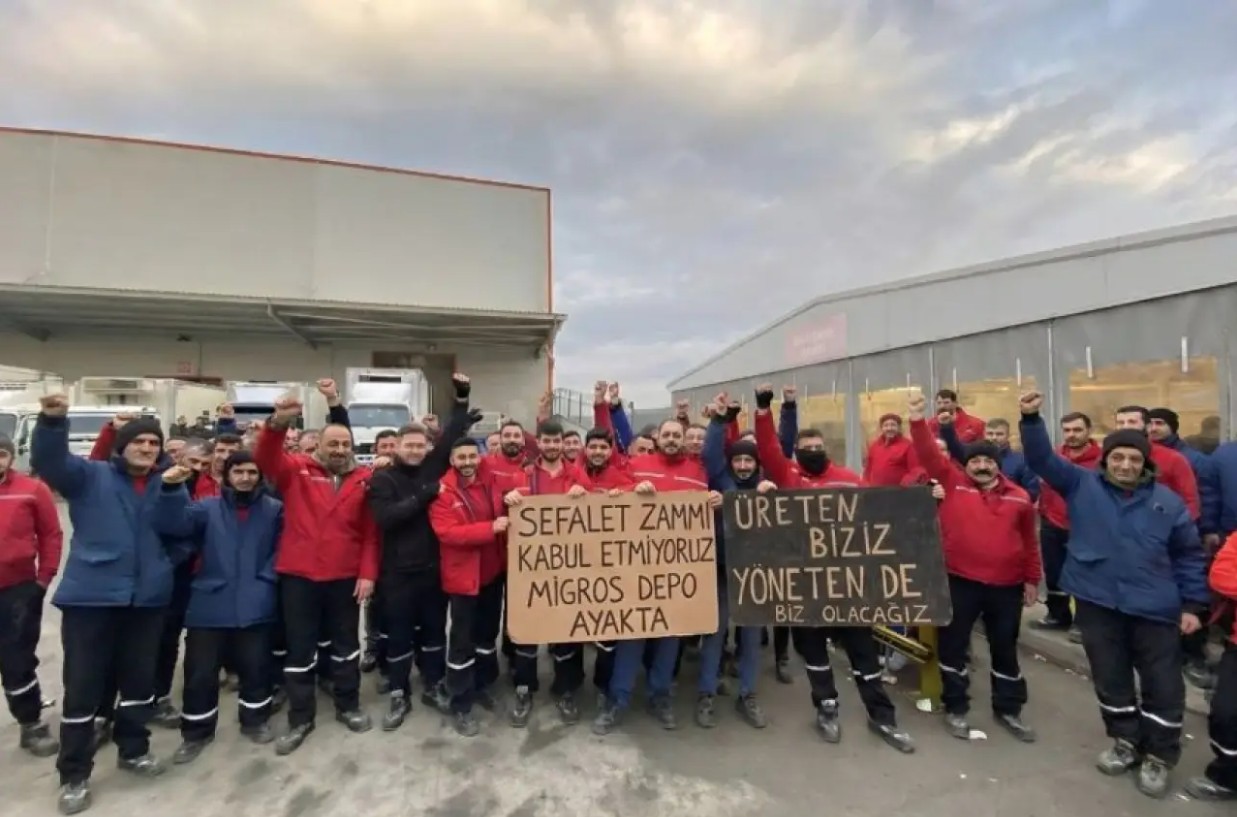
Resistance at the Migros Depot: The actions that took place in early 2026 was a process that ended in triumph. Beginning on January 23 and lasting 23 days, this struggle concluded on February 15, 2026, with a great victory for the workers. Refusing the 28% “misery raise” imposed on them, workers across 14 depots in 10 provinces walked off the job under the leadership of DGD-SEN (Warehouse, Port, Shipyard, and Marine Workers’ Union). During the actions, approximately 303 workers were fired, some were threatened with eviction from company housing, and numerous detentions occurred during protests. The demonstrations held in front of Migros boss Tuncay Özilhan’s residence and a public boycott were key factors in the company’s retreat.
- The gains achieved through the agreement between Migros management and DGD-SEN are as follows:
- The greatest victory was the abolition of the subcontracting system in the depots. Approximately 7,875 workers were transferred to direct Migros payroll. Even subcontracted white-collar employees in administrative units were granted staff positions.
- The 28% offer was accepted as the “base wage.” On top of this, a structure was established to include additional raises from the upcoming collective agreement with the authorized union (Tez Koop-Iş).
- Right of reinstatement was granted to all dismissed workers. Those who chose not to return were provided with additional compensation rights.
- Workers’ years spent as subcontractors now count towards establishing seniority at the company, and improvements were made regarding full payment of bank promotions and tax relief.
Resistance at the Okmeydanı Private Hospital: This began in November 2025 and ended in victory on its 51st day at the end of December 2025. It became one of the most concrete examples of health workers’ increasing struggle for rights in Turkey. This resistance served as a significant precedent not only for wage increases but also against subcontracting in healthcare and for humane working conditions. The spark was the hospital management’s imposition of a near-minimum wage increase on healthcare workers (nurses, caregivers, cleaning, and security staff) already crushed by inflation. Furthermore, bullying by managers and grueling shifts exceeding 12 hours were the final straw. Workers united under the banner of health sector unions and launched work stoppages. Resistance tents set up in front of the hospital bloomed with the support of local residents and other unions. The motto of the process was: “Healthcare is a team effort; its laborers cannot be crushed.” The resistance ended with the employer accepting the demands.
These examples prove to us that instead of watching the “big picture” from afar and lamenting, workers are showing exactly how to win by using the power that comes from production.
The only way out of this quagmire is for local and fragmented struggles to unite and take on a political character. The struggle for economic rights must be synthesized with the demand for democracy and freedom. A strong Labor and Democracy Movement, in which the Kurdish people are also stakeholders, is the only real barricade that can stop this authoritarian regime. Now is the time to establish the line of struggle for a democratic parliament and a country that favors the interests of the working class!
First published here by Marksizm Şimdi


