The legacy of Victor Berger and the Sewer Socialists
The Sewer Socialists' failings on race went hand in hand with their reformist strategy, with which they squandered the Socialist Party's leading position on the US left
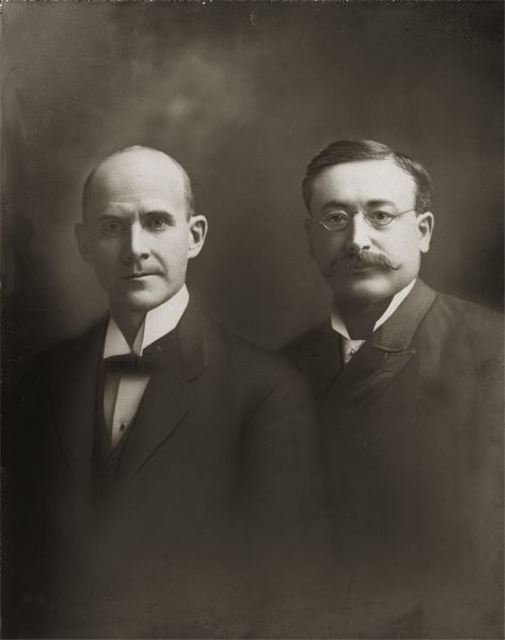

Of late there has been some debate in the U.S. left over the legacy of the 20th-century “Sewer Socialists.” The early 20th-century Socialist Party (SP) operation in Milwaukee, Wis., led by the Transylvanian immigrant congressman, Victor Berger, got the unusual nickname for its focus on local issues (like sewers). The Sewer Socialists tended to advocate taking a reformist, electoral, and gradual road toward achieving a socialist society—as opposed to more militant revolutionists in the Socialist Party who favored building a working-class movement capable of fighting for state power and overthrowing capitalism.
The story of Berger and the Sewer Socialists, an otherwise obscure piece of socialist history, has been held up as a model for the modern socialist movement by Jacobin writer Eric Blanc. Blanc’s choice of role models has led to some backlash from those around him in the Democratic Socialists of America (DSA) since Berger has often been remembered more for his racist views than for his achievements as a socialist in Congress or local government.
In reply to the backlash, Blanc has argued that while Berger did hold reprehensible views on both Asian immigrants and Black people in the early 20th century, by the interwar period he had evolved. Thus, according to Blanc, we should not “cancel” Berger and the Sewer Socialists but instead admire them for their evolution toward having more acceptable views.
At the end of his article, Blanc points out that many socialists that we admire today also had personal views that we would abhor. This is true; however, the matter of whether Victor Berger was personally a racist or whether he personally evolved on that issue are of less consequence than an analysis of the politics of the party he led and the faction within it that he represented.
The position that the 20th-century Socialist Party took on issues of race and immigration was critical. This issue was bigger than Berger himself and encompassed the entire Socialist Party under the leadership of figures like Victor Berger and Morris Hilquitt. The sad fact is that under their leadership, instead of the SP actually being a vanguard that pushed the working class forward on issues of race and immigration, building up the consciousness of the class and steeling it for victory, the SP leadership repeated ideas that Asian immigration would be economically damaging for the working class, even as it seemed to change on the issue when it came to European immigrants. It also tolerated open racism and bigotry against Black people amongst its ranks. This led ultimately to negative consequences for the party and the U.S. socialist movement as a whole.
Anti-Black racism
While Berger in his day was more notorious on the left for his anti-immigrant views, much of the hue and cry against Blanc online focused instead on Berger’s racist comments against Black people. Indeed, Blanc agrees that Berger’s prewar stance on race was “vile” but argues that he had begun to shift on the issue entering into the period of 1912-1918. He acknowledges that early on Berger had repeated lies that Black settlement in an area increased rates of sexual violence and republished articles from Southern SP members that attempted to synthesize so-called “race science” with socialism. Yet Blanc points out that in later years Berger began to condemn race science and republish anti-racist articles by Black socialists.
While Blanc’s analysis might demonstrate that Berger indeed had an “evolution” when it came to his personal views and what was published in the Milwaukee Leader, these do not really demonstrate the real cost of the retrograde positions taken by Berger and other leaders in his faction, such as the New York City socialist leader, Morris Hilquitt. For that we have to consider the legacy of Berger, not just as a socialist thinker, writer, or editor, but as a socialist leader. Indeed, one of the biggest issues facing the SP when it came to recruiting and engaging Black socialists was the toleration of its often openly segregationist Southern wing.

To understand this, we might look at the work of the Black radical Hubert Harrison. In the early 1910s, Harrison was an enthusiastic member of the SP in New York City and a supporter of its left wing, led by the IWW radical “Big Bill” Haywood. Harrison had a perspective of pushing the Socialist Party left on issues of race, with the goal of eventually making it a political home for huge numbers of Black workers. To this end he formed the Coloured Socialist Club and became a frequent contributor to the city’s main SP paper, The Call. His series of articles in that paper, entitled “Race Prejudice” ignited important discussion in the party on the issue.
However, the true explosion on the issue came in response, not to one of Harrison’s articles, but instead to the writing of Mary White Ovington, a white NAACP activist in New York. In a 1913 article in the left-wing socialist publication, New Review, Ovington analyzed the work of leftist groups based on their work in fighting Jim Crow. While Ovington approvingly related the work of her own NAACP and of the IWW, she wrote that while she wished that she “might cite the Socialist party, the party I so love, as the third force to stand aggressively for the Negroes’ full rights,” only local groups in Oklahoma in her estimation had done any real work to speak of. She related that in other states, such as Louisiana and Texas, the situation was even worse; members of the SP “have, at times, shown a race prejudice unexcelled by the most virulent Democrats.”
In the article she also reported on the 1912 convention of the SP, where the faction led by Victor Berger and Morris Hilquitt defeated the leftist faction led by “Big Bill” Haywood: “At the last National Socialist Convention, while the delegates spent hour after hour in frenzied talk over amendments to amendments of motions which no one remembered, no word, save that of Haywood’s, was uttered in appreciation of the existence of this most exploited race. One Negro delegate was present, but he was not given the opportunity to speak. To this convention, the United States Negro, composing one-fifth of all the workingmen in the Union, did not exist.”
Following Ovington’s article, a response was published by the State Secretary of the Mississippi SP, Ida Raymond, entitled “A Southern Socialist on the Negro Question.” This article was filled with racist bile against Black people. It was openly segregationist and claimed that the KKK had been necessary in order to oppose the “period of negro domination” in the South that had followed the Civil War.
In response to this article, Hubert Harrison wrote a letter to the editors of the New Review—which they declined to publish—in which he stated that articles like Raymond’s in New Review and similar articles published in The Call showed that “Southern Socialists are ‘Southerners’ first and ‘Socialists’ after. And the Socialist Party, in the laudable ambition of increasing membership and vote among all classes of the population is apt to keep in the rear whatever implications of its doctrine may offend and scare off the desired elements. This may be sound tactics, but may it not mask a definite danger? I think so. Wherefore, so long as the tattered remains of the Granger and Populist movements rally to your standards in the South, we shall have to keep from saying that Socialism stands for the full civic and political equality of all workers at least … I wonder now whether any Socialist, Southern or other could blame me for throwing in my lot with the IWW?”
As Harrison became increasingly critical in public of the SP leadership for tolerating these Southern reactionaries in the party, he began to face punishment as an SP member. Eventually he was forced out of the party by Morris Hilquitt, resigning his membership in 1918.
The example of Harrison demonstrates the cost of Berger and Hilquitt’s actions as leaders, not merely their personal views. By not taking action on the issue of racial justice, and tolerating openly racist elements of the party, they cost it important Black activists like Harrison. Indeed, this activity even led to the condemnation of W.E.B. Dubois at the time, a man whose support could have radically transformed the relationship between Black workers and the Socialist Party. This remains not just a stain on the legacy of figures like Hilquitt and Berger but also on that of Debs, who, despite a much better track record of personal anti-racist views, similarly failed to adequately challenge the racism of Southern members of the SP during his periods of leadership in the party.
Opposing Asian immigration
The early part of Blanc’s article repeats much of the horrific line that Berger took on immigration from Asia. Just like anti-Black racism, this bigotry wasn’t merely a personal issue for Berger, but was a feature of the leadership of the SP of that era. Berger and Hilquitt’s Socialist Party leadership made both economic and racial arguments against Asian and European immigration. For an example of the economic argument, take the resolution that Hilquitt put forward at the 1907 congress of the Second International, which called for the following:
“[T]he Congress, therefore declares it to be the duty of the Socialists and organized workingmen of all countries: 1. To advise and assist bonafide workingmen immigrants in their first struggles on the new soil: to educate them to the principles of Socialism and trade unionism: to receive them in their respective organizations and to collect them in the labor movement of the country of their adoption as speedily as possible. 2. To counteract the efforts of misleading representations of capitalist promoters by publication and wide circulation of truthful reports of the labor conditions of their respective counties especially through the medium of the international bureau. 3. To combat with all means at their command the willful importation of cheap foreign labor calculated to destroy labour organizations, to lower the standard of living of the working class, and to retard the ultimate realization of Socialism.”
This resolution was opposed at the congress not only by delegates from Japan and Argentina but by delegates from Hungary, Austria, and even the U.S.-based rival Socialist Labor Party. Needless to say, it was soundly defeated.
It is clear that despite sometimes railing against even European immigration, there was some evidence that Berger had made a turnabout on that issue even before the 1920s. In a 1910 Socialist Party congress debate cited by Blanc, Berger argues that while the U.S. is capable of “digesting” European immigrants like himself, “it is entirely different with other races. They have their own history of about fifty thousand years. That cannot be undone in a generation or two generations or in three generations.” Indeed, he had fully embraced this position by 1924; Blanc cites a Milwaukee Leader article of that year, in which Berger extols the work done by Irish, Italian, Polish, and Finnish workers. He even spares a few words to tack on “even the Negro” to this list!
This is why Blanc’s argument does seem to ring true that by the 1920s, Berger had evolved beyond purely racial or civilizational arguments against immigration. However, he continued to make the economic argument against immigration, almost exclusively when it came to Asian immigrants. In 1921, Blanc cites an article in the Milwaukee Leader as evidence of his newfound progressive ideals when it comes to Japanese immigrants. However, in the article Berger wrote: “It is no doubt necessary to prevent unrestricted Japanese immigration to the United States for some years to come but there need not be so much belligerency about it.”
He continued declaring that racism against Japanese people is not worthy of a socialist but then clarified, “The only legitimate reason why the Japanese should be mainly excluded lies in the fact that they jeopardize the economic welfare of Americans. This should be bluntly understood—and not put the exclusion on any false grounds. Because they jeopardize the economic welfare of Americans, the Americans on the coast cannot get along with them. If hordes of them were allowed to enter, the result would be race riots, with hell to pay.” This is merely a recapitulation of the economic argument against Asian immigration from the 1907 SP Second International draft resolution and Berger’s comments at the 1910 socialist convention, showing little to no evolution on this issue, even by the late date of 1924!
The decline of the Socialist Party – The real source of Berger’s “evolution?”
The elephant in the room when Blanc compares quotes between pre-war and post-war Berger is the massive decline in the Socialist Party’s standings triggered by a crisis in 1919. Following the Russian Revolution, it was clear that there was a new left-wing energy in the party that sought to throw out Berger and Hilquitt and replace them with leaders more in the Bolshevik mold. Seeing this coming, the leadership of the SP, including Berger and Hilquitt acted ahead of the 1919 congress to expel left-wing and non-English-speaking party organs, including the entirety of the Michigan section.
This, however, failed to forestall the left-wing reckoning. In June 1919, members of the party voted to bring in a new left-wing leadership. John Reed, the journalist who witnessed and chronicled the Bolshevik Revolution, received four times the votes of Berger, the party’s only elected congressman. In response, Berger, Hilquitt, and the right-wing leadership simply ignored the results of the election and engineered an emergency congress in Chicago. The old National Executive Committee made sure that left-wing sections of the SP were not able to participate in this congress, expelling whole sections before the congress, and at one point even asking police to remove John Reed from the floor.
The result of the stacked congress was pre-ordained, and Hilquitt, Berger, and their allies used it as justification to seize control of party assets. Meanwhile, across town from this sham congress, the Communist Party (CP) was founded by some of the former SP left. This led to an enormous schism and collapse of the SP, with many members leaving to join the CP.
The events of the summer of 1919 meant that, even though he and his allies had managed to hang on to the official leadership of the SP, it proved to be a pyrrhic victory for Berger and his allies. According to available membership data, at the beginning of the year, the party had 104,822 members, but at the end of the year it was down to 34,926. While Berger eventually managed to hold on to his congressional seat despite attempts by the ruling-class parties to eject him from Congress in 1919, he and his Wisconsin party operation were an increasingly isolated bastion of the SP which was crumbling on the national level.
In this context, attempts by the leadership faction of the SP to evolve the party’s line on race and immigration following this collapse appear in a different light. Many Black leaders saw this as too little and too late. Indeed, Hubert Harrison was one of these critics. In a 1920 article in his newspaper, New Negro, Harrison wrote of his former party:
“Now when their party has shrunk considerably in popular support and sentiment, they are willing to take up our cause. Well, we thank honest white people everywhere who take up our cause but we wish them to know that we have already taken it up ourselves. While they were refusing to diagnose our case, we diagnosed it ourselves. Now that we have prescribed the remedy, Race Solidarity, they came to use with their own prescription, Class Solidarity. It is too late gentlemen! … We can respect the Socialists of Scandinavia, France, Germany or England on their record. But your record so far does not entitle you to the respect of those who can see all around a subject. We say Race First because you have all along insisted on Race First and class after when you didn’t need our help.”
Harrison then went on to quote paragraphs from a contemporary article in The Call, which demonstrate that it had continued to publicly advocate for race science, even as the party had supposedly turned over a new leaf. The experience of Harrison speaks to the issue with “evolving” on race and the impact that these kinds of stances can have on a party. By the time the evolution had occurred, many Black activists who could have been key allies for the party were no longer willing to give it another chance.
It is on immigration where accusations, like those of Harrison, of opportunistically changing the party line appear most damning. The reality is that the crisis of 1919 caused a total change in the fabric of the membership of the party. Before the crisis, in 1912, only 15% of the SP membership was born outside the country; however, afterwards in 1920, the party was majority immigrant. Consequently, it was no longer possible for those like Hilquitt and Berger to maintain their early stance against even European immigration, although it appears they had shed these positions before this change had fully taken place.
Nevertheless, it is unclear whether Berger and the SP leadership that he was a part of ever evolved very much on Asian immigration. Sure, they might have moved away from racial arguments against immigration, but articles cited by Eric Blanc himself point to the fact that Berger and his paper continued to make economic arguments against Japanese immigration, even deep into the 1920s, when he was voting against immigration bans in Congress.
Victor Berger as an exemplar?
So, can we still learn from Victor Berger and the Sewer Socialists despite their racial baggage, as Eric Blanc argues? Sure. We can and should always learn from the history of the socialist movement in the U.S. In some ways, Berger can still be a positive role model. We could absolutely use a socialist independent of the Democratic and Republican parties making an argument for class independence and socialism in Congress, in the way that Berger did. In the same vein, his struggle to maintain his seat in the face of a bipartisan effort to eject him from Congress also has many positive lessons.
However, a critical analysis of Victor Berger and the Sewer Socialists can also teach us many lessons. For one thing, an analysis of the disastrous leadership of Berger and Hilquitt in 1919, and their bureaucratic clampdown on the left wing of the Socialist Party, could fill up an entirely different article. More relevant here, we can and should learn much from a critical analysis of the SP leadership’s positions on race and immigration. It shows that while it is better to have anti-racist views than racist ones, it takes more than a simple change to undo the damage caused by public racist positions in the past.
From Berger, Hilquitt and the early 20th-century leaders of the Socialist Party, we must take away the lesson that being the foremost opponents of racism and anti-immigrant bigotry is not merely a moral question, but one that could make the difference between relevance or collapse for our movement amongst huge swathes of the population for decades after our actions and words have already faded.
(Top photo) Socialist Party leaders Eugene V. Debs (left) and Victor Berger in 1897.
First published here by Workers’ Voice