
Socialists Oppose All Forms of Imperialist War
The conflict between China and Japan today is a clash between imperialists that socialists have no part in
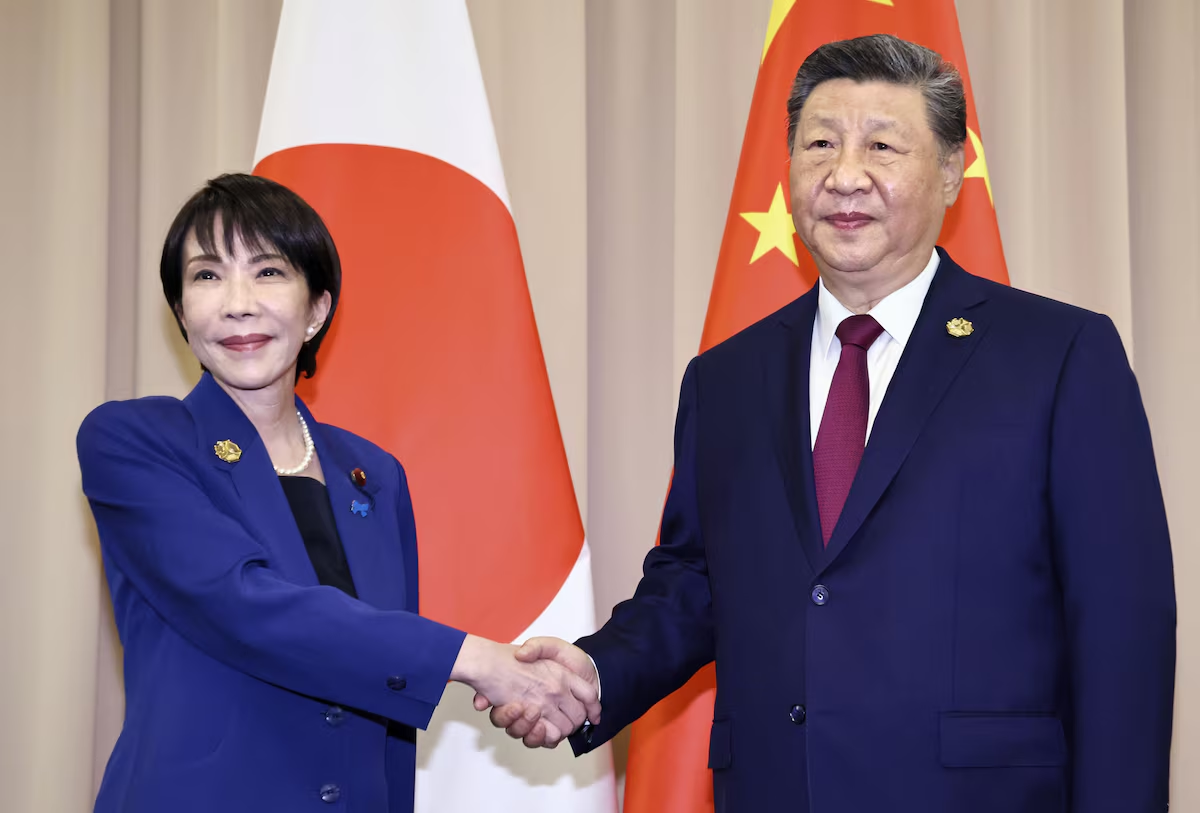
The skies over East Asia are once again shrouded in the shadow of war and confrontation—a single provocation, a threat of war, could plunge countless ordinary people into the abyss. In November 2025, Sanae Takaichi (Prime Minister/Leader of the ruling party of Japan) publicly declared in the Japanese Diet that if “China uses force against Taiwan,” Japan might use force for collective self-defense under the pretext of a “crisis of survival.” This statement immediately provoked a strong backlash and diplomatic protest from Beijing. The Chinese Ministry of Foreign Affairs and Ministry of National Defense warned that any crossing of the “red line” would lead to “devastating defeat.”
However, as socialists—we must transcend this superficial “national antagonism” and see clearly: this is not a simple confrontation between “democracy and authoritarianism,” nor a historical replay of “traditional enemies”; it is a new round of struggle between capital, power, and the state apparatus within the modern imperialist/state capitalist system, a tragedy in which the fate of ordinary people is ruthlessly manipulated by the politics and capital interests of great powers.
We resolutely refuse to stand on the side of either nationalism or patriotism—we stand with the world proletariat, the oppressed and exploited people. No matter how the threat of war is packaged under the banners of “democracy,” “sovereignty,” and “revival,” behind it lies exploitation, oppression, and the plunder of profits and resources.
The Injustice of Imperialist Wars
According to Lenin’s theory of imperialism—when capitalism enters the stage dominated by monopoly and financial capital, war between major powers becomes a tool for capital export and expansion in order to compete for markets, resources, and strategic strongholds. So-called “territorial disputes,” “ethnic conflicts,” and “historical issues” between nations are often used as excuses and fig leaves.
Today, we see a new face of imperialism—cloaked in the guise of “socialism,” exercising a high degree of state power, and building sweatshop after sweatshop. This emerging imperialism, through the state apparatus, concentrates capital, suppresses dissent, exerts internal pressure, and expands externally; it is fundamentally no different from the traditional Western imperialist powers. It may proclaim “socialism,” but its logic is capital accumulation, power expansion, and external intimidation.
When this “emerging imperialism” issues military warnings in the face of external challenges, its motivation is not “national dignity,” but rather to consolidate the interests of its ruling class and maintain its global capital and resource map. This system, in its class nature, is one with traditional imperialism.
Therefore, when the Chinese government responds strongly to Japan’s rhetoric and issues warnings of so-called “devastating defeat,” it cannot be simply viewed as an act of resistance against aggression; it is also a capitalist regime using “nationalism” and “sovereignty” to mask its hegemonic ambitions. Socialists must maintain the same unforgiving critical stance towards it.
Japan’s Imperialist Ambition to Re-arm
Right-wing figure Sanae Takaichi challenges history and reality. By emphasizing the rhetoric of “Taiwan’s crisis” and “Japan’s survival,” she attempts to revive militarism, using “nation,” “national security,” and “sovereignty” as banners to create legitimacy for military intervention.
Meanwhile, the Chinese authorities and official propaganda, under the guise of defending “sovereignty” and “unity,” raise the banner of nationalism, intensifying external confrontation and internal repression—even issuing military threats to Japan and warnings that “intervention will come at a heavy price.”
These two forces, seemingly opposed, actually converge on the same goal—they are both tools used by the bourgeoisie to achieve oppression, domination, and expansion through nationalism and the state apparatus. By inciting national hatred and fear, they turn people who should be pursuing unity and liberation into cannon fodder in conflict.
Imperialist nationalism is nothing more than a poison used by the ruling class to divide the people, divert contradictions, and maintain its rule. Socialists must never lend support to such nationalist maneuvering. As Leon Trotsky stated in his Transitional Program: Capitalism itself has no future; it stakes its last hope on the trump card of nationalism.
Proletarian internationalism is our weapon
As Trotsky emphasized—the liberation of the proletariat does not belong to any nation, nor to any state apparatus. We cannot be divided by national borders, ethnicity, skin color, or language. Our mission is to call upon all the exploited and oppressed people of the world—whether they come from China, Japan, or elsewhere—to unite against the capitalist system and break free from the shackles of imperialism.
We must launch a transnational, trans-ethnic internationalist movement to make Chinese workers, oppressed nations, and the proletariat of Japan and the world realize that their true enemy is not the other side, but rather, capital, the state apparatus, and the system of exploitation and war. We must establish genuine internationalist anti-war organizations—opposing both right-wing militarism and state capitalist regimes that wear the cloak of “socialism” but are in reality oppressive and expansionist.
We must fight for the world socialist revolution and for the liberation of oppressed humanity through propaganda, organization, and struggle. Only in this way can we transform the sharp blade of nationalism into the banner of internationalism; and the war machine into a bridge for the liberation of the people. Only in this way will peace cease to be a tool of capital and power; peace will cease to be a temporary transaction between national interests; peace will truly belong to the exploited people, oppressed nations, and future generations—a victory of genuine liberation from war and exploitation.
The Choice of History—Standing on the Side of the People
Today’s Sino-Japanese conflict is not the product of an irreconcilable hatred between two nations, nor a simple repetition of historical grievances. Rather, it is a crisis in the imperialist/state capitalist world system, a new round of competition between capital, power, and geopolitical interests. Socialists must stand firmly on the side of the people—regardless of where they come from or what national borders they hold. We must firmly uphold the banner of internationalism and socialism, rejecting all forms of imperialist war, nationalist confrontation, capitalist plunder, and class oppression. History will remember: when the flames of nationalism and statism ignite, when the shadows of capital and power loom, when the state apparatus prepares to mobilize for war, who stood up to fight for the liberation of all humanity, for the unity of the world proletariat, and for true peace and socialism?


