Trump lets drug kingpins walk free
Drug peace for me, drug war for thee
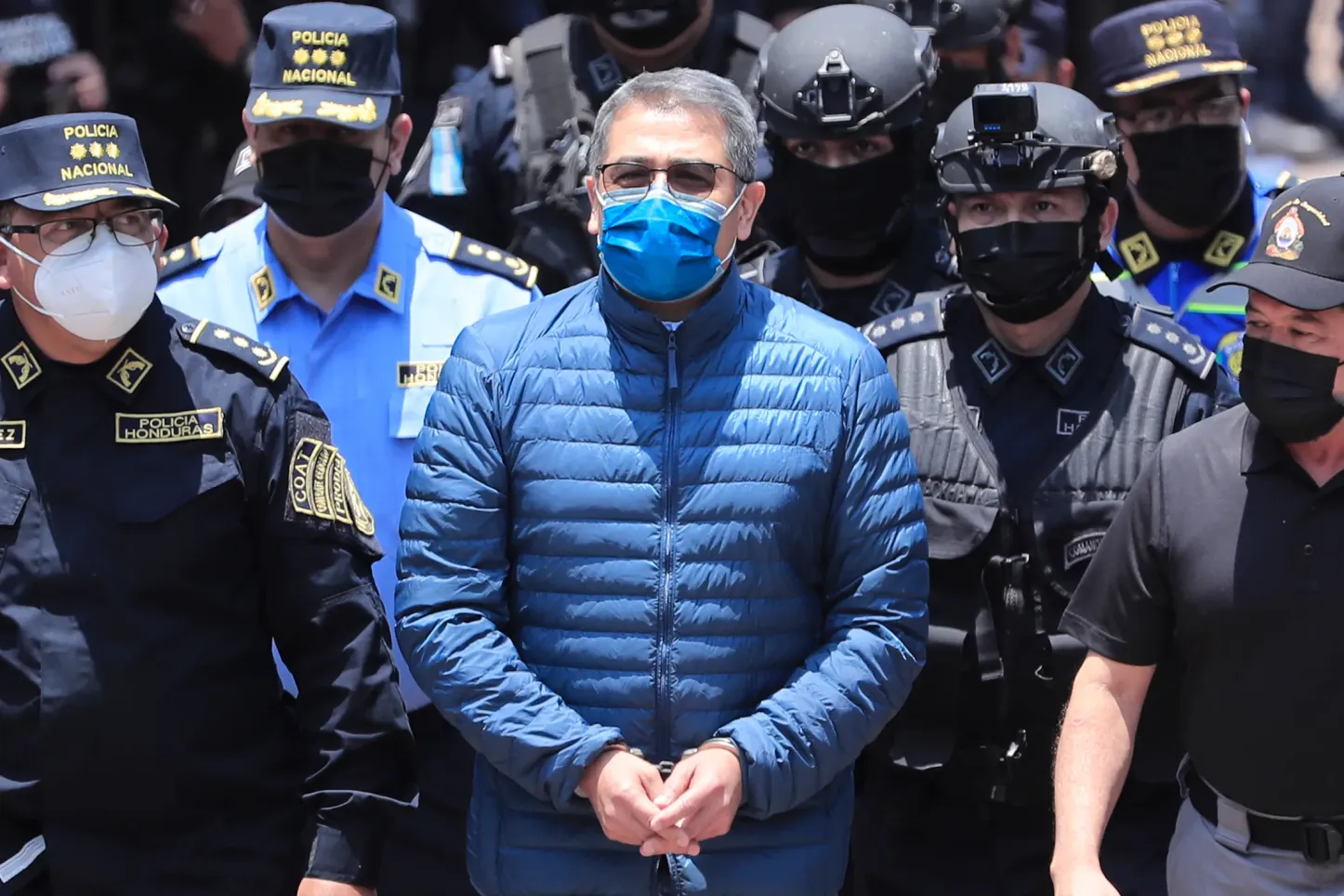
On Nov. 29, Donald Trump pardoned Juan Orlando Hernández, former president of Honduras and convicted drug kingpin. Apparently being a narco-president is just fine in Trump’s book, as long as you’re loyal to the whims of the United States. This is, of course, consistent with decades of U.S. policy of militarized drug war, which has seen federal agencies not stop but rather participate directly in the smuggling of drugs and weapons across the continent, playing kingmaker to wars between cartels and relying on them to also crush political dissent against U.S. interests.
In his trial in 2024, Hernández was found guilty of participating in a conspiracy, using the support of cartels to come to power, and then using his office to traffic weapons and drugs across the country, all while maintaining a loyal relationship with the government of the United States during the Obama and Trump I administrations. Prosecutors further accused Hernández of arranging the murders of rivals. His brother, Tony Hernández, participated in the conspiracy was convicted for organizing said murders.
In other words, Hernández has been convicted, with evidence, of the crimes that the Trump administration has baselessly accused Venezuelan president Nicolás Maduro of committing. But Hernández walked free from jail on Dec. 2, and the U.S. invasion of Venezuela seems poised to begin at any moment. The difference between these two results is that Hernández was a loyal ally to U.S. imperialism, friendly to U.S. capital while entrenching religious conservatism, banning abortion and gay marriage among myriad other measures to increase the power of the evangelical groups and Opus Dei.
Maduro is no guardian of the Venezuelan working class. But he has nevertheless publicly defied U.S. authority, and Venezuela provides an economic lifeline to Cuba, a country which has itself drawn the ire of U.S. imperialism for decades, even while it abandons the remaining vestiges of the workers’ state that it once had.
The timing of the pardon also coincided with the presidential election in Honduras, with Trump vocally supporting Nasry Asfura, the right-wing candidate representing Hernández’s National Party, and threatening to retaliate against the country if Asfura did not win. [As we go to press on Dec. 3, another right-winger, Salvador Nasralla, has claimed a narrow victory over Asfura.] Trump is not subtle in his efforts to wield imperialist power to get his way. But to treat this as unusual would be to sweep decades of the U.S. hypocritically participating in the drug trade to better control Latin American politics.
Across El Salvador, Costa Rica, Panama, Colombia, Venezuela, Haiti, Honduras, Guatemala, Argentina, Bolivia, Ecuador, Peru and Mexico, CIA operations have set up networks of reactionaries of all stripes that have assassinated union organizers, plotted coups, fought leftist guerrillas, and trafficked drugs across borders, including the U.S. border. But support for these operations was not some sort of private CIA conspiracy, it was government policy from the executive to the judiciary, crossing every major law enforcement body in the process.
Perhaps the most well-documented example is that of U.S. involvement in Panama, as it involved both an outright invasion, and saw the deposed dictator Manuel Noriega stand trial in the U.S. and face the testimony of accomplices turned witnesses—a category that he arguably belonged to himself as a long-time collaborator with the CIA.
Proceedings from the trial revealed that among the reasons for Noriega’s capture and prosecution was the fact that he had been complicit in running drugs through Panama to the U.S. at the same time as money and military support passed to the Contras in Nicaragua. His ultimate fall from the good graces of the U.S. appears to have been partly precipitated by his change of loyalty from the Cali cartel—also revealed to be a major patron of the Contras—to instead favor the rival Medellín cartel. Following the U.S. invasion that deposed Noriega, contrary to the Reagan administration’s claim that this would halt the drug trade, Panama became an international logistics and finance hub for the Cali cartel, laundering and smuggling cocaine to markets around the world. The government of Panama remains mysteriously disinterested in prosecuting transparently rampant money laundering.
Far from stopping narco-states, the United States is one. Much as organized crime has always been used to attack organized labor, imperialist domination is well served by the rampant impunity of drug lords. Trump and other bourgeois politicians’ “tough on crime” act is a snake-oil merchant’s trick, selling a cure for a disease they brought to town, all while demanding capital punishment for working people while guilty presidents walk free.
Bibliography
Marcy, William L. “Narcostates: Civil war, crime and the war on drugs in Mexico and Central America.” (Lynne Rienner Publishers, Inc.) 2023
Scott, Peter Dale and Marshall, Jonathan. “Cocaine politics: drugs, armies and the CIA in Central America.” (University of California Press) 1998
Photo: Ex-president of Honduras Juan Orlando Hernández being extradited to the United States in April 2022. (Gustavo Amador /EFE)