
Trump’s Air Strikes on Nigeria Authorized by Dictator Bola Tinubu
Nigeria is the largest oil producer in sub-Saharan Africa, with an area equal to that of Venezuela and a population of 220 million, compared to Venezuela’s 28 million inhabitants. Nigeria has one of the highest population densities in the world. Last month, the country’s Minister of Health admitted that 850,000 children die every year due to treatable diseases. This figure is around 85 times higher than the total number of people that die every year due to lack of physical security. It is estimated that in Katsina state, half of all children suffer from chronic malnutrition and 10% suffer from acute, life-threatening hunger. Every day, millions of people have to search and struggle to find enough money to buy food for their children and other essential items. In these circumstances, it is no surprise that some people are forced to join armed groups, whether for robbery, extortion, or protection.
The wealth created by Nigerian workers has increased dramatically in the last 25 years, and continues to increase. The most recent GDP growth figures show that the Nigerian economy continues growing faster than many other countries. All of this wealth is being appropriated by the national and foreign bourgeoisie. Globally, between 2000 and 2024, the richest 1% received 41% of the increase in wealth, while the 50% poorest people earned only 1% of this wealth.
Reports from UNICEF and the World Bank consistently show that northern Nigeria is one of the regions with the highest concentration of out-of-school children in the world. Mass educational deprivation not only produces illiteracy, but also creates a population that is politically manipulable and economically expendable. In northern Nigeria, abandoned children become easy targets for recruitment into extremist movements, criminal gangs, and militias that sell protection; they are not motivated by ideology, but by hunger, exclusion, and desperation. Many others that are completely innocent become victims of collective violence and military operations due to crises that they neither caused nor understand.
Christmas Attack
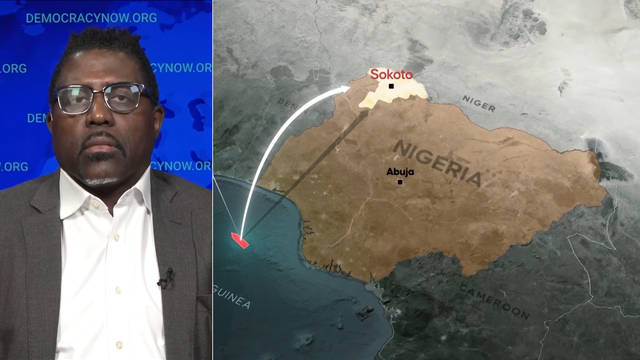
On Christmas there was an airstrike on a region of the Sokoto State ordered by Trump and supported by Bola Tinubu, the dictatorial leader of Nigeria. Twelve Tomahawk missiles were launched from ships docked in the Gulf of Guinea, off the coast of Nigeria.
Trump had already denounced the massacre of Christians on behalf of two so-called Islamic groups. After the agreement with the Nigerian president on Christmas Eve, the attack was carried out, which Trump confirmed on his social network Truth Social: “I have previously warned these Terrorists that if they did not stop the slaughtering of Christians, there would be hell to pay, and tonight, there was.” So, if the problem in Venezuela is drug-trafficking, in the case of Nigeria, the problem is the defense of Christians.
Trump’s brazenness became more evident when he congratulated the US Department of Defense for the attacks and ended by saying, “MERRY CHRISTMAS to all, including the dead Terrorists.”
Questioned about the possibility of new attacks, the Minister of Foreign Affairs of Nigeria, Yusuf Maitama Tuggar, said to the local station Channels TV: “It is an ongoing process and we are working with the United States. We are also collaborating with other countries.” It was Nigeria that provided the information to Washington, said Tuggar, adding that he had spoken on the phone with US Secretary of State Marco Rubio. “We spoke twice. We spoke for 19 minutes before the attack and then we talked again for five minutes before it began,” said Tuggar[1].
Trump’s threats and the target
The threats from Trump were supposedly directed towards Boko Haram, ISWAP, and smaller groups such as Lakurawa and Jenni. It turns out that all of these groups operate and have military bases in other states, while there are no reports that they have bases in Sokoto. However, the ultra-modern missiles were directed at and only struck the state of Sokoto.
The big question is, why attack Sokoto? Was it a mistake or intentional?
Trump and Bola Tinubu’s motives for the attacks
Although Trump and Bola Tinubu have different objectives, they are capitalizing on the issue of Boko Haram and ISWAP for their own political goals.
Bola Tinubu governs amid profound instability ca
used by the global economic crisis which forced him to eliminate fuel subsidies, resulting in accelerated inflation. At the same time, he has been facing different struggles, especially regarding the health sector, despite the resistance of the NLC and TUC trade unions. The anger of the masses is great, and the excuse of armed groups gives the government an important respite. For 16 years the government has been “trying” to defeat these groups, which helped Bola Tinubu’s group come to power in 2015.
Trump has another agenda. He has two immediate issues and another more strategic one. First he needs to deflect from the moral attacks he has been facing regarding the cases of pedophilia, and he uses the defense of Nigerian Christians to try to put on a front of Christian purity, while also taking advantage of the situation to make Islamophobic attacks. His other immediate interest is related to the fight against the gangs that divert oil produced by transnational companies that operate in Nigeria.
But we believe that the main target is not Christians nor oil theft, but the issue of Sahel. This is the strategic issue for Trump and US imperialism.
The dispute over Sahel
The successful expulsion of French imperialism and the Operation Barkane troops created the conditions for the emergence of Russian imperialism. At first the Russians relied on the private military contractor (PMC), Wagner Group. After Wagner Group was dismantled, Afrika Corps emerged but with even more control from the Russian State that was already heavily involved with the Ukraine War. With the difficulties imposed by the Ukrainian resistance, there was undoubtedly a decrease of Russian participation in the Sahel and, at the same time, European imperialism increased financing of Islamic groups to attempt to regain the ground lost by its companies.
This decline in Russia’s participation allowed Islamic groups to advance on the territory of Mali, even approaching the gates of Bamako and, worse still, preventing the flow of goods during the peak of the gasoline shortage in October and November. According to Assime Goita, the group Jama’atNusrat al-Islamwal-Muslimin (JNIM) which is tied to Al-Qaeda, “During the escort of tanker truck convoys, people are dying; there are ambushes on the roads and the tanker trucks catch fire with people inside, burning them to death.”
This is the window of opportunity that US imperialism sees to try to occupy the space as France leaves and Russian controls remains fragile.
European and US companies try to regain influence in Sahel
In Mali, the new mining code that has been in place since 2023, eliminates some tax and customs exemptions for mining companies, increases royalties, and allows Mali to increase its share in mining projects from 20% to 35%. The Loulo-Gounkoto gold mine has been inactive since January and under provisional administration by the government since mid-June. It is one of the largest mines in the world and makes up 14% of Barrick Gold’s revenue.
The mine closure also led to the arrest of the company’s executives, which has offered 370 million to suspend the process. The audit conducted by Goita’s administration forced Barrick Gold to collect US$1.2 billion.
This story is no exception. Anglo-American industries, among other companies, has undergone similar processes in Mali.
In Niger, uranium has been mined since 1960 by the French state-owned giant Areva, later renamed Orano, in 2018. The mining contract was set to end in 2007 and Areva was the only uranium mining operation in Niger, through its subsidies, Somair and Cominak (the latter closed in 2021 due to depletion of reserves). Annual production was 3,093 tons–around 10% of the global supply, 30% of French consumption, and almost a third of Niger’s exports. Under Mamadou Tandja’s administration, in 2018, Niger began to demand a fair share of more than 5% of the revenue from uranium mining.
Areva not only mined uranium, but also financed Taureg rebels in the north. In July 2007, the government expelled the head of Areva in Niger, Dominique Pin, and his security chief, Gilles Denamur.
In 2022, Niger granted a mining license in Azélik to China Nuclear Engineering and Construction Corporation (CNEC). This was Beijing’s first access to uranium mining in sub-Saharan Africa. In fact, today, Orano (formerly Areva), faced with the expulsion of French imperialism, is practically out of Niger, and Rosatom, the Russian state-owned electric company, has begun negotiations with Niamey to extract uranium for Russian capital.
The mining issue and the defense of transnational corporations, especially regarding uranium, is in our view the central issue behind the air strikes in Nigeria, near the Niger border.
There are other elements that indicate that the US intends to get involved in the conflicts in the Sahel. For example, the Trump administration has banned citizens of Mali and Burkina Faso from traveling to the US. In response, both countries announced equivalent measures that will take immediate effect.
Down with US aggression against Nigeria!
Out with Bola Tinubu, dictator and ally of US military imperialism!
For the self-determination of the peoples of the Sahel!
[1] Intervention militaire des États-Unis au Nigeria : Abuja évoque d’autres frappes dans le cadre d’opérations « conjointes ». www.jeuneafrique.com/1752718/politique/intervention-militaire-des-etats-unis-au-nigeria-abuja-evoque-dautres-frappes-dans-le-cadre-doperations-conjointes/


