
Trump Resumes the War to Try to Back Out of Failure
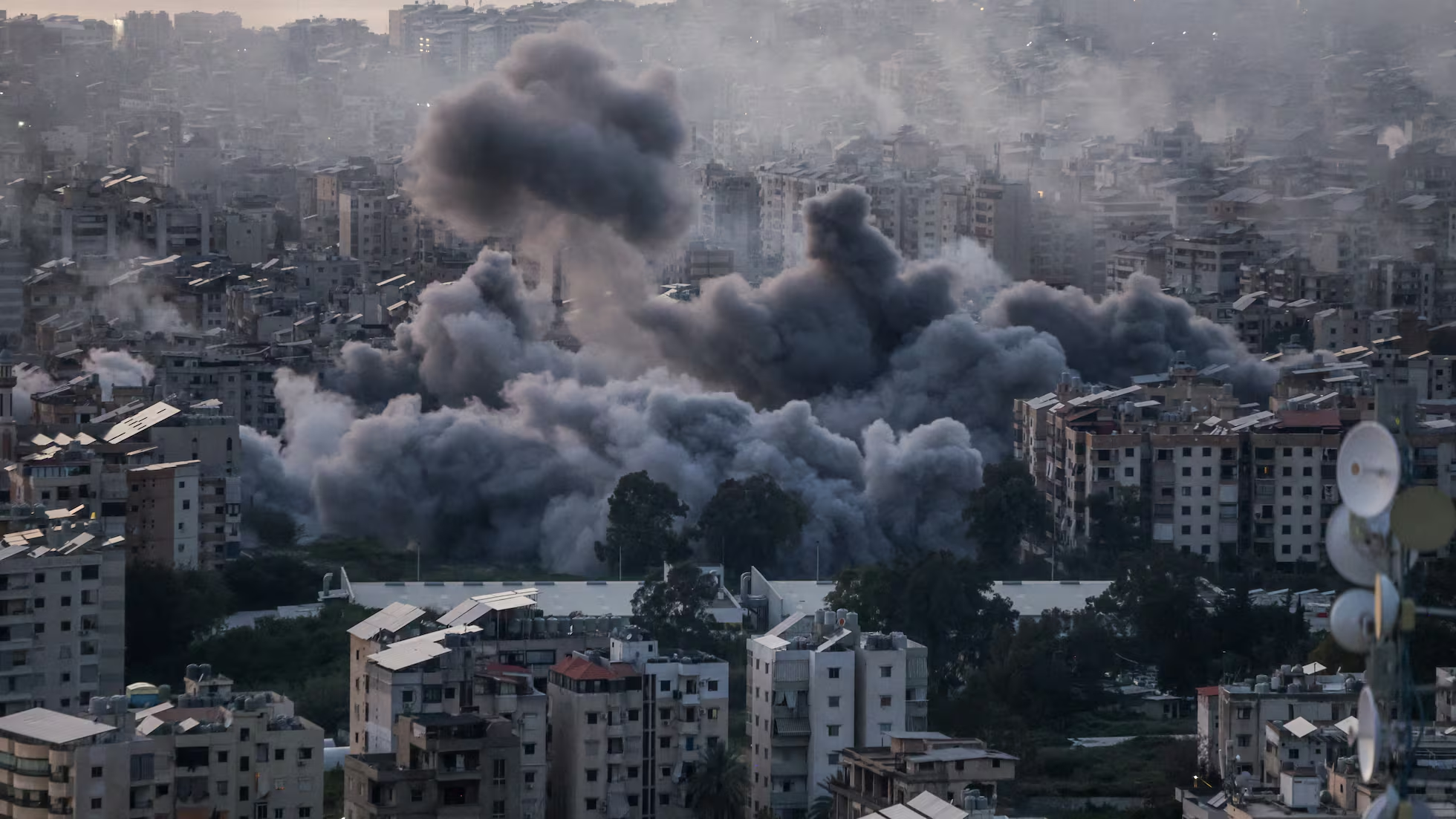
On April 17, President Trump signed a memorandum of understanding that, among other things, established a ceasefire on all fronts, including Lebanon, and guaranteed that Iran would allow ships to pass through the Strait of Hormuz without charging any fees for sixty days. In exchange, U.S. forces suspended the blockade of Iranian ports and the sanctions on Iran’s oil exports.
This memorandum favored Iran and reflects the failure of the aggression. However, Trump seeks to reverse that defeat, and the resumption of aggression may deepen it.
First came Lebanon. Trump imposed a neocolonial agreement on Lebanon that guarantees Israeli forces a permanent presence in the south of the country and the “right” to respond to any “threat.” The Lebanese government is obligated to disarm the militias linked to the Lebanese political party Hezbollah. In other words, Israel outsourced the fight against Hezbollah without withdrawing from Lebanese territory.
Next, Trump decided to attack Iran after three ships that disobeyed Iranian orders to cross the strait via the northern route were fired upon with warning shots on July 7. In addition, Trump once again blocked Iranian ports and reimposed sanctions on oil exports.
The U.S. attacks have continued over the course of eleven days, though they have not yet reached the scale of the thirty-eight-day offensive that began on February 28. However, Trump is threatening to significantly intensify the attacks, focusing on the south of the country, on Kharg Island, and on Pickaxe Mountain near Isfahan, where he believes 400 kilograms of 60% enriched uranium are stored.
Despite the military attacks and threats, the Iranian regime refuses to amend the Memorandum of Understanding in a way that would harm its interests. And it has responded to U.S. military aggression by attacking U.S. bases in several countries in the region.
Big Tech, oil companies, and the military-industrial complex profit from the war
On July 21, Secretary of Defense Pete Hegseth appeared before the U.S. Congress to request an additional $70 billion for the aggression against Iran. He stated that the war has already cost $37.5 billion. The total requested budget amounts to $1.5 trillion.
Part of those funds will go to major tech companies such as Palantir, Microsoft, Amazon, and SpaceX, which hold multibillion-dollar contracts to develop military systems integrated with artificial intelligence for military operations, surveillance, communications, logistics, data storage, and cloud computing services.
Another portion is allocated to the military-industrial complex, which includes companies such as Lockheed Martin, a manufacturer of aircraft, missiles, and helicopters; Raytheon (now RTX), producer of the Patriot and Tomahawk missiles; Northrop Grumman, manufacturer of the B-21 bomber; General Dynamics, which produces nuclear submarines, destroyers, and Abrams tanks; and Boeing, which specializes in military aircraft.
In addition to these corporations, oil companies such as ExxonMobil, Chevron, ConocoPhillips, and Occidental Petroleum are reaping billions of dollars in profits thanks to a nearly 50% increase in the price of oil, which pushed the price of a barrel of Brent crude to $90.
However, the closure of the Strait of Hormuz is dealing a severe blow to the global economy as a whole and is reflected in projections of slower economic growth, higher inflation, and higher interest rates—with an impact on both the stock prices of large corporations and the wallets of the working class.
That is why there are divisions among different sectors of the U.S. bourgeoisie: some support escalating the aggression to subdue Iran, while others criticize Trump’s decision to start and resume the war.
There are also divisions among the imperialist powers. While the United States, as the hegemonic imperialist power, continues its aggression against Iran—which led to the closure of the Strait of Hormuz—European imperialism seeks an end to the conflict and the reopening of the strait, since its economy is one of the hardest hit by high oil and gas prices.
The war’s unpopularity could lead to an electoral defeat
Since its election, the Trump administration has already faced several crises of popularity.
His friendship with the pedophile Jeffrey Epstein created tensions within the base of his right-wing MAGA (Make America Great Again) movement. Although less reported by the media, Epstein also maintained close ties with the Zionist leader Ehud Barak and, possibly, with Israeli intelligence through the father of his partner, the British media mogul Robert Maxwell, who died under circumstances that were never fully clarified and was buried on the Mount of Olives in the presence of the Israeli prime minister and Mossad leaders.
Another crisis stemmed from the actions of the immigration agency ICE, which Trump has turned into a political police force. The climax was the popular uprising in Minneapolis following an ICE raid and the killing of two protesters, which forced Trump to withdraw that force from the city. More recently, ICE killed two immigrants during violent police operations.
Now the focus of the crisis is the war and, in particular, its impact on inflation. The Trump administration’s unpopularity should be reflected in October’s midterm elections, leading to the loss of the majority in the House of Representatives.
To mitigate a potential defeat, Trump is resorting to gerrymandering, making it harder for the poorest sectors to vote through restrictions on mail-in voting and stricter requirements for proof of citizenship, as well as making false allegations of voter fraud.
Iran Fights to Secure Control of the Strait
U.S. and Israeli aggression posed an existential threat to both the Iranian regime and the country itself. However, after thirty-eight days of intense daily bombardment, Iran survived and secured control of the Strait of Hormuz, giving it a deterrent advantage over its enemies that it did not previously possess. In this way, the regime—now dominated by the Revolutionary Guard—strengthened its image among the segment of the Iranian population that supports it.
Nevertheless, internal repression continued after the massacre of more than 20,000 protesters on January 8 and 9 of this year. Even during the military aggression against the country, the government hanged eighteen protesters and imposed a disproportionate sentence on singer Parastoo Ahmadi, who appeared without a headscarf in a video and was sentenced to seventy-four lashes and two years of being barred from appearing in public or leaving the country. This week, Al Jazeera published an article about the closure of bars and cafes in downtown Tehran for admitting women without headscarves.
Such repression alienates a large segment of the population and weakens the country’s defense. The overwhelming majority of the Iranian people reject U.S. aggression. Historical experience shows that the population has never benefited from any foreign invasion. Furthermore, the attacks targeted both military and civilian objectives, putting the lives of the population and the country’s economic and social infrastructure at risk.
The position of the PSTU and the IWL-FI is clear. We stand in the same military trench as the Iranian regime against U.S. aggression, without this implying any political support for the regime. We advocate for the release of political prisoners and an end to executions. We understand that, to ensure the country’s defense—particularly in the event of a ground invasion—it is necessary to arm the population, especially in the south, on Kharg Island, and in the vicinity of Mount Pickaxe.


