The World Cup of chauvinism
Despite its long history of blatant corruption and general disdain for human rights, FIFA seems set to outdo itself this month, kowtowing to Trump and pretending that all is well, even as the U.S. government directly interferes with World Cup proceedings, in addition to more generally completely undermining any spirit of fraternity or internationalism that global sporting events are supposed to inspire. The World Cup may be one of the most beloved sporting events the world over, but the contours of its organization and presentation are firmly dominated by the priorities of capital and imperialism. Consequently, the World Cup is now Exhibit A of the fragmenting post-World War II liberal order that is crumbling under the weight of economic and political pressure.
The ugly business of the beautiful game
Long before this latest World Cup, FIFA has been practically synonymous with corruption and a craven, capitalist drive for profit at all costs. This is now the third World Cup in a row to be explicitly overshadowed by concerns about its hosts’ flagrant lack of care for human rights and/or the sovereignty of other nations, with Qatar’s use of slave labor for stadium construction and Russia’s then-relatively-small-scale seizure of Crimea from Ukraine raising concerns about their suitability. And of course, the rot runs much deeper than just the choice of who gets to host the World Cup, with foul play running from match-fixing to doping at some of soccer’s most legendary clubs.
Soccer under FIFA’s global reign is capitalist big business, and like all capitalist big business, it prioritizes profits for the owners at the expense of both the athletes who do the work of playing the game, and the general public that hopes to follow their exploits.
Nevertheless, there is something to be said about the degree to which this current World Cup’s scandals fly in the face of the message it is supposed to be sending to its audience. Soccer may be administered as a big business, but its international appeal rests on its accessibility, with generations of working-class and poor children needing only a single ball and something to serve as a goal post marker to be able to play it on the street. Many of soccer’s most famous legends, including Pele and Maradona among others, themselves grew up in poverty, and celebrated their origins even after gaining world fame.
While brutal, corrupt, and a site of abuse, the international club system is also seen as a ticket to a better life by economically disenfranchised youth around the world. The World Cup itself typically gives the people of its participating nations an opportunity to root for their countries and enjoy a global spotlight that otherwise is rarely extended to non-imperialist countries. The Trump administration’s open disdain for these countries’ participation, together with their broader anti-immigrant, nativist policies, are a slap in the face for most of the World Cup’s audience.
Whose idea was this anyway?
There is a further absurdity, of course, which is that this year’s World Cup was supposed to be unprecedentedly internationalist, with Mexico, Canada, and the U.S. making a joint bid to host the tournament between the three countries. Despite originally being a project proposed by Trump during his first administration (the bid was filed in 2017), the international hosting now comes into direct contradiction with Trump’s policies of border militarization (Trump probably didn’t imagine he would be in office in 2026 at the time).
Where prior scandal-ridden hosts have gone above and beyond to ensure that the business of the tournament itself proceeded unimpeded, waiving immigration processes, toning down on virulent domestic propaganda, and allowing visiting fans a lot of leeway, the U.S. seems intent on making this World Cup as unwelcoming as possible. Whether it’s long queues at the border crossing, unexplained visa cancellations, or interference with fan ticket allocations, the priority here is “America First.”
Perhaps the most egregious example of this so far is the refusal to allow entry for Omar Artan, an award-winning referee from Somalia who was supposed to help adjudicate the tournament. As a decorated referee widely seen as representing not just Somalia but all of Africa, Artan can credibly claim to be one of the most trusted people in the whole world, but that did not save him from being subjected to 11 hours of grilling by U.S. border guards, and ultimately deportation on nebulous charges of affiliation with terrorist groups. The response of FIFA leadership was to tell the world to “chill.”
Of course, FIFA has been more than willing to respond with punitive measures against unsatisfactory hosts when it is the rich and powerful complaining: in 2023, FIFA banned Indonesia from hosting tournaments in response to the Bali Province governor’s decision to refuse to provide lodging to a team representing Israel. FIFA is thus perfectly capable of reorganizing events in order to switch hosts and allow participants’ participation, as long as it’s for the benefit of an apartheid-state client of imperialism.
The U.S. co-hosts, for their part, have worked to enable the exceptionalist stance of the United States, and have done little to respond to its flagrant disrespect for everyone interested in the tournament. Not that many U.S. residents will be attending the matches either, with eye-watering ticket prices starting above $1000 and running far higher; news reports note that thousands of tickets remain unsold and expected tourism booms are failing to materialize. While that economic shortfall is already disastrous on its own for the local bourgeoisie, it also points to a broader failure: FIFA may play the role of providing bread and circuses to help mollify the world and distract the working class from its troubles, but what good is a circus we can’t afford to enter, and where the main act of the show is a middle finger to most of the audience?
Meanwhile, more agitational fuel is provided by the spectacle and farce of the obstacles facing the Iranian team’s participation in the tournament while the U.S. has carried out a war of naked aggression against Iran. While the underdog story of traveling against the odds to the heart of the imperialist war machine attacking their country has certainly already won support and sympathy for the Iranian team internationally, this dynamic is likely to encourage many in the U.S. to root for them as a way to express disapproval with the U.S. invasion and Trump’s government more generally (and it bears noting that the further Iran reaches in the tournament, the more logistical and PR headaches there will be for the U.S. government).
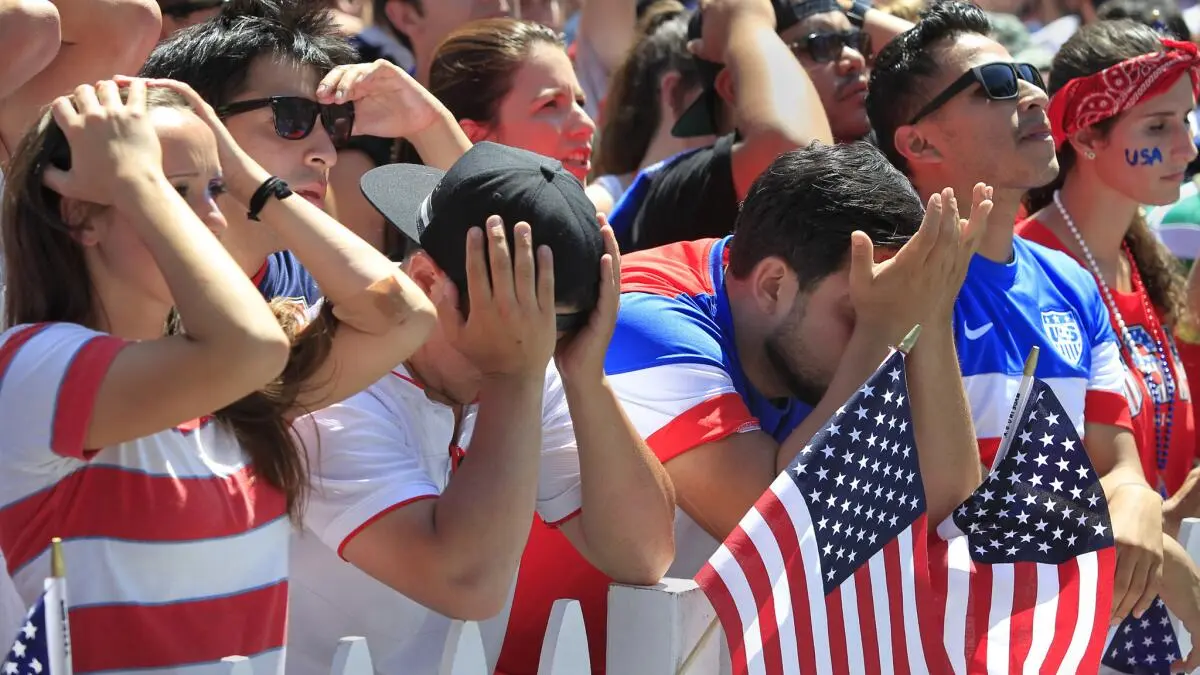
While rooting for semicolonial nations to win against the imperial hegemons is a time-honored tradition for leftist sports fans, the general domestic dissatisfaction with Trump and his bellicose patriotism (not to mention the oddly Evangelical Christian branding this year of the United States men’s national soccer team [USMNT]) is likely to push many U.S. residents to root for anyone but their home team. Traveling around the country as the opening matches kicked off on nearly every TV screen, you were more likely to see people sporting Mexico jerseys than U.S. ones, in addition to a sampling of every other competing country to have a local immigrant community; in the San Francisco Bay Area, it was the Jordanian team’s supporters driving a loud, flag-and-keffiyeh-clad motorcade up and down El Camino Real. Even businesses seem to be getting the memo: while Dick’s Sporting Goods was all about the U.S. Olympic teams during the Milan-Cortina Olympics at the beginning of the year, shoppers entering a Dick’s store in the U.S. today are more likely to be greeted by videos building hype for the German, Argentine, or Brazilian national teams, as opposed to the USMNT.
Class struggle continues in extra time
The World Cup and the massive urban construction projects associated with it have also been an important flashpoint for workers fighting against exploitation and tyranny. Service workers at Los Angeles’s SoFi stadium threatened to strike shortly before the beginning of the World Cup, demanding security assurances against ICE and improvements to pay and working conditions. While a tentative agreement was reached on June 9, it specifically includes a provision allowing workers to walk off the job if there is any ICE presence at the stadium during the World Cup; these workers are fighting on the frontlines against Trump’s immigration policies, taking concrete action where FIFA would rather just look the other way. Hotel workers in Philadelphia have made similar demands, while still threatening to strike during the FIFA games if negotiations over a new contract are unsatisfactory.
Social movements in Mexico have used the occasion of the World Cup to draw attention to government negligence and impunity even as the country goes into full-swing axolotlization (bright murals depicting the native axolotl salamander) to make the country more appealing to visitors. Teachers marching to demand repeals of austerity pension programs have been shot at with tear gas; the ammunition may not be as deadly as the bullets that massacred students on the eve of the 1968 Olympics, but it is nevertheless munitions being fired by the same Mexican state and regime, once again lining its weapons against the people.
For true sports internationalism
While the reality of international sports under capitalism is marked by exploitation, injustice and imperialism, there is nevertheless a kernel of internationalist sentiment in organizing a global sporting event that invites the participation of teams from all over the world.
In the past, international working-class organizations organized their own tournaments as an alternative to the capitalist (and in some respects, aristocratic) Olympics and World Cups, with the social-democratic Socialist Workers’ Sports International and the Comintern-led Red Sports International organizing several international sporting events in the 1920s and ’30s to rival the Olympics. While sectarianism limited the reach of these events (and the USSR would discontinue the Red Sports International following the Stalinist purges of the late 1930s), they nevertheless provided a glimpse of an alternative celebration of international sport that centers the working class in clear opposition to the prerogatives of imperialism.
Today, workers’ organizations internationally are in a much weaker position, and generally lack the base of proletarian sports clubs (and/or the Soviet workers’ state) that made these events feasible in interwar Europe. No group today was in a position to convene an alternative World Cup that could credibly challenge the authority and reach of FIFA and its capitalist patrons. Building an international sports culture that truly is of and speaks to the working class requires us to first advance politically and organizationally.
The first step today is to accompany and replicate the organizing being done by the service workers at SoFi stadium and elsewhere, who have stood up to and denounced the myriad injustices of the World Cup, and mustered the power of their class position and organization to refuse the imposition of ICE terror. It is only by building this sort of political power and organization that our class will be able to assert its own vision of sports internationalism, and order FIFA and its Trumps, Blatters, and Infantinos off of the playing field once and for all.
Photo: Allen J. Schaben / Los Angeles Times