The death of Osman Hadi, and the situation in Bangladesh
While Hadi's killers remain unknown at large, his death and that of other student leaders are a sign of the strengthening of reactionary forces as well as an instigator for further violence
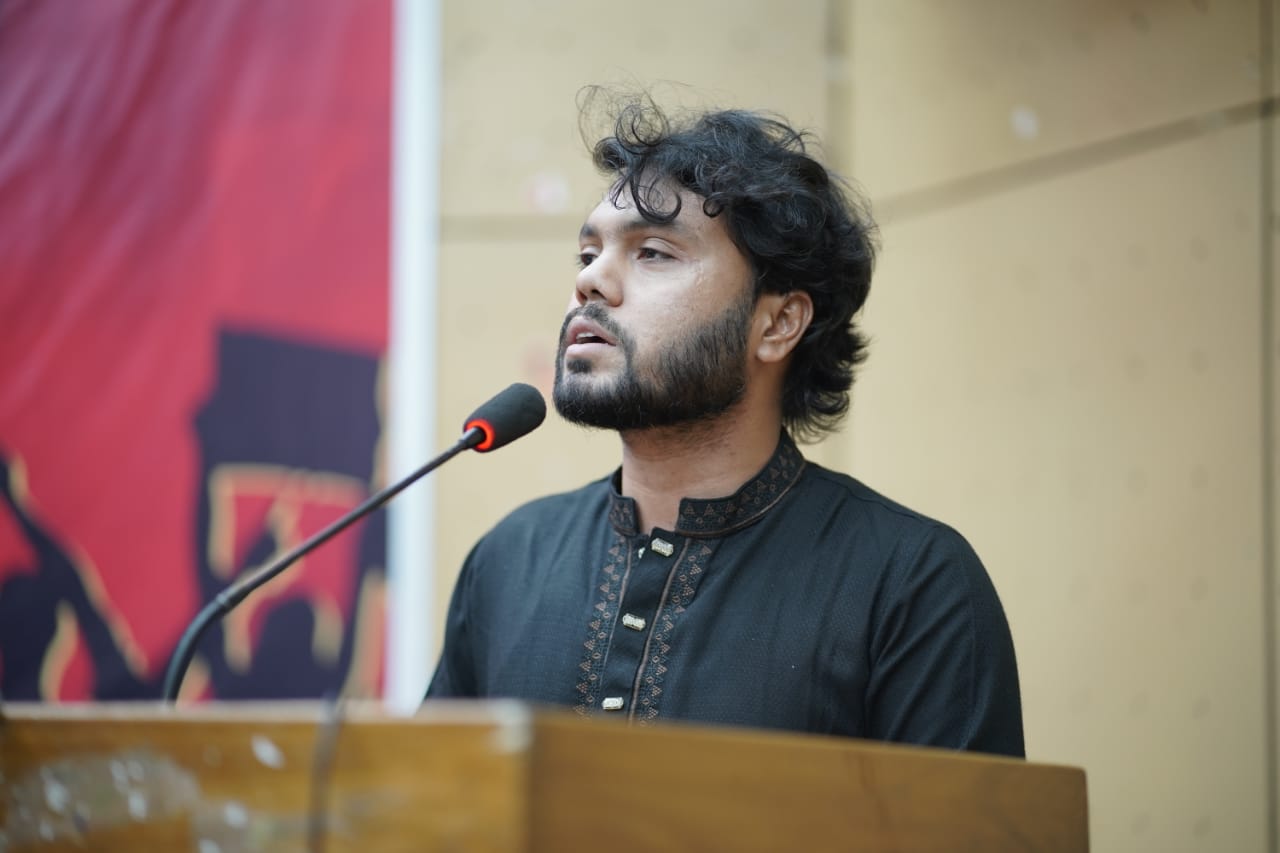
On the 12th of December, the founder and leader of the Inqilab Moncho, and a key leader of Bangladesh’s July uprising 2024, was shot. He would die from his injuries a week leader, in a hospital in Singapore. His assassination has sparked the largest mobilization since the fall of Sheik Hasina’s government in August of 2024.
It isn’t known who killed Osman Hadi, but among the suspects are members of the now underground Awami league, Indian spies, or even people linked with the Jamaat. Suspicions pointing towards an Indian hand grew stronger when it was found out that the assailants fled to India after assassinating Osman Hadi. Whatever be the case, the death of Hadi has sparked widespread anger, not just against India but also against the incumbent interim government led by Mohammed Yunus.
These protests have seen several reactionary right wing organizations joining the mobilization under a wider agenda of opposing India. Organizations like the Jamaat-i-Islami and its student union have grown in strength since being rehabilitated by the interim government. Over the course of the protests which unfolded on Hadi’s death, several cultural institutions like the Chayanaut were vandalized. In the lead up to these protests, reactionary elements attacked folk singers called Bauls, allegedly for singing blasphemous songs.
The July uprising was not a reactionary Islamist movement, even if it had a powerful component of protesters who were Islamists. The present upsurge in reactionary attacks on minorities and Bengali cultural institutions is not a conscious extension of that uprising, but the result of one of its chief failures, and primarily the failure of the present technocratic interim government ruling Bangladesh.
The Bangladesh July uprising in context
Between 2009 and 2024, the Awami League ruled Bangladesh with an iron grip. Sheik Hasina was virtually the dictator of Bangladesh, presiding over an economy in the throes of foreign capital, being run like a sweatshop for the benefit of textile corporations.
At the heart of this system was a heavily militarized police and paramilitary force loyal to Sheik Hasina. She sought to legitimize this dictatorship by focussing her terror on right wing parties like the Jamaat and BNP (Bangladesh Nationalist Party). The liberation war was invoked to punish her political opponents on the right, while cornering any competition from progressive leftist forces. In time, the liberation war would be rewritten and mythologized until it appeared less a war of the Bangladeshi people and more a campaign of the Awami League.
For as long as there was some economic progress and people would find jobs, resentment against Sheik Hasina’s rule was pacified. This ended in 2020, when the COVID pandemic shook world capitalism, destroying whole economies, and striking at the economic core of Bangladesh, its heavily export dependent textile sector.
Suddenly unemployment and joblessness became a problem. Adding to its woes, the Russo-Ukrainian war brought turmoil to global oil and food supplies. Bangladesh and many other countries were on the receiving end of the inflationary pressure from these developments. Sheik Hasina’s economic model was crumbling, and with it her political power.
Sheik Hasina won the 2014 elections in a landslide, largely because there was no one to oppose her. The elections of 2019 and 2024 were repetitions of this pattern, where Awami League bullying prompted the BNP to boycott elections, leaving the field open for the Awami League to walk back into power uncontested. These sweeping electoral victories hid the burgeoning resentment against the Awami League government. All that was needed was a spark to set the tinderbox on fire. That spark came in the form of the ham-handed imposition of the new job reservation system which ensured 30% of all government jobs for the descendants of liberation war fighters.
In the context of widespread youth unemployment and worsening economic conditions, this was intolerable. Making the situation worse, was Sheik Hasina herself implying the students protesting against this were ‘Razakar’, referring to the pro-Pakistan collaborators who fought against Bangladeshi independence.
The protests were unlike anything that the Awami League had faced, they were subjected to severe repression. Efforts to roll back the reservation policy were too little too late. The protests seemed unstoppable, it came to a point where real power fell to the streets rather than in the corridors of parliament or the party offices of the Awami League. The protestor’s charge on the parliament was the last decisive moment, the army would not stand by Sheik Hasina, she was whisked away in a military aircraft to India.
This was the end of the 15 year rule of Sheik Hasina and the Awami League, but it was not certain what would replace it. The protests mimicked many democratic uprisings throughout the 21st century, the Arab Spring, and more recently the uprising in Sri Lanka. These ‘leaderless’ movements consummated without any political or economic programme often fell to opportunism, to confusion, or opened the door for more organized reactionary forces to fill the political vacuum.
Soon after Sheik Hasina was ousted from power, an interim caretaker government was formed. Mohammed Yunus, the Nobel Prize winning banker, famous for his micro-finance bank, was invited to lead this government. Suffice it to say, the U.S.-educated technocrat was fully pro-capitalist. This was proven in most concrete terms when he allowed police firing on striking garment workers in Dhaka. Under him, the new government was oriented in a definitively pro-capitalist direction.
Though Yunus was not a reactionary himself, he quickly realized that his government had no social base to work with, unlike the Awami League which historically had the support of the Bangladeshi bourgeoisie, large sections of the police, the bureaucracy, the security apparatus, and minorities. Yunus pivoted to the most popular force that was not linked with the either mainstream parties of the BNP or Awami League, namely the Jamaat. It was not long after the interim government was formed that the Jamaat was rehabilitated and legalized. At the same time, the Awami League had its activities curtailed.
In the year since the interim government was formed, Bangladesh remained in a state of flux. While power no longer remained in the streets, old political equations no longer held ground. New parties, like the National Citizens Party, and the Inqilab Moncho were formed, while previously marginalized right wing forces like the Jamaat-i-Islami have grown in popularity.
At the same time, left parties remain marginalized in their reach and influence. Without the institutional backup and resources that right wing and Islamist parties can wield, the left cannot match them, not without international solidarity, and the widest most active support of the working class and youth. On the other side, independent liberal secular forces, mostly led by progressive petty bourgeois and student groups, don’t have the institutional support or mass base to challenge the organizational power of the Jamaat.
Thus, a combination of objective and subjective conditions have given rise to the present situation, where reactionary Islamist forces are growing in strength, feeding off the anger of the masses towards Indian hegemony, the Awami League, and the general state of affairs created by Bangladeshi capitalists.
Who was Osman Hadi ?
Osman Hadi was the son of a madrassa teacher, born in 1993 he grew up in the world that many Bangladeshis of his generation did. This era was dominated by the two bourgeois parties of Bangladesh, the Awami League and the BNP. The rule of the BNP and its right wing coalition ended in 1996, and their second term ended in 2004. Since then, Bangladesh’s political system has been shaped by the Awami League, Sheik Hasina, and growing Indian political, economic and cultural influence.
Osman Hadi had been educated in a madrassa and found work in a private university, this made him distant from the main centers of student politics, which is in the public educational institutions. Hadi’s political views were formed by the conditions of his upbringing, and he was not alone in this. Many in the youth equated secularism with the dictatorial rule of Sheik Hasina and the Awami League, Hadi was one of those youth.
Sheik Hasina’s rule focused on suppressing Islamist student politics, devaluing madrassa education, and suppressing Islamic organizations, regardless of their views. For a generation that was detatched from the legacy of the struggle against military dictatorship of the Ershad era, and the liberation war, the Islamists no longer evoked a sense of dread that could keep legitimizing the Awami League’s repressive regime. All the while, resentment against the repressive rule of the Awamie League under Sheik Hasina kept growing, it reached a boiling point in the July movement of 2024. During these protests, Sharif Osman Hadi came into his own as an organizer.
Though he had sympathies towards Islamic organizations, he distanced himself from the Jamaat and other reactionary Islamist forces. His politics was far more moderate. However, his sympathies ensured that he would be just as distanced from secularism and the working class. As a key organizer of the July protests Hadi grew in popularity among the Bangladeshi youth.
When the NCP was formed, Hadi formed his own independent organization, the Inqilab Moncho. They led the charge against the Awami League, following the ouster of Sheik Hasina. Their campaign was a key reason why the Awami League was banned from participating in the upcoming elections, and had their activities curtailed. It isn’t without reason that people suspect that he was killed by the Awami League.
On the 12th of December, unknown gunmen fired upon him in a drive-by shooting, he would die from his wounds about a week later while being treated in a Singapore hospital. His killers are still at large, and it is suspected that they have escaped into India via the Meghalaya border. His death angered the youth of Bangladesh, and sparked a massive mobilization pitted against India and the interim government which has so far failed to bring the killers to account. An unfortunate by-product of this mobilization, was the strengthening of reactionaries. Lumpen elements attacked cultural institutions throughout Dhaka, and razed the remaining parts of Sheik Mujibar Rahman’s house.
Hadi’s death comes at a time when other NCP leaders died under suspicious conditions. Jannat Ara Rumi died on the 17th of December, found hanging in her hostel room, reportedly being forced to take her life. Md Motaleb Sikdar died five days ago on the 23rd of December. These suspicious developments come about soon after the declaration of the new election dates. Bangladesh will go to polls in February of 2026, and the situation only continues to worsen.
Attacks on Hindus and cultural institutions
One of the most glaring instances of mob violence took place on the heels of the protests over Hadi. A Hindu garment worker in the town of Mymensingh was caught by a mob, beaten to death and lynched. His corpse was burned on a tree in the middle of a highway, in full public view, his burning was recorded.
This happened shortly after cultural institutes like the Chhayanaut and Udichi were ransacked in Dhaka. Both these institutes were centres of secular learning, both of them were important repositories of knowledge for traditional Bengali cultural knowledge. This was not the first time that a secular cultural institute was attacked, the famous folk musician Rahul Ananda’s historical house in Dhaka was ransacked and burned by reactionary-minded lumpens in 2024, at the height of the July movement.
Attacks on Hindus in Bangladesh have been growing since the July movement, and are a direct consequence of reactionary forces being legitimized, while secular progressive forces remain stagnant or marginalized. Hindus and other minorities have largely been organizing themselves to defend against attacks and pressure from reactionary forces, large protests in Sylhet and Chittagong in 2024 show this.
The attacks on Hindus have been downplayed or outright dismissed by the caretaker government, while India has tried to use this to pressure Bangladesh diplomatically, in addition to pressuring Bangladesh economically. India’s pressure tactics have only fueled more hatred among Bangladeshis towards it, reactionary forces have often conflated India and Hindus, something that the present ruling party of the BJP asserts as well.
Since its coming the caretaker government has struggled to build up state forces. The police and paramilitaries like the RAB (Rapid Action Battalion) were far too integrated into the Awami League government. Following Sheik Hasina’s ouster, the police and paramilitaries were subjected to non-stop attacks and purges. The caretaker government under Md Yunus have largely failed to rebuild policing in Bangladesh. The state remains weak, the army remains uncooperative, and the public remains angry. This situation has allowed lumpen elements to gain in power, mob violence, looting and gangsterism is becoming rampant. Politically linked lumpens, reactionary mobs linked with the Jamaat are re-emerging in strength and minorities, particularly Bangladesh’s 13 million strong Hindu minority, have been at the receiving end of their violence.
The situation now
In the first six months since the July uprising there have been 258 separate incidents of violence against Hindus. The objectives behind these attacks vary from political vendetta, to local anger, or outright communalism. The caretaker government has tried, unsuccessfully, to hide its failure to keep any semblance of law and order in Bangladesh. Having no real social base to operate on, the caretaker government pivoted to the Islamist parties of Bangladesh. Thus receiving their opportunity, they reorganized and built back up, feeding off the anger against the Awami League government, and using the momentum of the protests to attack not just the symbols of the Awami League government, but questioning the liberation war and secularism.
More often than not, anti-Indian sentiment is conflated with anti-Hindu sentiments. The July uprising and its fighters were not limited to Islamists, a large contingent were secular and progressive in their thinking. However, the scattered and disunited progressive forces were unable to combat the organizational effectiveness of the Jamaat and like-minded Islamists, organizing through their networks of Madrassas and well-funded Islamic organizations.
Despite the clear presence of Islamists in the organization of protests, the movement and the protests were clearly progressive. The overthrow of the Hasina regime had helped restore some democratic functioning, it led to the abolition of oppressive tools of repression like the RAB, and brought important concessions for garment workers. Up to 48,000 criminal cases against garment workers who protested in 2023 were dropped, and new legislation has been passed which will make union formation easier. The victory for the garment workers were won despite the openly pro-capitalist Yunus government, because of the progressive momentum unleashed by the July uprising.
The students were at the core of the political processes that unfolded from the month of August of 2024. The new NCP was the political expression of this process, formed as a centrist ostensibly liberal party that intended to restore bourgeois democracy in Bangladesh. The new party had all the makings of a directionless petty-bourgeois formation, while progressive it lacked any coherent direction on how to build back Bangladesh. Their participation in the caretaker government resulted in several progressive laws being passed, particularly in the realm of IT and labour.
However, without an active intervention in the political process by the working class, any movement led by a party like this was vulnerable to fall into the arms of reactionaries. In the same way that the Anti-Corruption protests which took place in India in 2011-2012 eventually paved the way for a BJP victory, the NCP may as well pave the way for a Jamaat victory in Bangladesh.
In the most recent political developments, a new political party has emerged in Bangladesh, the first being openly representative of Hindus, the BMJP (Bangladesh Minority Janata Party), while the NCP has joined the Jamaat led eight party alliance. The political trajectory of Bangladesh is now firmly reactionary, even though the situation remains fluid. The political vacuum that exists is fast being filled by newly empowered right wing reactionary Islamist forces while the working class remains as absent as before from the political scene.
The tasks for Bangladesh remain fundamentally unchanged, the country was formed on the basis of a progressive struggle for self-determination. The Bangladeshi struggle was a consequence of the pre-revolutionary upheaval in Pakistan, in many ways it was also the realization of the revolutionary processes emerging within Pakistan. The three most critical demands of this struggle were 1) The secular state 2) Democratic rights 3) Independence from imperialism.
The collapse of the revolutionary process in Pakistan, and the present situation in Bangladesh proves in the most definitive manner, that only through a socialist revolution can these goals be achieved.
Sources
https://www.thedailystar.net/news/bangladesh/politics/news/ncp-ldp-have-joined-jamaat-led-alliance-ameer-shafiqur-rahman-4067816
https://www.instagram.com/p/DSPW-6ejBvh/?img_index=10
https://www.firstpost.com/world/bmjp-a-new-party-is-born-in-bangladesh-representing-the-plight-of-hindus-other-minorities-13963386.html
https://www.thehindu.com/news/international/258-communal-attacks-in-bangladesh-in-the-first-half-of-2025-bangladesh-minority-religious-group/article69797365.ece
https://timesofindia.indiatimes.com/world/south-asia/chittagong-sees-biggest-rally-in-months-by-hindus/articleshow/114605254.cms