
On the Mecca Defense Pact
In the days before October 7th 2023, Israel announced before the United Nations, their plan to link the economies of India and Europe through the nations of the Arabian Peninsula. This ambitious plan was titled the India-Middle East-Economic-Corridor (IMEC). This plan placed Israel as a central node of a trade corridor connecting the economies of India, the Gulf monarchies and Europe through Israel. A vital part of the plan was the so-called Ben Gurion canal which cut through a sizable chunk of Gaza and Israel’s Southern border with Egypt’s Sinai. This was the zenith of efforts by the United States and the Gulf countries to normalize ties with Israel and construct a self-regulating political structure in the region, one that acknowledges Israeli occupations of Palestinian land, Israeli apartheid and secures the tyrannical gulf monarchies with Israeli security, Indian labour and European money.
Not long after this announcement, Hamas conducted a bold attack on the Israelis from Gaza, breaking out of the blockaded settlement and nearly reaching the western boundary of the Palestinian West Bank. Israel’s retaliation against Gaza resulted in one of the deadliest genocides of the 21st century, one that is still ongoing. In the aftermath of the war on Gaza, the IMEC fell apart. None of the gulf countries were willing to stand beside Israel, its pretensions of peace and humanity as the “only democracy in the middle east” crumbled to bits. The war exposed Israeli lies and hypocrisy, but it also forced the Zionist zealots in charge of the country to continue the war, partly to maintain its own survival and in part to maintain the unsustainable apartheid occupation of Palestine, and partly to realize the agenda of a Greater Israel.
The last two years have seen Israeli aggression reach hitherto unforeseen heights. Soon after it went to war on Gaza, Israel expanded the war to Lebanon and then to Iran. The much-touted IDF is still struggling to complete the occupation of Gaza, it has largely failed to break through and destroy Hezbollah, and now it has succeeded in dragging the United States into a war with Iran. Israel itself is in a military quagmire, and it has now pulled the United States directly into it.
What is the Mecca Defence pact?
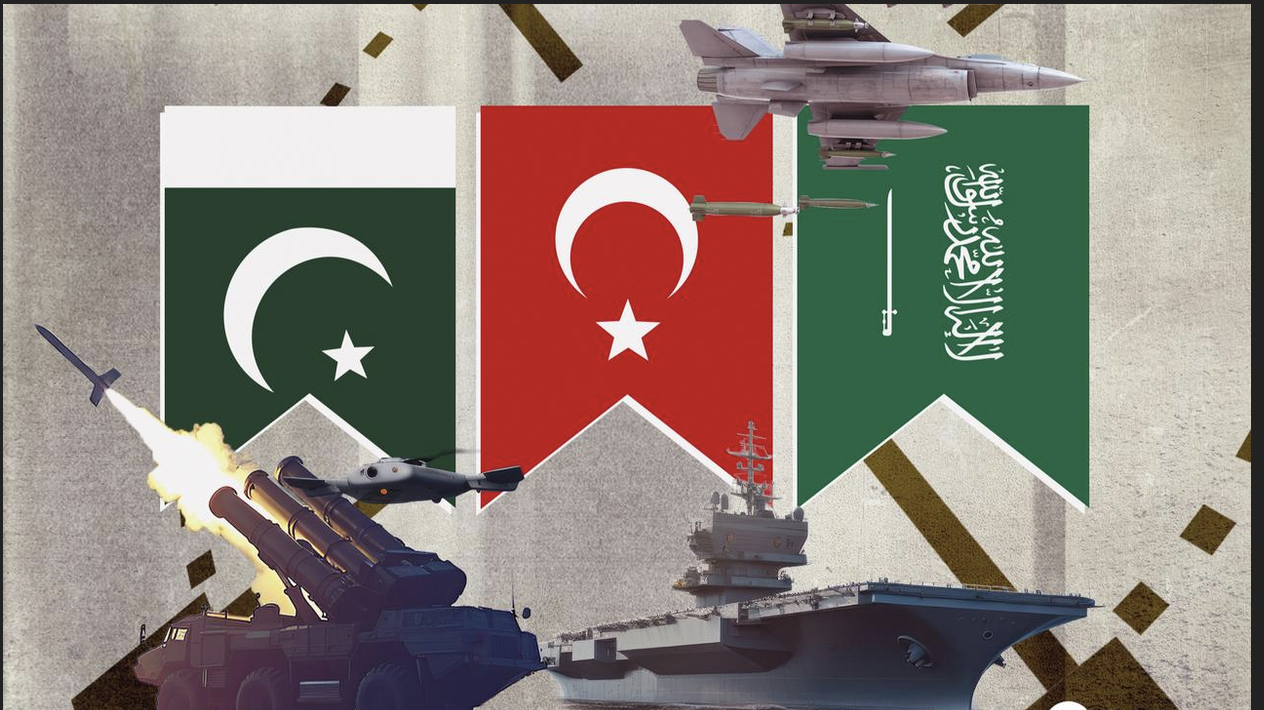
The Gulf states, which had till now relied largely on the security guarantee of the United States, began seeking alternatives. The search for alternatives has led Saudi Arabia, the most powerful and independent of the Gulf monarchies, to construct an alliance with Pakistan and Turkiye. Today, the pact has been formalized as the Mecca pact, involving three countries. This new defensive military alliance, grants Saudi Arabia security under Pakistan’s nuclear umbrella and the security of Turkish military power. For Turkiye and Pakistan, it provides reach into the wider Arabian Peninsula while for Pakistan, allows it both economic support from the Saudis (in exchange of military security) and potential for economic and diplomatic blackmail against India, as Saudi Arabia remains one of India’s main oil suppliers.
The principles of the alliance draw inspiration from NATO. An attack on one is an attack on all, the pact’s provisions would trigger only if one of the member states is attacked. As such, the pact is designed primarily to be defensive in nature, being invoked only if one of the member states is attacked by another power. Before Turkiye joined the pact, there was an already existing defensive pact between Saudi Arabia and Pakistan. The first test of the Saudi-Pakistan alliance emerged when Afghanistan and Pakistan engaged in a brief border war. The two countries are still locked in hostilities with no peace in sight. Pakistan was left largely to itself against the threat from Afghanistan, with Saudi Arabia’s role limited to negotiating a ceasefire.
The next challenge to the pact came in the form of the Houthi attacks. For the better part of the last fifteen years, the force led by Ansarallah, more popularly known as the Houthis, have been locked in a bitter civil war against the Saudi backed government based in Hadhramaut. The Saudi military intervened directly against the Houthis, only to find themselves in one embarrassing defeat after another.
Their performance in the Houthi conflict has proven that the Saudi military is little more than a royal guard force, incapable of a serious war. It possesses some of the latest weaponry, but they do not know how to use it effectively. In such a situation, the Saudi state is locked into a strategic dependence on other powers. Till recently, the Saudis were entirely reliant on the United States of America as the security guarantor, but with the United States locked in its own quagmire in Iran, the Saudis can no longer rely on the United States for protection. Their search for alternatives has led them to the Mecca Defence pact.
The Houthis have found themselves emboldened after having successfully enforced a near blockade of the straits of Bab El Mandab during Israel’s war on Gaza. For the last two years, the Houthis have been building their forces and find themselves perfectly positioned to strike against a weakening Yemeni government army. In recent days, as of writing this article, a Houthi offensive has captured the entire stretch of Western coastal Yemen, and a chunk of territory formerly belonging to the STC, another rebel faction backed by the UAE. The critical port of Aden is now in danger of being surrounded, while the Houthis begun attacks on strategic Saudi oil infrastructure like the East-West pipeline.
With this dire threat from the Houthis, it remains to be seen whether the Saudis will invoke the provisions of the Defence Pact, or whether the pact will remain a dead letter with neither aligned country joining in defence.
Saudi Arabia and the Gulf monarchies
The Gulf nations run large economies buoyed by oil exports. They are all without exception dictatorial monarchies, with royal control over strategic resources. Yet, the oil exports themselves are tied to the US dollar, a part of an unwritten security arrangement with the United States of America. In exchange for the security cover given by the United States, the Gulf oil monarchies, would not deviate from the Petro-dollar, effectively tethering the economies of the gulf to that of the United States. This tether has come under strain under the rule of Mohammad Bin Salman, the present ruler of Saudi Arabia who wishes to assert autonomous power for the Saudis. Of all the Gulf nations, the Saudis are perhaps best positioned to achieve this on account of a larger territory and population, however it suffers the same fundamental weakness that is common to gulf monarchies.
The capitalist development in the Gulf nations is largely a result of the United States’ and the United Kingdom’s quest for securing a strategic oil reserve. Some states like the UAE are the product of British reorganization and imperialist strategy.
Much of the Gulf’s oil infrastructure is the result of early American investment, companies like Aramco were built by American capital. It was not until the former ruler of Saudi Arabia, King Faisal, nationalized the company to build Saudi Aramco that the kingdom was able to have its own oil industry. Rather than risk a wider war and instability over oil, the United States preferred to ensure strategic military control over the Gulf nations, as long as oil was connected to the dollar based financial network. In practice, it would mean the US would act as the security provider for the Gulf nations, while the Gulf nations held control over their oil.
The result of this arrangement, was ensuring the Gulf monarchies never had any serious military capabilities. Their vulnerability was fully exposed by Saddam Hussein’s invasion of Kuwait in 1991, when the Iraqi army steamrolled over the tiny military of the Kuwaiti royal forces in a matter of hours. On the other hand US invasion of Iraq that year showed its power and commitment to the defence of the Gulf states and by extension its strategic oil resources. For about two decades, the US commitment to the security of the Gulf states ensured they would remain pliant spokes in the wheel of US imperialist hegemony. This was first destabilized by the US invasion of Iraq in 2003, and then further strained by the democratic uprisings in the Arab world.
The end of the US security architecture in the region was not an overnight transformation. The strain of American power caused by the Iraq and Afghan wars, the destabilizing effect of the regime change in Iraq, and the rise of China among other factors, added to the strain on American hegemony over the region. Political changes within Saudi Arabia pushed these developments further. The death of King Abdullah opened the path for King Salman to ascend the throne, his ascension was marked by a brutal purge of the royal family and erstwhile monarchist establishment.
Once in power King Salman not only perpetuated the reactionary monarchy, he also pursued a foreign policy which asserted autonomy from US imperialism. A key part of this strategy required hedging Saudi Arabia’s global position by improving relations with the Chinese as a counterweight to US influence. The other was quietly shoring up Saudi ties with Pakistan, while retaining economic relations with India. It must be noted, that Pakistan, India and Bangladesh are among the largest sources of labour for Saudi Arabia, and the rest of the gulf region with 7.5 million migrant workers from South Asia adding to its labour force. Most of this workforce is immigrant, and open to exploitation under the Kafala migrant labour system. Yet, without this labour force, the gulf economies would likely collapse.
During the first Trump administration, Saudi and the other Gulf states, especially the UAE, followed through with the Trump sponsored plan to normalize relations with Israel. The IMEC was the concrete outcome of this strategy, helped along further by the right-wing Hindutva government in India that is ideologically aligned with Israel. However, the attack by Hamas began unravelling these plans. Israel’s unhinged war on Palestine, Lebanon and attacks within the territory of the Gulf states (such as the assassination of Hamas leaders in Qatar), left the Gulf monarchies frightened.
Finding no advantage in normalizing relations with Israel, Saudi and the Gulf states embarked on a new strategy where they could create a security architecture independent of Israel and the United States. This was made all the easier once the United States under the second Trump administration brought out its new strategic vision. In this new National Security vision, the United States would focus primarily on the Pacific and the Western hemisphere, leaving a preferably self-regulating security system for West Asia and Europe.
In practice it has meant an American policy that is hesitant, confused and focused far too much on Israel for the United States to act decisively. The US navy has attempted to help escort ships through the Bab El Mandeb, when the Houthis began their blockade of Israeli shipping, to little effect.
The USA’s interventions have achieved little in terms of strategic goals, but caused a lot of damage to lives and livelihoods of the people in the region. They could not secure safe passage for Israeli trade through the Bab el Mandeb straits, nor could they defeat the Houthis, nor could Israel decisively defeat Hezbollah and they have yet to consolidate their conquest of Gaza. In the meantime, the Israeli economy appears to be heading towards collapse, kept alive entirely with the backing of the USA and India.
In this context, the Saudi plan for developing an alternative security structure, free from American hegemony becomes even more urgent. Their search brought them to Pakistan and Turkiye.
The Turkish presence in the Persian Gulf
Since the end of the Second World War, Turkiye shrugged off its neutrality in favour of joining NATO. This alliance placed Turkiye as a frontline state against the Soviet Union, while granting unfettered access to the imperialist alliance to the Bosphorus straits. Critically, it gave NATO leverage against the Soviet Union by giving them the option to close the straits of Bosphorus in the event of hostilities.
This geo-strategy remains relevant in a post-Soviet world, which must now deal with the rise of Russian imperialism. Turkiye for its part has fully exploited this position to negotiate a more privileged position within the NATO alliance. Turkish military power has grown, especially in the last 20 years. It is now the second largest armed force within NATO with foreign bases over many Eastern Mediterranean countries and along the Persian Gulf,. It also possess a military foothold in East Africa with its base in Djibouti. Under the bonapartist leadership of Recep Tayyip Erdogan, Turkiye has sought to present itself as the leader of the Islamic world.
In the last decade or so, Turkiye’s turn away from secularism and towards Islamism has become particularly sharp. This is not merely a domestic political maneuver, but has a clear geo-strategic agenda along with it. Neo-Ottomanism is increasingly becoming an inseparable part of the state’s foreign policy. Turkiye has specifically projected power over the former territories of the Ottoman Empire from North Africa to the Caucasus, and down South to the Horn of Africa. It equipped and sponsored Azerbaijan’s war on Armenia, it continues to intervene in the Libyan civil war, it has invaded Syria and seized territory, it freely armed Islamist rebels in Syria, while also hosting Hamas leaders. Turkish influence is being felt across North Africa and West Asia.
Turkiye hosts military bases on the Red Sea and the Persian Gulf (a military mission in Qatar). Both of these regions are now war zones. Turkish power and influence in the region is being tested while the Turkish economy suffers one of its worst periods of decline in recent years. The cost of ambition is beginning to bite Turkiye and testing its geo-strategy. In the midst of this, Turkiye has found another avenue to increase its influence in the region, by joining the Mecca Pact.
Until now, Turkiye has shown no signs of willing to commit to any war involving Saudi Arabia, and it is unlikely to do so if it goes against its political interests. Turkiye has to weigh many different interests at once, with the frail foundations of a stagnating economy being exhausted by Erdogan’s Bonapartism and political ambitions. For Saudi Arabia, Turkiye might be a good alternative to the USA, as it could simultaneously counter Israeli influence as well as project power in a realistic manner. However, Saudi Arabia has little leverage with which to convince Turkiye into joining in its defence, unlike Pakistan.
Pakistan in the Gulf
The Pakistani state subsists on the exploitation of its peripheral regions, in order to maintain a parasitical and privileged militarized elite. Pakistan has found itself in this unenviable position due to historical conditions stemming from the partition of the sub-continent. Pakistan is constantly forced to go into debt, just so that it may keep some degree of military parity with India, and maintain the parasitic military elite and bureaucracy.
Pakistani rule over Kashmir, Balochistan and the North West Frontier province resembles colonial rule where an authoritarian military bureaucracy governs over a subject people through force. Limited representation is often hypocritical bordering on farce. It is in every way, a prison house of peoples. Pakistani capital largely relies on land, agriculture and cheap labour, which it exports. It must allow for the ever-deepening exploitation of resources in occupied regions like Balochistan just so it may survive economically.
The role of Pakistan in the affairs of West Asia is not new. It is a key non-NATO ally of the US, it was and remains part of CENTCOM, along with all of the Gulf states. The Pakistani role in aiding the US invasion of Afghanistan was critical. During the 1970s Pakistani general Zia ul Haq played a critical role in assisting King Hussein of Jordan in the suppression of the PLO, resulting in one of the worst massacres of Palestinians in the history of the Palestinian struggle. Pakistan was also a critical component of the US strategy to contain the Soviet Union along with Shah era Iran, for which the CIA extensively supported the Islamist regime of General Zia. Pakistan was critical in arming the Mujahideen against the Soviet Union during the Soviet invasion of Afghanistan, and played a key role in helping the Taliban win power in Afghanistan in the 1990s, a war in which Iran, Russia and India were aiding the Northern Alliance.
Pakistan became the seventh nuclear-armed state in the world in 1998, a feat that it could achieve with the financial backing of Saudi Arabia (up to 60% of the project’s costs), and the tacit approval of the United States of America. The Saudis invested in the development of Pakistan’s military capabilities with the intent of benefitting from a potential nuclear umbrella for themselves. Today, the Saudis are seeking to cash in on their investment through the Mecca Pact.
The Saudis are seeking to expand their investments in Pakistan, with discussions of up to $25 billion in the energy and mining sector. They are specially focused on a large refinery project in Balochistan, and a stake acquisition of the Copper-Gold mine of Reko Diq. These investments are a lifeline for the struggling economy of Pakistan, which has been particularly affected by the pandemic, and repeated natural disasters such as flooding along the Indus River basin and more recently the droughts caused by the El Nino.
Pakistan too, is invested in Saudi Arabia. Much of its economy relies on remittances from migrant labour working in the gulf states, including Saudi Arabia. In fact, Saudi Arabia accounts for up to 25% of remittances coming to Pakistan, amounting to $9 billion. Defending this flow is not just a question of pragmatism but survival for Pakistan’s economy.
It wouldn’t be wrong to say that Saudi Arabia has a lot of leverage when dealing with Pakistan and many options for it to coerce Pakistan into joining its war. The wording of the Mecca pact is such that it could convincingly compel Pakistan to come to the defence of Saudi Arabia. Yet, Pakistan has been seen to hesitate. Saudi Arabia for its part did not come to the aid of Pakistan in its conflict with Afghanistan, despite a prior existing defence agreement. At the same time, Pakistan has been actively mediating between Iran and the United States during the duration of the Iran war. It can’t perform this role, while also appearing as a defender of Saudi Arabia, a nation that Iran attacked not too long ago. Neither can Pakistan maintain its strategic neutrality towards Iran if it commits itself to a war with the Houthis.
For Pakistan’s military elite, already besieged by revolts in Kashmir and Balochistan, the question of intervening to hold up a defence pact with Saudi Arabia, must be weighed against domestic concerns. The Pakistani military requires a democratic façade to justify its rule, it must pay heed to public sentiments. Joining a war on the side of Saudi Arabia, which would potentially open Pakistan to joining with an imperialist coalition, would be deeply unpopular among the Pakistani populace. For a nation whose people struggle for basic democratic rights, buying essential commodities and power, joining a far-off war would be the last thing on anybody’s priority. Undoubtedly, if the Pakistani military does want to join a war against the Houthis, it must do so against the wishes of its own people, and be ready to foot to bill of an expensive foreign intervention.
At the same time, if the Saudis push Pakistan with the economic leverage they hold, it might be hard for Pakistan to deny.
Our position on the war in Yemen
The revolutions across Arab countries in 2011 also affected Yemen. The uprisings known collectively as the Yemeni revolution began in January of 2011 and continued through the middle of 2012. It resulted in the overthrow of the pro-US and Saudi supported Saleh government. The Houthis were part of the revolutionary process. They took advantage of the political vacuum created by the revolution to seize control of key territories. Eventually, the Houthis would seize the capital of Sanaa and declare the dissolution of the Yemeni government.
Saudi led efforts to negotiate a settlement with the Houthis ended prematurely, with the Houthis flatly refusing what they claimed would be a division of Yemen. The assassination of their chief negotiator ended any chance of further talks.
In 2015 the capital Sanaa fell to the Houthis. It was at this point, that Saudi Arabia gathered a coalition to invade Yemen, beginning with airstrikes. The United States was an eager participant in this war, coordinating the air strikes and providing intelligence, but refusing direct participation. The Saudi-led ground operations were a disaster and resulted in nothing more than an embarrassment for the Saudi king. Once it became clear that the Houthis could not be removed from power through military means, the Saudis enforced a naval blockade with the help of the US navy, causing a manmade famine in the region.
Till now, Ansarallah has held firm, holding most of North Western Yemen, accounting for the most populous part of the country, while the Saudi backed government controls the South. With the collapse of the UAE-backed Southern Transitional Council (STC), there are only two factions left in the Yemeni civil war, the official Yemeni government in South and East Yemen, and the Houthi led government in North and West Yemen.
The religious component of this conflict can’t be ignored either. Ansarallah is modeled on the Lebanese Hezbollah, drawing from the Zaydi Shia of Yemen. Their programme and military organization draw heavily from the Hezbollah. As a Shia force in the region, they have the backing of Iran in terms of weapons and money. Iranian assistance to the Houthis achieves two geopolitical goals: on the one hand it acts as a second pivot against the Saudis from the South, while at the same time can allow Iran to seal off the only alternative to the straits of Hormuz.
In the context of the current ongoing war on Iran, the Houthis have played a decisive role attacking Saudi Arabia from the South while helping enforce a blockade on the Bab el Mandeb straits.
There is no mistaking the character of the Houthi rebels. They are a reactionary force, restricting women’s rights, enforcing discrimination against Jews, and running a dictatorial military authority over their territories. The Houthis have been known to use child soldiers as well. Their methods, however brutish, does not determine the morality of their objective.
From their very inception the Houthi insurgents were opposed to US imperialism and the hegemony of the Saudis over Yemen. The Saleh government was opposed not only by insurgent forces like the Houthis, but also the populace of Yemen for his corrupt and bonapartist rule. The Houthis face the arch-reactionary force in the Islamic world, the Saudi monarchy. They have also fought in solidarity with the Palestinians, being the only active military force to attack Israel in retaliation for the genocide on Gaza.
Though the Houthis are a reactionary force, they are engaged in a progressive struggle. The war imposed on Yemen, to overthrow the Houthi government, plays to imperialist interests. The war is being done for the interests of US imperialism, the Zionists in Israel and the monarchy in Saudi Arabia.
For the member countries of the Mecca pact and more importantly their people, the question is clear. It is not in the interests of the workers, peasants, youth of Pakistan and Turkiye to join Saudi Arabia’s war on Yemen. It is not in the interests of the people of Saudi Arabia to conduct this war on Yemen. The only beneficiaries of a wartorn and impoverished Yemen, subjugated to imperialism, are the Gulf monarchs, and their US backers. It will also be for the benefit of the Zionists in Israel, who would eliminate the only military force that can blockade them from the sea.
We who stand on the side of Palestinian liberation, cannot stay neutral on the matter of the war on Yemen, or the war on Iran. These three wars are today connected. Through the Mecca Pact, the Saudis hope to expand this war to drag in Turkey and South Asia into the crisis. We condemn the Saudis for their blockade and war on Yemen, and we condemn the US and Israelis for their war on Iran.
DOWN WITH US IMPERIALISM !
DOWN WITH THE SAUDIS !
DOWN WITH THE MECCA PACT !
NO IMPERIALIST WARS ! STOP ALL IMPERIALIST WARS !
HANDS OFF YEMEN ! HANDS OFF IRAN !


