
Marxism Today No. 22 Out Now
A journal of revolutionary theory
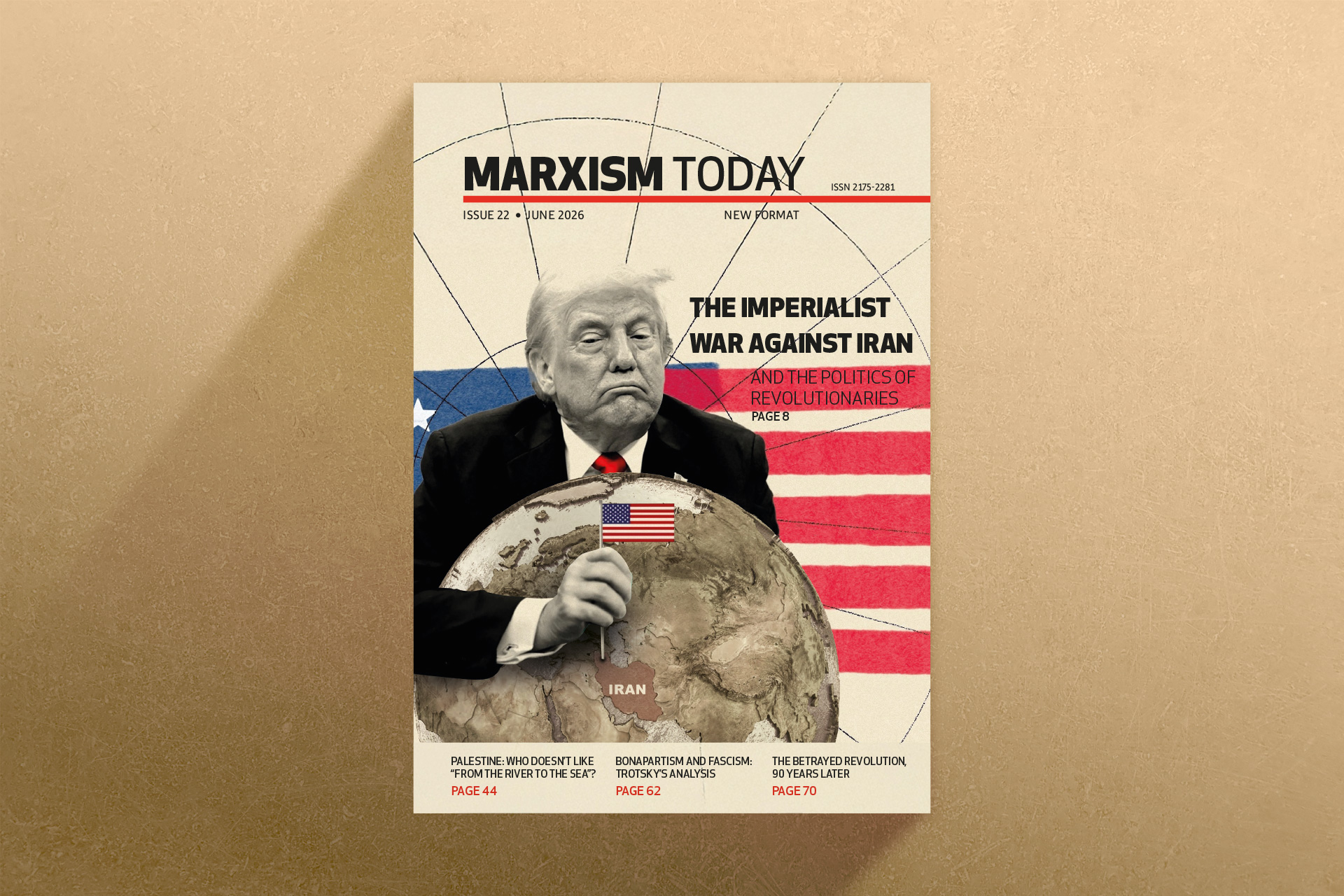
Marxism Today is available now, purchasable here. Below we reprint this issue’s first, introductory article by Francesco Ricci
A journal for militants and activists who are aware that “without revolutionary theory there is no revolutionary movement.” The theory Lenin was referring to in this famous phrase was Marxism, and the meaning of that statement is that socialist consciousness—that is, ultimately, the consciousness of the need to smash the bourgeois state in order to establish, through revolutionary means, workers’ power over the whole of society (the dictatorship of the proletariat), does not spring up spontaneously among workers; it is not merely a reflection of their material condition or of the class struggle itself that they are inevitably compelled to wage in a class-divided society. That consciousness must be “brought in from outside” the daily confrontation between the classes, and this is what justifies the need to build a revolutionary vanguard party that brings together the most advanced sector of workers and youth emerging from those very struggles.
Marxism Today aims to be one of the tools to assist in this fundamental “battle.”
We have reached issue 22 of the magazine, the third since we launched our new format. The goal—and we hope it’s been successful (but that’s up to the readers)—is to address both the main themes of the current class struggle with a theoretical rather than a merely chronological approach, as well as to delve into purely theoretical issues that we consider relevant for intervening in the class struggle.
This issue opens with an article by Fabio Bosco (Brazil) on the aggression of U.S. imperialism and Zionism against Iran. Bosco offers arguments that both critique several of the prevailing positions on the “left” and explain what we believe the position of Marxists should be. At the time of sending the magazine to press, we do not know what will happen next: but the fundamental reflections of the article, we believe, will remain valid in any case.
Also in the “Current Affairs” section, we find an essay by Laura Requena and Felipe Alegría (Spain) analyzing the crisis of the European Union within the framework of the crisis of the world order and the (for now) distant confrontation between the declining imperialism of the United States and the emerging imperialisms of China and Russia. After analyzing the industrial and technological decline of the EU, the text describes the rearmament race of European imperialisms and the costs of bourgeois policies that fall on the masses. Finally, the authors point out some of the elements of that program which, according to the IWL, would be necessary to build a workers’ alternative.
This section is rounded out by an article by Tony Stabile and Erwin Freed (United States) that seeks to debunk one of reformism’s new global myths: Zohran Mamdani, the (Democratic Party) mayor of New York, hailed by that entire “left” that harbors illusions about the possibility of governing the capitalist system differently.
The following section, “Debates and Controversies,” is also substantial. And what is more controversial on the left today than the characterization of the war in Ukraine? Tarás Shevchuk (Ukraine) analyzes the reality of that war, which began in February 2022 with Russian imperialism’s aggression against Ukraine.
This characterization of the war by our International has led us to engage in polemics not only with the positions of neo-Stalinist “campism,” but also with some organizations that define themselves as “Trotskyist,” as is the case (examined here) with the Current for the Permanent Revolution (formerly TF, organized around the Argentine PTS).
The theoretical and programmatic debate continues with an article by Jerónimo Castro (Portugal) on so-called “multipolarism.” What is meant (within the campist and reformist left) by “multipolarism”? What lies behind this new ideology? How can we apply the Leninist categories of imperialism and semi-colonies today? Castro argues why our International believes that we must not choose between supporting one imperialist bandit against another, but rather that we must fight them all.
This section concludes with an article by the author of this introduction on Palestine, the heroic Palestinian resistance (a topic often omitted in order to reduce everything to a mere humanitarian issue), and the positions of the Revolutionary Communist International, the name recently adopted by the IMT, led by Alan Woods. The RCI rejects the slogan “Free Palestine from the river to the sea” on the grounds that the national question is not a class question, and by invoking a united class struggle of the Palestinian and “Israeli” proletariat. In this article, we attempt to identify the connections between this position (which seeks to present itself as “more revolutionary”) and the revision it actually entails of the theory-program of permanent revolution.
Since the previous issue, we have launched a new section of the journal: “Basic Concepts of Marxism.” In this issue, it includes three articles.
An article by Florence Oppen (United States), titled “What Is a Revolution and How to Intervene in It?”, in which the author summarizes the Marxist conception of some fundamental concepts: what is a revolutionary situation? and what are the implications of the theory of permanent revolution? How do revolutionaries approach the question of revolutionary violence?
Fabiana Stefanoni (Italy), for her part, addresses another highly timely issue: what are fascism and Bonapartism? What are the differences between these two concepts, which are often misused in debate? The author re-examines the writings of Leon Trotsky, particularly those from the 1930s, demonstrating that they not only constitute one of the principal contributions to the development of Marxism but are also an irreplaceable tool for today. Trotsky’s analysis, summarized by Stefanoni, allows us to analyze today’s right-wing movements and explain the relationships between Bonapartism and fascism—and, within each, between the two main classes of society (the bourgeoisie and the proletariat) and the petty-bourgeois “semi-class.”
The section is rounded out by an article by Gustavo Machado (Brazil). Machado, who has for years run a popular YouTube channel in Brazil dedicated to spreading Marxism (Orientação Marxista), addresses here the topic of “fictitious capital” and, building on Marx’s analysis, explains why fictitious capital is not something “non-existent,” but rather a specific form of capital’s existence.
In the “Introduction to Reading the Classics” section of this issue, we find an article by Joana Salay (Brazil) who, marking the 90th anniversary of the publication of “The Revolution Betrayed,” one of Trotsky’s most important works, reviews the book’s main elements to highlight its extreme relevance for orienting ourselves today. What was the bureaucracy in the workers’ states? Was the restoration of capitalism inevitable? Returning to the present, Salay identifies a thread of continuity between the Stalinism masterfully analyzed by Trotsky and the positions of today’s “neo-Stalinism”—that is, the positions of political parties and groups that, more or less explicitly, revive certain “theoretical” positions of Stalinism.
This issue concludes with a section of reviews of several recently published books on Palestine and Marx.
We hope you enjoy reading this issue and ask that you help us distribute the magazine among your colleagues and fellow students.


