Iran represses mass protests; Trump renews threats of military intervention
Economic collapse and political repression drove mass demonstrations across the country
A broad wave of protests spread across all provinces of Iran since late 2025. The mobilizations grew to large proportions and began to shake the Iranian theocratic regime. The state’s response was violent and bloody repression.
On Jan. 13, Iran International, in a report printed in many major news outlets, said that sources in the Iranian government had revealed that at least 12,000 people were killed in the government’s crackdown on protesters. On Jan. 23, the Washington-based Human Rights Activists News Agency gave an estimate of over 5000 deaths, while reporting that another 9787 deaths were “under investigation.” Other sources have given even higher estimates.
On Jan. 22, President Trump said that an “armada” of U.S. warships has been directed to the area to possibly intervene militarily if Iran continues to kill protesters. “We have a lot of ships going that direction, just in case,” Trump told reporters on Air Force One, while returning from Davos, Switzerland. “I’d rather not see anything happen, but we’re watching them very closely.”
In response to the protests, the government intensified control over communications, cutting access to the internet and other sources of information. This repressive hardening expresses not strength, but weakness: a regime that can no longer govern and increasingly resorts to coercion and violence to preserve its authority. Even so, the popular revolt has not been completely contained, though it has waned in intensity
.
The bazaar breaks with the regime
A combination of explosive inflation, mass poverty, persistent inequality, and environmental collapse—exacerbated by international economic sanctions—has revealed the structural incapacity of the Iranian regime to guarantee minimum conditions of material survival for broad layers of the population, even in a country extremely rich in natural resources.
The immediate trigger of the protests was the collapse of the Iranian currency, the rial. In just one month, it lost around 20% of its value. Since mid-2025, the devaluation has reached 40%. The result has been a generalized rise in prices, a sharp decline in purchasing power, and the expansion of social insecurity.
The protests began in the Grand Bazaar of Tehran, a politically decisive fact. The bazaars are controlled by the commercial petty bourgeoisie, a social sector that sustained the regime for decades. This group played a central role in the 1979 Revolution and maintained a historic alliance with the Islamic Republic.
When this social layer begins to break with the government, it becomes evident that the crisis is not superficial. It is a deep crisis, in which the regime starts to lose the support of social sectors that historically guaranteed its stability. From the bazaar, demonstrations quickly spread throughout the country.
The slogans chanted by protesters express a qualitative political shift. Demands are no longer limited to prices or wages. Slogans such as “death to the dictator” and “woman, life, freedom” gain strength. Economic demands begin to merge with political and democratic demands, revealing how the struggle for material survival increasingly turns into a direct confrontation with the regime.
Iran has lived through a continuous cycle of mobilizations for nearly a decade. Since 2017, the country has experienced a sequence of struggles, including workers’ strikes, protests against fuel price increases, revolts over water shortages in Tehran, and, in 2022, the major explosion of the “Woman, Life, Freedom” movement following the killing of the young Kurdish-Iranian woman Gina Mahsa Amini by the so-called “morality police.” None of these crises was resolved. All accumulated and converged in this new national uprising.
Wealth for the few, poverty for the many
The Iranian paradox is clear and typical of semicolonial capitalist countries. According to the International Energy Agency (IEA), (source: https://www.eia.gov/international/overview/country/IRN) Iran holds the world’s second-largest gas reserves and the third-largest oil reserves.
Yet social indicators reveal a dramatic picture. With annual inflation at 39.5%, food prices rising 42.9%, and more than 36% of the population living below the poverty line of US$8.30 per day, the economic crisis is pushing millions of Iranians into the streets (data from the “World Bank, Poverty & Equity Brief: Islamic Republic of Iran,” October 2025, https://documents1.worldbank.org/curated/en/099640404212584734/pdf/IDU-707990f6-e879-41c1-9d99-c93c15967845.pdf). Annual inflation shows repeated spikes and sustained high levels in recent years, contributing to the erosion of purchasing power and rising social tension (https://www.statista.com/statistics/294320/iran-inflation-rate/).
Poverty is expected to continue to rise in 2026, reaching 38.8%, which would push another 3 million people into poverty. The minimum wage is extremely low, and high inflation has surged since 2017. Only 41% of the working-age population participates in the formal labor market. At the same time, one third of all wealth in the country is concentrated in the hands of just 1% of the population.
This 1% constitutes the Iranian capitalist class: a bourgeoisie deeply intertwined with the state, the repressive apparatus, the high clergy, and international capital. It is a class incapable of playing any progressive role. The regime does not govern for the majority of the population, but for this minority, using systematic repression as a central mechanism for preserving social order.
The working class enters the scene
A decisive element of the current conjuncture is the more organized entry of the working class and its organizations. Teachers, nurses, truck drivers, metalworkers, and miners have been protesting for months. This represents an extraordinary demonstration of courage in a country where independent organizations, especially trade unions, are criminalized.
The entry of the working class can qualitatively alter the conflict, as it introduces into the social struggle the only class capable of paralyzing the economy and placing the question of power into perspective. The most strategic sector is that of oil and gas workers. In December, around 5000 workers went on strike in Asaluyeh, the country’s largest energy hub, responsible for more than half of national income, according to the Red Flag website (https://redflag.org.au/article/iran-on-fire-rebellion-returns-to-the-streets).
When these workers stop, the heart of the economy is directly hit. This gives the energy-sector working class a decisive strategic weight and could open the objective possibility of revolutionary crises in the country. Not by chance, oil and gas workers played a central role in the 1979 Iranian Revolution, which overthrew the Shah and delivered a hard blow to U.S. imperialism.
Alongside actions on shop floors, universities have once again stood out as centers of political mobilization. Students protest against repression, authoritarianism, and gender inequality, expanding the social reach of the uprising.
This process confirms an important thesis of Leon Trotsky, according to which, in dependent capitalist countries, economic demands and democratic demands tend to merge, since the local bourgeoisie is incapable of resolving even the most elementary demands. The struggle against high prices leads to a struggle against the regime. The struggle for democratic rights leads to confrontation with the class that controls the economy.
Imperialism, sanctions, and the deepening of the crisis
None of this can be understood without considering the role of imperialism. Decades of economic sanctions have weakened the Iranian economy, disrupted productive chains, and impoverished the population. More recently, military attacks by the United States and Israel have destroyed military, civilian, and energy infrastructure, further deepening the social crisis.
On Jan. 23, the Trump administration announced a new round of sanctions against Iran, this time targeting at least nine ships within the “shadow fleet” of vessels that transport Iranian oil and petroleum products.
In addition, the United States has imposed 25% tariffs on countries that trade with Iran, which are set to accelerate currency devaluation, expand poverty, and worsen economic instability. Imperialism does not oppose the Iranian regime in the name of democracy, but rather disputes geopolitical and economic control of the country, intensifying exploitation and the suffering of the masses.
This process is not limited to Western imperialism. Other powers also participate in the plunder of Iranian wealth, beginning with China, the destination of around 89% of Iran’s oil exports. In this relationship, Iran is reduced to the role of a supplier of cheap raw materials, often sold at steep discounts due to oil embargoes, reinforcing the country’s subordinate insertion in the international division of labor.
It is a “campist” political line, widespread in some North American left organizations, to treat the Iranian regime as progressive simply because it comes into conflict, at certain moments, with Western imperialism, while turning a blind eye to Beijing’s support for Iran’s bloody dictatorship. The Iranian government does not act in defense of workers or democracy, but seeks better conditions to preserve its own material and political reproduction, based on economic exploitation and systematic repression.
In this context, it becomes clear that no progressive solution can emerge either from the theocratic regime or from pro-imperialist liberal alternatives, such as that of Pahlavi, nor from subordinate alignments with powers like China. Only the independent action of the working class, in alliance with oppressed sectors, can open the path toward a genuinely democratic outcome under the control of the country’s workers.
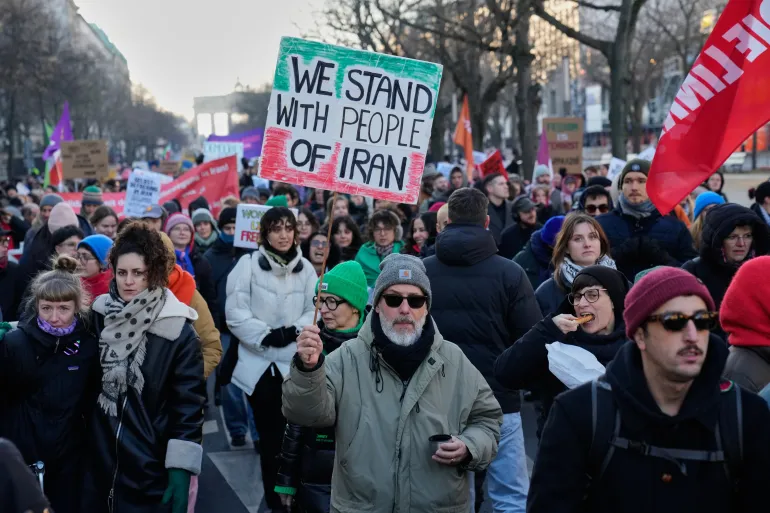
Photo: Demonstrators march in Berlin, Germany, on Jan. 18 in solidarity with the protests in Iran. (Ebrahim Noroozi / AP)
First published here by Workers’ Voice