Drug trafficking is a capitalist business, convenient for imperialist intervention
It’s no coincidence that Trump and Colombia’s far-right Uribismo agree on anti-drug policies of military repression and forced eradication of illicit crops, as well as the defense of “cooperation” between the United States and Colombia. They are united by their undeclared defense of the drug trade’s illegality, considering its profits represent 7% of the global GDP.
What is drug trafficking?
Beyond their adverse health effects, narcotics are commodities with exchange value—that is, they are produced for the market. Just as sneakers are commodities because they are produced for the market to be exchanged for money, so too are narcotics. Therefore, drug trafficking is a capitalist business, but illegal, making it one of the most profitable due to its extraordinary margins. It also serves as an excuse for imperialist intervention in producing countries, such as Colombia. This is not the case with legal commodities such as tobacco and alcohol, which also have harmful effects on human health.
Various sectors of the bourgeoisie benefit from this business. In Colombia, for example, it is the drug-trafficking, cattle-ranching, and landowning bourgeoisie. In addition to banks and companies that launder money from the business, there is also the military-industrial bourgeoisie that produces weapons for the wars that give rise to this economy. Finally, there are the “respected” capitalists who are in charge of supplies, including the glyphosate factories that spray the coca leaf, supposedly to eradicate it. In Mexico, a country that produces fentanyl, cartel capitalists profit. In China, capitalists profit from producing inputs for both fentanyl and cocaine.
Like any capitalist business, drug trafficking is protected by the state, even though it is illegal. Agents from institutions such as the armed forces, police, customs, and aviation officials (such as Aerocivil in Colombia) guarantee the business. One well-known example involves the accusations against Álvaro Uribe Vélez, who was the director of Aerocivil from 1980 to 1982. He approved licenses for the Medellín Cartel’s drug-trafficking air routes. The Minister of Justice, Rodrigo Lara Bonilla, later revoked these licenses. Bonilla was assassinated by the same drug cartel for challenging its businessmen, who included Pablo Escobar.
No crime goes unmeasured by capital
As an anonymous author of an article published in the British magazine The Quarterly Review in July 1826, states, capital is capable of committing any crime to make a profit.
This is true: Capital risks committing crimes, whether small or large, depending on the promised rate of profit from the production of a given commodity. If the rate of profit is 10%, capital will exploit workers to the point of destroying their health. However, if the rate is higher—for example, 3,000%, which is roughly the rate of profit on cocaine—capital will commit crimes against humanity, such as organizing paramilitary groups to carry out massacres. Santiago Uribe, the brother of former President Álvaro Uribe, was recently sentenced to 28 years in prison for this very reason. His cousin Mario Uribe was sentenced to seven years for aggravated conspiracy to commit crimes and for pacts and alliances with far-right paramilitary groups, specifically the United Self-Defense Forces of Colombia (AUC). The Uribes can be described as high-risk businessmen, not simply entrepreneurs.
Other crimes of capital include smuggling, human trafficking, financial speculation, fraudulent bankruptcies, and corruption of state budgets, among others.
Let’s look at the Quarterly Reviewer’s quote on the subject:
“Capital flees from turmoil and strife and is timid by nature. This is true, but not the whole truth. Just as nature abhors a vacuum, capital abhors the absence of profit or too little profit. As profit increases, capital becomes emboldened. Offer it a 10% return, and it will go anywhere. Offer it a 20% return, and it will be encouraged. Offer it a 50% return, and it will be positively reckless. Offer it a 100% return, and it will leap over all human laws. Offer it a 300% return, and it will risk anything, even the gallows. If turmoil and strife mean profit, then capital will stir them up. Proof: smuggling and the slave trade.” (P. J. Dunning, Trade Unions, etc., p. 36). Quoted by Karl Marx in Capital, chapter XXIV.)
For capitalism, whether business is legal or illegal is irrelevant. This system has only one moral code: that which governs profit. Anything goes if it is useful for making a profit.
Social production and private profit
In capitalism, there is a contradiction between social production and private appropriation of wealth.
Production is social because it involves large-scale cooperation between workers worldwide, as well as scientific knowledge and technology. These are products of the collective social and historical development of humanity.
However, although production is a collective and social effort, the means of production (factories, machines, and capital) are owned by a minority social class: the capitalist class and its private companies. Therefore, the surplus value generated by workers’ labor, converted into profit, is appropriated by private owners, not the collective of workers who produced it. This is no different in the case of narcotics because, as mentioned, these products are simple commodities, except they are illegal, which increases their profit margin.
The cocaine market
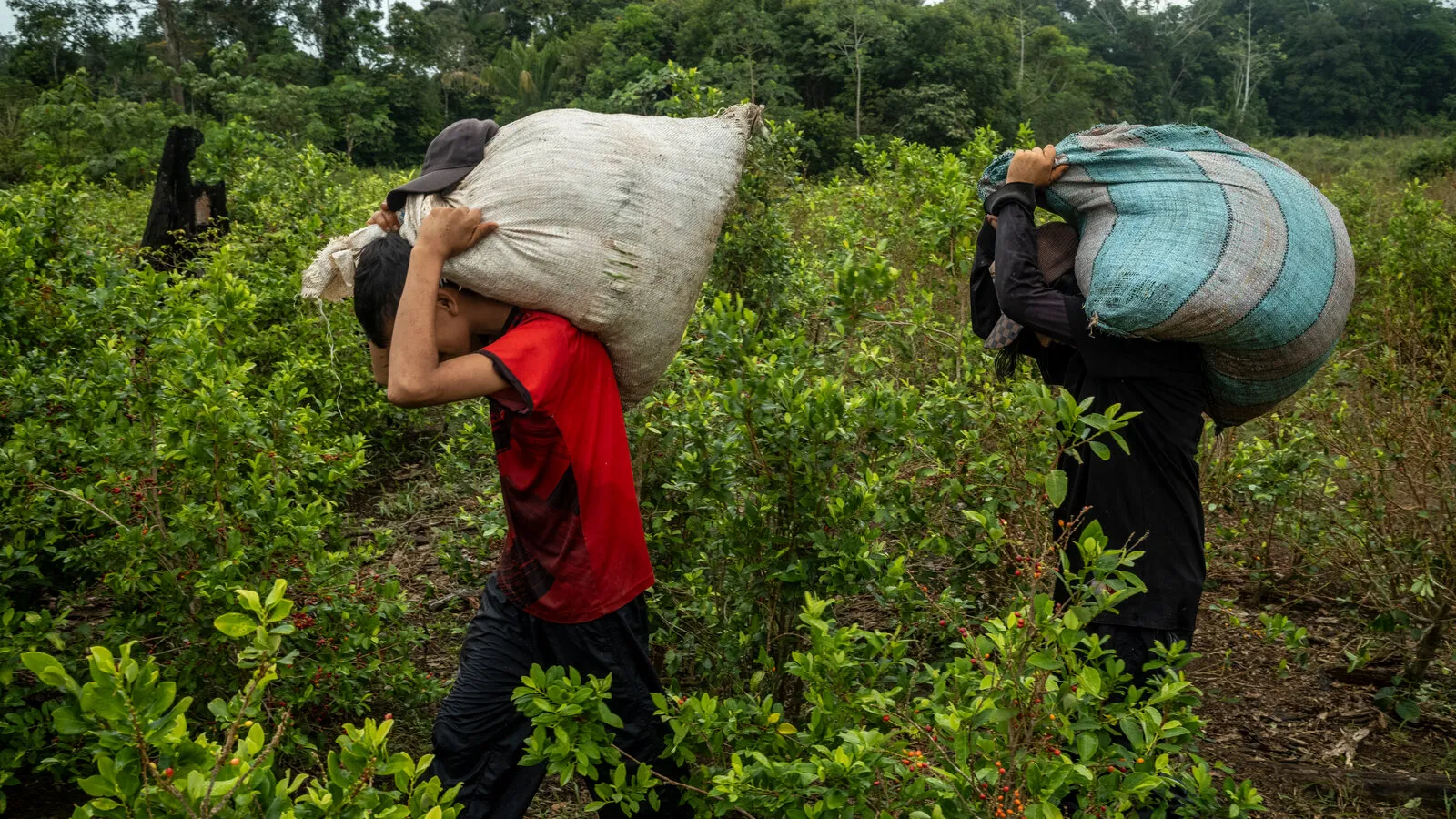
In 2024, global cocaine production was 3,708 tons. It is based on raw materials, such as coca leaves, which are grown in Colombia on 230,000 hectares, in Peru on 95,000 hectares, and in Bolivia on 30,000 hectares. It also requires chemical inputs, such as potassium permanganate, which is used to purify coca paste. Other inputs include acetone, sulfuric acid, hydrochloric acid, and ether. These inputs are primarily produced by China, followed by India, Germany, and the United States. This is social production.
A farmer in Colombia receives 50 cents per kilo of coca leaves; a kilo of cocaine base paste is worth around $500; and a kilo of cocaine in Colombia is worth about $5,000. However, that same kilo can fetch up to $39,000 in the United States or Europe. This high level of profitability is the driving force behind the crimes associated with the cocaine market in Colombia and around the world. However, the profit from fentanyl is much greater. The appropriation of all that profit is private.
The fentanyl market
Mexico is the largest producer of fentanyl for sale as a narcotic. Entrepreneurs there are organized into two cartels: the Jalisco New Generation Cartel (CJNG) and the Sinaloa Cartel. The Sinaloa Cartel is run by the sons of Joaquín “El Chapo” Guzmán, a prominent Mexican drug lord currently serving a life sentence in the ADX Florence federal prison in Colorado for exporting his “valuable” merchandise to the United States. Currently, most of the fentanyl reaching the United States enters through Mexico’s northern border, resulting in approximately 100,000 overdose deaths in the United States each year. China is the main producer of the raw material (precursors).
Heroin and opioids
Heroin and opium production is concentrated in two areas: the “Golden Triangle” in Southeast Asia and the “Golden Crescent” in Central Asia. The main producing countries are Burma (Myanmar), Afghanistan, and Mexico. As with cocaine and fentanyl, China is the main producer of precursors.
The United Nations Office on Drugs and Crime (UNODC) estimates total annual revenues from the opium and heroin trade to be between $2.8 billion and $3.4 billion, based on data from several years ago. It is important to note that these figures can vary considerably, and recent estimates are difficult to determine with certainty.
In Europe, the annual retail value of the heroin market was estimated to be at least €5.2 billion in 2021” (Google.com, AI mode).
Prohibition benefits capitalists but not the population
The debate over the legality of drugs is as old as the existence of drugs themselves.
In this area, economic and social realities have, as always, gained ground over law and legislation. Throughout history, different substances have been considered medicines or consumed socially, only to be banned; conversely, “illegal” substances have become legal and socially accepted. What was considered illegal or harmful to the human body and society yesterday has been de facto imposed and then legalized: tobacco, alcohol, stimulants, sedatives, etc. Rather than being a moral or legal problem, the issue is the imposition of a “new” product and the control of its production, distribution, and consumption. Capitalists do not distinguish between what is moral or immoral, legal or illegal, or harmful or harmless. They only distinguish very precisely between what yields little profit and what yields a lot.
Imperialist “morality” is also expressed in the political and military manifestations of this phenomenon.
For U.S. imperialism, only that which favors national security is permitted; therefore, the economic plundering and political domination of semi-colonial countries are permitted. The U.S. demands that countries such as Colombia, Peru, Mexico, and Bolivia outlaw the cultivation of marijuana and coca leaves and repress drug trafficking by any means necessary. However, in other regions and countries, these activities are permitted to continue, and they are even used to further strategic objectives. (Luis Herrera, “Drug Trafficking: Lucrative Capitalist Business and Pretext for Imperialist Intervention”).
One of the best-known references to the prohibition of alcohol consumption is the Prohibition in the United States (1920-1933), which was replicated in other countries. The law prohibited the manufacture, sale, and transportation of alcoholic beverages. It was repealed in 1933 precisely because it did not work, having led to a boom in organized crime with Al Capone as one of its most prominent leaders.
In Colombia, where the national bourgeoisie idealizes American capitalism, something similar was done with chicha, an ancient indigenous fermented corn drink. Its production and sale were prohibited by Decree 1839 of 1948 and Law 34 of 1949.
The ban was orchestrated so that chicha would not compete with beer produced by Bavaria, a factory owned by Julio Mario Santo Domingo, who wanted a monopoly on alcoholic beverages. However, chicha production and consumption did not cease because of the ban. Now, not only is it permitted, but a chicha festival is also held every year in the traditional La Perseverancia neighborhood in the city center under the auspices of the local government.
The prohibition of cocaine in Colombia and other countries had the same effect as the prohibition of alcohol in the United States: organized crime was strengthened, and many Al Capones emerged, such as Pablo Escobar, the Rodríguez Orejuela brothers, the Ochoas, Carlos Ledher, and Gonzalo Rodríguez Gacha. Not to mention the legal ones; it is alleged that the cocaine mafia has had senators and representatives in Congress, including Pablo Escobar himself, as well as former President Álvaro Uribe Vélez, who has been accused of having links to drug trafficking.
Further proof that the U.S. anti-drug policy is merely a pretext for military intervention is Trump’s pardon and release of former Honduran President Juan Orlando Hernández from a U.S. prison on December 2. Hernández had been sentenced to 45 years in prison in 2024 on charges of drug trafficking, weapons possession, and importing hundreds of tons of cocaine into the United States. Trump pardoned this drug trafficker because of their political affinity and because Hernández was his lackey in the previous administration. However, Trump accuses Maduro and Petro of being drug traffickers, even though they are not, as a pretext for intervention in these two countries.
Drug Trafficking and Armed Conflict in Colombia
Historically, Colombian bourgeois sectors have chosen illegal shortcuts to enrich themselves, profiting from businesses such as smuggling and drug trafficking. These illegal businesses have cushioned the Colombian economy, allowing it to weather recessions and economic crises. This illegal income has permeated all branches of the economy and society, generating chronic violence in Colombia.
Bourgeois smugglers and drug traffickers resort to arms to protect their businesses. The military apparatus responsible for violence in Colombia has also been permeated by income from illegal businesses, whether through “innoculation” or taxes on businesses, control of territories and routes, or direct participation in the production and distribution of narcotics. Drug trafficking is so powerful that it has deeply penetrated the army and police. In the case of the guerrillas, it has transformed them from organizations with a petty-bourgeois reformist program into armies at the service of the drug trade.
Following the marijuana boom of the 1970s and the cocaine boom of the 1980s, drug traffickers organized armed paramilitary groups to monopolize the drug trade, seize land from peasants, and clear-cut the countryside. They claimed that these groups were formed to combat the guerrilla insurgency. One of the sponsors of these armed groups is Álvaro Uribe Vélez. While serving as governor of Antioquia, he legalized paramilitary groups under the name Community Associations for Rural and Urban Vigilance (Convivir) through Decree Law 356 of 1994 during the administrations of César Gaviria and Ernesto Samper.
Around that time, a faction of the Maoist guerrilla group Popular Liberation Army (EPL), demobilized in 1991, joined the paramilitaries to engage in drug trafficking and support landowners and cattle ranchers. Several of that group’s main commanders became drug lords. One of them, Dairo Antonio Úsuga (also known as Otoniel), became the leader of the paramilitary and drug-trafficking group Los Urabeños, which later changed its name to Clan del Golfo. It is now one of the largest right-wing armed groups, with between 7,000 and 14,000 paramilitaries in its ranks. Currently, dissidents from the FARC and the ELN are accused of being involved in drug trafficking, though these guerrilla groups deny it.
Against this backdrop, Petro’s government has promoted a policy of total peace, encompassing both self-proclaimed guerrilla and paramilitary organizations. Within this framework, bombings have occurred, resulting in the deaths of children recruited by armed groups. These children’s deaths have been condemned by the left and, opportunistically, the right.
Not only has the drug-trafficking bourgeoisie used paramilitarism to displace poor peasants and expropriate their land, covering an area of more than seven million hectares, but so has the landowning and cattle-ranching bourgeoisie. Therefore, one could argue that today there is a drug-trafficking, landowning, and cattle-ranching bourgeoisie.
Similarly, the industrial bourgeoisie and multinational corporations have used paramilitarism to assassinate union leaders, weaken unions, and undermine the workers’ struggle. They do this by financing paramilitary groups to defend their interests. For example, the multinational banana company Chiquita Brands was sanctioned for financing the United Self-Defense Forces of Colombia (AUC), a group designated as terrorist by the US government. Chiquita Brands was also fined $38.3 million to compensate the families of 16 victims.
Coca-Cola has not been sanctioned because the U.S. justice system claims there is no evidence that its Atlanta headquarters is involved. However, executives of the Colombian branch have been accused of financing paramilitary groups to murder union leaders in the 1990s and 2000s. However, the Colombian justice system does not prosecute or punish these crimes because it defends the interests of businessmen, not workers.
Legalize the business and treat addiction as a public health issue
Some sectors of the bourgeoisie defend the legalization of drugs because repression and prohibition have proven ineffective. Legalization would eliminate the illegal nature of drugs and the immense profits distributed among drug traffickers, money laundering banks, and corrupt officials. It also eliminates the justification for imperialist intervention in producing countries and on the periphery, as the Trump administration is currently doing with its military presence in the Caribbean and off the coast of Venezuela.
From a working-class perspective, drug trafficking is a public health problem that must be understood as a branch of the economy, like alcohol. Its effects are used by millions as an escape from capitalist alienation and the decay of society. Therefore, a fundamental solution does not lie in prohibiting and persecuting substances, plants, plantations, or the peasants and workers who depend on their production. Rather, it lies in fighting the bourgeois owners of the business and the illegal nature that multiplies their profits, as well as the social problem of consumption.
The fight against drug trafficking is closely linked to the fight against capitalism and the struggle for a socialist revolution. Within this strategic framework, it is necessary and possible to fight for urgent measures that eliminate the distortion drug trafficking represents for the economy and the class struggle, even in today’s decadent society.
Legalization under state control is the solution. The first step is to eliminate the illegal nature of the business, which makes it profitable. Then, it should be made legal, like alcohol and tobacco. Marijuana is in the process of being legalized. Uruguay was the first country to fully legalize it in 2013, followed by Canada in 2018, Malta in 2021, and Luxembourg in 2023. Germany partially legalized it for recreational use and home cultivation in April 2024, permitting limited possession and cultivation. Sales through cannabis clubs are planned for the future. In Mexico, recreational use for personal consumption has been decriminalized, though large-scale commercial sales are restricted. In the United States, marijuana is illegal at the federal level but has been legalized in several states.
All drugs should be legal and under state and social control to eliminate the drug cartel monopoly. Therefore, cocaine and marijuana production, distribution, and consumption should be legalized in Colombia.
Legalizing drugs does not mean we recommend consumption. On the contrary, we support developing anti-addiction campaigns because, as with all drugs, addiction damages health. That is why legalization implies several measures.
Fighting the “anti-drug” intervention and militarization of U.S. imperialism.
Second, workers should control pharmaceutical laboratories, ports, free trade zones, and the financial system.
Expropriate the assets of drug traffickers and companies involved in money laundering without compensation.
We must decriminalize consumption. The criminalization of drug use primarily targets consumers and small-time dealers, while the major drug lords enjoy impunity and the collaboration of state institution agents. These measures will reduce violence, corruption, and homicides related to this illicit business.
Public health campaigns should address addiction and guarantee care and rehabilitation plans for people addicted to all drugs, including alcohol. Establish a regulated market that allows for quality, purity, and dosage controls to reduce the risk of overdose due to adulteration or ignorance of the substance’s potency.
Allocate resources for social investment. Funds currently allocated to the “war on drugs” could be directed toward social investments, such as prevention and treatment programs for people with addiction.
Offer access to medical treatment without stigma; drug use will be viewed as a health issue rather than a criminal justice issue.