
A look at the tactics of the immigrant movement in Los Angeles
At the beginning of the ICE raids in June, which produced profound shock and anger across the city, there was an opening to rapidly mobilize and involve tens of thousands in Los Angeles. The unions would have to play a central role. The idea of a general strike in the city was something plausible, if distant. There was even some discussion about this among union leaders. But there was little to no effort toward this goal.
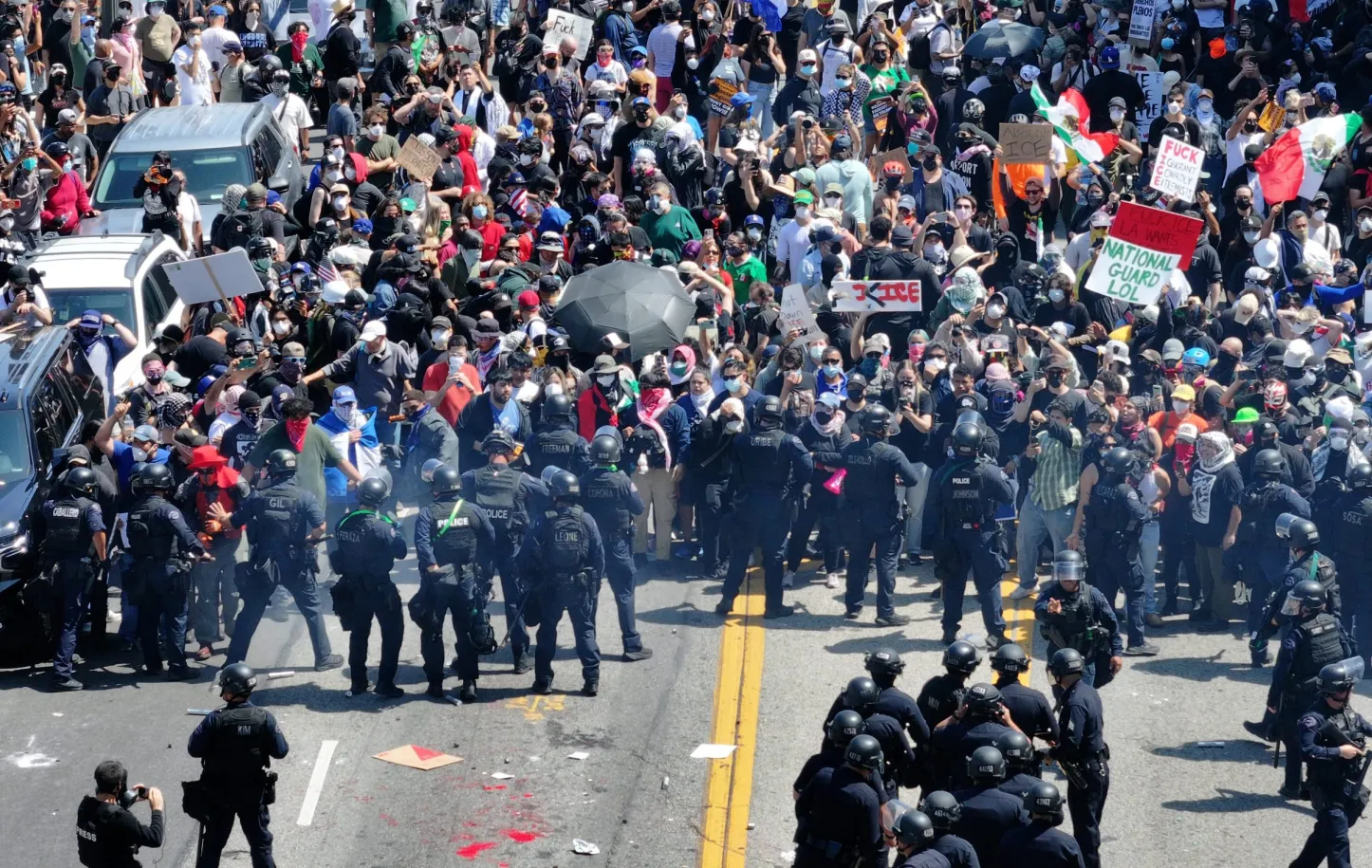
In June 2025 the masses of Los Angeles became the center of the class struggle in the United States. As the federal government sent brigades of Gestapo-like ICE agents into the city and its surroundings, and then went on to deploy the National Guard and the Marines, the immigrant community of LA and its allies, to a degree already organized around rapid response networks and immigrant solidarity groups, went out to meet the agents and troops occupying their city.
In neighborhoods like Paramount, whole communities fought to get ICE off their streets. What unfolded provided the first embryonic glimpse to activists across the country of what a mass-based movement against ICE and Trump could be in the struggle to defend our democratic rights and build working-class power.
From the Ambience raid to No Kings protests
On Friday, June 6, mass raids started in Los Angeles. A major operation was carried out against garment workers at the Ambience Apparel garment factory. As ICE came in, the community came out with their organizations, such as the LA Tenants Union (LATU), SEIU, and the Community Self-Defense Coalition. There was a standoff for a couple of hours, and the president of SEIU, David Huerta, was brutally arrested.
As the occupation of LA unfolded, the B-18, which is the basement underneath the Federal Building, became a focal point for part of the movement. Since it serves as the only mass detention center in the city, some formed the idea of shutting it down. The mobilization shuttered the facility, but only temporarily. The conflicts at the Federal Building were used by Trump as an excuse to send in the National Guard to “protect federal property,” along with the claim that the troops would end alleged “violence” throughout the city. The level of organization necessary to push ICE out of LA was not there yet.
When the National Guard was called in on June 8, it fulfilled a dual purpose: to “guard” the Federal Building against the protesters, and to assist in arresting organizers. In the main they did not assist in raids, with an important exception: the Paramount raids.
In Paramount, hundreds of people showed up to derail the ICE operation. With people ripping up rocks from the ground and physically pushing out ICE vehicles from their streets, it became a full-on confrontation between the community and ICE. And the community won. This type of spontaneous action would repeat itself primarily throughout June and July. The community showing up against ICE was of a qualitatively different character than the rapid-response patrols. Small groups of twos and threes have a very difficult time trying to stop a raid, while these types of community showings made ICE operations much more costly to carry out.
By June 9, hotel workers at the Marriott and the Westin were calling the Self-Defense Coalition to inform them that ICE was staying in the hotels. People from the city started organizing to not let the agents get any rest. Crowds would show up in the night and have a cacerolazo—banging pots and pans—and have rallies throughout the night. In order to not burn out, people made it fun, blasting music.
On June 10, the Democratic mayor, Karen Bass, issued a curfew. This gave a green light for the sheriffs to brutalize protesters. Suddenly, people with families, children, and elders did not want to participate because of the heightened danger, and the mass character of the protests was narrowed. The organized strength of the movement was not yet to the level of being able to confront such aggression by the State.
But even so, when No Kings rolled around on June 14, there was a mass turnout with over 200,000 people in the streets. June 14 was all about immigration, getting the National Guard out of LA, and putting an end to ICE abductions. Like the spontaneous community response in Paramount, it demonstrated that there are untold numbers of people willing to show up against the oppression of their communities; they just have to be organized.
Community organizing
A significant amount of anti-ICE organizing was carried out by the Community Self Defense Coalition (CSDC). At the beginning of 2025, the CDSC was created in anticipation of incoming raids. Over 70 grassroots and civil organizations came together on the initiative of Union del Barrio, a “Raza Internationalist” and socialist organization.. One of its main projects was training activists to carry out patrols that would document and disrupt ICE, making it difficult for them to carry out their raids. In the early days of June, these patrols demonstrated that it was possible to confront ICE, with hundreds of patroller videos circulating online. By pre-identifying agents before raids began and informing the community through social media and Signal chats, the CSDC was able to prevent smaller scale raids and deportations, an immensely important activity.
Over time, the networks established by the CSDC began to do outreach to residents and small businesses, to put up signs and numbers to call if ICE is spotted, and to provide safe passage for undocumented workers if ICE is in the area. There have also been community workshops on how to organize patrolling. Food distributions were set up for people who are unable to work due to the ICE presence.
LATU has also been involved in on-the-ground organizing. It has connected with jornaleros (day laborers) and vendors, to stay informed of ICE movement. It has also become involved with community building through food distributions and the watching and making of political films. It has been successful in linking the fight at the Home Depots with housing struggles, in the process training more organizers for the broader social justice struggle.
At Cal State LA, organizers started to preemptively organize in case ICE ever thought of coming onto campus. They do not want to wait for raids to be carried out to get organized, but to meet raids with an already strong mass organization. The professors organized themselves, and student activists set out to organize the over 22,000 students that attend the university. They started doing foot-patrol training, workshops on how to identify ICE, and invited everyone on the campus, as well as setting up protocols of what to do if ICE shows up.
Teachers at schools also became an important component of the movement. At certain schools, teachers have set up perimeter patrols that they carry out every single day. Some of these schools are already in contact with one another, so that if ICE shows up in one, others are notified and are able to go into shut-down as well. The significance of this lies not only in the security this provides for undocumented students, but also that teachers themselves become organically rooted in the workplace and community. It is an example of a larger project of workers organizing themselves at their workplaces. Organizing that brought in workers at schools, Home Depots, tenant and labor unions, the CDSC, street vendors, and community organizations would be a formidable force.
Role of labor unions
An element that has been nearly absent from the movement in LA has been organized labor. The brutal arrest of SEIU USWW President David Huerta during the ICE raid on Ambiance Apparel on June 6 raised the perspective of labor coming to the forefront of a militant anti-ICE movement. But while there were some initiatives, it did not bear out. There was no concentrated effort to mobilize the 800,000 union members in Los Angeles County. At best, several hundred might have been present at a few of the larger marches as a visible union contingent.
There were two initiatives of some significance. The first was dubbed Summer of Resistance, an effort of United Teachers of Los Angeles (UTLA) and SEIU to create a cultural space with workshops at Placita Olvera, in downtown Los Angeles (DTLA), with the detention center just a few blocks away. Despite this, there was no attempt to link up this effort with mass mobilizations of the unions. The closest was a call by Unite Here, SEIU, and UTLA for a boycott and work stoppage on Aug. 12. There was a march at McArthur Park and in DTLA, but no work stoppage.
Also, UTLA, largely at the initiative of CSDC educator members, has encouraged and provided support to teachers to build school site sanctuary teams and patrols. These teams fight for stronger school sanctuary policies including effective and protective lockdowns, something the District has very meekly given guidance on. And school patrols have become important forms of worker self-activity that have the potential to build the local struggles spoken of above.
Where do we go from here?
Despite the untiring efforts of the organizers and the masses in L.A., ICE is still kidnapping our neighbors. Despite the general disgust with the deportation regime, Trump is still in power. The sober truth of the matter is that the movement is still not strong enough to effectively kick out ICE from its cities and impose its will on the administration. A movement capable of doing so cannot be summoned into existence, it must be organized.
At the beginning of the ICE raids in June, which produced profound shock and anger across the city, there was an opening to rapidly mobilize and involve tens of thousands in Los Angeles. The unions would have to play a central role. The idea of a general strike in the city was something plausible, if distant. There was even some discussion about this among union leaders. But there was little to no effort toward this goal.
While many unions such as UTLA, SEIU, UNITE HERE, and nurses unions have escalated their militancy in the past few years, including strikes over their contracts, when it comes to political action our unions are unfortunately stuck in lobbying, electing local Democrats, and in schemes like the Democratic Party-initiated Prop. 50 ballot measure to re-map congressional districts. Organized labor, the strongest force that could oppose the raids, was absent.
The idea that we have the power to change society is not foreign to unions, but there is a great gap between this idea and political practice. Unions, the organizations built through the blood, sweat, and tears of the working class for the defense of their most heartfelt demands, should be at the forefront, defending their class against these pseudo-Gestapo thugs. Their unwillingness to do so is borne out of a history of business unionism, a decades-long cozying up to the Democratic Party, and of the union’s privileged bureaucracy having grown uncomfortable with the idea of a highly politicized and mobilized rank-and-file that threatens to upend the established hierarchy.
What was incredible to see about the struggle in Los Angeles was the self-organization of the class, the intense desire to fight back demonstrated by tens of thousands in the streets. This energy, harnessed, can change the world. Through democratically organized and mass-based grassroots coalitions, the will of millions can be mobilized to strike like a single fist. To accomplish this we must encourage unions like SEIU, which represents many undocumented workers and has shown some willingness to enter the fight, to get even more involved, while at the same time denouncing the traitorous behavior of those labor leaders that cozy up to the same Trump administration that is attacking the labor movement.
We must radically transform our union cultures to stimulate increased grassroots worker activity at the worksite and union-wide levels, and develop class-independent political action so that workers rely on themselves and their solidarity to change the course of the country, and challenge the legal and cultural shackles that have kept our unions weak and on the defensive.
We need imagination and boldness in our struggle. One of the surest ways that we could defeat the ICE raids would be a general strike, to shut down the city and upend the profits of the capitalists who support Trump. An active strike could further take control of the main transportation arteries of the city and prevent the free movement of those who terrorize our communities.
Our efforts must build into mass mobilizations capable of throwing into disrepair the entire capitalist regime. Labor, arm-in-arm with grassroots coalitions, can lead the way, organizing up to partial and general strikes against the raids and deportations. These actions, linked up across the country, can create a real crisis of governance and legitimacy for Trump, end the deportation regime, and win permanent civil and political rights for all immigrants.
Papers for all!
Photo: Protesters gather in Los Angeles on June 8, 2025, to demand an end to ICE raids on workplaces. (Tayfun Coskun / Anadolu)
First published here by Workers’ Voice.
También disponible en español


