
U.S. elections: The two hated big business parties slug it out
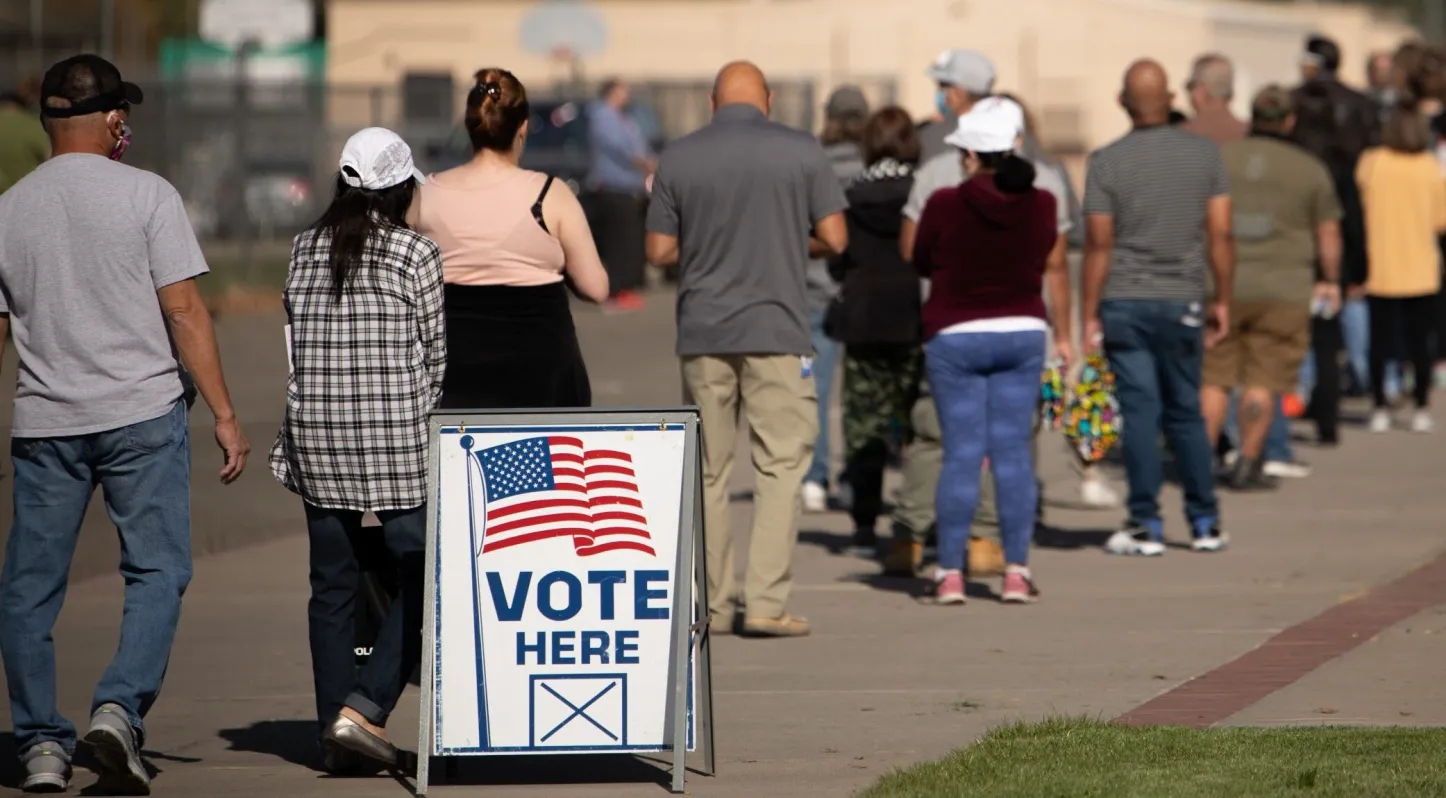
The 2026 elections are on track to be the most expensive in U.S. history, with over $11.6 billion in projected spending—topping the 2024 presidential vote. All observers expect Republicans to lose the house. Polling expert Nate Silver gives them a 70% chance of losing the Senate too. It’s not bad odds for a party behind what may be the most overtly failed war in U.S. history—whose consequences continue to unfold without end in sight (oil is $115 a barrel today, $50 higher than October of last year). And that is only one of many widely reviled actions taken over the last 21 months by the president and his party.
Republicans, however, are fortunate to face the country’s second most hated party. Indeed, observers are not talking about a blue wave, so much as a red undertow.
Yes, eleven-figure spending on campaigns has done little to hide the missing enthusiasm and confidence for those in charge. War, genocide, mass surveillance, lawless state terror, AI everywhere, the explosion of data centers, staggering costs of health care, housing, fuel, necessities and pleasures, corruption, growing climatic disasters, the resurgence of a thousand bigotries—no one in office can claim exemption from shared responsibility in these. And neither party presents a vision with a viable way out.
MAGA offers a fantasy in which a few authentic angry individuals stand up to the criminals in power (drain the swamp, release the Epstein list etc.) while simultaneously giving supporters the opportunity to participate vicariously, or even directly, in some of the more vicious crimes against those at the bottom. Two years of reality and mass opposition have taken the sheen off this fantasy for many. It’s not a dead movement by any means, but that it is in crisis is undeniable. And the 2026 midterm elections will supply a rough measurement of the extent of this crisis.
The elections will be complicated by attacks on voting rights and challenges to results—in the courts and possibly elsewhere. The Trump administration has begun investigations of several figures in the few weeks and days before the election, including former FBI head James Comey and Senator Ilhan Omar (breaking standard Justice Department practice to abstain from investigating candidates in the 60 days before an election). It has attempted to use the postal service to obstruct mail-in ballots, impounded 20,000 California ballots under suspicion of immigrant votes, is issuing grand jury subpoenas to California elections officials, and is preemptively suing to prevent Alaska from certifying the election of a Democrat for Senator should the Republican lose by more votes than that obtained by another candidate with the same first and last name. Trump is now even proposing criminal charges—though yes, the Democratic Party did seek out someone with the same name as their opponent and helped get him on the ballot, a completely underhanded tactic).
It should be expected that the balance of election results—particularly in Congress but also in key state and local races—will not be determined until long after election day. On election day, Trump may employ ICE agents, military or National Guard troops to intimidate voters. Vigilante groups may take it upon themselves to do the same, though there has been little to no visible organization of such action leading up to the election.
In all cases, working and oppressed people must organize to stop attacks on voting rights and on basic democratic procedure—regardless of which party stands to win seats in the government. Democratic rights are a thousand times more valuable to working people than to their bosses.
There have already been important mobilizations against these attacks. Black students’ mass marches to polling booths in protest against the closure of ballot boxes on their college campus have been an important step in the right direction, as have efforts to organize rallies to defend federal interference on election day and afterward. It is important to continue these efforts to stop attacks on voting rights and on basic democratic procedure. It is clear that the big tech bosses want to do away with the current limited freedoms that working people still have, and replace it with an AI-powered panopticon. Their drive to expand surveillance and automation will continue until they are defeated for good.
How should working and oppressed people relate to the elections and political landscape of 2026?
There is no question that Trump is carrying out a historic offensive on working and oppressed people. And he cannot be passed off as a simple aberration. He has had firm backing from several layers of the ultra-rich, and many of his policies have been given the green light by large sections of the power structure, including courts.
Most major institutions (most dramatically universities and the Republican Party) have folded without a fight before Trump’s offensive or joined in gleefully. His program has been undermined only by the entry of millions of ordinary people into political action on the street and in workplaces, the highest point of which remains Minnesota’s response to the wave of ICE repression earlier this year, which saw entire communities mobilize to defend their neighbors and co-workers, tens of thousands march in sub-zero weather, and the specter of political work stoppages emerge – however modest they may have turned out to be in January. These public mass actions have frequently discouraged the state from backing Trump’s actions (largely through court rulings) and forced the Trump administration into several tactical retreats.
The war in Iran may have qualitatively undermined Trump’s personal significance. But support for his program—in one form or another—will not disappear so easily.
Big business interests value Trump’s political project for its willingness to smash the organizing efforts of workers, oppressed communities and political dissidents, for its ability to displace class war with race war, and for its readiness to remove barriers to unregulated AI and fossil fuel industries in order to expand the reach of a repressive apparatus in preparation for super-exploitation and war. Other layers clearly do believe that it is practical and necessary for the U.S. to step back from its past role of imperialist hegemon and global arbiter.
But Trump could not carry out his program if not for the groundwork laid by the Democratic Party in the labor and social movements. The failure to respond with the most modest levels of urgency to Trump’s many-sided offensive on labor (i.e., open war on immigrants, removing collective bargaining rights, and mass layoffs in the federal workforce) is a symptom of rot accumulated over decades. Voting Democrats into office one more time would not have prevented this moment. And it will not prevent the continued weakening of labor and social movements.
To the contrary: Continued support for the Democratic Party means the further degradation of our movements and an even more favorable ground for current or future movements towards authoritarianism.
What of the Democratic Party’s “socialist” and “progressive” candidates?
Since 2016, there has been a growth of nominally left candidates in the Democratic Party, backed by the DSA and other electoral groupings like Our Revolution and Justice Democrats. This year, 38 Democratic Party House candidates were endorsed in the primaries by one or more of these forces and by Bernie Sanders; 23 made it into the general elections.
The DSA itself has grown from about 6000 members before 2016 to some 128,000 today. Roughly half that number joined since the mayoral election of Zohran Mamdani in New York City. In what direction is this electoral work taking Democratic Party? In what direction is it taking the DSA?
Of Sanders, and all the candidates endorsed by the DSA, not one has opposed a Democratic nominee for U.S. president. All function quite plainly as loyal members of that party. Ocasio-Cortez even appeared with Biden in matching sunglasses just as the establishment was planning to replace his candidacy.
Mamdani’s decision to keep Jessica Tisch as police commissioner, to expand the NYPD, to arrest people protesting Netanyahu rather than arresting Netanyahu, to meet publicly with Trump and offer nothing but smiles and praise—how does any of this help to build a clear socialist movement or a determined resistance to the offensive on working and oppressed people?
While Mamdani is sharing his credibility with Trump, rents continue to rise, along with all other prices. His office serves to blunt resistance to the Trump offensive while undermining confidence in the socialist movement. There is nothing that the DSA could have gotten out of these meetings with Trump that is worth what has been sacrificed.
Mamdani’s rehabilitation of the NYPD came as Ocasio-Cortez declared “Woke 1” crazy, disavowing the very notion that humans could somehow live without putting each other in cages. In this way these elected officials serve to systematically turn back the gains in political consciousness created by historic mass explosions of millions.
Meanwhile, Sanders publicly met with professional fascist Steve Bannon to unite against AI, after publicly praising Trump’s militarization of the border. Has there ever been a worse time to introduce such confusion into the working class?
Abdul El-Sayed, the Democratic senatorial candidate in Michigan, provides another useful case study. He openly identifies not as a socialist but as pro-capitalist. He calls for making Medicare available to all, but not for banning private insurance (which is an essential step in removing massive redundant costs, and in turning public health care into a right that protects all). In other words, he calls for resurrecting the public option once promised in the ACA. He doesn’t propose nationalizing monopolies but instead breaking them up. He opposes aggression abroad not out of principles of solidarity with the peoples who are victimized, but because it doesn’t benefit people in the U.S. enough.
El-Sayed’s program is barely distinguishable from that of Sanders’, except that he is more honest about its capitalist orientation. And like Sanders, El-Sayed is beginning to flirt with the far right, opposing aid to Israel more and more on the grounds of America First sentiment rather than solidarity with Palestinians. In a recent advertisement, he even plays clips of Fox News pundits describing him as an America First candidate and a clip of Tucker Carlson supporting his campaign.
Left advocates of reforming the Democratic Party are fond of claiming that the party is nothing more than an “empty car”—you just need to step in and take it over. No one is even there to stop you! Just walk right into your local Democratic town committee and take hold of the wheel! These claims are hard to square with reality.
There are about half a million elected officials in the United States. The Democratic Party likely claims about half of those at any given time and is running candidates against the other half (sometimes multiple candidates when primaries are considered). Behind every candidate and every elected official is a political apparatus—staffers, advisors, consultants, business owners, appointees to government positions, non-profits, donors, owners and editors of news outlets, police chiefs, generals, judges, lawyers, banks, landlords, insurance companies, volunteer organizations, congregations, and yes, union officials.
Together, in consultation with or at the direction of their network of powerful friends, these elected officials manage the largest, most fearsome imperialist power the world has ever known. They manage it on behalf of the most wealthy and powerful figures in the country, and in accordance with methods to make them even wealthier and more powerful.
This Democratic Party embodies 200 years’ experience in managing this power. It is the oldest party in the world, it was at the helm for key moments of American imperialist ascent, and fooling workers to go along with it all was one of the first tricks it learned.
Today, the Democrats help organize society around their class’s rivalry with Chinese and Russian capital. Today, this means a mad dash for AI and regional wars. Tomorrow, it will mean world war. At all times it means plunging toward ever more catastrophic climate change.
Getting into the Democratic Party is more like hoping in the back of a bus driven and filled by a death cult. So is joining the Republicans. While the driver of the second bus may scream, rave, and swerve, the one in the first is also barreling towards a cliff, however careful and subdued his expression may be.
An independent working-class party will not be created by running candidates in the Democratic Party. The question is not to go into the Democratic Party and split it. The question is to go into the organizations of working and oppressed people that are held hostage by the Democratic Party, and to split them away from the Democrats.
Most people in working-class organizations are not active in the Democratic Party—especially outside of election time. The people most likely to lead a break with the Democrats, those most valuable leading such a break—are active in social movements. And they will only gain the confidence to break with the party when they are more active in social movements independent of the Democrats and have brought more people into such activity.
The DSA strategy has done the opposite: It has taken people involved in independent social movements and brought them into the Democratic Party. Meanwhile, one need only look out to France, Spain, Bolivia, India, South Korea, Albania, or any number of parts of the world to see that our class is infinitely more powerful when it acts on its own.
Mass movement to defend democratic rights
Defending elections and the principle that working people should have a say in society is an important step. We need to build these mobilizations into movements that last beyond the election. The key to defending ourselves against Trump’s remaining attacks against democratic rights and working class living conditions, as well as the attacks that will follow, is to build unions and grassroots organizations that can mobilize working people in our millions, to demand a right to live and a say over our society. A mass mobilization can stop a coup even when politicians are ready to throw in the towel.
To stop the creeping expansion of surveillance AI, to win back rights for immigrants and queer people, to expand rights for the oppressed even further, and to challenge the rich’s control over society at the roots, this is the movement that we need.
First published here by Workers’ Voice


