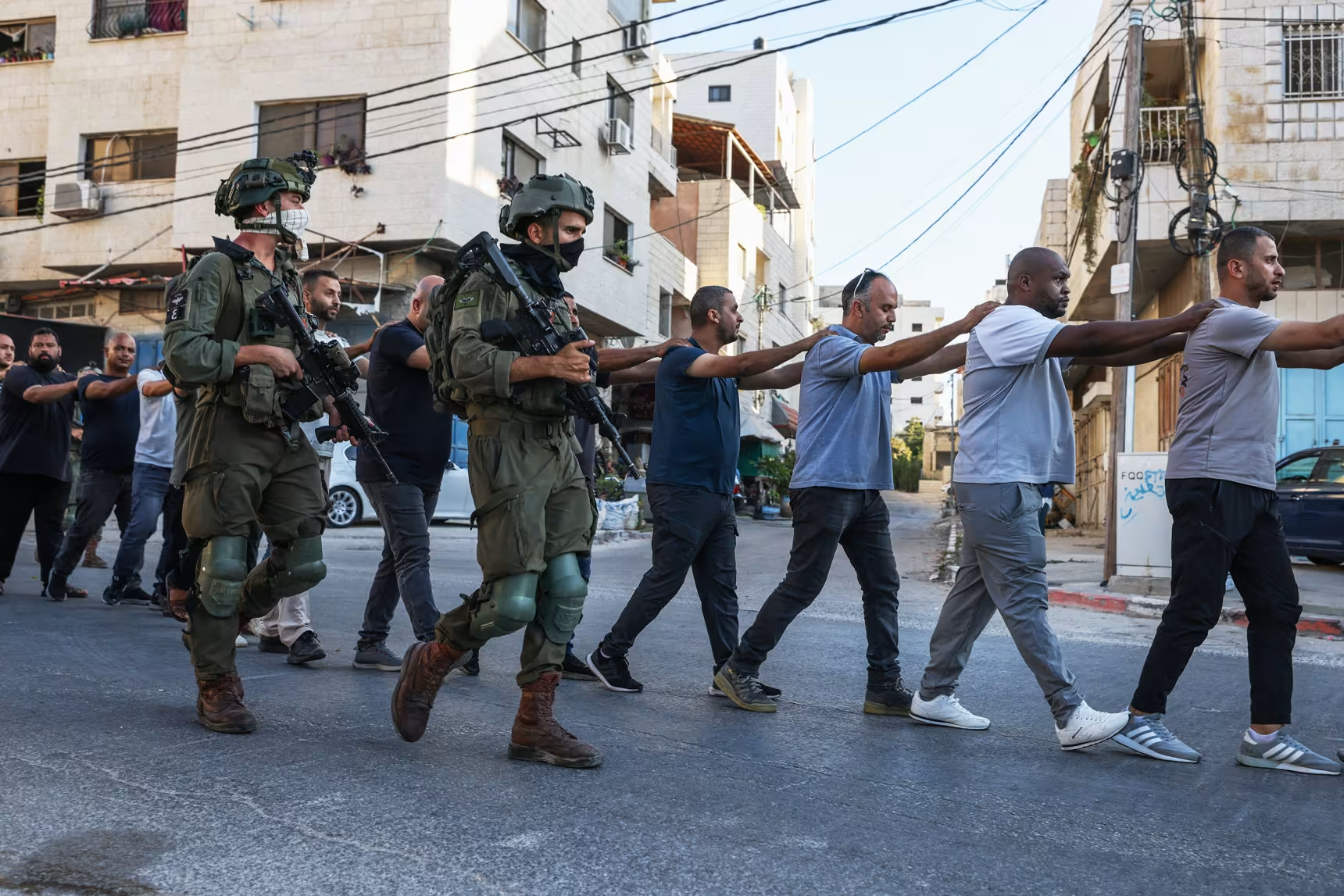
October 7, 2023: The Largest Military Operation on Occupied Territory
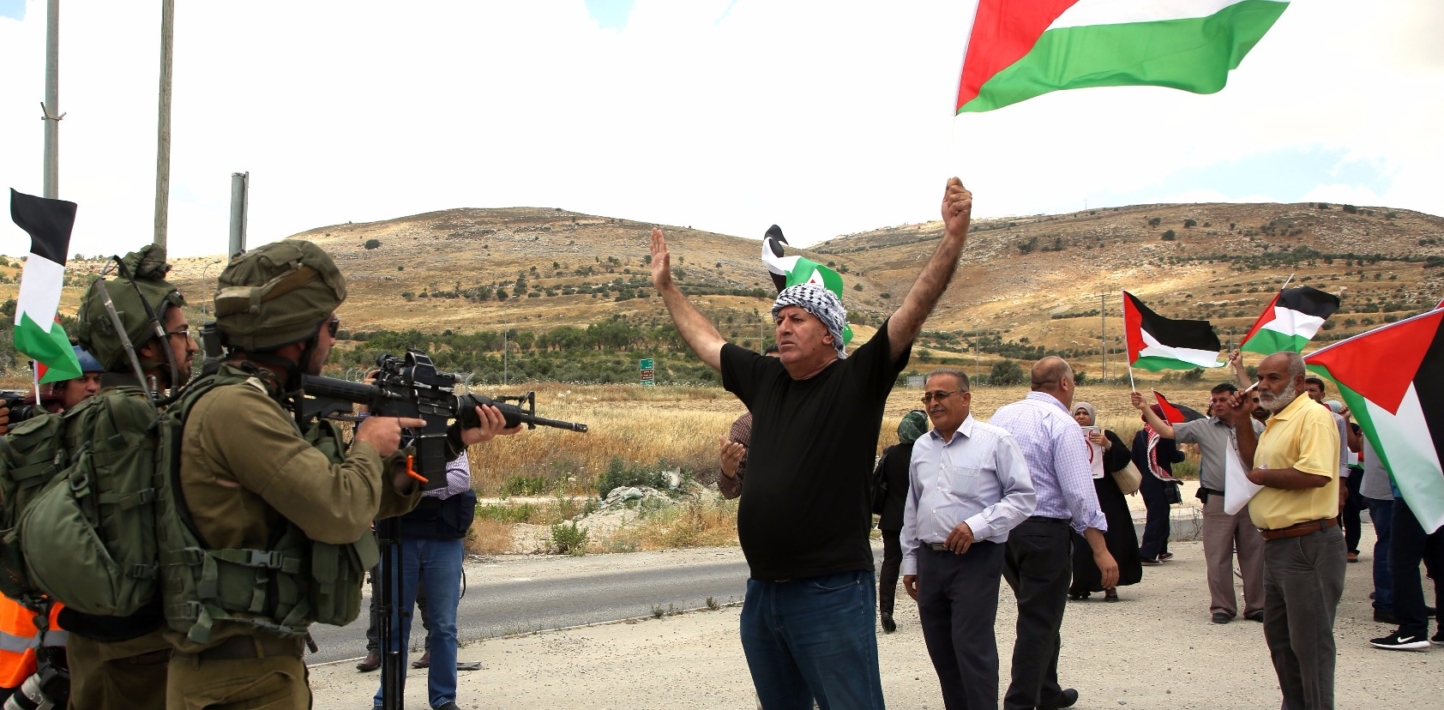
“After the Paris Commune had been drowned in blood and the reactionary knaves of the whole world dragged its banner in the filth of vilification and slander, there were not a few democratic Philistines who, adapting themselves to reaction, slandered the Communards for shooting 64 hostages headed by the Paris archbishop. Marx did not hesitate a moment in defending this bloody act of the Commune.”
(Lev Trotsky, Their Morals and Ours, 1938)
The film by two “Israelis,” Naza (which is filling movie theaters), is causing quite a stir. Through the testimonies of Zionist soldiers involved in the massacre, it documents the horrors committed in Gaza—atrocities that, incidentally, had already been attested to, though without receiving the same attention, by dozens of journalists (especially Palestinians) who were murdered by snipers from the racist entity.
The right-wing government in Italy is responding by urging people to watch the latest season of the “Israeli” Netflix series Fauda: pure Zionist propaganda that, by turning the facts on their head, portrays October 7 from the perspective of “Israeli” military personnel and intelligence agents—presented as “victims”— while Palestinian fighters are portrayed as bloodthirsty beasts and fanatical cutthroats who kill poor, innocent civilians.
However, the “defense” of the Palestinians by center-left intellectuals who are paving the way for a bourgeois change of government (the Five Star Movement and the PD) is the kind one would gladly do without. It is entirely based on a complete distortion of history and current events. Figures such as journalists Formigli and Michele Santoro, or the critical Zionists Gad Lerner and Travaglio, condemn violence “on both sides”—that of the “Palestinian terrorists” (as they call them) and that of Netanyahu (they accuse only the government in power, thereby protecting the Zionist entity as such).
Marco Travaglio, editor-in-chief of Il Fatto Quotidiano and ideological mentor to the Five Star Movement, is already the author of a book on Palestine that is presented as a reconstruction of history (1), yet in it the true history is precisely missing. After long questioning, in his editorials, the use of the term “genocide” (while the bodies of Palestinians filled the mass graves in Gaza), he has repeatedly claimed that the original blame for all this lies with the Arabs, who allegedly did not willingly accept the partition of Palestine carried out in 1948 by the UN (at the behest of imperialism, eager to establish its own military base in a crucial area, we might add).
Entire sectors of the PD (starting with the oxymoronic “Left for Israel” faction of the PD) go even further and, alongside the right-wing government, invoke law and order—intimidated by the massive movement that flooded Italian squares last fall and convinced that they can prevent a resumption of the protests through the threat of repression. That is why they support the decree on “anti-Semitism” presented by the government—which, drafted by racists, the grandchildren of Mussolini, equates anti-Zionism (which by definition implies anti-racism) with anti-Semitic racism, as if the so-called Jewish state were the responsibility of all Jews (when, in fact, a growing number of Jews worldwide do not support this monster).
Meanwhile, the Five Star Movement, determined to present itself at this stage as further to the left than the PD on various issues, rejects the decree, pretending to forget that it is yet another repressive measure in line with those enacted by the center-left (including itself) when it was in government.
However, it is not worth dwelling—at least for our readers—on this “left”—as it is called in the press—which is merely preparing to return to government in order to implement anti-worker policies, just as it has done in all its previous stints in government. We prefer to focus here on the reformist left and those organizations that stand to its left.
The Hypocrisy of the “Two-State Solution”
An example of this political current is Rifondazione Comunista, with the two factions that have split from what remains of that party. The two leaderships are divided over the best way to realign with the center-left: to capitulate outright, as Acerbo proposes, or to try to build bargaining power by, for the time being, presenting themselves as distinct from the center-left, as Paolo Ferrero (a former minister in one of the worst anti-worker governments of recent decades—Prodi’s) proposes.
Although divided on tactics, the two wings nevertheless share the same position on Palestine: “two peoples, two states”—that is, the proposal that anyone familiar with, even superficially, the so-called “Palestinian question” would consider (if they are honest) deceptive, because it implies acceptance of the Zionist occupation of much of Palestine—except for the territories occupied in 1967 (essentially the Gaza Strip and the West Bank)—which would be generously ceded to the Palestinians to create a mini-state, without territorial continuity, with no right of return to their lands for millions of Palestinians, and ignoring the nearly two million Palestinians living under apartheid conditions within “Israel.” A proposal based on the supposed “right to exist” of the “Israel” colony (as upheld by the vast majority of the global reformist movement, from Rifondazione Comunista to Syriza, including Die Linke). A proposal backed by many imperialist governments (such as that of the “progressive” Sánchez in Spain, currently grappling with massive protests), precisely because for decades it has been nothing more than a mirage promised to the Palestinians, peddled by capitalist forces such as the current collaborationist Palestinian National Authority (and previously by Arafat’s Fatah), whose sole function is to keep the Palestinians in check and which, in addition to being a proposal based on injustice, is not even contemplated by Zionism in all its forms.
Pap and the reformist substitute for the “binational state”
Given that, in these times, in the face of capitalism’s disaster (wars, poverty, environmental destruction) and the impotence of reformism—which sows illusions about the possibility of governing an unreformable system in a different way—presenting oneself as a “reformist” lacks support, especially among what has been aptly defined as the “Gaza generation” (which is filling the squares even as we speak in France), there are those who are trying to carve out a niche for themselves, seemingly further to the left. This is the case with Potere al Popolo (PAP) and its majority shareholder, the neo-Stalinist Rete dei Comunisti.
Here, there is no talk of the “two-state solution,” knowing that it has little credibility among those mobilizing for Palestine. And, quite rightly, they also refuse to participate in the ritual of “condemning October 7.” However, the perspective they propose is the “one-state solution,” or a binational state. This is a perspective that begins with an accurate denunciation of the “two-state” deception but which—in its various forms (2)—effectively recognizes a supposed “right to exist” in that land for those who have colonized it, extending the right to “self-determination” not only to the Palestinians (an oppressed people) but also to “Israeli” Jews (who, by contrast, are not an oppressed people), thereby confusing the Leninist defense of the “self-determination of oppressed peoples” with the liberal conception of self-determination (which makes no distinction between oppressed and oppressor peoples).
This perspective is just as unworkable as the “two-state” solution, since it overlooks the need to completely end the colonization of Palestine, separates the national question from the socialist one, and disregards an internationalist perspective for the Middle East that would defeat all the reactionary regimes in the region.
Not to mention the context in which this position is framed: aligning, in the name of “multipolarism,” with certain imperialist powers (China and Russia) against those considered worse (the U.S., the “West”). It even goes so far as to gloss over—with some discomfort—the fact that China (considered a better and preferable imperialist power, or even a model of “Chinese-style socialism”) is “Israel’s” main trading partner and has even increased its exports during the Gaza massacre (3) and has continued to supply the Zionists with Autel Robotics drones, used against the Palestinians (and against the Flotilla).
With minor nuances, all of these positions are based on recognition of UN resolutions—that is, that body which is far from angelic and which not only sanctioned the birth of the “Israel” colony but has also, for decades, covered up the existence of the Zionist entity under a cloak of legality, designating as “occupied territories” only those that the Zionists seized following the 1967 “Six-Day War,” and not the entirety of the territory that some call “Israel”—that is, four-fifths of Palestine.
Obviously, there is not a shred of realism in these positions. All of them stem from the deliberate will of the leaderships of these organizations—beyond mere statements—not to question the compatibility with capitalism or the needs of the various imperialist powers they choose to align themselves with. In fact, questioning the existence of “Israel,” whether in the form of the “two-state solution” or the “binational state,” means questioning capitalism and its vital interests. And the reformists’ outlook does not encompass any of this: the word “revolution” is not spared (after all, even the youth of the PD use it now…), but it carries the same weight as when it is used in certain detergent commercials.
Free Palestine, from the river to the sea
We will not reiterate here the position of our party and our International, which we have presented on dozens of previous occasions. We will simply recall, in summary, that we—drawing on the legacy of Trotskyism (the only current that has fought against Zionism since the birth of “Israel”)—defend the goal of a free Palestine “from the river to the sea,” which implies the destruction of the “Israel” colony, the expulsion of the Zionists, and the recovery by the Palestinians of all of historic Palestine: not only the so-called “occupied territories,” but also most of what is today known as “Israel,” while recognizing the right of antizionist Jews who agree to live in peace in Palestine to form a national minority. Only on this basis—which can be achieved only by uniting the national struggle with social struggles within the framework of a program of permanent revolution—will it be possible to unite the Arab masses throughout the region to achieve the goal of a socialist federation of the Middle East. For us, this goal requires—in order to be fully realized—the building, in Palestine and the other countries of the Middle East as well, of Trotskyist parties armed with this program, which form part of a refounded Fourth International.
In this regard, we consider erroneous not only the two majority positions on the left described above (the “two-state solution” and the “binational state”), but also any position that isolates and pits the national question—a democratic objective—against the socialist one, as well as the opposite position of those who deny the national question in the name of an abstract “pure revolution.” Perhaps, in this second case, as some do (in particular, the RCP and Alan Woods’ International, which—not by chance—rejects the slogan “Free Palestine from the river to the sea”), thinking that one can “divide ‘Israel’ along class lines” and “unite ‘Israeli’ workers with the Palestinians.” This seemingly “leftist” position actually eliminates the entire Leninist conception of the national question and stems from a serious misunderstanding of the theory and program of the permanent revolution (a misunderstanding that is even more serious for those who define themselves as Trotskyists) (4). As if that were not enough, it is a position that ignores the fact that the workers of “Israel”—who obviously exist—are a privileged caste of settlers who not only live above the standard of living of workers throughout the region but also base their privileges precisely on the fact that they are part of a colony financed and sustained by imperialism. This explains, incidentally, why, in eighty years, you can count on one hand (and they are, obviously, worthy of praise) the “Israelis” who, having arrived in or been born in “Israel,” have broken with the colonial entity to go fight alongside the Palestinians.
The Banality of Intellectuals
Several intellectuals from the so-called left have commented on the harrowing images in the documentary Naza and expressed outrage at the testimonies of military personnel who explain how, on countless occasions, they have bombed homes, neighborhoods, schools, and hospitals, causing hundreds of “collateral deaths” in order to strike “a terrorist” (which is also how these intellectuals refer to Palestinian fighters). From this, it follows that they have not been informed that the stated goal of the Zionists, for over a century, has been the elimination of the Palestinians from Palestine through genocide and expulsion brought about by terror.
These lackey intellectuals, who continue to run in livery behind their master’s carriage—who, every time they open their mouths, issue their relentless “condemnation of October 7,” only to immediately swear by “Israel’s right to exist”—philosophically ponder, quoting Hannah Arendt, the “banality of evil.” Why didn’t “Israel” make better use of its intelligence services to prevent October 7th?, they ask. The blame, they claim, lies with Netanyahu, who had been informed of October 7th and “did nothing to prevent it”—that is, to massacre the Palestinians in advance before they broke out of the Gaza cage.
It’s no surprise: you don’t bite the hand that feeds you. But what are we to make of the leadership of 99% of the reformist parties—and also of those who, for some strange reason, call themselves “revolutionaries”—who, after a century of practical demonstrations (if we want to call the dozens of massacres perpetrated by the Zionists that), after Gaza has been razed to the ground live on television, while the entire West Bank is occupied by the Zionists and bombs are falling on Lebanon and Iran, continue with the litany of “civilians massacred on October 7”?
The litany about the “civilian victims” of October 7
The lament over “the civilians” killed on October 7 cuts across the board: that is to say, it does not come solely from those who would like to see peaceful coexistence between the colonized and the colonizers. However, even those who side with the Palestinians lament the “massacre of civilians” on October 7 and the taking of hostages by the Resistance.
Where does this insistence on “civilians” come from? Throughout occupied Palestine (and not just in the West Bank), even where their maps indicate “Israel,” there are no “civilians,” but rather settlers who for a century have been trying by every means to eliminate the Palestinian inhabitants: this type of colonialism is precisely called “settler colonialism” because its primary objective is not the exploitation of the indigenous population, but its elimination (which is why the comparison with apartheid-era South Africa is inappropriate, since there the Afrikaners aimed to exploit Black people through wage labor—a practice that, incidentally, continues today in another form). The “Israelis”—that is, the citizens of the “Jewish state”—are therefore not comparable to civilians in any other country; whether they are in uniform (and military service is mandatory there) or dressed in civilian clothes, they are and remain settlers.
Beyond this objective observation, this distinction—which many take for granted as “natural”—between combatants and civilians is not unique to Marxism. Rather, it belongs to so-called “international law,” which, though presented as “universal,” is, like all law, drafted by the ruling class and therefore class-based. That same law defines under what circumstances it is legitimate to resort to force (jus ad bellum) and how war must be conducted (jus in bello). In this sense, for example, various UN resolutions recognize the legitimacy of the struggle (including armed struggle) of peoples subjected to domination, but at the same time prescribe respect for “civilians.”
These are the points of reference (explicit or implicit) for many left-wing commentators, including some (let us repeat) who call themselves “revolutionaries.” That is to say, they recognize the Palestinians’ “right” to fight—even with weapons—not because it is simply just and necessary, but because the UN says so… And, in accordance with the laws drafted by the class enemy, they warn the Palestinians that attacking civilians or taking them hostage is unacceptable.
Lenin defined the League of Nations (which preceded the UN) as “a den of imperialist bandits.” If he had been able to see the UN—which for decades has covered up imperialist wars or even waged them directly (with soldiers wearing a different-colored helmet, the blue helmet)—which sends these “peacekeeping” troops to impose imperialist order by any means necessary, including massacres, torture, and rape (see what the blue helmets have done in Bosnia, the Congo, Haiti, Somalia, Sierra Leone, Guinea, Mozambique, and many other places)—Lenin would have been able to apply that label to the UN as well—an organization that, in contrast, much of the left regards as a sort of angelic entity, standing above the international class struggle.
Even those who are critical of the UN (and, in the case of Palestine, this should be obvious, given that the Zionist colony was established and protected for decades precisely by the UN) have, nevertheless, often internalized the idea of the existence of “international law”—neutral from a class perspective—which holds that the lives of men and women have value only if they are not wearing a uniform. This idea, on closer inspection, proves very useful for imperialist wars, which have always needed “cannon fodder.”
Lamentations over “civilians” stem from these distortions, at best, or from hypocrisy, at worst.
The paradox is that these same leaders and intellectuals may then praise films such as Pontecorvo’s The Battle of Algiers, which depicts how Algerian fighters were forced to resort to planting bombs in markets, movie theaters, bars, etc., in order to free themselves and, ultimately, expel the French colonists. Larbi Ben M’Hidi, a leader of the FLN, when accused of attacking civilians with bags concealing bombs, replied that he was willing to exchange the fighters’ bags for the cannons and bombers at the colonists’ disposal.
A historian (an anti-Zionist Jew) such as Enzo Traverso (5) has pointed out that partisan resistance in Europe during World War II often had to attack civilian targets.
This raises the question of whether what is accepted as heroism in the case of Algeria or the partisans is not recognized for the Palestinians because the historical events of the past do not require taking a side today (although there is no shortage of those who even distance themselves from the GAP attack on Via Rasella in Rome in 1944 or continue to lament the assassination of Giovanni Gentile, the philosopher of Mussolini’s Republic, at the hands of the partisans).
Civilians, Hostages, and… the Commune
One can only imagine the words (undoubtedly not very politically correct) with which Marx and Engels would have commented on the positions of certain intellectuals who, to a greater or lesser extent, refer to “Marxism,” in the style of Judith Butler, who, along with Michael Lowy and others, signed a manifesto on Iran this summer that, right from the title (“To the Iranian political prisoners, caught between the two blades of a pair of scissors”) (6), equates imperialist and Zionist aggression against Iran with Iran itself as the victim, only to then develop that very concept ambiguously, using phrases like “on the one hand… on the other hand” and “two sources of oppression,” while devoting just a quarter of the text to attacking the aggressors—imperialism and Zionism.
Obviously, we, too, are in favor of the liberation of Iranian political prisoners and feel no sympathy for the regime of the ayatollahs, which usurped the workers’ revolution of 1978–1979 and massacred thousands of revolutionaries; but, as Marxists, in a war between imperialism and a semicolony, we align ourselves with the latter, while remaining irreconcilable opponents of its reactionary regime. For it is only from the position on the side of the attacked dependent country that the overthrow of the reactionary regime can be achieved.
It is, therefore, paradoxical that even certain intellectuals who define themselves as “Trotskyists” forget Trotsky’s unequivocal positions in similar cases, such as Japan’s aggression against China (at that time a semicolony) in 1937, when Trotsky stated: “By participating in the military struggle under the command of Chiang Kai-shek —since, unfortunately, he is the one in command of the war of independence—we are politically preparing to overthrow Chiang Kai-shek: this is the only revolutionary policy.” (7) It is worth recalling that Chiang was responsible for the massacre of the Canton Commune.
Several of the signatories of Butler’s appeal, as might be expected, were among the harshest critics of the events of October 7. Butler herself went so far as to speak of “a terrifying and repugnant massacre” (8)—referring not to what the Zionists have been doing for a century, but… to the Palestinians’ military action. On other occasions she has attempted to “contextualize” the events, but in any case, both she and other intellectuals such as Slavoj Žižek have not ceased to lament the deaths of “civilians” on “both sides.”
The tradition of Marxism has nothing to do with pacifism or with submitting to liberal conceptions of law. Revolutionaries have never equated Rome’s violence with Spartacus’, nor the oppressor’s violence with that of the oppressed trying to free themselves.
This hypocrisy was foreign to Marx, and undoubtedly, upon seeing certain “Marxists” who hide behind it, he would have repeated that they were not… Marxist.
Shall we recall Marx’s unconditional defense of the Paris Commune’s taking of civilian hostages? And the execution by firing squad of 64 hostages (including Bishop Darboy) on the orders of the heroic twenty-five-year-old Raoul Rigault, the Commune’s delegate for Public Safety? We read in The Civil War in France: “When Thiers (…) reinstated, from the outset of the conflict, the ‘humanitarian’ custom of killing Commune prisoners, the Commune, in order to protect their lives, was forced to resort to the Prussian practice of taking hostages. The lives of the hostages had already been doomed more than once by the continuous executions of prisoners carried out by the Versaillais. How could they be saved any longer after the massacre with which MacMahon’s Praetorians celebrated their entry into Paris? Was the taking of hostages— the last safeguard against the unscrupulous ferocity of bourgeois governments? (…) The Commune had repeatedly offered to exchange the archbishop—and many priests as well—for Blanqui alone, who was then in Thiers’s hands. Thiers stubbornly refused. He knew that with Blanqui he would give the Commune a leader, whereas the archbishop would be more useful to him as a corpse.” (9)
As for Engels, he said that if the Communards could be blamed for anything, it was for having been too lenient with the class enemy. (10).
The Bolsheviks, for their part, even took the family members of generals—whom they forced to fight in the Red Army—as hostages during the civil war. Trotsky himself signed the order on the hostages in 1918. (11)
What a contrast to the complaints and nuances regarding Zionist “civilians” from certain so-called disciples today!
The most subtle hypocrisy: “it’s legitimate, but…”
Others, such as Gilbert Achcar (leader of the so-called Mandelist “Fourth International,” better known as the United Secretariat), use arguments no less hypocritical, but more subtle and less visible.
Specifically, these “defenders” of the Palestinian cause put forward four theses.
– First thesis: “The Palestinians should once again resort to (only, according to some; mostly, according to others) means of mass political struggle such as strikes, etc.”
Forgetting that, for the reasons outlined above, there is no “normal” capitalist exploitation in Palestine: the struggle consists of defending survival against the Zionists who aspire to massacre and genocide.
– Second argument: “The Palestinians should resort to force if necessary, but only as they did during the First Intifada (1987).” Or, to put it another way, the Palestinians should use, at most, slingshots and stones—not machine guns or rockets. To these gentlemen, the image of the Palestinian child with a slingshot seems heroic, while that of the Palestinian with a machine gun is considered inappropriate. However, they forget that slingshots, rather than rifles, were not chosen to avoid upsetting the petty-bourgeois academic, but because people fought with whatever was available—that is, with slingshots because (unfortunately) nothing better was available.
– Third thesis: “Beyond any consideration of legitimacy, the result of October 7 has been the Gaza Strip in ruins.”
Here we face the height of hypocrisy. Behind this thesis lies the old leitmotiv that goes: “if the victim does not react, they avoid the worst.” A refrain that is not only ignominious but, in the case of Palestine, doubly false, given that for a century the Zionists have been massacring Palestinians even without an immediate pretext, because that is the very essence of Zionism.
– Fourth thesis: “‘Israel’s’ military superiority cannot be questioned.”
This, too, is a false argument; history and current events show otherwise. “Israel” and imperialism have been checkmated or defeated on countless occasions. There is no need to recall Vietnam, Iraq, or Afghanistan: it suffices to see how the world’s strongest armies have so far failed to subdue a semicolonial country like Iran. And not only that: for over a century, the Palestinian Resistance has been fighting, and even after the massacres of recent years, the Zionists and imperialists have failed to disarm it.
The idea of the enemy’s invincibility is part of the typical mindset of petty-bourgeois intellectuals who seek a quiet corner of history where they can write their books or pursue their academic careers. But the events of October 7 provide further proof that the enemy, however powerful it may be, is not invincible.
The Reality of October 7
The events of October 7 were falsified from the very next day. There are books, such as the one by Roberto Iannuzzi (12), that have documented and debunked the mountain of lies spread by the bourgeois press, which echoed the Zionist government’s propaganda: children dismembered, rapes, etc. All of this is false and has been refuted by dozens of independent investigations and, in some cases (albeit on the back page), by the very same newspapers that had fabricated these “news stories.”
In dozens of other articles and in a book (13), we have also written about what matters most and is generally omitted: the hundred years of history preceding October 7. A hundred years of massacres, bombings, imprisonments, torture, and rapes committed by the Zionists. All of this has been documented, better than we ever could, by a great historian (an anti-Zionist Jew) such as Ilan Pappé (14) and by many other honest historians, who, thanks also to October 7 and the mass movement it has sparked, are now being published not only by small presses.
Returning to the events of that day, Iannuzzi has offered one of the best reconstructions. At dawn on October 7, 2023, a military front composed of all organizations committed to the Resistance launched an attack, led by some 1,200 fighters from Hamas, the PFLP, PFLP-GC, FDLP, JIP, and other smaller groups (about ten in total). Thousands of Palestinians, using whatever they could find, broke through at various points along the ultra-high-tech barrier (costing over one billion dollars) that encircled Gaza and its inhabitants, separating them from the rest of their occupied territory.
The targets were various military outposts (including the Urim military base, home to the infamous Department 8200, an “elite” unit of the Zionist security services dedicated to intercepting and identifying Palestinians) and the search for hostages to exchange them for the thousands (about 10,000) of Palestinian hostages who are mistreated, tortured, and methodically raped every day in the prisons of the so-called “only democracy in the Middle East.”
The rest is well known: most of the hostages were killed by the IDF’s indiscriminate gunfire; others survived even the Zionist bombings and were exchanged for Palestinian prisoners.
In recent weeks, some have insisted that Netanyahu had been warned in advance of Operation “Al-Aqsa Flood” and that he would not have obstructed it so he could later attack Gaza. This, with various nuances, has been claimed since the day after October 7. This is a distortion of the facts that serves two purposes: first, to separate “Israel’s” responsibilities from those of Netanyahu, placing the blame for Zionism solely on the latter (as if Zionism had not begun its genocidal policies long before this shady figure appeared, even under the leadership of so-called “Labor” presidents); second, in some cases unconsciously, this narrative plays into the hands of those who wish to claim that “Israel” was attacked on October 7 by the Palestinian Resistance solely as a result of a conspiracy, thereby lending fresh credence to the thesis of the Zionists’ “invincibility” and the Palestinians’ supposed powerlessness. It is most likely that it was precisely this sense of superiority and this conviction of invincibility that led them to ignore the signs—which had undoubtedly been picked up by Gaza’s jailers—of the military operation being prepared.
The Enduring Significance of October 7
However, October 7 was also much more than that.
It was a very severe blow dealt to “Israel.” It demonstrated, first and foremost, that the enemy, no matter how well-armed, is not invincible—contrary to what skepticism advocates claim.
For decades, historiography has described the GAP’s operation on Via Rasella in Rome on March 23, 1944, as the largest partisan operation in occupied territory. Today, we can affirm that the Palestinian Resistance’s operation on October 7 was even more significant.
October 7 and the years that followed have laid bare to the masses what “Israel” truly is. All the lies of Zionist propaganda and the imperialism that defends it will no longer be able to heal this wound. “Israel” is today more isolated than ever, while support for the Palestinian cause has mobilized millions of young people and workers around the world (including many young Jews who want nothing to do with Zionism).
That is why it is the duty of all of us to support the courageous struggle of the Palestinian Resistance, to defend it against all slander, and not to be deterred by attempts at censorship and repression. The best way we have to participate in this struggle is to link support for the Palestinian Resistance with the political and social struggle against the Meloni government and against all imperialist governments.
The Pdac and the IWL-Fourth International are committed to this struggle, and we invite anyone who wants to advance it to join us, to come learn about and help build the international revolutionary party needed to win.
If today we can speak of a “Gaza generation”—one that fills the world’s squares with its unstoppable energy—it is because Palestine has become the symbol of the struggle against all injustices and against the barbarism of the capitalist system, a social system that we must bring to an end through revolutionary means.
For these reasons, we do not merely sympathize with the Palestinian Resistance; rather, we affirm that our Palestinian comrades’ struggle is our own. That is why, once again, we must thank those young Palestinians who, on October 7, broke out of the cage of Gaza—in which they had been forced to live since birth—and dared, to paraphrase Marx, to “storm heaven.”
Notes
(1) See M. Travaglio, Israel and the Palestinians in a Nutshell (PaperFirst, 2023).
(2) For more information on the so-called “one-state solution,” we refer readers to our book: From the River to the Sea: On the Side of the Palestinian Resistance (ed. Rjazanov, 2025).
(3) Since October 7, China’s exports to “Israel” have continued to grow.
(4) Regarding the theory-program of permanent revolution in relation to Palestine, we refer once again to our book cited in note no. 2 or to our article debating the RCP: “Palestine: Why Doesn’t the RCP Like ‘From the River to the Sea’?”
https://www.alternativacomunista.it/politica/nazionale/palestina-perche-al-pcr-non-piace-dal-fiume-al-mare
(5) Enzo Traverso is the author of many excellent books. Here we refer to his work: Gaza in the Mirror of History(Laterza, 2024), which is undoubtedly worth reading, even though Traverso is also a proponent of the (illusory) idea of a binational state and, after having demonstrated the baseless nature of so many moralistic arguments, nonetheless falls, in a contradictory manner, into some fruitless disquisitions on “international law.”
(6) The appeal by Judith Butler, Michael Lowy, and other intellectuals is titled “To the Political Prisoners of Iran, Caught ‘Between the Two Blades of a Pair of Scissors’”
https://www.theguardian.com/commentisfree/ng-interactive/2026/aug/20/iran-political-prisoners
(7) Lev Trotsky, “On the Sino-Japanese War” [letter to Diego Rivera], September 23, 1937. We have translated and published it with our notes in Trotskismo oggi, no. 20, 2022.
(8) This reflection by Judith Butler on October 7 can be found in “The Compass of Mourning,” in London Review of Books, October 19, 2023.
(9) V. K. Marx, The Civil War in France, 1871https://www.marxists.org/italiano/marx-engels/1871/gcf/index.htm
The quoted passage is found in Chapter 4 of the Third Declaration on the Commune, drafted by Marx and adopted by the International Workingmen’s Association.
To be precise, the order to shoot the hostages was given by Raoul Rigault, and in the case of the bishop and the rest of the hostages, by Théophile Ferré, a young man of the same age who replaced Rigault when the latter was appointed public prosecutor of the Commune. Both, leaders of the Blanquist wing of the Commune, were shot to death, victims of the bloody repression with which the bourgeoisie not only took revenge on the Commune but also sought to warn the workers never again to dare challenge its rule. That is precisely what the Zionists also did when they razed the Gaza Strip following the October 7th operation; in this case, not only as a warning, but also as part of Zionism’s own genocidal project.
(10) See F. Engels, Introduction (1891) to K. Marx, The Civil War in France (1871).
(11) The order was issued by Trotsky on September 30, 1918, in his capacity as chairman of the Revolutionary War Council. It stipulated that, in the event of an officer’s desertion, his family members were to be arrested. The text of the order is published in Lev Trotsky, The Armed Revolution. Military Writings, 1 (Feltrinelli, 1971, p. 147). Trotsky defends and argues for the necessity of this measure in Their Morals and Ours (ed. Rjazanov, 2023, see p. 38 ff.)
(12) Roberto Iannuzzi, October 7: Between Truth and Propaganda (Fazi, 2024).
(13) See the book cited in note no. 2.
(14) Among Ilan Pappé’s books (all of which are very useful and highly recommended), we highlight here: The Ethnic Cleansing of Palestine, published in 2008 and reprinted several times by Fazi; or, also from Fazi, The World’s Largest Prison: A History of the Occupied Territories (2022). His most recent book is The End of Israel: The Collapse of Zionism and the Possible Peace in Palestine (Fazi, 2025)
. The “possible peace” referred to in the title is precisely that “one-state solution” on which we have offered our opinion in this article and, in greater detail, in our book (see note no. 2), which also contains an annotated bibliography on the Palestinian struggle.