Cornell rape case: Jane Doe is not alone!
Outrage has swept across the United States and around the world in response to the emergence of the details of a horrific gang rape in a frat house at Cornell, one of the country’s most prestigious academic institutions. A short week later, almost on the other side of the country in Arizona, the story broke that a candidate for Congress had been raped by two men while fixing road signs for her campaign. Separated by thousands of miles and differing circumstances, they illustrate the pervasiveness of sexual violence in our society.
As Cornell and the local layers of police and government trade blame and make excuses for failing to investigate the case thoroughly when it first occurred in 2024, students are demanding answers, with anti-rape rallies called at Cornell and in solidarity at other institutions. In doing so, they join forces with broader movements against sexual violence and gender oppression that have been taking up this vital struggle around the world.
What they teach you at Cornell
Hastily reopening the case in response to the public furor, Cornell’s administration and local authorities in New York have pointed to legal and procedural reasons for why this case was initially slipped under the rug in 2024, identifying two obstacles in particular. First, the police that conducted the incident interview with the victim in 2024 failed to relay to state prosecutors that the victim asserted, “I can say with 100% confidence I was raped”. Despite this clear accusation, such a charge was apparently not passed on to the prosecutors entrusted with the case and not considered at the time.
Second, it has been identified that current New York law has very weak provisions for protecting victims of sexual assault who are attacked while under the influence of drugs or alcohol. Per the still-active law, if the initial consumption of intoxicants was consensual, then no further actions that occurred while under the influence can be considered rape. This flies completely in the face of today’s general understanding of consent, and belies the victim’s own testimony that very clearly identifies how, despite consenting to certain activities at the frat house, she did not consent to later acts and even lost the physical capacity to consent as the night went on and she was pressured to consume more and more drugs, particularly ketamine, a powerful dissociative.
These legal and procedural obstacles are important, and speak volumes about the untrustworthiness of the police and law-enforcement system more broadly, but exclusively focusing on these procedural problems would miss the broader picture of sexual violence in society, and on college campuses in particular. An astounding 26% of women (and 7% of men) experience sexual violence at some point in their four years of undergraduate college. These statistics are horrifying in any context, but they are particularly shocking given that attending college is portrayed as a pivotal right of passage for a significant chunk of the population, including much of the working class. Our society systematically sends our children through an academic process where more than one in four of the girls will be raped.
This violence has a class component as well. The modern university serves a dual role: It educates and indoctrinates the working class to enter the professional workforce, and it also serves as a finishing school for the children of the rich to socialize and network with each other in order to build ties to reproduce their class (universities also serve as investment funds, landlords, and as nexus points for the military-industrial complex). It is not an accident that this case took place at an elite school, and in a fraternity house. If the university as a whole is a factory for the reproduction of class society, fraternities are the executive suites where rich men are taught to indulge in the impunity that their class gives them.
While the U.S. has never had a formal aristocracy, North American fraternities are organized in a distinctly aristocratic fashion. Their public rhetoric presents themselves as charitable societies, but the focus of the fraternities (and sororities, their female counterparts) is to be social clubs for the rich. Membership often runs in families, with sons and younger brothers essentially guaranteed entry into their predecessors’ fraternity. These organizations function on a national level, beginning as bourgeois secret societies in the 19th century and evolving into their institutionalized forms since then, with chapters on nearly every college campus in the country.
The fraternities are well-represented in alumni donor networks that gild university funding and drive student recruitment for the university. High membership fees and social screening preserve their upper-class character, and membership initiation traditionally involves severe hazing rituals of systemic abuse, a practice that effectively conditions many of these men into a culture of control and abuse that directly primes them to commit sexual assault.
On any given night, frat houses across the country are full of ketamine, cocaine, and other hard drugs, all while these boys’ parents continue to order the deaths and arrests of countless victims of the war on drugs. This phenomenon is intergenerational, and well-known on campuses: Whether you attended college in the 1960s or today, you’re likely to hear a joke that the initials of SAE, a particularly notorious fraternity, stand for “Sexual Assault Expected.”
Attention also needs to be given to the role of the capitalist university administration, which tries to present itself as an investigative body, and occasionally even pretends to be an opponent to the influence of the fraternities. But the university administration is neither an ally to the oppressed, nor even a disinterested neutral arbiter. It has an immediate conflict of interest in that its priority is to preserve the reputation of the school, and with it, new student applications. Rape reporting procedures are not designed to accommodate the victim, they are designed to minimize liability for the university, whether that’s in the form of public negative press or the private question of pleasing the wealthy friends of individuals who committed terrible crimes.
Speaking with survivors of campus sexual assault and friends who accompanied them through these processes, they describe how these processes involve repeat re-traumatization of the victims whose testimony is interrogated. At the end of the process, the best that a victim can typically hope for is that their attacker will be subject to a restraining order barring them from the university campus. Consequently, and together with other social pressures that discourage sexual assault reporting, most cases go unreported and unaddressed.
Images from the Cornell protests show how students have been making the connections between the university’s cowardly attempts to avoid responsibility for the rape and its heavy-handed action against student protesters for Palestine, carrying signs saying, “Expel rapists, not protesters!” Cornell and other universities’ attacks on student activists at the government’s behest and their failure to respond to sexual assault on campus are two sides of the same corrupt coin, the systematic prioritization of protecting the reputation of the university and its richest patrons over the needs and safety of the students and workers on the campus.
The rapist in chief and his cronies
Rape and sexual oppression are not new. But the specter of a president who palled around with Jeffrey Epstein, who bragged about molesting women on public television in the run-up to his first election, who appointed the rapist Brett Kavanaugh to the highest judicial office, and who has presided over the wholesale hollowing out of reproductive rights and gender-affirming health care, does have a direct impact on the incidence of sexual assault and a climate that tolerates it. For his part, the president’s comments on the Cornell case are to say that he “feels bad” for the defendants—that is to say, the accused rapists. Wrapped up in MAGA’s almost cartoonish obsession with male virility and aggression is a valorization of crude braggadocio misogyny that is a license and a threat for real violence to follow.
This appears to be the pattern at hand in the assault and rape of Democratic Party candidate Bernadette Greene-Placentia, who is challenging a MAGA Republican, Rep. Abe Hamadeh, for his congressional seat. Greene-Placentia was attacked from behind, knocked unconscious, raped, and left bleeding in an empty parking lot at 3 a.m. on Aug. 14 while she went about her routine of fixing campaign signs. She has said that she seems to remember that among other sexual comments, her attackers called her a “Democratic bitch.” The circumstances strongly suggest that these men were encouraged to carry out sexual violence against any woman that represents even the slightest deviation from MAGA’s patriarchal, eclectic norms of masculine dominance, in politics or elsewhere.
How do we fight back?
While Trump is a fitting poster child for sexist impunity, confronting sexual oppression requires more than just voting in a different party. This impunity has firm roots inside police forces on a national level: the police themselves are highly likely to be the perpetrators of sexual assault or intimate partner violence. Even when they are not literally the perpetrators of the case at hand, they are liable to be dismissive of victims and to do little to redress their concerns.
Beyond concerns at the law enforcement level, it is the economic and social fabric of capitalism that reinforces sexist oppression. Capitalists directly rely on a sexist division of labor in order to divest themselves of responsibility for covering social reproduction—the “free” labor of childcare, eldercare, and day-to-day domestic tasks that are necessary for the working class to make it from one day to the next, and which is disproportionately foisted on to women—thus reducing labor costs. This is then reinforced through the propagation and commodification of sexist ideologies and social arrangements in order to maintain divisions in society and justify the exploitation, with institutions like fraternities, university administrations and the police existing to protect and uphold the status quo.
Thus, it’s not enough to vote for a different capitalist to fix this. It’s not enough to just organize education programs about sexism on campus. We need to organize mass movements demanding the restoration of the right to abortion, the right to bodily autonomy, the right to gender-affirming care, and the right to quality reproductive health care, and for punishment for the rapists, because securing these rights and norms provides the minimal basis for women and gender minorities’ participation in society.
Unions and other working-class organizations need to take up the responsibility of educating their memberships on the nature of sexual oppression and its prevalence and to recognize that it’s a struggle that goes hand-in-hand not just with the fight to win better working conditions on the job and as working people, but also the broader fight against capitalism itself. The fight to end sexual oppression cannot win without destroying the ruling-class institutions that perpetrate it, including the police. The halls of power in today’s capitalist world are full of rapists and people happy to shake hands with them; we can’t decisively secure rights for women and working people more broadly by haggling for entry, we need to confront them head on and fight to win.
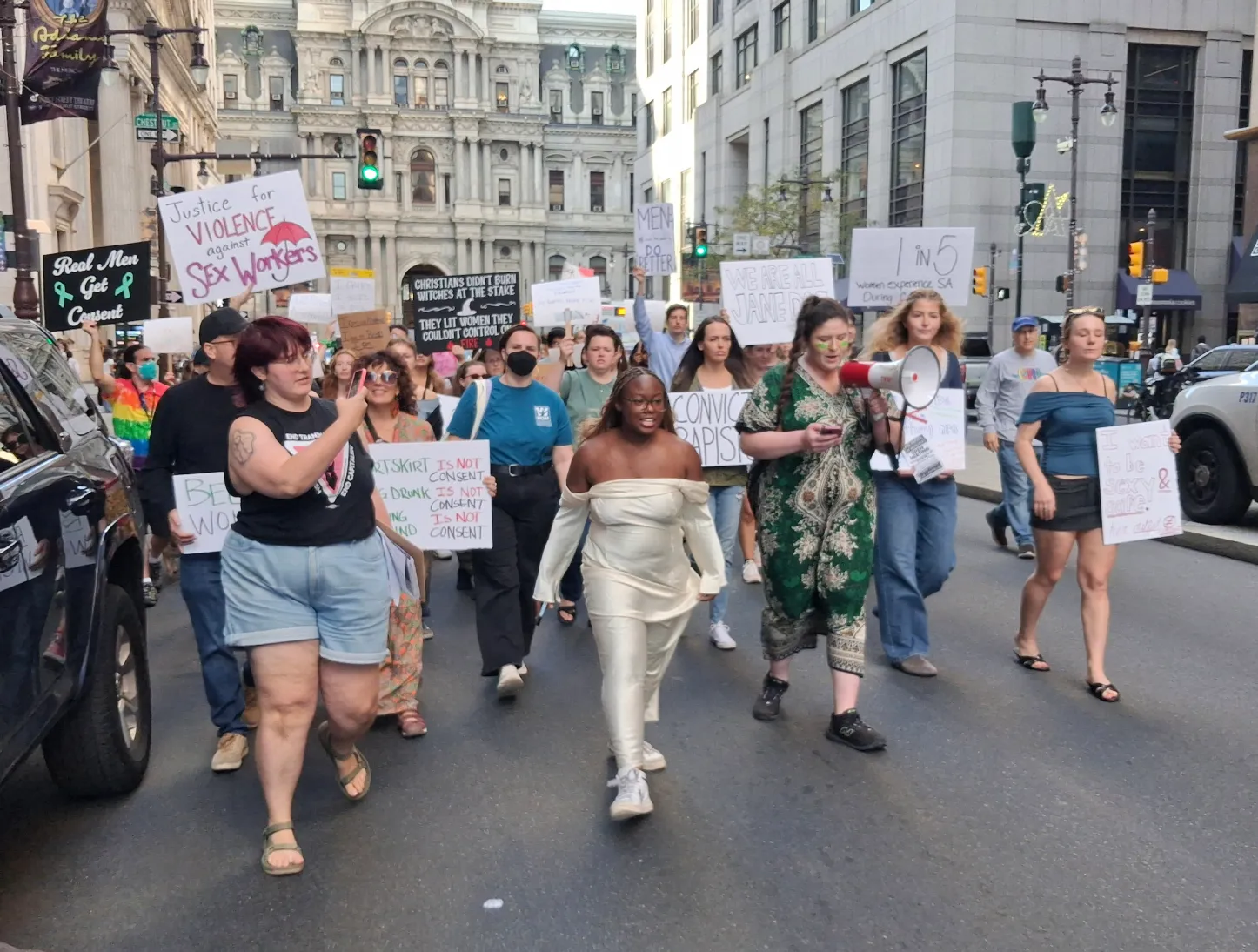
Photo: Marchers in Philadelphia on Oct. 8 protest against rape and in solidarity with Jane Doe at Cornell. (John Leslie / Workers’ Voice)
First published here by Workers’ Voice