
The Most Grotesque Electoral Farce in Russian History
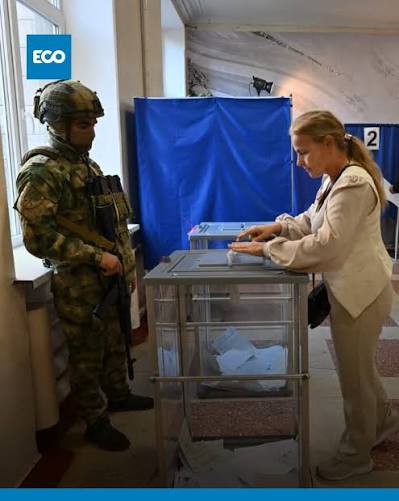
From September 18 to 20, voting for the parliament—known as the State Duma—took place over three days and three nights. There have been no free or democratic elections in the country for several decades. In particular, since Putin came to power, elections have been a mere formality within a regime whose central institution is the FSB—the direct successor to the KGB. The State Duma and the Federation Council serve a purely decorative function, with a handful of parties under the regime’s strict control. But on this occasion, due to the economic, social, demographic, political, and military crisis engulfing the country—a result of its imperialist war in Ukraine becoming bogged down—that regime revealed its enormous fragility. And the “election results” it presented to the world only heightened its embarrassing ridicule.
The masses live in great fear of the regime’s brutal repression. Nevertheless, they express with sharp irony their rejection of this war—officially called a “Special Military Operation”—which they never wanted and which imposes ever-greater sacrifices upon them. It began by sending the children of dozens of oppressed nationalities and peoples—and of the poor masses in remote regions—to their deaths, and now the hunt for forced conscription is already affecting the population of major cities. In repudiation of all this, popular ingenuity, as an act of denunciation, dubbed these elections a“Special Electoral Operation”.
A dictatorship in presidential–parliamentary guise
Only a few parties are tolerated by the regime. The ruling “United Russia” party, whose candidate lists were headed by military officers, war criminals, and high-ranking government officials such as Foreign Minister Sergey Lavrov or the party’s chairman Dmitry Medvedev.
The “Communist Party of the Russian Federation” (CPRF), founded in 1993, presents itself as the direct heir to the CPSU, with its long-standing General Secretary, Gennady Zyuganov, a Great Russian chauvinist who calls himself a “patriot.” It claims to defend “wage earners,” and part of its electoral base consists of the millions of employees of the state and the military-industrial complex—teachers, doctors, nurses… But its leadership represents the interests of the managers of companies producing for the domestic market and agricultural enterprises resulting from the privatization and concentration of farmland.
The “Liberal Democratic Party” (LDPR), a far-right, xenophobic, Great Russian chauvinist party that espouses imperial authoritarianism toward the former Soviet republics, bears absolutely no relation to its “democratic” label. A fourth party, born in the Putin era, is “Fair Russia,” which, under a “social democratic” guise, espouses social-chauvinist policies and advocates for state control of the economy. With the onset of the current war-induced crisis, the Kremlin fostered a new creation: the “New People’s Party,” made up of “outsiders” who are running against the old guard of politicians.
It experienced relatively rapid growth. All of these parties are united in their explicit support for Putin’s war.
Yabloko: Condemned for Calling for Peace!
However, the discordant note in this election was Yabloko. An old neoliberal party, founded and integrated into the regime—with its various transformations—over the past 30 years. Its name, which also means “apple”, derives from the surname of its founder, Grigory Yavlinsky, author of Gorbachev’s capitalist economic plan, known as the “500-day plan.” Yabloko’s position was for an end to the war. Its slogan was “For Peace and Freedom.” Yabloko failed to reach the threshold for parliamentary representation in the last election. Yet, upon publicizing this slogan, it began to garner nearly 14% of the vote in the polls! This support was particularly strong among the youth of the middle classes in major cities. Alarm bells rang in the Kremlin’s secret services!
It didn’t take long for the regime’s parties to file a lawsuit against Yabloko. And swiftly, the Supreme Court of the Russian Federation struck Yabloko’s candidate lists from the ballot. Its leaders faced summary criminal proceedings. Lev Shlosberg, one of the party’s vice presidents, was sentenced to 11 years in prison, and Maxim Kruglov, another vice president, to 7 years in prison. Their election observers were also banned. A devastating blow to the only openly anti-war opposition!
Bans alone weren’t enough; blatant and violent fraud was necessary
The ruling party, “United Russia,” has fallen so far in the eyes of the masses that the regime had to resort to the most diverse forms of fraud to rig the results. Putin’s party, the “war party,” could not afford to lose votes after nearly five years of war! The goal was to increase them! And to present him as the “winner with 57% of the vote,” even though he received 49% in 2021! Ella Pamfilova, who has been chair of the Central Election Commission for 10 years, has done her job. “Democracy” in Russia is closely monitored, and she will earn another commendation from Putin.
Here are some facts about her meticulous work. Massive exclusion of candidates: approximately one in ten candidates was barred from the election. About 500 people had their registration revoked or were excluded for other reasons.
In the occupied territories and border areas, an anomalous early voting process was implemented: more than 4 million people voted early. Meanwhile, only about 260,000 did so in the other 37 regions.
There were no foreign observers. Nor was there access for election observers in Ukraine’s occupied territories. The addresses of polling stations and voting locations were not published there. Mobile ballot boxes and voting within military units were widely used! There was no standard video surveillance.
There was coercion to use electronic voting, which does not allow for oversight at the polling station. People were pressured to vote electronically at work, at school, and even at the polling stations themselves. Often, paper ballots were only provided if the voter specifically requested them.
Numerous incidents affected paper voting: on Sunday the 20th, many polling stations experienced problems with the distribution of paper ballots, which led to longer lines and prompted people to opt for electronic voting.
Suspiciously high initial turnout for electronic voting: In Moscow, approximately 750,000 people voted electronically in the first two hours—a figure that is roughly three times that recorded in the 2021 election!
Disappearance of a candidate before the election: Yulia Kuznetsova disappeared shortly before the vote. Subsequently, her election observers began to be expelled from polling stations based on “a complaint,” which she later described as fabricated.
Forced expulsion and detention of observers: Observers were expelled from polling stations under false pretenses, and some were detained by the police. Mass exclusion of observers: On the first day, at least 1,334 observers representing the CPRF and Yabloko were barred from entering. In the Voronezh region alone, 481 CPRF observers were excluded.
Tampering with security bags (where ballots are stored) and ballot substitution: In Krasnodar, two members of the election commission opened security bags and substituted ballots in the presence of a police officer. Nighttime tampering: In Yakutsk, observers caught the chair and vice-chair of the election commission opening a security bag containing ballots during the night. Subsequently, the ballots it contained were declared invalid. Damaged seals and invalidated ballots: Following an inspection in the Oryol region, 250 ballots from a portable ballot box were declared invalid.
Pressure on those who filed complaints: Observers were not only expelled but also detained, fined, and intimidated.


