U.S. imperialism is losing in Iran and will lose even more
Half a year since Trump launched the U.S. military’s latest excursion to attack Iran, the Islamic Republic has not merely survived but has found new economic and political leverage in its control over maritime trade at the same time that it appears to have maintained its military capacity to continue fending off attacks.
Trump’s score against the bipartisan imperialist consensus
Trump’s public goals in this war have been repeatedly subject to change. Boasts and threats related to regime change have fallen by the wayside as the U.S. now struggles to even secure the status quo that existed before the war.
Trump’s failure here is underlined by the efforts of his predecessor, Barack Obama, who had secured a pact that traded a relaxing of anti-Iran sanctions for commitments to close off avenues to nuclear weapons production. Trump withdrew from this already coercive plan during his first term. The failure of Trump’s approach is apparent in that drafts for ceasefires and potential peace with Iran have been proposed where the U.S. would provide much the same sanctions relief that had been promised by Obama, in exchange not for Obama’s deal, but for a return to the pre-war status quo of free trade through the Strait of Hormuz.
There is a further irony that the U.S.-Israeli attacks, far from securing regime change, appear to have consolidated the regime. Both also saved it from the biggest threat to its legitimacy in decades (the massive January-February protests) and allowed it to dodge a succession crisis related to the passing of Ayatollah Ali Khamenei.
Under the cover of imperialist airstrikes, the Iranian Revolutionary Guard Corps (IRGC) was able to quickly consolidate the succession of Mojtaba Khamenei, avoiding the public criticism that would likely have accompanied such an appointment outside of times of war. While Mojtaba Khamenei has a dynastic link to his assassinated father, his personal political ties are much more based on the IRGC military-industrial apparatus than on the clerical establishment that his father represented. Ali Khamenei’s signature policy was a fatwa (religious ban) on nuclear weapons development. Mojtaba Khamanei seems unlikely to share his father’s opinion on this matter. To the extent that the U.S. has carried out “regime change,” they appear to have changed the regime to one that is even more committed to nuclear ambitions and military confrontation with the U.S. and Israel.
Trump is thus caught in a bind. The war is unprecedentedly unpopular with the general public, with only one-third of people in the U.S. supporting it. This popularity is expected to further decrease if there is any sort of escalation that results in significant U.S. casualties. But within the U.S. government and the capitalist class, Trump’s government is now cornered by Iran hawks and Israel supporters (not all of them Republicans) that refuse to accept the military defeat that Trump’s government has incurred.
Iran threatens to rewrite the rules of international trade
If Trump appears beleaguered and desperate for a solution, Iran’s public signaling thus far suggests that it feels quite confident in its position, despite the economic damage that it has sustained. Throughout July and early August, they rebuffed even-handed offers from Oman for joint administration of the Strait of Hormuz, ultimately moving forward with a deal that is perceived to cement Iran’s authority over the Strait, with smaller concessions for Oman and other compliant Gulf States.
Iran’s direct interventions against maritime trade, both in the Strait of Hormuz and also further afield, with allied forces threatening Saudi-, Israel- and U.S.-linked shipping through the Red Sea as well, upend the norms of international free trade that were a crowning achievement of the post-WWII capitalist order. Iran’s assertion of authority over the Strait of Hormuz could lead other states, such as Indonesia (home of the vital Strait of Malacca), to reconsider their own geopolitical leverage, further undermining the global capitalist economy.
Trump has been able to avoid some of the worst economic fallout from trade interruptions by massively drawing down and exporting from the strategic oil reserve that the U.S. has built up over decades, which has preserved a lifeline of access to oil for the world economy. But this remains a stopgap solution: the more that the U.S. and other economic linchpins draw down their fuel supplies, the less flexibility they will have to react to supply shocks down the road. Drawing down reserves puts more time on the clock before supply runs out, but this means little in the long run if the U.S. is unable to restore traffic through the Strait of Hormuz.
U.S. military exhaustion and the new wars of the 21st century
While the early days of the war were punctuated by repeat announcements from Trump’s government that Iranian munitions had been completely destroyed, the actual situation on the ground appears to be nearly the opposite. Reports in early August suggest that the U.S. has nearly depleted its supply of both defensive interceptor missiles and long-range attack missiles. In other words, the U.S. has almost completely exhausted its global military capacity against Iran, and has nothing to show for it. Iran, meanwhile, appears poised to continue firing missiles across the Gulf.
The U.S. has demonstrated that for all its military technology and infrastructure, it is not able to project power decisively in the Middle East anymore, even against states with minimal military backing from imperialist powers. The international geopolitical calculus that presumed U.S. military superiority around the world has been destroyed, and the U.S. military will be flat-footed in its responses to challenges going forward as it tries to overcome the very public munitions deficit that it just created itself.
This development in Iran mirrors a similar development in Ukraine: the late-20th century military calculus that favored elite, state-of-the-art jet planes and tank columns has been defeated by the mass production of relatively cheap drones. The air superiority military doctrines that U.S., Israeli, and Russian power structured themselves around are now outdated. The fiber-optic drones used by Ukraine to dodge Russian radar systems are now also used by Hezbollah to fly past Israeli defenses, while Russia deploys Iranian-style Shahed drones against Ukraine’s U.S.-designed missile defense systems, even as its invading army struggles to gain any new purchase on Ukrainian land. War has changed, and it threatens the presumed power and authority of any state that has yet to adapt.
The end of the U.S.-Israeli war against Iran is still to be written. But whatever happens next, U.S. imperialism has already suffered blows to its prestige, authority, and credibility that it may never recover from. In this moment of weakness, it is vital to continue organizing antiwar demonstrations and movements in the U.S., raise the political costs of rearmament, and consolidate the masses of people who are outraged by the violent crimes of imperialism and taking action against the capitalist economy that fuels it.
First published here by Workers’ Voice
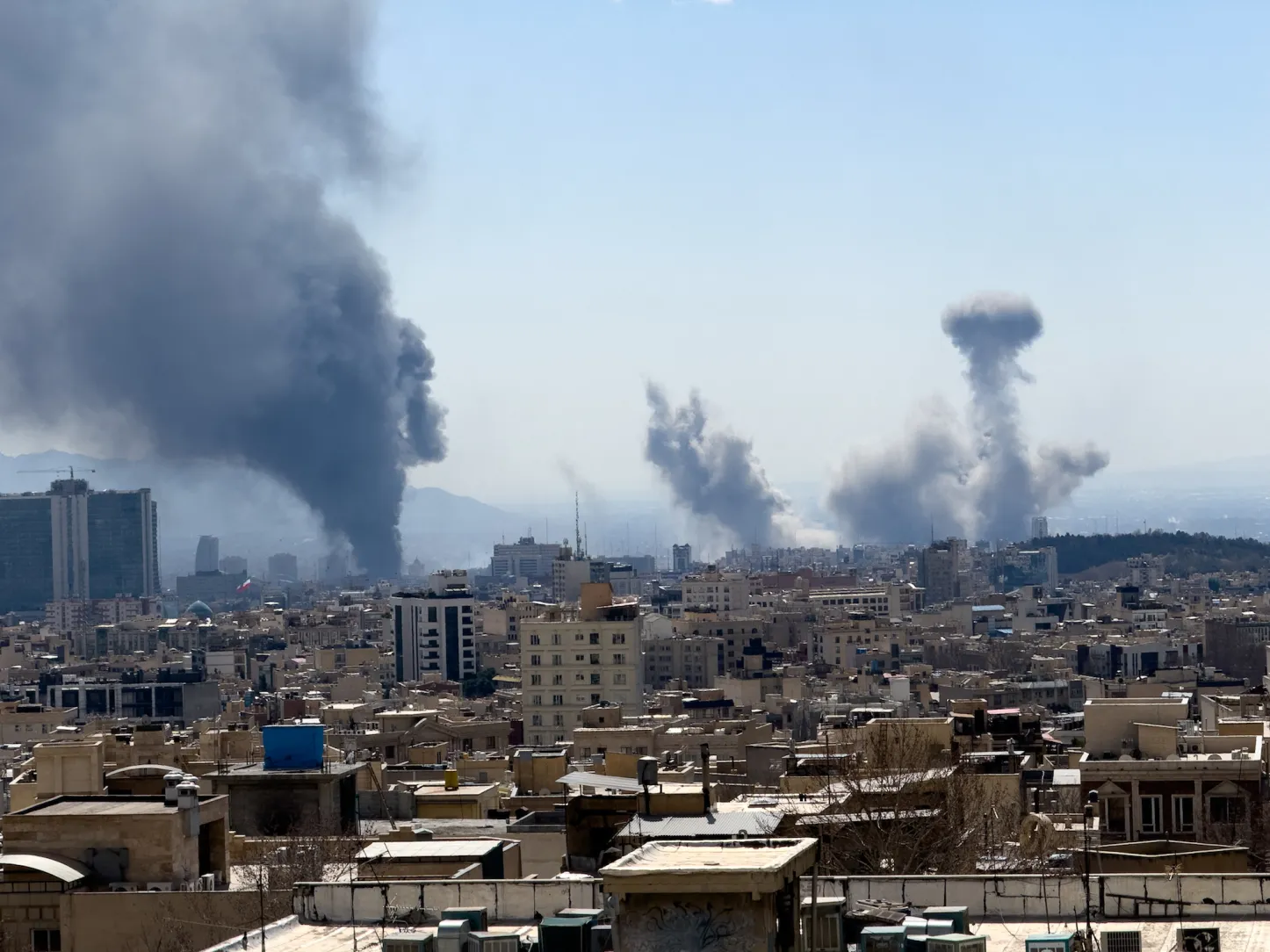
Photo: U.S. bombs Tehran at beginning of war, on March 1, 2026. (Mahsa / Middle East Images / AFP via Getty Images)